SUBSCRIBE TO OUR FREE NEWSLETTER
Daily news & progressive opinion—funded by the people, not the corporations—delivered straight to your inbox.
5
#000000
#FFFFFF
To donate by check, phone, or other method, see our More Ways to Give page.
Daily news & progressive opinion—funded by the people, not the corporations—delivered straight to your inbox.
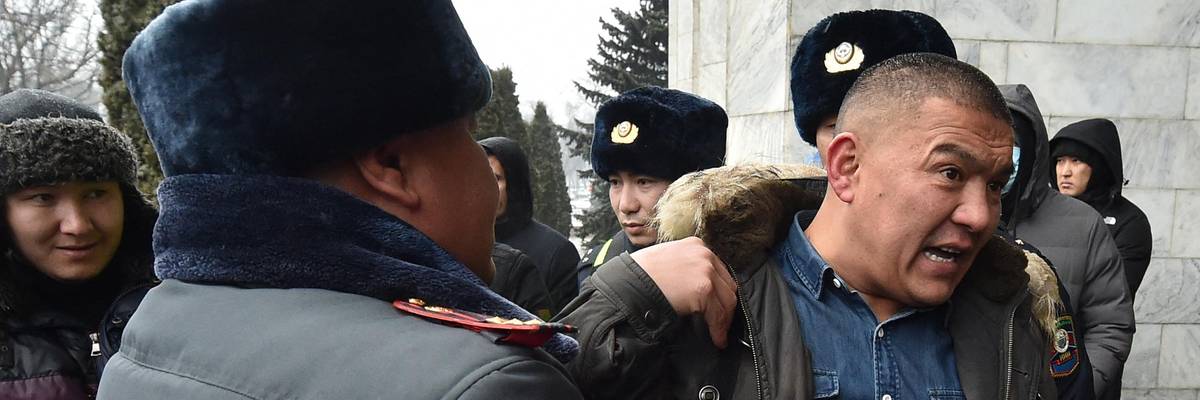
Police officers detain a demonstrator during a rally outside the Kyrgyz parliament building in Bishkek, Kazakhstan on January 7, 2022. (Photo: Vyacheslav Oseledko/AFP via Getty Images)
Human rights advocates expressed alarm Friday after Kazakhstan's president ordered security forces to "shoot to kill without warning" protesters engaged in ongoing demonstrations over high fuel prices, economic inequality, and corruption.
President Kassym-Jomart Tokayev announced he had given the order in a speech as he also accused media outlets of encouraging unrest and claimed without evidence that demonstrators have taken orders from a "single command post" and have "a clear plan of attacks on military, administrative, and social facilities in all areas."
"They need to be destroyed and this will be done," said Tokayev of the demonstrators, adding that suggestions of negotiating peacefully with the public were "just nonsense."
Noting that authorities "have a duty to maintain order," Amnesty International said on social media that "giving blanket approval for police officers and troops to fire without warning is unlawful and a recipe for disaster."
The popular uprising began Sunday in the western city of Zhanaozen after the government lifted a cap on the price of liquefied petroleum gas (LPG), which is used widely by Kazakh drivers. After the cap was lifted, gas station prices quickly doubled from the equivalent of $0.14 to $0.28 per liter.
The price hike exacerbated simmering anger over economic inequality in the oil-rich Central Asian country, where the average worker earns less than $600 per month and wealth is concentrated among the very rich.
"The only thing flourishing in Kazakhstan is corruption," a protester identified as Saule told Euronews Friday.
As the demonstrations grew, protesters expressed anger over a system in which the president appoints regional leaders rather than holding elections. On Friday, attendees at a rally in Zhanaozen called for a return to the constitution that was in place after Kazakhstan became an independent country in 1991, which had "a more democratic tone and a clearer division of power than the current one," according to the Washington Post.
"The protests unfolding in Kazakhstan, which have turned violent, are a direct consequence of the authorities' widespread repression of basic human rights."
The government has agreed to some concessions since the unrest began, announcing a new cap on LPG prices and utility bills on Thursday, dismissing Tokayev's cabinet, and suggesting that Parliament could be dissolved and new elections could be held.
But Tokayev has blamed tens of thousands of demonstrators for the escalation of unrest, including a fire that was set at City Hall in Almaty, the nation's largest city, on Wednesday. He also called on Russian President Vladimir Putin to send troops into the country, a move Tokayev said Friday had helped his government regain power.
Security forces have reportedly killed at least 26 people since the protests began, with the Interior Ministry saying the "armed criminals" had been "liquidated." Authorities also said Friday that nearly 4,000 "riot participants" had been detained and blamed demonstrators for the deaths of 13 police officers.
Authorities said they were carrying out an "anti-terrorist operation" in Almaty, leading protesters to gather with signs reading, "We are residents of Almaty, not terrorists."
"The protests unfolding in Kazakhstan, which have turned violent, are a direct consequence of the authorities' widespread repression of basic human rights," said Marie Struthers, Amnesty International's director for Eastern Europe and Central Asia, on Wednesday. "For years, the government has relentlessly persecuted peaceful dissent, leaving the Kazakhstani people in a state of agitation and despair."
"Instead of threatening to crack down on protesters, the Kazakhstani authorities must resolve the situation peacefully by immediately and unconditionally releasing all those who have been arbitrarily detained and addressing past abuses committed by the state," Struthers added. "Protesters accused of internationally recognized crimes for violent actions should be provided with fair trials in accordance with international human rights law."
Free press advocates also condemned reports that at least eight journalists have been detained for reporting on the uprising while at least two news sites have been blocked for covering the events of the past week.
The Ministry of Information said as the protests grew that outlets which "knowingly [spread] false information" would face an increased maximum penalty of up to seven years in prison.
"We call on the Kazakh government to cease detaining members of the media, ensure the free flow of information, and take all possible measures to ensure the safety of journalists on the ground," said Gulnoza Said, Europe and Central Asia program coordinator for the Committee to Protect Journalists.
Dear Common Dreams reader, It’s been nearly 30 years since I co-founded Common Dreams with my late wife, Lina Newhouser. We had the radical notion that journalism should serve the public good, not corporate profits. It was clear to us from the outset what it would take to build such a project. No paid advertisements. No corporate sponsors. No millionaire publisher telling us what to think or do. Many people said we wouldn't last a year, but we proved those doubters wrong. Together with a tremendous team of journalists and dedicated staff, we built an independent media outlet free from the constraints of profits and corporate control. Our mission has always been simple: To inform. To inspire. To ignite change for the common good. Building Common Dreams was not easy. Our survival was never guaranteed. When you take on the most powerful forces—Wall Street greed, fossil fuel industry destruction, Big Tech lobbyists, and uber-rich oligarchs who have spent billions upon billions rigging the economy and democracy in their favor—the only bulwark you have is supporters who believe in your work. But here’s the urgent message from me today. It's never been this bad out there. And it's never been this hard to keep us going. At the very moment Common Dreams is most needed, the threats we face are intensifying. We need your support now more than ever. We don't accept corporate advertising and never will. We don't have a paywall because we don't think people should be blocked from critical news based on their ability to pay. Everything we do is funded by the donations of readers like you. When everyone does the little they can afford, we are strong. But if that support retreats or dries up, so do we. Will you donate now to make sure Common Dreams not only survives but thrives? —Craig Brown, Co-founder |
Human rights advocates expressed alarm Friday after Kazakhstan's president ordered security forces to "shoot to kill without warning" protesters engaged in ongoing demonstrations over high fuel prices, economic inequality, and corruption.
President Kassym-Jomart Tokayev announced he had given the order in a speech as he also accused media outlets of encouraging unrest and claimed without evidence that demonstrators have taken orders from a "single command post" and have "a clear plan of attacks on military, administrative, and social facilities in all areas."
"They need to be destroyed and this will be done," said Tokayev of the demonstrators, adding that suggestions of negotiating peacefully with the public were "just nonsense."
Noting that authorities "have a duty to maintain order," Amnesty International said on social media that "giving blanket approval for police officers and troops to fire without warning is unlawful and a recipe for disaster."
The popular uprising began Sunday in the western city of Zhanaozen after the government lifted a cap on the price of liquefied petroleum gas (LPG), which is used widely by Kazakh drivers. After the cap was lifted, gas station prices quickly doubled from the equivalent of $0.14 to $0.28 per liter.
The price hike exacerbated simmering anger over economic inequality in the oil-rich Central Asian country, where the average worker earns less than $600 per month and wealth is concentrated among the very rich.
"The only thing flourishing in Kazakhstan is corruption," a protester identified as Saule told Euronews Friday.
As the demonstrations grew, protesters expressed anger over a system in which the president appoints regional leaders rather than holding elections. On Friday, attendees at a rally in Zhanaozen called for a return to the constitution that was in place after Kazakhstan became an independent country in 1991, which had "a more democratic tone and a clearer division of power than the current one," according to the Washington Post.
"The protests unfolding in Kazakhstan, which have turned violent, are a direct consequence of the authorities' widespread repression of basic human rights."
The government has agreed to some concessions since the unrest began, announcing a new cap on LPG prices and utility bills on Thursday, dismissing Tokayev's cabinet, and suggesting that Parliament could be dissolved and new elections could be held.
But Tokayev has blamed tens of thousands of demonstrators for the escalation of unrest, including a fire that was set at City Hall in Almaty, the nation's largest city, on Wednesday. He also called on Russian President Vladimir Putin to send troops into the country, a move Tokayev said Friday had helped his government regain power.
Security forces have reportedly killed at least 26 people since the protests began, with the Interior Ministry saying the "armed criminals" had been "liquidated." Authorities also said Friday that nearly 4,000 "riot participants" had been detained and blamed demonstrators for the deaths of 13 police officers.
Authorities said they were carrying out an "anti-terrorist operation" in Almaty, leading protesters to gather with signs reading, "We are residents of Almaty, not terrorists."
"The protests unfolding in Kazakhstan, which have turned violent, are a direct consequence of the authorities' widespread repression of basic human rights," said Marie Struthers, Amnesty International's director for Eastern Europe and Central Asia, on Wednesday. "For years, the government has relentlessly persecuted peaceful dissent, leaving the Kazakhstani people in a state of agitation and despair."
"Instead of threatening to crack down on protesters, the Kazakhstani authorities must resolve the situation peacefully by immediately and unconditionally releasing all those who have been arbitrarily detained and addressing past abuses committed by the state," Struthers added. "Protesters accused of internationally recognized crimes for violent actions should be provided with fair trials in accordance with international human rights law."
Free press advocates also condemned reports that at least eight journalists have been detained for reporting on the uprising while at least two news sites have been blocked for covering the events of the past week.
The Ministry of Information said as the protests grew that outlets which "knowingly [spread] false information" would face an increased maximum penalty of up to seven years in prison.
"We call on the Kazakh government to cease detaining members of the media, ensure the free flow of information, and take all possible measures to ensure the safety of journalists on the ground," said Gulnoza Said, Europe and Central Asia program coordinator for the Committee to Protect Journalists.
Human rights advocates expressed alarm Friday after Kazakhstan's president ordered security forces to "shoot to kill without warning" protesters engaged in ongoing demonstrations over high fuel prices, economic inequality, and corruption.
President Kassym-Jomart Tokayev announced he had given the order in a speech as he also accused media outlets of encouraging unrest and claimed without evidence that demonstrators have taken orders from a "single command post" and have "a clear plan of attacks on military, administrative, and social facilities in all areas."
"They need to be destroyed and this will be done," said Tokayev of the demonstrators, adding that suggestions of negotiating peacefully with the public were "just nonsense."
Noting that authorities "have a duty to maintain order," Amnesty International said on social media that "giving blanket approval for police officers and troops to fire without warning is unlawful and a recipe for disaster."
The popular uprising began Sunday in the western city of Zhanaozen after the government lifted a cap on the price of liquefied petroleum gas (LPG), which is used widely by Kazakh drivers. After the cap was lifted, gas station prices quickly doubled from the equivalent of $0.14 to $0.28 per liter.
The price hike exacerbated simmering anger over economic inequality in the oil-rich Central Asian country, where the average worker earns less than $600 per month and wealth is concentrated among the very rich.
"The only thing flourishing in Kazakhstan is corruption," a protester identified as Saule told Euronews Friday.
As the demonstrations grew, protesters expressed anger over a system in which the president appoints regional leaders rather than holding elections. On Friday, attendees at a rally in Zhanaozen called for a return to the constitution that was in place after Kazakhstan became an independent country in 1991, which had "a more democratic tone and a clearer division of power than the current one," according to the Washington Post.
"The protests unfolding in Kazakhstan, which have turned violent, are a direct consequence of the authorities' widespread repression of basic human rights."
The government has agreed to some concessions since the unrest began, announcing a new cap on LPG prices and utility bills on Thursday, dismissing Tokayev's cabinet, and suggesting that Parliament could be dissolved and new elections could be held.
But Tokayev has blamed tens of thousands of demonstrators for the escalation of unrest, including a fire that was set at City Hall in Almaty, the nation's largest city, on Wednesday. He also called on Russian President Vladimir Putin to send troops into the country, a move Tokayev said Friday had helped his government regain power.
Security forces have reportedly killed at least 26 people since the protests began, with the Interior Ministry saying the "armed criminals" had been "liquidated." Authorities also said Friday that nearly 4,000 "riot participants" had been detained and blamed demonstrators for the deaths of 13 police officers.
Authorities said they were carrying out an "anti-terrorist operation" in Almaty, leading protesters to gather with signs reading, "We are residents of Almaty, not terrorists."
"The protests unfolding in Kazakhstan, which have turned violent, are a direct consequence of the authorities' widespread repression of basic human rights," said Marie Struthers, Amnesty International's director for Eastern Europe and Central Asia, on Wednesday. "For years, the government has relentlessly persecuted peaceful dissent, leaving the Kazakhstani people in a state of agitation and despair."
"Instead of threatening to crack down on protesters, the Kazakhstani authorities must resolve the situation peacefully by immediately and unconditionally releasing all those who have been arbitrarily detained and addressing past abuses committed by the state," Struthers added. "Protesters accused of internationally recognized crimes for violent actions should be provided with fair trials in accordance with international human rights law."
Free press advocates also condemned reports that at least eight journalists have been detained for reporting on the uprising while at least two news sites have been blocked for covering the events of the past week.
The Ministry of Information said as the protests grew that outlets which "knowingly [spread] false information" would face an increased maximum penalty of up to seven years in prison.
"We call on the Kazakh government to cease detaining members of the media, ensure the free flow of information, and take all possible measures to ensure the safety of journalists on the ground," said Gulnoza Said, Europe and Central Asia program coordinator for the Committee to Protect Journalists.