

SUBSCRIBE TO OUR FREE NEWSLETTER
Daily news & progressive opinion—funded by the people, not the corporations—delivered straight to your inbox.
5
#000000
#FFFFFF
To donate by check, phone, or other method, see our More Ways to Give page.
Daily news & progressive opinion—funded by the people, not the corporations—delivered straight to your inbox.
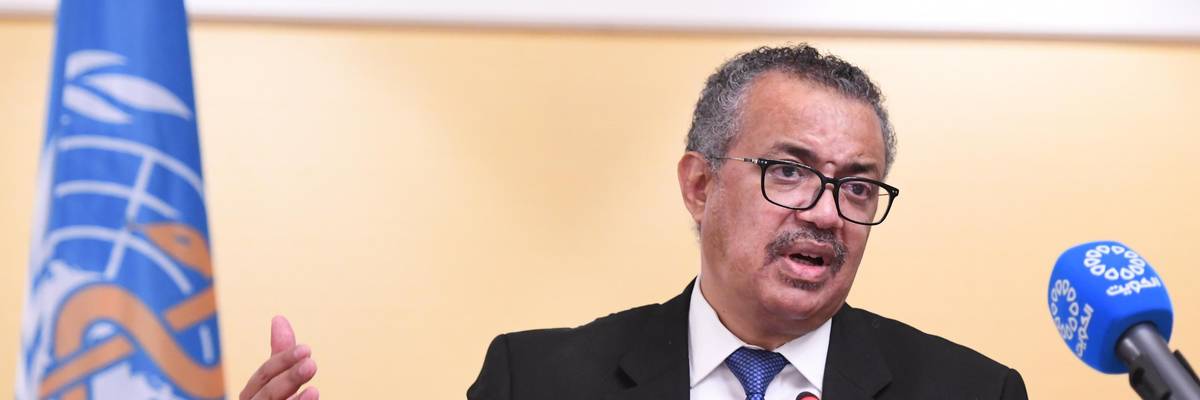
Director-General of the World Health Organization Tedros Adhanom Ghebreyesus at a press conference in Kuwait City, Kuwait on July 28, 2021. (Photo: Jaber Abdulkhaleg/Anadolu Agency via Getty Images)
The head of the World Health Organization warned Tuesday that the new Omicron variant is spreading at an unprecedented rate and reiterated his assessment that ending the coronavirus pandemic requires ending global vaccine inequity.
"If we allow inequity to continue, we allow the pandemic to continue."
"Seventy-seven countries have now reported cases of Omicron, and the reality is that Omicron is probably in most countries, even if it hasn't been detected yet," WHO Director-General Tedros Adhanom Ghebreyesus said at a press briefing Tuesday.
While the new variant may prove to be milder than others, he said that "the sheer number of cases could once again overwhelm unprepared health systems."
Rich nations' booster programs that have ramped up in the face of Omicron--against which current vaccines appear les effective--may also trigger another wave of "vaccine hoarding," he said.
"Giving boosters to groups at low risk of severe disease or death," said Tedros, "simply endangers the lives of those at high risk who are still waiting for their primary doses because of supply constraints."
Tedros highlighted the stark gap in access to even a first round of inoculations, saying that "41 countries have still not been able to vaccinate 10% of their populations, and 98 countries have not reached 40%."
The path to finally reining in Covid-19, he said, is clear.
"If we end inequity, we end the pandemic," said Tedros. "If we allow inequity to continue, we allow the pandemic to continue."
The CEO of Gavi, the Vaccine Alliance, similarly warned Tuesday of a looming surge in vaccines being hoarded by rich nations.
Along with the WHO and Coalition for Epidemic Preparedness Innovations (CEPI), Gavi co-leads COVAX, the vaccine sharing initiative.
"Emergence of the Omicron variant has provided a cruel reminder that the world does not have the time to wait."
In an interview with The Associated Press, Gavi chief executive Dr. Seth Berkley said with the emergence of the Omicron variant, "We... are beginning to see donors not wanting to donate their doses as fast as they might have because of the uncertainty now of where we are."
"Our long-term concern is, if it turns out that new variant vaccines are required, that there may be an 'Inequity 2.0,' where we see wealthy countries hoard those vaccines once again, like we saw at the beginning of the pandemic," said Berkley.
A trio of social justice and public health advocacy groups, meanwhile, is elevating demands for the Biden administration to take greater action to enable scaled-up global production of mRNA vaccines, like those produced by Moderna and Pfizer.
As the Washington Post reported Wednesday:
Pressure has mounted on the United States in part because global efforts to beat vaccine hoarding and inequality have struggled. Covax, an initiative backed by the World Health Organization that was designed to pool money to ensure vaccine supply for poorer nations, initially aimed to donate 2 billion doses by the end of 2021. It is now racing to deliver a far-diminished target of 800 million doses.
The Post cites a letter to the White House from Partners In Health, PrEP4All, and Public Citizen in which they write that "it is essential the U.S. government scales the ambition of [its] plan to produce billions more doses per year and retains ownership over any new domestic manufacturing capacity that is established."
"Emergence of the Omicron variant," the groups wrote, "has provided a cruel reminder that the world does not have the time to wait. So long as the United States and other high-income country governments allow the SARS-CoV2 virus to circulate unabated due to insufficient vaccine access, we risk the emergence of more variants."
Dear Common Dreams reader, It’s been nearly 30 years since I co-founded Common Dreams with my late wife, Lina Newhouser. We had the radical notion that journalism should serve the public good, not corporate profits. It was clear to us from the outset what it would take to build such a project. No paid advertisements. No corporate sponsors. No millionaire publisher telling us what to think or do. Many people said we wouldn't last a year, but we proved those doubters wrong. Together with a tremendous team of journalists and dedicated staff, we built an independent media outlet free from the constraints of profits and corporate control. Our mission has always been simple: To inform. To inspire. To ignite change for the common good. Building Common Dreams was not easy. Our survival was never guaranteed. When you take on the most powerful forces—Wall Street greed, fossil fuel industry destruction, Big Tech lobbyists, and uber-rich oligarchs who have spent billions upon billions rigging the economy and democracy in their favor—the only bulwark you have is supporters who believe in your work. But here’s the urgent message from me today. It's never been this bad out there. And it's never been this hard to keep us going. At the very moment Common Dreams is most needed, the threats we face are intensifying. We need your support now more than ever. We don't accept corporate advertising and never will. We don't have a paywall because we don't think people should be blocked from critical news based on their ability to pay. Everything we do is funded by the donations of readers like you. When everyone does the little they can afford, we are strong. But if that support retreats or dries up, so do we. Will you donate now to make sure Common Dreams not only survives but thrives? —Craig Brown, Co-founder |
The head of the World Health Organization warned Tuesday that the new Omicron variant is spreading at an unprecedented rate and reiterated his assessment that ending the coronavirus pandemic requires ending global vaccine inequity.
"If we allow inequity to continue, we allow the pandemic to continue."
"Seventy-seven countries have now reported cases of Omicron, and the reality is that Omicron is probably in most countries, even if it hasn't been detected yet," WHO Director-General Tedros Adhanom Ghebreyesus said at a press briefing Tuesday.
While the new variant may prove to be milder than others, he said that "the sheer number of cases could once again overwhelm unprepared health systems."
Rich nations' booster programs that have ramped up in the face of Omicron--against which current vaccines appear les effective--may also trigger another wave of "vaccine hoarding," he said.
"Giving boosters to groups at low risk of severe disease or death," said Tedros, "simply endangers the lives of those at high risk who are still waiting for their primary doses because of supply constraints."
Tedros highlighted the stark gap in access to even a first round of inoculations, saying that "41 countries have still not been able to vaccinate 10% of their populations, and 98 countries have not reached 40%."
The path to finally reining in Covid-19, he said, is clear.
"If we end inequity, we end the pandemic," said Tedros. "If we allow inequity to continue, we allow the pandemic to continue."
The CEO of Gavi, the Vaccine Alliance, similarly warned Tuesday of a looming surge in vaccines being hoarded by rich nations.
Along with the WHO and Coalition for Epidemic Preparedness Innovations (CEPI), Gavi co-leads COVAX, the vaccine sharing initiative.
"Emergence of the Omicron variant has provided a cruel reminder that the world does not have the time to wait."
In an interview with The Associated Press, Gavi chief executive Dr. Seth Berkley said with the emergence of the Omicron variant, "We... are beginning to see donors not wanting to donate their doses as fast as they might have because of the uncertainty now of where we are."
"Our long-term concern is, if it turns out that new variant vaccines are required, that there may be an 'Inequity 2.0,' where we see wealthy countries hoard those vaccines once again, like we saw at the beginning of the pandemic," said Berkley.
A trio of social justice and public health advocacy groups, meanwhile, is elevating demands for the Biden administration to take greater action to enable scaled-up global production of mRNA vaccines, like those produced by Moderna and Pfizer.
As the Washington Post reported Wednesday:
Pressure has mounted on the United States in part because global efforts to beat vaccine hoarding and inequality have struggled. Covax, an initiative backed by the World Health Organization that was designed to pool money to ensure vaccine supply for poorer nations, initially aimed to donate 2 billion doses by the end of 2021. It is now racing to deliver a far-diminished target of 800 million doses.
The Post cites a letter to the White House from Partners In Health, PrEP4All, and Public Citizen in which they write that "it is essential the U.S. government scales the ambition of [its] plan to produce billions more doses per year and retains ownership over any new domestic manufacturing capacity that is established."
"Emergence of the Omicron variant," the groups wrote, "has provided a cruel reminder that the world does not have the time to wait. So long as the United States and other high-income country governments allow the SARS-CoV2 virus to circulate unabated due to insufficient vaccine access, we risk the emergence of more variants."
The head of the World Health Organization warned Tuesday that the new Omicron variant is spreading at an unprecedented rate and reiterated his assessment that ending the coronavirus pandemic requires ending global vaccine inequity.
"If we allow inequity to continue, we allow the pandemic to continue."
"Seventy-seven countries have now reported cases of Omicron, and the reality is that Omicron is probably in most countries, even if it hasn't been detected yet," WHO Director-General Tedros Adhanom Ghebreyesus said at a press briefing Tuesday.
While the new variant may prove to be milder than others, he said that "the sheer number of cases could once again overwhelm unprepared health systems."
Rich nations' booster programs that have ramped up in the face of Omicron--against which current vaccines appear les effective--may also trigger another wave of "vaccine hoarding," he said.
"Giving boosters to groups at low risk of severe disease or death," said Tedros, "simply endangers the lives of those at high risk who are still waiting for their primary doses because of supply constraints."
Tedros highlighted the stark gap in access to even a first round of inoculations, saying that "41 countries have still not been able to vaccinate 10% of their populations, and 98 countries have not reached 40%."
The path to finally reining in Covid-19, he said, is clear.
"If we end inequity, we end the pandemic," said Tedros. "If we allow inequity to continue, we allow the pandemic to continue."
The CEO of Gavi, the Vaccine Alliance, similarly warned Tuesday of a looming surge in vaccines being hoarded by rich nations.
Along with the WHO and Coalition for Epidemic Preparedness Innovations (CEPI), Gavi co-leads COVAX, the vaccine sharing initiative.
"Emergence of the Omicron variant has provided a cruel reminder that the world does not have the time to wait."
In an interview with The Associated Press, Gavi chief executive Dr. Seth Berkley said with the emergence of the Omicron variant, "We... are beginning to see donors not wanting to donate their doses as fast as they might have because of the uncertainty now of where we are."
"Our long-term concern is, if it turns out that new variant vaccines are required, that there may be an 'Inequity 2.0,' where we see wealthy countries hoard those vaccines once again, like we saw at the beginning of the pandemic," said Berkley.
A trio of social justice and public health advocacy groups, meanwhile, is elevating demands for the Biden administration to take greater action to enable scaled-up global production of mRNA vaccines, like those produced by Moderna and Pfizer.
As the Washington Post reported Wednesday:
Pressure has mounted on the United States in part because global efforts to beat vaccine hoarding and inequality have struggled. Covax, an initiative backed by the World Health Organization that was designed to pool money to ensure vaccine supply for poorer nations, initially aimed to donate 2 billion doses by the end of 2021. It is now racing to deliver a far-diminished target of 800 million doses.
The Post cites a letter to the White House from Partners In Health, PrEP4All, and Public Citizen in which they write that "it is essential the U.S. government scales the ambition of [its] plan to produce billions more doses per year and retains ownership over any new domestic manufacturing capacity that is established."
"Emergence of the Omicron variant," the groups wrote, "has provided a cruel reminder that the world does not have the time to wait. So long as the United States and other high-income country governments allow the SARS-CoV2 virus to circulate unabated due to insufficient vaccine access, we risk the emergence of more variants."

