SUBSCRIBE TO OUR FREE NEWSLETTER
Daily news & progressive opinion—funded by the people, not the corporations—delivered straight to your inbox.
5
#000000
#FFFFFF
To donate by check, phone, or other method, see our More Ways to Give page.
Daily news & progressive opinion—funded by the people, not the corporations—delivered straight to your inbox.
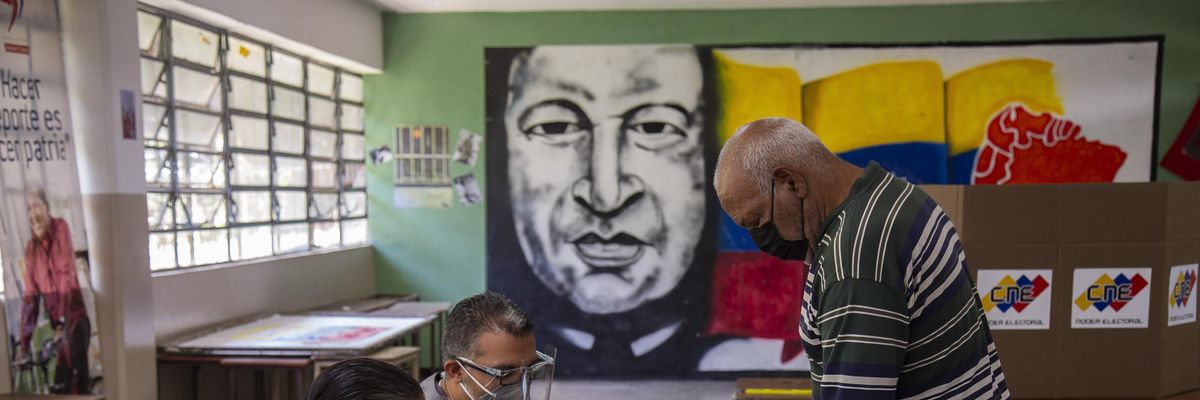
A voter verifies his fingerprint at the polling station during the regional and local elections in Caracas, Venezuela, on November 21, 2021. (Photo: Pedro Rances Mattey/Anadolu Agency via Getty Images)
A delegation of observers from a New York City-based progressive legal group on Wednesday pushed back against the Biden administration's claims about Venezuela's recent regional elections in which allies of President Nicolas Maduro's socialist party were largely victorious.
"We observed a balanced and transparent voting process which voters expressed confidence in."
Allies of Maduro and his United Socialist Party of Venezuela (PSUV) secured 20 out of 23 governorships in the November 21 elections. The opposition coalition United Democratic Table (MUD) candidates succeeded in the Cojedes and Zulia states while Neighbors Force (FV) won in the Nueva Esparta State.
The National Lawyers Guild (NLG) delegation--among various international observers who traveled to Venezuela for the elections--shared its findings in a statement that began, "We observed a balanced and transparent voting process which voters expressed confidence in."
Founded in 1937 as an alternative to the more conservative American Bar Association, the NLG sent eight observers to 12 sites in the Venezeulan capital Caracas as well as provinces in Miranda and La Guaira states.
"Overall we observed a climate of political energy grounded in an understanding that the voting day process, regardless of one's individual political ideology, functions fairly and is received as legitimate," the group said. "Also, we observed that the level of voter participation--almost 42% of registered voters in the context of a nonpresidential election, Covid-19, and severe economic sanctions--is significant and worthy of note."
The NLG said that "from a technical point of view, we observed an electoral system that was fundamentally transparent and facilitated by a workforce (poll workers, coordinators, table presidents) with strong technical competence regarding the functioning of the machines and the integrated election systems."
After speaking with voters at all sites, the NLG observers found that those "aligned with opposition parties also expressed confidence in the voting system. Additionally, the participation of opposition parties at polling sites, including as witnesses in opening and closing processes, strengthened the process and underscored the legitimacy of election results."
The NLG statement continued:
At a number of points throughout the day we witnessed voters frustrated with the heat, "wait times," some technical malfunctions, and occasionally with some confusion finding themselves on the voter rolls. These instances were not the norm at the sites we visited and therefore do not find that these incidents amount to systemic flaws or election "irregularities." Instead, they appear to be part of a complex, far-reaching, and broad election system intended to be accessible in all corners of a country of almost 29 million people, while under U.S. sanctions.
"We are clear that in all parts of the world, including in the United States, there exist Election Day dynamics which can complicate the electoral process, but which do not undermine or delegitimize an open and free process such as this," said NLG delegate Vladimir Martinez.
The European Union also sent election monitors to Venezuela. They expressed concerns about the disqualification of some opposition candidates and the death of a voter in a shooting near a polling station but also highlighted improvements, according to the Associated Press.
"The regional and municipal elections of November 21 were a first and crucial test for the return of most of the opposition parties to the elections in Venezuela," the E.U.'s initial report said. "The electoral process showed the persistence of structural deficiencies, although electoral conditions improved compared to the three previous national elections."
In a lengthy statement Monday, U.S. Secretary of State Antony Blinken claimed that "the Maduro regime deprived Venezuelans yet again of their right to participate in a free and fair electoral process."
"Fearful of the voice and vote of Venezuelans, the regime grossly skewed the process to determine the result of this election long before any ballots had been cast," Blinken said. "Arbitrary arrests and harassment of political and civil society actors, criminalization of opposition parties' activities, bans on candidates across the political spectrum, manipulation of voter registration rolls, persistent media censorship, and other authoritarian tactics all but quashed political pluralism and ensured the elections would not reflect the will of the Venezuelan people."
The NLG delegates said they "reject" the Biden administration's characterization of the elections in Venezuela, which is enduring an economic crisis exacerbated by U.S. sanctions.
NLG President Suzanne Adely, a member of the delegation, suggested Blinken's comments were motivated by justifying the administration's policies, which include maintaining sanctions imposed under former President Donald Trump and continuing to recognize opposition leader Juan Guaido as the South American country's "interim president."
"The U.S.'s consistently false narrative of elections in Venezuela is formulated to legitimize the continuation of U.S. sanctions, which are violations of international law and amount to economic warfare," said Adely. "The U.S. sanctions harm the Venezuelan people and aim to undermine and destabilize Venezuela in order to further U.S. interests in the region."
Sunday's elections were the first since 2017 in which main opposition parties participated. Voters elected not only governors but also 253 state legislators, 335 mayors, and 2,471 municipal councilors.
Writing Monday for Common Dreams, Leonardo Flores, a Latin American policy expert and campaigner with the anti-war group CodePink, outlined five reasons for the Venezuelan left's success over the weekend:
According to Flores, "These elections should put the Biden administration on notice that continuing to support the MUD, and in particular, the fiction of Guaido as 'interim president,' is a failed policy."
Dear Common Dreams reader, It’s been nearly 30 years since I co-founded Common Dreams with my late wife, Lina Newhouser. We had the radical notion that journalism should serve the public good, not corporate profits. It was clear to us from the outset what it would take to build such a project. No paid advertisements. No corporate sponsors. No millionaire publisher telling us what to think or do. Many people said we wouldn't last a year, but we proved those doubters wrong. Together with a tremendous team of journalists and dedicated staff, we built an independent media outlet free from the constraints of profits and corporate control. Our mission has always been simple: To inform. To inspire. To ignite change for the common good. Building Common Dreams was not easy. Our survival was never guaranteed. When you take on the most powerful forces—Wall Street greed, fossil fuel industry destruction, Big Tech lobbyists, and uber-rich oligarchs who have spent billions upon billions rigging the economy and democracy in their favor—the only bulwark you have is supporters who believe in your work. But here’s the urgent message from me today. It's never been this bad out there. And it's never been this hard to keep us going. At the very moment Common Dreams is most needed, the threats we face are intensifying. We need your support now more than ever. We don't accept corporate advertising and never will. We don't have a paywall because we don't think people should be blocked from critical news based on their ability to pay. Everything we do is funded by the donations of readers like you. When everyone does the little they can afford, we are strong. But if that support retreats or dries up, so do we. Will you donate now to make sure Common Dreams not only survives but thrives? —Craig Brown, Co-founder |
A delegation of observers from a New York City-based progressive legal group on Wednesday pushed back against the Biden administration's claims about Venezuela's recent regional elections in which allies of President Nicolas Maduro's socialist party were largely victorious.
"We observed a balanced and transparent voting process which voters expressed confidence in."
Allies of Maduro and his United Socialist Party of Venezuela (PSUV) secured 20 out of 23 governorships in the November 21 elections. The opposition coalition United Democratic Table (MUD) candidates succeeded in the Cojedes and Zulia states while Neighbors Force (FV) won in the Nueva Esparta State.
The National Lawyers Guild (NLG) delegation--among various international observers who traveled to Venezuela for the elections--shared its findings in a statement that began, "We observed a balanced and transparent voting process which voters expressed confidence in."
Founded in 1937 as an alternative to the more conservative American Bar Association, the NLG sent eight observers to 12 sites in the Venezeulan capital Caracas as well as provinces in Miranda and La Guaira states.
"Overall we observed a climate of political energy grounded in an understanding that the voting day process, regardless of one's individual political ideology, functions fairly and is received as legitimate," the group said. "Also, we observed that the level of voter participation--almost 42% of registered voters in the context of a nonpresidential election, Covid-19, and severe economic sanctions--is significant and worthy of note."
The NLG said that "from a technical point of view, we observed an electoral system that was fundamentally transparent and facilitated by a workforce (poll workers, coordinators, table presidents) with strong technical competence regarding the functioning of the machines and the integrated election systems."
After speaking with voters at all sites, the NLG observers found that those "aligned with opposition parties also expressed confidence in the voting system. Additionally, the participation of opposition parties at polling sites, including as witnesses in opening and closing processes, strengthened the process and underscored the legitimacy of election results."
The NLG statement continued:
At a number of points throughout the day we witnessed voters frustrated with the heat, "wait times," some technical malfunctions, and occasionally with some confusion finding themselves on the voter rolls. These instances were not the norm at the sites we visited and therefore do not find that these incidents amount to systemic flaws or election "irregularities." Instead, they appear to be part of a complex, far-reaching, and broad election system intended to be accessible in all corners of a country of almost 29 million people, while under U.S. sanctions.
"We are clear that in all parts of the world, including in the United States, there exist Election Day dynamics which can complicate the electoral process, but which do not undermine or delegitimize an open and free process such as this," said NLG delegate Vladimir Martinez.
The European Union also sent election monitors to Venezuela. They expressed concerns about the disqualification of some opposition candidates and the death of a voter in a shooting near a polling station but also highlighted improvements, according to the Associated Press.
"The regional and municipal elections of November 21 were a first and crucial test for the return of most of the opposition parties to the elections in Venezuela," the E.U.'s initial report said. "The electoral process showed the persistence of structural deficiencies, although electoral conditions improved compared to the three previous national elections."
In a lengthy statement Monday, U.S. Secretary of State Antony Blinken claimed that "the Maduro regime deprived Venezuelans yet again of their right to participate in a free and fair electoral process."
"Fearful of the voice and vote of Venezuelans, the regime grossly skewed the process to determine the result of this election long before any ballots had been cast," Blinken said. "Arbitrary arrests and harassment of political and civil society actors, criminalization of opposition parties' activities, bans on candidates across the political spectrum, manipulation of voter registration rolls, persistent media censorship, and other authoritarian tactics all but quashed political pluralism and ensured the elections would not reflect the will of the Venezuelan people."
The NLG delegates said they "reject" the Biden administration's characterization of the elections in Venezuela, which is enduring an economic crisis exacerbated by U.S. sanctions.
NLG President Suzanne Adely, a member of the delegation, suggested Blinken's comments were motivated by justifying the administration's policies, which include maintaining sanctions imposed under former President Donald Trump and continuing to recognize opposition leader Juan Guaido as the South American country's "interim president."
"The U.S.'s consistently false narrative of elections in Venezuela is formulated to legitimize the continuation of U.S. sanctions, which are violations of international law and amount to economic warfare," said Adely. "The U.S. sanctions harm the Venezuelan people and aim to undermine and destabilize Venezuela in order to further U.S. interests in the region."
Sunday's elections were the first since 2017 in which main opposition parties participated. Voters elected not only governors but also 253 state legislators, 335 mayors, and 2,471 municipal councilors.
Writing Monday for Common Dreams, Leonardo Flores, a Latin American policy expert and campaigner with the anti-war group CodePink, outlined five reasons for the Venezuelan left's success over the weekend:
According to Flores, "These elections should put the Biden administration on notice that continuing to support the MUD, and in particular, the fiction of Guaido as 'interim president,' is a failed policy."
A delegation of observers from a New York City-based progressive legal group on Wednesday pushed back against the Biden administration's claims about Venezuela's recent regional elections in which allies of President Nicolas Maduro's socialist party were largely victorious.
"We observed a balanced and transparent voting process which voters expressed confidence in."
Allies of Maduro and his United Socialist Party of Venezuela (PSUV) secured 20 out of 23 governorships in the November 21 elections. The opposition coalition United Democratic Table (MUD) candidates succeeded in the Cojedes and Zulia states while Neighbors Force (FV) won in the Nueva Esparta State.
The National Lawyers Guild (NLG) delegation--among various international observers who traveled to Venezuela for the elections--shared its findings in a statement that began, "We observed a balanced and transparent voting process which voters expressed confidence in."
Founded in 1937 as an alternative to the more conservative American Bar Association, the NLG sent eight observers to 12 sites in the Venezeulan capital Caracas as well as provinces in Miranda and La Guaira states.
"Overall we observed a climate of political energy grounded in an understanding that the voting day process, regardless of one's individual political ideology, functions fairly and is received as legitimate," the group said. "Also, we observed that the level of voter participation--almost 42% of registered voters in the context of a nonpresidential election, Covid-19, and severe economic sanctions--is significant and worthy of note."
The NLG said that "from a technical point of view, we observed an electoral system that was fundamentally transparent and facilitated by a workforce (poll workers, coordinators, table presidents) with strong technical competence regarding the functioning of the machines and the integrated election systems."
After speaking with voters at all sites, the NLG observers found that those "aligned with opposition parties also expressed confidence in the voting system. Additionally, the participation of opposition parties at polling sites, including as witnesses in opening and closing processes, strengthened the process and underscored the legitimacy of election results."
The NLG statement continued:
At a number of points throughout the day we witnessed voters frustrated with the heat, "wait times," some technical malfunctions, and occasionally with some confusion finding themselves on the voter rolls. These instances were not the norm at the sites we visited and therefore do not find that these incidents amount to systemic flaws or election "irregularities." Instead, they appear to be part of a complex, far-reaching, and broad election system intended to be accessible in all corners of a country of almost 29 million people, while under U.S. sanctions.
"We are clear that in all parts of the world, including in the United States, there exist Election Day dynamics which can complicate the electoral process, but which do not undermine or delegitimize an open and free process such as this," said NLG delegate Vladimir Martinez.
The European Union also sent election monitors to Venezuela. They expressed concerns about the disqualification of some opposition candidates and the death of a voter in a shooting near a polling station but also highlighted improvements, according to the Associated Press.
"The regional and municipal elections of November 21 were a first and crucial test for the return of most of the opposition parties to the elections in Venezuela," the E.U.'s initial report said. "The electoral process showed the persistence of structural deficiencies, although electoral conditions improved compared to the three previous national elections."
In a lengthy statement Monday, U.S. Secretary of State Antony Blinken claimed that "the Maduro regime deprived Venezuelans yet again of their right to participate in a free and fair electoral process."
"Fearful of the voice and vote of Venezuelans, the regime grossly skewed the process to determine the result of this election long before any ballots had been cast," Blinken said. "Arbitrary arrests and harassment of political and civil society actors, criminalization of opposition parties' activities, bans on candidates across the political spectrum, manipulation of voter registration rolls, persistent media censorship, and other authoritarian tactics all but quashed political pluralism and ensured the elections would not reflect the will of the Venezuelan people."
The NLG delegates said they "reject" the Biden administration's characterization of the elections in Venezuela, which is enduring an economic crisis exacerbated by U.S. sanctions.
NLG President Suzanne Adely, a member of the delegation, suggested Blinken's comments were motivated by justifying the administration's policies, which include maintaining sanctions imposed under former President Donald Trump and continuing to recognize opposition leader Juan Guaido as the South American country's "interim president."
"The U.S.'s consistently false narrative of elections in Venezuela is formulated to legitimize the continuation of U.S. sanctions, which are violations of international law and amount to economic warfare," said Adely. "The U.S. sanctions harm the Venezuelan people and aim to undermine and destabilize Venezuela in order to further U.S. interests in the region."
Sunday's elections were the first since 2017 in which main opposition parties participated. Voters elected not only governors but also 253 state legislators, 335 mayors, and 2,471 municipal councilors.
Writing Monday for Common Dreams, Leonardo Flores, a Latin American policy expert and campaigner with the anti-war group CodePink, outlined five reasons for the Venezuelan left's success over the weekend:
According to Flores, "These elections should put the Biden administration on notice that continuing to support the MUD, and in particular, the fiction of Guaido as 'interim president,' is a failed policy."