

SUBSCRIBE TO OUR FREE NEWSLETTER
Daily news & progressive opinion—funded by the people, not the corporations—delivered straight to your inbox.
5
#000000
#FFFFFF
To donate by check, phone, or other method, see our More Ways to Give page.
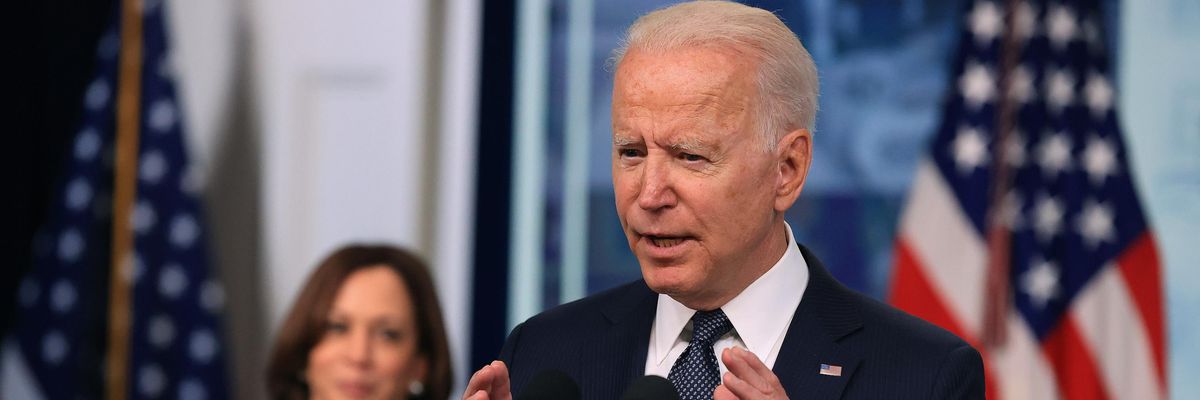
As the COP26 summit stretched into overtime on Friday--with diplomats in Glasgow, Scotland unable to finalize an international climate accord by the scheduled deadline due to sharp disagreements over fossil fuel language, the pace of emissions reductions, and aid for developing countries--progressives in the U.S. implored President Joe Biden to take ambitious climate action through the executive branch.
"The fate of climate action does not rest on a handful of recalcitrant senators or world leaders."
"The haggling over the drafts of the conference agreement only underscores how far political leaders are from introducing meaningful plans to address this planetary crisis," Mitch Jones, policy director at Food & Water Watch, said in a statement. "Governments that cannot directly and forcefully confront the fossil fuel industry are doing nothing but advertising their failure."
"Even a call to stop government fossil fuel subsidies--a modest but necessary first step--had to be weakened in order to coddle corporate polluters," said Jones, alluding to the enfeeblement on Thursday of a draft decision text, which campaigners attributed in large part to industry influence, given the heavy presence of oil and gas lobbyists at the United Nations meeting.
Related Content

"The egregious failure to achieve even modest, voluntary agreements is disappointing, but not surprising," said Jones, who argued that the outcome at COP26 should galvanize more robust climate policy from the White House, not be used as an excuse for inaction.
Earlier this week, researchers behind the Climate Action Tracker found that even if current emissions reduction targets--including pledges made in Glasgow--are met, countries will still emit twice as much greenhouse gas pollution in 2030 as required to meet the Paris agreement's more ambitious goal of keeping global warming below 1.5degC by the end of the century.
That's "all the more reason that real climate action must not wait, especially here in the United States," Jones argued.
The recently passed bipartisan physical infrastructure bill is riddled with fossil fuel subsidies and, according to Stephen Semler of the Security Policy Reform Institute, contains mitigation funding that amounts to less than 5% of the budget of the U.S. military, which is one of the biggest polluters on the planet.
After the bipartisan infrastructure measure was approved, Rep. Alexandria Ocasio-Cortez (D-N.Y.) warned that failing to pass the more climate-friendly Build Back Better reconciliation package could "loc[k] in U.S. emissions."
"There is plenty that President Biden can and must be doing to promote a safe and livable future."
Jones, however, stressed the need for strong executive action to combat the climate crisis regardless of what happens in the legislative branch.
"Everyone can see that the climate provisions of the Build Back Batter Act have been substantially weakened--and there are still doubts about its final passage," he said. "But the fate of climate action does not rest on a handful of recalcitrant senators or world leaders."
"The Biden administration has tools at its disposal that it is simply failing to use," said Jones. "This White House should fulfill its campaign promise to stop oil and gas drilling on public lands, put an end to oil and gas exports, and stop approving new dirty energy power plants and pipelines. If President Biden believes we are in an emergency, he should act accordingly."
A new report published Friday revealed that despite its claims to climate leadership, the U.S. is expected to expand oil and gas production more than any other country between now and 2030.
That includes a planned fracking boom in the Permian Basin that would unleash nearly 40 billion tons of carbon dioxide by midcentury. There are 23 other fossil fuel projects--among them the Line 3, Dakota Access, and Mountain Valley pipelines and several liquified gas export terminals--that Biden has the executive authority to block. His administarion can also halt the sale of new fossil fuel leases for public lands and offshore drilling.
Jones emphasized that "there is plenty that President Biden can and must be doing to promote a safe and livable future. Biden must use his executive authority to stop the expansion of fossil fuels, reject industry-friendly scams, and put the full force of his administration behind a transition off fossil fuels."
Alluding to Thursday's launch of a multi-national coalition committed to halting all new drilling and ultimately phasing out coal, oil, and gas for good, Jones said that "it was heartening to see some renewed enthusiasm for strong policies to limit the global supply of fossil fuels."
"The 10-nation Beyond Oil and Gas Alliance," he added, "represents the approach that must prevail across the world if we are to have a realistic chance at averting further catastrophe."
As the COP26 summit stretched into overtime on Friday--with diplomats in Glasgow, Scotland unable to finalize an international climate accord by the scheduled deadline due to sharp disagreements over fossil fuel language, the pace of emissions reductions, and aid for developing countries--progressives in the U.S. implored President Joe Biden to take ambitious climate action through the executive branch.
"The fate of climate action does not rest on a handful of recalcitrant senators or world leaders."
"The haggling over the drafts of the conference agreement only underscores how far political leaders are from introducing meaningful plans to address this planetary crisis," Mitch Jones, policy director at Food & Water Watch, said in a statement. "Governments that cannot directly and forcefully confront the fossil fuel industry are doing nothing but advertising their failure."
"Even a call to stop government fossil fuel subsidies--a modest but necessary first step--had to be weakened in order to coddle corporate polluters," said Jones, alluding to the enfeeblement on Thursday of a draft decision text, which campaigners attributed in large part to industry influence, given the heavy presence of oil and gas lobbyists at the United Nations meeting.
Related Content
"The egregious failure to achieve even modest, voluntary agreements is disappointing, but not surprising," said Jones, who argued that the outcome at COP26 should galvanize more robust climate policy from the White House, not be used as an excuse for inaction.
Earlier this week, researchers behind the Climate Action Tracker found that even if current emissions reduction targets--including pledges made in Glasgow--are met, countries will still emit twice as much greenhouse gas pollution in 2030 as required to meet the Paris agreement's more ambitious goal of keeping global warming below 1.5degC by the end of the century.
That's "all the more reason that real climate action must not wait, especially here in the United States," Jones argued.
The recently passed bipartisan physical infrastructure bill is riddled with fossil fuel subsidies and, according to Stephen Semler of the Security Policy Reform Institute, contains mitigation funding that amounts to less than 5% of the budget of the U.S. military, which is one of the biggest polluters on the planet.
After the bipartisan infrastructure measure was approved, Rep. Alexandria Ocasio-Cortez (D-N.Y.) warned that failing to pass the more climate-friendly Build Back Better reconciliation package could "loc[k] in U.S. emissions."
"There is plenty that President Biden can and must be doing to promote a safe and livable future."
Jones, however, stressed the need for strong executive action to combat the climate crisis regardless of what happens in the legislative branch.
"Everyone can see that the climate provisions of the Build Back Batter Act have been substantially weakened--and there are still doubts about its final passage," he said. "But the fate of climate action does not rest on a handful of recalcitrant senators or world leaders."
"The Biden administration has tools at its disposal that it is simply failing to use," said Jones. "This White House should fulfill its campaign promise to stop oil and gas drilling on public lands, put an end to oil and gas exports, and stop approving new dirty energy power plants and pipelines. If President Biden believes we are in an emergency, he should act accordingly."
A new report published Friday revealed that despite its claims to climate leadership, the U.S. is expected to expand oil and gas production more than any other country between now and 2030.
That includes a planned fracking boom in the Permian Basin that would unleash nearly 40 billion tons of carbon dioxide by midcentury. There are 23 other fossil fuel projects--among them the Line 3, Dakota Access, and Mountain Valley pipelines and several liquified gas export terminals--that Biden has the executive authority to block. His administarion can also halt the sale of new fossil fuel leases for public lands and offshore drilling.
Jones emphasized that "there is plenty that President Biden can and must be doing to promote a safe and livable future. Biden must use his executive authority to stop the expansion of fossil fuels, reject industry-friendly scams, and put the full force of his administration behind a transition off fossil fuels."
Alluding to Thursday's launch of a multi-national coalition committed to halting all new drilling and ultimately phasing out coal, oil, and gas for good, Jones said that "it was heartening to see some renewed enthusiasm for strong policies to limit the global supply of fossil fuels."
"The 10-nation Beyond Oil and Gas Alliance," he added, "represents the approach that must prevail across the world if we are to have a realistic chance at averting further catastrophe."
As the COP26 summit stretched into overtime on Friday--with diplomats in Glasgow, Scotland unable to finalize an international climate accord by the scheduled deadline due to sharp disagreements over fossil fuel language, the pace of emissions reductions, and aid for developing countries--progressives in the U.S. implored President Joe Biden to take ambitious climate action through the executive branch.
"The fate of climate action does not rest on a handful of recalcitrant senators or world leaders."
"The haggling over the drafts of the conference agreement only underscores how far political leaders are from introducing meaningful plans to address this planetary crisis," Mitch Jones, policy director at Food & Water Watch, said in a statement. "Governments that cannot directly and forcefully confront the fossil fuel industry are doing nothing but advertising their failure."
"Even a call to stop government fossil fuel subsidies--a modest but necessary first step--had to be weakened in order to coddle corporate polluters," said Jones, alluding to the enfeeblement on Thursday of a draft decision text, which campaigners attributed in large part to industry influence, given the heavy presence of oil and gas lobbyists at the United Nations meeting.
Related Content
"The egregious failure to achieve even modest, voluntary agreements is disappointing, but not surprising," said Jones, who argued that the outcome at COP26 should galvanize more robust climate policy from the White House, not be used as an excuse for inaction.
Earlier this week, researchers behind the Climate Action Tracker found that even if current emissions reduction targets--including pledges made in Glasgow--are met, countries will still emit twice as much greenhouse gas pollution in 2030 as required to meet the Paris agreement's more ambitious goal of keeping global warming below 1.5degC by the end of the century.
That's "all the more reason that real climate action must not wait, especially here in the United States," Jones argued.
The recently passed bipartisan physical infrastructure bill is riddled with fossil fuel subsidies and, according to Stephen Semler of the Security Policy Reform Institute, contains mitigation funding that amounts to less than 5% of the budget of the U.S. military, which is one of the biggest polluters on the planet.
After the bipartisan infrastructure measure was approved, Rep. Alexandria Ocasio-Cortez (D-N.Y.) warned that failing to pass the more climate-friendly Build Back Better reconciliation package could "loc[k] in U.S. emissions."
"There is plenty that President Biden can and must be doing to promote a safe and livable future."
Jones, however, stressed the need for strong executive action to combat the climate crisis regardless of what happens in the legislative branch.
"Everyone can see that the climate provisions of the Build Back Batter Act have been substantially weakened--and there are still doubts about its final passage," he said. "But the fate of climate action does not rest on a handful of recalcitrant senators or world leaders."
"The Biden administration has tools at its disposal that it is simply failing to use," said Jones. "This White House should fulfill its campaign promise to stop oil and gas drilling on public lands, put an end to oil and gas exports, and stop approving new dirty energy power plants and pipelines. If President Biden believes we are in an emergency, he should act accordingly."
A new report published Friday revealed that despite its claims to climate leadership, the U.S. is expected to expand oil and gas production more than any other country between now and 2030.
That includes a planned fracking boom in the Permian Basin that would unleash nearly 40 billion tons of carbon dioxide by midcentury. There are 23 other fossil fuel projects--among them the Line 3, Dakota Access, and Mountain Valley pipelines and several liquified gas export terminals--that Biden has the executive authority to block. His administarion can also halt the sale of new fossil fuel leases for public lands and offshore drilling.
Jones emphasized that "there is plenty that President Biden can and must be doing to promote a safe and livable future. Biden must use his executive authority to stop the expansion of fossil fuels, reject industry-friendly scams, and put the full force of his administration behind a transition off fossil fuels."
Alluding to Thursday's launch of a multi-national coalition committed to halting all new drilling and ultimately phasing out coal, oil, and gas for good, Jones said that "it was heartening to see some renewed enthusiasm for strong policies to limit the global supply of fossil fuels."
"The 10-nation Beyond Oil and Gas Alliance," he added, "represents the approach that must prevail across the world if we are to have a realistic chance at averting further catastrophe."

