

SUBSCRIBE TO OUR FREE NEWSLETTER
Daily news & progressive opinion—funded by the people, not the corporations—delivered straight to your inbox.
5
#000000
#FFFFFF
To donate by check, phone, or other method, see our More Ways to Give page.
Daily news & progressive opinion—funded by the people, not the corporations—delivered straight to your inbox.
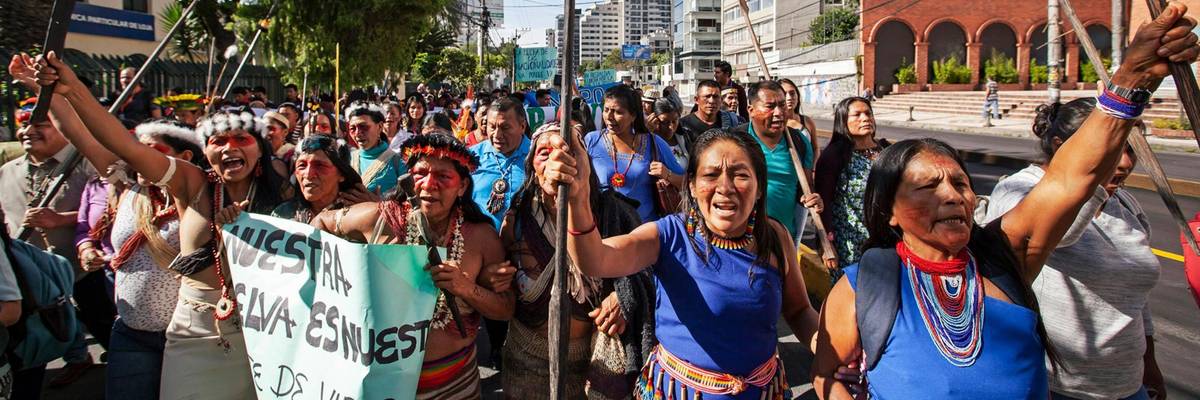
Indigenous Amazon protectors on October 18, 2021 filed the first in a series of lawsuits challenging a pair of decrees by Ecuadorian President Guillermo Lasso in service of expanding the fossil fuel and mining industries.
In a bid to halt what one Indigenous leader called a "policy of death," communities from Ecuador's Amazon region on Monday sued the country's right-wing president, who is planning a major expansion of fossil fuel extraction and mining that threatens millions of acres of pristine rainforest and the survival of native peoples.
"President Guillermo Lasso intends to impose an extractive agenda and sacrifice the lives of thousands of Indigenous families who inhabit these territories."
In the first of a series of lawsuits against President Guillermo Lasso, Indigenous nations, groups, and advocates allege that Executive Decree 95--which aims to double the country's oil production to one million barrels per day by deregulating the fossil fuel industry--violates their internationally recognized right to free, prior, and informed consultation and consent.
Lasso, a former banker who defeated progressive economist Andres Arauz in a second-round runoff election in April, has also said he wants to make mining one of Ecuador's leading income sources.
Monday's lawsuit will be followed by a second suit against Executive Decree 151, which loosens environmental controls to expedite foreign mining companies' entry into the Amazon region against the wishes of Indigenous peoples. The plaintiffs are demanding Ecuador's Constitutional Court strike down both decrees.
"The Ecuadorean government sees in our territory only resource interests," Waorani of Pastaza (CONCONAWEP) President Nemonte Nenquimo said outside the Quito court, according to Reuters. "Our territory is our decision and we'll never allow oil or mining companies to enter and destroy our home and kill our culture."
According to Amazon Watch:
These decrees are a threat to the Amazon, its peoples, and the climate. They pave the way for a massive expansion of extraction in some of the most ecologically fragile and culturally sensitive areas, and if history is any lesson, promise continued rights violations of Indigenous peoples and nature.
Viktor Quenama, president of the A'i Kofan community of Sinangoe, said, "We are fighting to defend our territory, our rivers, our forest, our fish, and our animals. Without our forest and without water, we cannot live."
"We have made a firm decision to keep our territory free from mining," he added. "We don't want the Aguarico River and its tributaries to be exploited and contaminated. Our elders, youth, men, and women are all united in this struggle. We want to care for our territory so that future generations can live well. The Ecuadorian government must respect our rights and let us live freely."
Maria Espinosa, an attorney with the advocacy group Amazon Frontlines, said that "we are presenting these lawsuits against Executive Decrees 95 and 151 because we consider that these decrees are in clear violation of Indigenous people's rights to prior consent and pre-legislative consultation."
"These decrees seek to accelerate extractive activities such as oil and mining, which generate grave and irreparable impacts against the physical and cultural survival of Indigenous peoples," she continued. "Through unconsulted administrative procedures and the pretext of economic development, President Guillermo Lasso intends to impose an extractive agenda and sacrifice the lives of thousands of Indigenous families who inhabit these territories."
Confederation of Indigenous Nationalities of Ecuador (CONAIE) President Leonidas Iza said that the Ecuadorian government seeks "to continue this policy of death."
"This isn't a problem of the Indigenous," asserted Iza, "it's one of civilization."
Dear Common Dreams reader, It’s been nearly 30 years since I co-founded Common Dreams with my late wife, Lina Newhouser. We had the radical notion that journalism should serve the public good, not corporate profits. It was clear to us from the outset what it would take to build such a project. No paid advertisements. No corporate sponsors. No millionaire publisher telling us what to think or do. Many people said we wouldn't last a year, but we proved those doubters wrong. Together with a tremendous team of journalists and dedicated staff, we built an independent media outlet free from the constraints of profits and corporate control. Our mission has always been simple: To inform. To inspire. To ignite change for the common good. Building Common Dreams was not easy. Our survival was never guaranteed. When you take on the most powerful forces—Wall Street greed, fossil fuel industry destruction, Big Tech lobbyists, and uber-rich oligarchs who have spent billions upon billions rigging the economy and democracy in their favor—the only bulwark you have is supporters who believe in your work. But here’s the urgent message from me today. It's never been this bad out there. And it's never been this hard to keep us going. At the very moment Common Dreams is most needed, the threats we face are intensifying. We need your support now more than ever. We don't accept corporate advertising and never will. We don't have a paywall because we don't think people should be blocked from critical news based on their ability to pay. Everything we do is funded by the donations of readers like you. When everyone does the little they can afford, we are strong. But if that support retreats or dries up, so do we. Will you donate now to make sure Common Dreams not only survives but thrives? —Craig Brown, Co-founder |
In a bid to halt what one Indigenous leader called a "policy of death," communities from Ecuador's Amazon region on Monday sued the country's right-wing president, who is planning a major expansion of fossil fuel extraction and mining that threatens millions of acres of pristine rainforest and the survival of native peoples.
"President Guillermo Lasso intends to impose an extractive agenda and sacrifice the lives of thousands of Indigenous families who inhabit these territories."
In the first of a series of lawsuits against President Guillermo Lasso, Indigenous nations, groups, and advocates allege that Executive Decree 95--which aims to double the country's oil production to one million barrels per day by deregulating the fossil fuel industry--violates their internationally recognized right to free, prior, and informed consultation and consent.
Lasso, a former banker who defeated progressive economist Andres Arauz in a second-round runoff election in April, has also said he wants to make mining one of Ecuador's leading income sources.
Monday's lawsuit will be followed by a second suit against Executive Decree 151, which loosens environmental controls to expedite foreign mining companies' entry into the Amazon region against the wishes of Indigenous peoples. The plaintiffs are demanding Ecuador's Constitutional Court strike down both decrees.
"The Ecuadorean government sees in our territory only resource interests," Waorani of Pastaza (CONCONAWEP) President Nemonte Nenquimo said outside the Quito court, according to Reuters. "Our territory is our decision and we'll never allow oil or mining companies to enter and destroy our home and kill our culture."
According to Amazon Watch:
These decrees are a threat to the Amazon, its peoples, and the climate. They pave the way for a massive expansion of extraction in some of the most ecologically fragile and culturally sensitive areas, and if history is any lesson, promise continued rights violations of Indigenous peoples and nature.
Viktor Quenama, president of the A'i Kofan community of Sinangoe, said, "We are fighting to defend our territory, our rivers, our forest, our fish, and our animals. Without our forest and without water, we cannot live."
"We have made a firm decision to keep our territory free from mining," he added. "We don't want the Aguarico River and its tributaries to be exploited and contaminated. Our elders, youth, men, and women are all united in this struggle. We want to care for our territory so that future generations can live well. The Ecuadorian government must respect our rights and let us live freely."
Maria Espinosa, an attorney with the advocacy group Amazon Frontlines, said that "we are presenting these lawsuits against Executive Decrees 95 and 151 because we consider that these decrees are in clear violation of Indigenous people's rights to prior consent and pre-legislative consultation."
"These decrees seek to accelerate extractive activities such as oil and mining, which generate grave and irreparable impacts against the physical and cultural survival of Indigenous peoples," she continued. "Through unconsulted administrative procedures and the pretext of economic development, President Guillermo Lasso intends to impose an extractive agenda and sacrifice the lives of thousands of Indigenous families who inhabit these territories."
Confederation of Indigenous Nationalities of Ecuador (CONAIE) President Leonidas Iza said that the Ecuadorian government seeks "to continue this policy of death."
"This isn't a problem of the Indigenous," asserted Iza, "it's one of civilization."
In a bid to halt what one Indigenous leader called a "policy of death," communities from Ecuador's Amazon region on Monday sued the country's right-wing president, who is planning a major expansion of fossil fuel extraction and mining that threatens millions of acres of pristine rainforest and the survival of native peoples.
"President Guillermo Lasso intends to impose an extractive agenda and sacrifice the lives of thousands of Indigenous families who inhabit these territories."
In the first of a series of lawsuits against President Guillermo Lasso, Indigenous nations, groups, and advocates allege that Executive Decree 95--which aims to double the country's oil production to one million barrels per day by deregulating the fossil fuel industry--violates their internationally recognized right to free, prior, and informed consultation and consent.
Lasso, a former banker who defeated progressive economist Andres Arauz in a second-round runoff election in April, has also said he wants to make mining one of Ecuador's leading income sources.
Monday's lawsuit will be followed by a second suit against Executive Decree 151, which loosens environmental controls to expedite foreign mining companies' entry into the Amazon region against the wishes of Indigenous peoples. The plaintiffs are demanding Ecuador's Constitutional Court strike down both decrees.
"The Ecuadorean government sees in our territory only resource interests," Waorani of Pastaza (CONCONAWEP) President Nemonte Nenquimo said outside the Quito court, according to Reuters. "Our territory is our decision and we'll never allow oil or mining companies to enter and destroy our home and kill our culture."
According to Amazon Watch:
These decrees are a threat to the Amazon, its peoples, and the climate. They pave the way for a massive expansion of extraction in some of the most ecologically fragile and culturally sensitive areas, and if history is any lesson, promise continued rights violations of Indigenous peoples and nature.
Viktor Quenama, president of the A'i Kofan community of Sinangoe, said, "We are fighting to defend our territory, our rivers, our forest, our fish, and our animals. Without our forest and without water, we cannot live."
"We have made a firm decision to keep our territory free from mining," he added. "We don't want the Aguarico River and its tributaries to be exploited and contaminated. Our elders, youth, men, and women are all united in this struggle. We want to care for our territory so that future generations can live well. The Ecuadorian government must respect our rights and let us live freely."
Maria Espinosa, an attorney with the advocacy group Amazon Frontlines, said that "we are presenting these lawsuits against Executive Decrees 95 and 151 because we consider that these decrees are in clear violation of Indigenous people's rights to prior consent and pre-legislative consultation."
"These decrees seek to accelerate extractive activities such as oil and mining, which generate grave and irreparable impacts against the physical and cultural survival of Indigenous peoples," she continued. "Through unconsulted administrative procedures and the pretext of economic development, President Guillermo Lasso intends to impose an extractive agenda and sacrifice the lives of thousands of Indigenous families who inhabit these territories."
Confederation of Indigenous Nationalities of Ecuador (CONAIE) President Leonidas Iza said that the Ecuadorian government seeks "to continue this policy of death."
"This isn't a problem of the Indigenous," asserted Iza, "it's one of civilization."

