SUBSCRIBE TO OUR FREE NEWSLETTER
Daily news & progressive opinion—funded by the people, not the corporations—delivered straight to your inbox.
5
#000000
#FFFFFF
To donate by check, phone, or other method, see our More Ways to Give page.
Daily news & progressive opinion—funded by the people, not the corporations—delivered straight to your inbox.
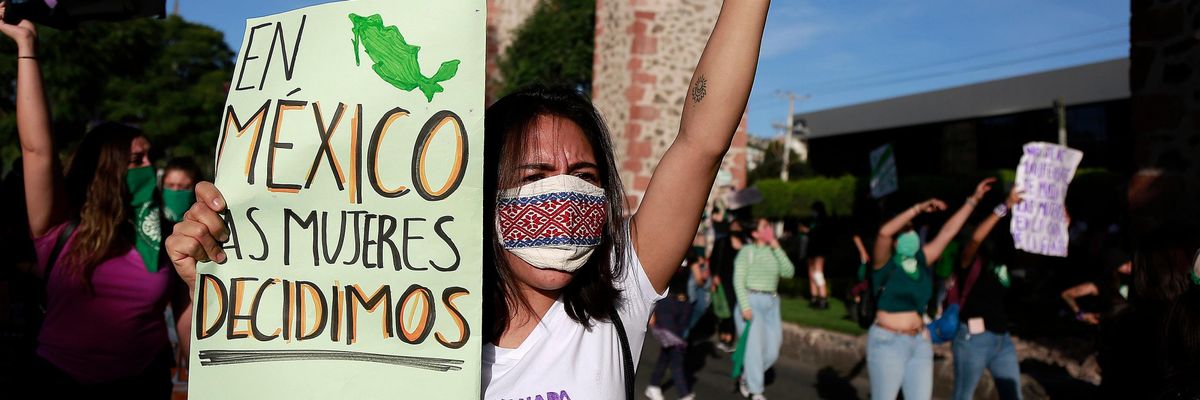
A woman holds up a sign that reads "In Mexico, we women decide" during a demonstration in favor of decriminalization of abortion on the International Safe Abortion Day on September 28, 2020 in Queretaro, Mexico. (Photo: Cesar Gomez/Jam Media/Getty Images)
Standing in stark contrast with a newly effective anti-abortion law in neighboring Texas, Mexico's Supreme Court on Tuesday unanimously ruled that a state law criminalizing abortion is unconstitutional, setting a precedent that advocates say is likely to ultimately lead to full legalization in the nation with the world's second-largest Roman Catholic population.
"Today is a historic day for the rights of all Mexican women."
--Chief Justice Arturo Zaldivar
The Washington Post reports Mexico's high court found that a law in the northern state of Coahuila punishing women who have abortions with three years' imprisonment violates the nation's constitution. Women jailed for undergoing the procedure may now be freed following the decision.
"Today is a historic day for the rights of all Mexican women," Supreme Court Chief Justice Arturo Zaldivar said after the ruling was announced. "It is a watershed in the history of the rights of all women, especially the most vulnerable."
Justice Ana Margarita Rios Farjat wrote:
In light of the Constitution, which does not prohibit abortion, can the state punish it? By punishing it, the state sanctions a behavior rooted in a series of rights possessed by women and by people with the capacity to bear children, and who participate in the decision to abort, such as the right to human dignity, autonomy, and free development of the personality; to legal equality, health, and reproductive freedom. In other words, sanctioning the voluntary interruption of pregnancy implies a limit to all these human rights.
"The pregnant person is criminalized, without it being constitutionally defined if life is invariably protected from conception, and what is the treatment of the embryo in the legal world," she added.
While Tuesday's ruling does not legalize abortion nationwide, it establishes precedent that reproductive rights advocates say they will use to challenge laws criminalizing the procedure in 29 of Mexico's 32 states. Only Oaxaca, Hidalgo, and Veracruz, plus Mexico City, have legalized or decriminalized abortion.
The court's decision follows years of grassroots organizing by feminist and human rights groups.
"The wave turned out to be a green tide," tweeted attorney and activist Estefania Veloz, referring to the color synonymous with the campaign for safe and legal abortion in Latin America. "[This is] for all the women who died in clandestine abortions, for my friends who could not choose their motherhood, and for the girls who will grow up in a freer country."
Rebeca Ramos, executive director of the reproductive rights organization GIRE, called the court's decision "an enormous step toward legalization in the entire country."
"We are absolutely ready to present legal challenges to the denial of safe and legal abortion," Ramos told The New York Times.
Jamie L. Manson, president of the U.S. group Catholics for Choice, said in a statement that "this decision is a resounding victory for the fundamental values of Catholic social teaching, particularly respect for human dignity, liberation, and preferential treatment of the poor."
"It is also a monumental step forward for the rights of women and all pregnant people in Mexico," added Manson, "and it sends a hopeful signal to the scores of reproductive justice advocates working hard to win similar freedoms in countries across Latin America."
Observers noted that while nations including Mexico and Argentina have recently taken major steps to advance reproductive rights, numerous U.S. states with Republican-controlled legislatures have moved aggressively to severely restrict abortion access.
"Here in the United States, we are confronting unprecedented, extreme abortion bans in states like Texas, and our majority-Catholic U.S. Supreme Court presents a possible threat to the future of abortion rights," said Manson. "With reproductive freedom in mortal danger, we look to the brave activists across our southern border for strength and inspiration."
On Tuesday, United Nations experts condemned Texas' new law--which bans abortions after six weeks of pregnancy and allows no exceptions for victims of rape or incest--as a violation of international law.
Reem Alsalem, the U.N.'s independent monitor on violence against women, said that by refusing to block the law, the U.S. Supreme Court's conservative justices have "chosen to trample on the protection of women's reproductive rights, thereby exposing them and abortion providers to more violence."
Dear Common Dreams reader, It’s been nearly 30 years since I co-founded Common Dreams with my late wife, Lina Newhouser. We had the radical notion that journalism should serve the public good, not corporate profits. It was clear to us from the outset what it would take to build such a project. No paid advertisements. No corporate sponsors. No millionaire publisher telling us what to think or do. Many people said we wouldn't last a year, but we proved those doubters wrong. Together with a tremendous team of journalists and dedicated staff, we built an independent media outlet free from the constraints of profits and corporate control. Our mission has always been simple: To inform. To inspire. To ignite change for the common good. Building Common Dreams was not easy. Our survival was never guaranteed. When you take on the most powerful forces—Wall Street greed, fossil fuel industry destruction, Big Tech lobbyists, and uber-rich oligarchs who have spent billions upon billions rigging the economy and democracy in their favor—the only bulwark you have is supporters who believe in your work. But here’s the urgent message from me today. It's never been this bad out there. And it's never been this hard to keep us going. At the very moment Common Dreams is most needed, the threats we face are intensifying. We need your support now more than ever. We don't accept corporate advertising and never will. We don't have a paywall because we don't think people should be blocked from critical news based on their ability to pay. Everything we do is funded by the donations of readers like you. When everyone does the little they can afford, we are strong. But if that support retreats or dries up, so do we. Will you donate now to make sure Common Dreams not only survives but thrives? —Craig Brown, Co-founder |
Standing in stark contrast with a newly effective anti-abortion law in neighboring Texas, Mexico's Supreme Court on Tuesday unanimously ruled that a state law criminalizing abortion is unconstitutional, setting a precedent that advocates say is likely to ultimately lead to full legalization in the nation with the world's second-largest Roman Catholic population.
"Today is a historic day for the rights of all Mexican women."
--Chief Justice Arturo Zaldivar
The Washington Post reports Mexico's high court found that a law in the northern state of Coahuila punishing women who have abortions with three years' imprisonment violates the nation's constitution. Women jailed for undergoing the procedure may now be freed following the decision.
"Today is a historic day for the rights of all Mexican women," Supreme Court Chief Justice Arturo Zaldivar said after the ruling was announced. "It is a watershed in the history of the rights of all women, especially the most vulnerable."
Justice Ana Margarita Rios Farjat wrote:
In light of the Constitution, which does not prohibit abortion, can the state punish it? By punishing it, the state sanctions a behavior rooted in a series of rights possessed by women and by people with the capacity to bear children, and who participate in the decision to abort, such as the right to human dignity, autonomy, and free development of the personality; to legal equality, health, and reproductive freedom. In other words, sanctioning the voluntary interruption of pregnancy implies a limit to all these human rights.
"The pregnant person is criminalized, without it being constitutionally defined if life is invariably protected from conception, and what is the treatment of the embryo in the legal world," she added.
While Tuesday's ruling does not legalize abortion nationwide, it establishes precedent that reproductive rights advocates say they will use to challenge laws criminalizing the procedure in 29 of Mexico's 32 states. Only Oaxaca, Hidalgo, and Veracruz, plus Mexico City, have legalized or decriminalized abortion.
The court's decision follows years of grassroots organizing by feminist and human rights groups.
"The wave turned out to be a green tide," tweeted attorney and activist Estefania Veloz, referring to the color synonymous with the campaign for safe and legal abortion in Latin America. "[This is] for all the women who died in clandestine abortions, for my friends who could not choose their motherhood, and for the girls who will grow up in a freer country."
Rebeca Ramos, executive director of the reproductive rights organization GIRE, called the court's decision "an enormous step toward legalization in the entire country."
"We are absolutely ready to present legal challenges to the denial of safe and legal abortion," Ramos told The New York Times.
Jamie L. Manson, president of the U.S. group Catholics for Choice, said in a statement that "this decision is a resounding victory for the fundamental values of Catholic social teaching, particularly respect for human dignity, liberation, and preferential treatment of the poor."
"It is also a monumental step forward for the rights of women and all pregnant people in Mexico," added Manson, "and it sends a hopeful signal to the scores of reproductive justice advocates working hard to win similar freedoms in countries across Latin America."
Observers noted that while nations including Mexico and Argentina have recently taken major steps to advance reproductive rights, numerous U.S. states with Republican-controlled legislatures have moved aggressively to severely restrict abortion access.
"Here in the United States, we are confronting unprecedented, extreme abortion bans in states like Texas, and our majority-Catholic U.S. Supreme Court presents a possible threat to the future of abortion rights," said Manson. "With reproductive freedom in mortal danger, we look to the brave activists across our southern border for strength and inspiration."
On Tuesday, United Nations experts condemned Texas' new law--which bans abortions after six weeks of pregnancy and allows no exceptions for victims of rape or incest--as a violation of international law.
Reem Alsalem, the U.N.'s independent monitor on violence against women, said that by refusing to block the law, the U.S. Supreme Court's conservative justices have "chosen to trample on the protection of women's reproductive rights, thereby exposing them and abortion providers to more violence."
Standing in stark contrast with a newly effective anti-abortion law in neighboring Texas, Mexico's Supreme Court on Tuesday unanimously ruled that a state law criminalizing abortion is unconstitutional, setting a precedent that advocates say is likely to ultimately lead to full legalization in the nation with the world's second-largest Roman Catholic population.
"Today is a historic day for the rights of all Mexican women."
--Chief Justice Arturo Zaldivar
The Washington Post reports Mexico's high court found that a law in the northern state of Coahuila punishing women who have abortions with three years' imprisonment violates the nation's constitution. Women jailed for undergoing the procedure may now be freed following the decision.
"Today is a historic day for the rights of all Mexican women," Supreme Court Chief Justice Arturo Zaldivar said after the ruling was announced. "It is a watershed in the history of the rights of all women, especially the most vulnerable."
Justice Ana Margarita Rios Farjat wrote:
In light of the Constitution, which does not prohibit abortion, can the state punish it? By punishing it, the state sanctions a behavior rooted in a series of rights possessed by women and by people with the capacity to bear children, and who participate in the decision to abort, such as the right to human dignity, autonomy, and free development of the personality; to legal equality, health, and reproductive freedom. In other words, sanctioning the voluntary interruption of pregnancy implies a limit to all these human rights.
"The pregnant person is criminalized, without it being constitutionally defined if life is invariably protected from conception, and what is the treatment of the embryo in the legal world," she added.
While Tuesday's ruling does not legalize abortion nationwide, it establishes precedent that reproductive rights advocates say they will use to challenge laws criminalizing the procedure in 29 of Mexico's 32 states. Only Oaxaca, Hidalgo, and Veracruz, plus Mexico City, have legalized or decriminalized abortion.
The court's decision follows years of grassroots organizing by feminist and human rights groups.
"The wave turned out to be a green tide," tweeted attorney and activist Estefania Veloz, referring to the color synonymous with the campaign for safe and legal abortion in Latin America. "[This is] for all the women who died in clandestine abortions, for my friends who could not choose their motherhood, and for the girls who will grow up in a freer country."
Rebeca Ramos, executive director of the reproductive rights organization GIRE, called the court's decision "an enormous step toward legalization in the entire country."
"We are absolutely ready to present legal challenges to the denial of safe and legal abortion," Ramos told The New York Times.
Jamie L. Manson, president of the U.S. group Catholics for Choice, said in a statement that "this decision is a resounding victory for the fundamental values of Catholic social teaching, particularly respect for human dignity, liberation, and preferential treatment of the poor."
"It is also a monumental step forward for the rights of women and all pregnant people in Mexico," added Manson, "and it sends a hopeful signal to the scores of reproductive justice advocates working hard to win similar freedoms in countries across Latin America."
Observers noted that while nations including Mexico and Argentina have recently taken major steps to advance reproductive rights, numerous U.S. states with Republican-controlled legislatures have moved aggressively to severely restrict abortion access.
"Here in the United States, we are confronting unprecedented, extreme abortion bans in states like Texas, and our majority-Catholic U.S. Supreme Court presents a possible threat to the future of abortion rights," said Manson. "With reproductive freedom in mortal danger, we look to the brave activists across our southern border for strength and inspiration."
On Tuesday, United Nations experts condemned Texas' new law--which bans abortions after six weeks of pregnancy and allows no exceptions for victims of rape or incest--as a violation of international law.
Reem Alsalem, the U.N.'s independent monitor on violence against women, said that by refusing to block the law, the U.S. Supreme Court's conservative justices have "chosen to trample on the protection of women's reproductive rights, thereby exposing them and abortion providers to more violence."