

SUBSCRIBE TO OUR FREE NEWSLETTER
Daily news & progressive opinion—funded by the people, not the corporations—delivered straight to your inbox.
5
#000000
#FFFFFF
To donate by check, phone, or other method, see our More Ways to Give page.
Daily news & progressive opinion—funded by the people, not the corporations—delivered straight to your inbox.
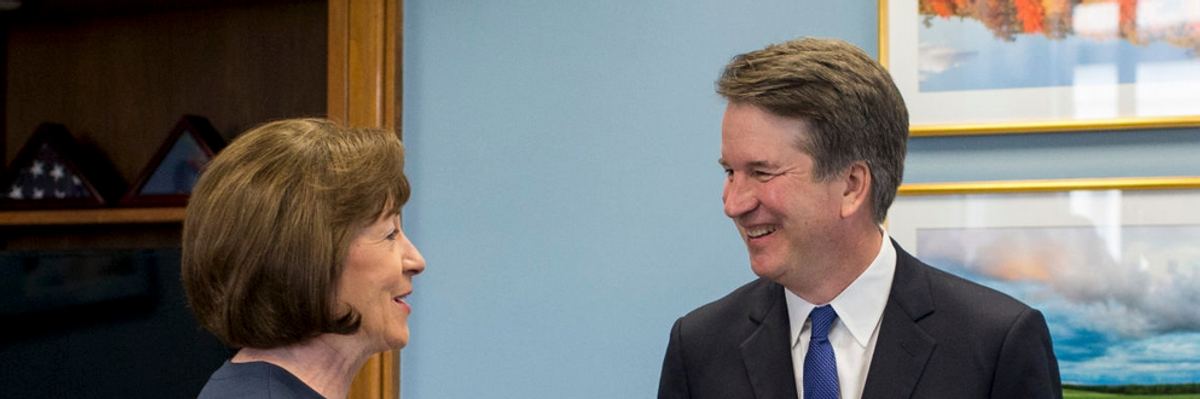
Supreme Court nominee Brett Kavanaugh meets with Sen. Susan Collins (R-Maine) in her office on Capitol Hill on August 21, 2018 in Washington, D.C. (Photo: Zach Gibson/Getty Images)
In a 2018 speech announcing her decisive vote in favor of confirming right-wing judge Brett Kavanaugh to the Supreme Court, Republican Sen. Susan Collins of Maine insisted--despite the abundance of evidence to the contrary--that he would value legal precedent and not support efforts to overturn Roe v. Wade.
"This is Susan Collins' court and her legacy."
--Marie Follayttar, Mainers for Accountable Leadership
But less than three years later, Kavanaugh effectively did just that by joining four of his fellow conservative justices late Wednesday in voting to leave in place Texas' six-week abortion ban, the most restrictive in the nation. While the court's 5-4 majority claimed in a brief unsigned order that its decision "is not based on any conclusion about the constitutionality of Texas' law," analysts argued that the conservative justices' move guts Roe v. Wade "under the cover of a procedural punt."
In the weeks ahead of her vote to confirm Kavanaugh--a Trump nominee who was accused of sexual assault--Collins repeatedly expressed her belief that the judge "reveres our Constitution" and would not approve of overturning Roe, a 1973 decision that established abortion as a constitutional right.
A compilation of Collins' remarks posted online in the wake of the Supreme Court's Wednesday order offers a glimpse at some of the Maine senator's past comments touting Kavanaugh's expressed commitment to keeping Roe intact:
Marie Follayttar, director of Mainers for Accountable Leadership, told Common Dreams on Thursday that Collins "will forever be the U.S. senator who gaslit a nation and her constituents and voted to install Brett Kavanaugh, who cast a vote against a woman's right to an abortion."
"This is Susan Collins' court and her legacy," said Follayttar. "Collins told us that Kavanaugh would respect precedent. Two hundred and thirty Maine attorneys wrote her that Kavanaugh would 'cast the fifth vote, making a majority, to erode or eliminate federal protections for a woman's right to choose.'"
"We failed to defeat Susan Collins at the ballot box, but we will succeed in making sure her role in overturning Roe vs. Wade is remembered," she continued. "It's incumbent on the Biden administration and Democratic leadership to expand the court, abolish the filibuster, and protect our right to an abortion. Anything less is unacceptable."
The Texas law that the Supreme Court opted to uphold with its dead-of-night order empowers private individuals to sue abortion providers and anyone who "aids and abets" patients attempting to obtain the procedure after around six weeks of a preganancy. Texas Republicans deliberately crafted the law--which amounts to a near-total ban on abortions in the state--to shield it from legal challenges, a maneuver that other GOP-controlled states are now likely to replicate.
Slate court reporter Mark Joseph Stern wrote early Thursday that "although the majority did not say these words exactly, the upshot of Wednesday's decision is undeniable: The Supreme Court has abandoned the constitutional right to abortion. Roe is no longer good law."
"In defending her vote to confirm him to the bench, Republican Sen. Susan Collins said Kavanaugh believed that precedent was 'not something to be trimmed, narrowed, discarded, or overlooked,'" Stern noted. "Now Kavanaugh has allowed Texas to overturn Roe, a nearly half-century-old precedent. He took less than three years to prove her wrong."
Dear Common Dreams reader, It’s been nearly 30 years since I co-founded Common Dreams with my late wife, Lina Newhouser. We had the radical notion that journalism should serve the public good, not corporate profits. It was clear to us from the outset what it would take to build such a project. No paid advertisements. No corporate sponsors. No millionaire publisher telling us what to think or do. Many people said we wouldn't last a year, but we proved those doubters wrong. Together with a tremendous team of journalists and dedicated staff, we built an independent media outlet free from the constraints of profits and corporate control. Our mission has always been simple: To inform. To inspire. To ignite change for the common good. Building Common Dreams was not easy. Our survival was never guaranteed. When you take on the most powerful forces—Wall Street greed, fossil fuel industry destruction, Big Tech lobbyists, and uber-rich oligarchs who have spent billions upon billions rigging the economy and democracy in their favor—the only bulwark you have is supporters who believe in your work. But here’s the urgent message from me today. It's never been this bad out there. And it's never been this hard to keep us going. At the very moment Common Dreams is most needed, the threats we face are intensifying. We need your support now more than ever. We don't accept corporate advertising and never will. We don't have a paywall because we don't think people should be blocked from critical news based on their ability to pay. Everything we do is funded by the donations of readers like you. When everyone does the little they can afford, we are strong. But if that support retreats or dries up, so do we. Will you donate now to make sure Common Dreams not only survives but thrives? —Craig Brown, Co-founder |
In a 2018 speech announcing her decisive vote in favor of confirming right-wing judge Brett Kavanaugh to the Supreme Court, Republican Sen. Susan Collins of Maine insisted--despite the abundance of evidence to the contrary--that he would value legal precedent and not support efforts to overturn Roe v. Wade.
"This is Susan Collins' court and her legacy."
--Marie Follayttar, Mainers for Accountable Leadership
But less than three years later, Kavanaugh effectively did just that by joining four of his fellow conservative justices late Wednesday in voting to leave in place Texas' six-week abortion ban, the most restrictive in the nation. While the court's 5-4 majority claimed in a brief unsigned order that its decision "is not based on any conclusion about the constitutionality of Texas' law," analysts argued that the conservative justices' move guts Roe v. Wade "under the cover of a procedural punt."
In the weeks ahead of her vote to confirm Kavanaugh--a Trump nominee who was accused of sexual assault--Collins repeatedly expressed her belief that the judge "reveres our Constitution" and would not approve of overturning Roe, a 1973 decision that established abortion as a constitutional right.
A compilation of Collins' remarks posted online in the wake of the Supreme Court's Wednesday order offers a glimpse at some of the Maine senator's past comments touting Kavanaugh's expressed commitment to keeping Roe intact:
Marie Follayttar, director of Mainers for Accountable Leadership, told Common Dreams on Thursday that Collins "will forever be the U.S. senator who gaslit a nation and her constituents and voted to install Brett Kavanaugh, who cast a vote against a woman's right to an abortion."
"This is Susan Collins' court and her legacy," said Follayttar. "Collins told us that Kavanaugh would respect precedent. Two hundred and thirty Maine attorneys wrote her that Kavanaugh would 'cast the fifth vote, making a majority, to erode or eliminate federal protections for a woman's right to choose.'"
"We failed to defeat Susan Collins at the ballot box, but we will succeed in making sure her role in overturning Roe vs. Wade is remembered," she continued. "It's incumbent on the Biden administration and Democratic leadership to expand the court, abolish the filibuster, and protect our right to an abortion. Anything less is unacceptable."
The Texas law that the Supreme Court opted to uphold with its dead-of-night order empowers private individuals to sue abortion providers and anyone who "aids and abets" patients attempting to obtain the procedure after around six weeks of a preganancy. Texas Republicans deliberately crafted the law--which amounts to a near-total ban on abortions in the state--to shield it from legal challenges, a maneuver that other GOP-controlled states are now likely to replicate.
Slate court reporter Mark Joseph Stern wrote early Thursday that "although the majority did not say these words exactly, the upshot of Wednesday's decision is undeniable: The Supreme Court has abandoned the constitutional right to abortion. Roe is no longer good law."
"In defending her vote to confirm him to the bench, Republican Sen. Susan Collins said Kavanaugh believed that precedent was 'not something to be trimmed, narrowed, discarded, or overlooked,'" Stern noted. "Now Kavanaugh has allowed Texas to overturn Roe, a nearly half-century-old precedent. He took less than three years to prove her wrong."
In a 2018 speech announcing her decisive vote in favor of confirming right-wing judge Brett Kavanaugh to the Supreme Court, Republican Sen. Susan Collins of Maine insisted--despite the abundance of evidence to the contrary--that he would value legal precedent and not support efforts to overturn Roe v. Wade.
"This is Susan Collins' court and her legacy."
--Marie Follayttar, Mainers for Accountable Leadership
But less than three years later, Kavanaugh effectively did just that by joining four of his fellow conservative justices late Wednesday in voting to leave in place Texas' six-week abortion ban, the most restrictive in the nation. While the court's 5-4 majority claimed in a brief unsigned order that its decision "is not based on any conclusion about the constitutionality of Texas' law," analysts argued that the conservative justices' move guts Roe v. Wade "under the cover of a procedural punt."
In the weeks ahead of her vote to confirm Kavanaugh--a Trump nominee who was accused of sexual assault--Collins repeatedly expressed her belief that the judge "reveres our Constitution" and would not approve of overturning Roe, a 1973 decision that established abortion as a constitutional right.
A compilation of Collins' remarks posted online in the wake of the Supreme Court's Wednesday order offers a glimpse at some of the Maine senator's past comments touting Kavanaugh's expressed commitment to keeping Roe intact:
Marie Follayttar, director of Mainers for Accountable Leadership, told Common Dreams on Thursday that Collins "will forever be the U.S. senator who gaslit a nation and her constituents and voted to install Brett Kavanaugh, who cast a vote against a woman's right to an abortion."
"This is Susan Collins' court and her legacy," said Follayttar. "Collins told us that Kavanaugh would respect precedent. Two hundred and thirty Maine attorneys wrote her that Kavanaugh would 'cast the fifth vote, making a majority, to erode or eliminate federal protections for a woman's right to choose.'"
"We failed to defeat Susan Collins at the ballot box, but we will succeed in making sure her role in overturning Roe vs. Wade is remembered," she continued. "It's incumbent on the Biden administration and Democratic leadership to expand the court, abolish the filibuster, and protect our right to an abortion. Anything less is unacceptable."
The Texas law that the Supreme Court opted to uphold with its dead-of-night order empowers private individuals to sue abortion providers and anyone who "aids and abets" patients attempting to obtain the procedure after around six weeks of a preganancy. Texas Republicans deliberately crafted the law--which amounts to a near-total ban on abortions in the state--to shield it from legal challenges, a maneuver that other GOP-controlled states are now likely to replicate.
Slate court reporter Mark Joseph Stern wrote early Thursday that "although the majority did not say these words exactly, the upshot of Wednesday's decision is undeniable: The Supreme Court has abandoned the constitutional right to abortion. Roe is no longer good law."
"In defending her vote to confirm him to the bench, Republican Sen. Susan Collins said Kavanaugh believed that precedent was 'not something to be trimmed, narrowed, discarded, or overlooked,'" Stern noted. "Now Kavanaugh has allowed Texas to overturn Roe, a nearly half-century-old precedent. He took less than three years to prove her wrong."

