
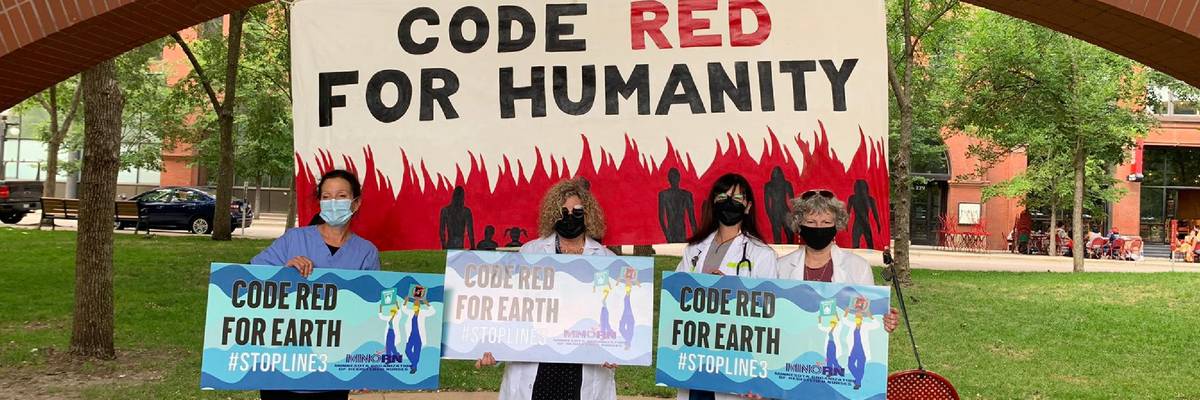
Health professionals gathered for a solidarity event against Line 3 at Mears Park in St. Paul, Minnesota on August 17, 2021. (Photo: Health Professionals for a Healthy Climate/Twitter)
Joining Fight Against Line 3, Health Professionals Urge Biden to Block Project
"It is essentially science denial to permit a pipeline of this magnitude during a climate crisis."
U.S. doctors, nurses, and other health professionals came together Tuesday for a national day of solidarity against Line 3 that included various events and a letter calling on President Joe Biden to block Enbridge's tar sands project.
The health professionals are pressuring Biden to "take action that climate science demands, listen to the voices of Indigenous frontline leaders," and reverse the federal government's permitting of Line 3 under former President Donald Trump.
Their call echoes demands of Indigenous and climate activists who have long fought against the Canadian company's effort to replace an aging pipeline with one that would have the capacity to transport 760,000 barrels daily.
Noting the United Nations Intergovernmental Panel on Climate Change (IPCC) report on the latest climate science that was released last week, the health professionals write to Biden:
We applaud you for rejoining the Paris climate agreement and canceling the Keystone XL Pipeline. We now call on you to revoke the permits for the Enbridge Line 3 pipeline expansion in Minnesota. Line 3 will carry the same product as the Keystone XL Pipeline, dirty tar sands oil. If it is put into operation, Line 3 will accelerate the damage to our climate, releasing carbon emissions equivalent to that of 50 coal plants, every year. This is in stark contrast to your stated goal to reach a net-zero emissions economy by 2050. We have neither the carbon budget nor financial budget to continue investing in fossil fuel infrastructure if we want to meet that ambitious but necessary goal. We also don't have the time--as U.N. Secretary General Antonio Guterres stated, the IPCC report "...must sound a death knell for coal and fossil fuels, before they destroy our planet."
The health professionals highlight that Line 3 is a problem for not only the climate but also environmental justice, warning that letting the project proceed conflicts with Biden's "stated goal to stand up against fossil fuel companies and other polluters who put their own profits over people and disproportionately harm communities of color and low income communities."
"Line 3 cuts through the heart of the Anishinaabe territory in Minnesota, violating treaty rights, damaging sacred wild rice beds, and threatening the health of our Indigenous communities, who have already experienced generations of oppression and trauma due to exploitation of their land and their people," the letter says. "Health professionals across the country stand in solidarity with our Indigenous leaders who are putting their bodies on the line to defend sacred water, land, and climate."
Pointing out that "Line 3 negatively impacts manoomin, a sacred food central to the Anishinaabe way of life," Thaius Boyd, an Ohkay Owingeh tribal member who is also a part of Health Students for a Healthy Climate, said in a statement that preventing the project "safeguards Indigenous health, environment, and future generations."
The letter was spearheaded by Health Professionals for a Healthy Climate and signed by Physicians for Social Responsibility (PSR), Medical Society Consortium on Climate Change and Health, Academy of Integrative Health & Medicine, Alliance of Nurses for Healthy Environments, Medical Students for a Sustainable Future, and multiple state groups.
Individual health professionals also spoke out against Line 3 on Tuesday.
"Americans need to--and want to--end our addiction to oil, because it's exacting a terrible toll on our health and destabilizing our climate," said Dr. Jonathan Patz, director of the Global Health Institute at the University of Wisconsin-Madison, in a statement.
Patz--who, for 15 years, served as a lead author for the IPCC, which was awarded the Nobel Peace Prize in 2007--also spoke at a Tuesday afternoon event in St. Paul, Minnesota, one of at least a dozen actions nationwide.
"The carbon-intensive extraction from open-pit mining makes tar sands the world's most destructive oil operation threatening our health and the environment," Patz said. "And like tar in cigarettes, the bitumen in tar sands oil, which is released when pipes inevitably burst, is carcinogenic. Use of this hazardous substance must end here and now."
"Americans across the country are experiencing health impacts of climate change this summer--extreme heat, drought, and poor air quality from wildfire smoke," noted Dr. Laalitha Surapaneni, an assistant professor at the University of Minnesota Medical School.
Surapaneni, who is on the PSR board of directors and a member of Health Professionals for a Healthy Climate, asserted that "it is essentially science denial to permit a pipeline of this magnitude during a climate crisis."
Minnesota Rep. Dr. Kelly Morrison (D-33B), a practicing OB-GYN, explained that "as a physician and a state legislator, I believe it is my obligation to advocate for public health."
"The recently released U.N.'s IPCC report has been described as a 'code red for humanity,'" she said. "Climate change has rapidly become the world's existential public health crisis, and to address it we must rapidly decarbonize by ending the extraction and burning of fossil fuels, and that includes ending new investment in fossil fuel infrastructure. Minnesota and the United States can lead by stopping Line 3 now."
We are at a crossroads
This country and this world are at a monumental crossroads. In a few short weeks, US voters will have an opportunity to beat back the forces of fascism and confront the billionaires who are rigging the economy, our media system, and our democracy, making it increasingly impossible for ordinary people to get by. We’re not just talking about the election. We’re talking about what must be done once these fascist elements are vanquished from power. We need a bolder set of solutions than what either major party has so far been willing to offer and a working-class movement ready to fight like hell for it. Trump didn't emerge from nowhere. The conditions that fueled MAGA authoritarianism were created by decades of radical neoliberal economic policies and a corrupt political system dominated by corporate interests. They slashed taxes on the super-rich, promising that the benefits would trickle down. They said giveaways to the corporate titans would make life more affordable for the rest of us. It was all bullshit. And when a bitter, betrayed populace searches for someone to blame, right-wing demagogues have little trouble finding scapegoats. People know when they're being lied to, but you won't hear any of this from the corporate media. Only independent journalism—powered and funded by people who believe in building a better world—can deliver truly trustworthy daily news. Our Fall Campaign is underway, and we need your help. To power our newsroom through the rest of the year, we need to raise $125,000 by midnight on October 31. So if you share our vision, please contribute whatever you can to sustain our work. |
U.S. doctors, nurses, and other health professionals came together Tuesday for a national day of solidarity against Line 3 that included various events and a letter calling on President Joe Biden to block Enbridge's tar sands project.
The health professionals are pressuring Biden to "take action that climate science demands, listen to the voices of Indigenous frontline leaders," and reverse the federal government's permitting of Line 3 under former President Donald Trump.
Their call echoes demands of Indigenous and climate activists who have long fought against the Canadian company's effort to replace an aging pipeline with one that would have the capacity to transport 760,000 barrels daily.
Noting the United Nations Intergovernmental Panel on Climate Change (IPCC) report on the latest climate science that was released last week, the health professionals write to Biden:
We applaud you for rejoining the Paris climate agreement and canceling the Keystone XL Pipeline. We now call on you to revoke the permits for the Enbridge Line 3 pipeline expansion in Minnesota. Line 3 will carry the same product as the Keystone XL Pipeline, dirty tar sands oil. If it is put into operation, Line 3 will accelerate the damage to our climate, releasing carbon emissions equivalent to that of 50 coal plants, every year. This is in stark contrast to your stated goal to reach a net-zero emissions economy by 2050. We have neither the carbon budget nor financial budget to continue investing in fossil fuel infrastructure if we want to meet that ambitious but necessary goal. We also don't have the time--as U.N. Secretary General Antonio Guterres stated, the IPCC report "...must sound a death knell for coal and fossil fuels, before they destroy our planet."
The health professionals highlight that Line 3 is a problem for not only the climate but also environmental justice, warning that letting the project proceed conflicts with Biden's "stated goal to stand up against fossil fuel companies and other polluters who put their own profits over people and disproportionately harm communities of color and low income communities."
"Line 3 cuts through the heart of the Anishinaabe territory in Minnesota, violating treaty rights, damaging sacred wild rice beds, and threatening the health of our Indigenous communities, who have already experienced generations of oppression and trauma due to exploitation of their land and their people," the letter says. "Health professionals across the country stand in solidarity with our Indigenous leaders who are putting their bodies on the line to defend sacred water, land, and climate."
Pointing out that "Line 3 negatively impacts manoomin, a sacred food central to the Anishinaabe way of life," Thaius Boyd, an Ohkay Owingeh tribal member who is also a part of Health Students for a Healthy Climate, said in a statement that preventing the project "safeguards Indigenous health, environment, and future generations."
The letter was spearheaded by Health Professionals for a Healthy Climate and signed by Physicians for Social Responsibility (PSR), Medical Society Consortium on Climate Change and Health, Academy of Integrative Health & Medicine, Alliance of Nurses for Healthy Environments, Medical Students for a Sustainable Future, and multiple state groups.
Individual health professionals also spoke out against Line 3 on Tuesday.
"Americans need to--and want to--end our addiction to oil, because it's exacting a terrible toll on our health and destabilizing our climate," said Dr. Jonathan Patz, director of the Global Health Institute at the University of Wisconsin-Madison, in a statement.
Patz--who, for 15 years, served as a lead author for the IPCC, which was awarded the Nobel Peace Prize in 2007--also spoke at a Tuesday afternoon event in St. Paul, Minnesota, one of at least a dozen actions nationwide.
"The carbon-intensive extraction from open-pit mining makes tar sands the world's most destructive oil operation threatening our health and the environment," Patz said. "And like tar in cigarettes, the bitumen in tar sands oil, which is released when pipes inevitably burst, is carcinogenic. Use of this hazardous substance must end here and now."
"Americans across the country are experiencing health impacts of climate change this summer--extreme heat, drought, and poor air quality from wildfire smoke," noted Dr. Laalitha Surapaneni, an assistant professor at the University of Minnesota Medical School.
Surapaneni, who is on the PSR board of directors and a member of Health Professionals for a Healthy Climate, asserted that "it is essentially science denial to permit a pipeline of this magnitude during a climate crisis."
Minnesota Rep. Dr. Kelly Morrison (D-33B), a practicing OB-GYN, explained that "as a physician and a state legislator, I believe it is my obligation to advocate for public health."
"The recently released U.N.'s IPCC report has been described as a 'code red for humanity,'" she said. "Climate change has rapidly become the world's existential public health crisis, and to address it we must rapidly decarbonize by ending the extraction and burning of fossil fuels, and that includes ending new investment in fossil fuel infrastructure. Minnesota and the United States can lead by stopping Line 3 now."
U.S. doctors, nurses, and other health professionals came together Tuesday for a national day of solidarity against Line 3 that included various events and a letter calling on President Joe Biden to block Enbridge's tar sands project.
The health professionals are pressuring Biden to "take action that climate science demands, listen to the voices of Indigenous frontline leaders," and reverse the federal government's permitting of Line 3 under former President Donald Trump.
Their call echoes demands of Indigenous and climate activists who have long fought against the Canadian company's effort to replace an aging pipeline with one that would have the capacity to transport 760,000 barrels daily.
Noting the United Nations Intergovernmental Panel on Climate Change (IPCC) report on the latest climate science that was released last week, the health professionals write to Biden:
We applaud you for rejoining the Paris climate agreement and canceling the Keystone XL Pipeline. We now call on you to revoke the permits for the Enbridge Line 3 pipeline expansion in Minnesota. Line 3 will carry the same product as the Keystone XL Pipeline, dirty tar sands oil. If it is put into operation, Line 3 will accelerate the damage to our climate, releasing carbon emissions equivalent to that of 50 coal plants, every year. This is in stark contrast to your stated goal to reach a net-zero emissions economy by 2050. We have neither the carbon budget nor financial budget to continue investing in fossil fuel infrastructure if we want to meet that ambitious but necessary goal. We also don't have the time--as U.N. Secretary General Antonio Guterres stated, the IPCC report "...must sound a death knell for coal and fossil fuels, before they destroy our planet."
The health professionals highlight that Line 3 is a problem for not only the climate but also environmental justice, warning that letting the project proceed conflicts with Biden's "stated goal to stand up against fossil fuel companies and other polluters who put their own profits over people and disproportionately harm communities of color and low income communities."
"Line 3 cuts through the heart of the Anishinaabe territory in Minnesota, violating treaty rights, damaging sacred wild rice beds, and threatening the health of our Indigenous communities, who have already experienced generations of oppression and trauma due to exploitation of their land and their people," the letter says. "Health professionals across the country stand in solidarity with our Indigenous leaders who are putting their bodies on the line to defend sacred water, land, and climate."
Pointing out that "Line 3 negatively impacts manoomin, a sacred food central to the Anishinaabe way of life," Thaius Boyd, an Ohkay Owingeh tribal member who is also a part of Health Students for a Healthy Climate, said in a statement that preventing the project "safeguards Indigenous health, environment, and future generations."
The letter was spearheaded by Health Professionals for a Healthy Climate and signed by Physicians for Social Responsibility (PSR), Medical Society Consortium on Climate Change and Health, Academy of Integrative Health & Medicine, Alliance of Nurses for Healthy Environments, Medical Students for a Sustainable Future, and multiple state groups.
Individual health professionals also spoke out against Line 3 on Tuesday.
"Americans need to--and want to--end our addiction to oil, because it's exacting a terrible toll on our health and destabilizing our climate," said Dr. Jonathan Patz, director of the Global Health Institute at the University of Wisconsin-Madison, in a statement.
Patz--who, for 15 years, served as a lead author for the IPCC, which was awarded the Nobel Peace Prize in 2007--also spoke at a Tuesday afternoon event in St. Paul, Minnesota, one of at least a dozen actions nationwide.
"The carbon-intensive extraction from open-pit mining makes tar sands the world's most destructive oil operation threatening our health and the environment," Patz said. "And like tar in cigarettes, the bitumen in tar sands oil, which is released when pipes inevitably burst, is carcinogenic. Use of this hazardous substance must end here and now."
"Americans across the country are experiencing health impacts of climate change this summer--extreme heat, drought, and poor air quality from wildfire smoke," noted Dr. Laalitha Surapaneni, an assistant professor at the University of Minnesota Medical School.
Surapaneni, who is on the PSR board of directors and a member of Health Professionals for a Healthy Climate, asserted that "it is essentially science denial to permit a pipeline of this magnitude during a climate crisis."
Minnesota Rep. Dr. Kelly Morrison (D-33B), a practicing OB-GYN, explained that "as a physician and a state legislator, I believe it is my obligation to advocate for public health."
"The recently released U.N.'s IPCC report has been described as a 'code red for humanity,'" she said. "Climate change has rapidly become the world's existential public health crisis, and to address it we must rapidly decarbonize by ending the extraction and burning of fossil fuels, and that includes ending new investment in fossil fuel infrastructure. Minnesota and the United States can lead by stopping Line 3 now."