SUBSCRIBE TO OUR FREE NEWSLETTER
Daily news & progressive opinion—funded by the people, not the corporations—delivered straight to your inbox.
5
#000000
#FFFFFF
To donate by check, phone, or other method, see our More Ways to Give page.
Daily news & progressive opinion—funded by the people, not the corporations—delivered straight to your inbox.
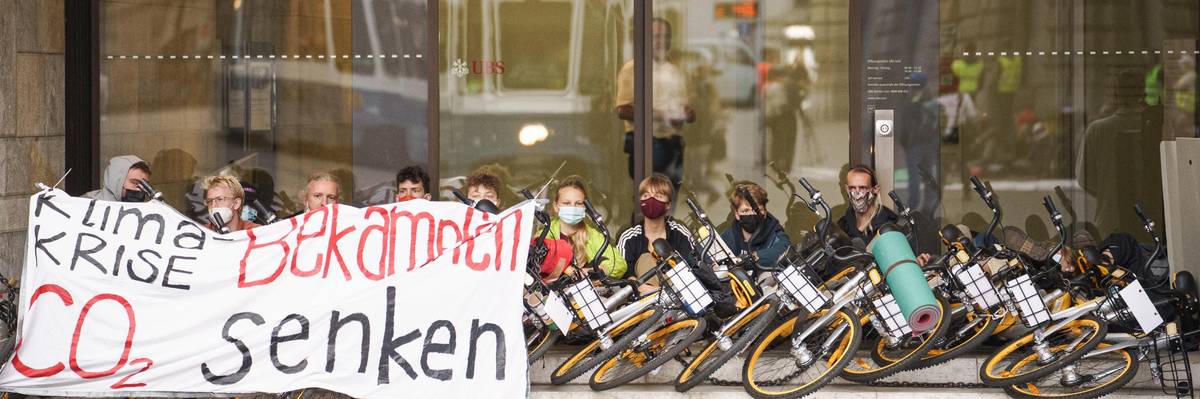
Climate justice activists occupied the center of Zurich's financial district on August 2, 2021 to demand that the two biggest banks in Switzerland divest from oil, gas, and coal. (Photo: Rise Up for Change/flickr/cc)
Climate justice campaigners occupied the center of Zurich's financial district Monday to demand that the two biggest banks in Switzerland divest from oil, gas, and coal.
Dozens of "singing and chanting activists" blocked entrances to the headquarters of Credit Suisse and a UBS office building on Paradeplatz square, Reuters reported. Police officers arrested about 30 people who refused to disperse during the peaceful demonstration.
Frida Kohlmann, spokesperson for the Rise Up for Change group, said in a statement that Credit Suisse and UBS have failed to respond appropriately to the climate emergency.
"That is why the climate justice movement is occupying the Credit Suisse headquarters and the nearby UBS office today to draw attention to the consequences of the Swiss financial institutions' inaction," Kohlmann said.
" Civil disobedience is our duty," tweeted Collectif BreakFree Suisse, part of the movement to stop financial actors from continuing to fund dirty energy projects that are fueling extreme weather-related disasters. "Either phase out fossil fuels or face forest fires, famines, droughts, and floods."
In response to the protest, UBS said in a statement: "Climate protection is a top priority at UBS... We are committed to reducing greenhouse gas emissions across our business to net zero by 2050, with science-based interim targets for 2025, 2030, and 2035."
Despite having "decreased fossil fuel financing by 73%, from $7.7 billion in 2016 to $2.1 billion in 2020," UBS continues to invest money in "thermal coal mining, oil refining, shale gas drilling," and more, according to a recent analysis by CNBC.
Credit Suisse asserted that it "is committed to climate protection and achieving the goals of the Paris Climate Agreement," referring to the 2015 international treaty that seeks to reduce carbon pollution and limit global temperature rise to below 1.5degC.
On its "DisCreditSuisse" campaign website, Collectif BreakFree Suisse said that while "Credit Suisse claims to align itself with the objectives of the Paris Agreement... it is one of the banks that is fueling the climate catastrophe the most." According to a recent analysis (pdf) of the world's largest asset managers, the bank ranks 72 out of 75 in terms of responsible investing.
"Although Credit Suisse officially supports the objectives of the Paris climate agreement, it has been financing companies in the coal, oil, and gas sectors since 2015 with billions of dollars for the exploration, production, and processing of fossil fuels," the group said. "Between 2016 and 2019, Credit Suisse invested (pdf) a total of $74.3 billion in fossil fuels. In particular, the bank provided almost $23 billion in financial support for global firms actively expanding their fossil fuels businesses."
"The existing instruments and guidelines do not appear to have led to any changes in the bank's decision-making processes," the group added. "The bank's loan and investment portfolios are simply not being decarbonized at a pace commensurate with IPCC recommendations and the climate crisis. The bank is thus discrediting itself."
Dear Common Dreams reader, It’s been nearly 30 years since I co-founded Common Dreams with my late wife, Lina Newhouser. We had the radical notion that journalism should serve the public good, not corporate profits. It was clear to us from the outset what it would take to build such a project. No paid advertisements. No corporate sponsors. No millionaire publisher telling us what to think or do. Many people said we wouldn't last a year, but we proved those doubters wrong. Together with a tremendous team of journalists and dedicated staff, we built an independent media outlet free from the constraints of profits and corporate control. Our mission has always been simple: To inform. To inspire. To ignite change for the common good. Building Common Dreams was not easy. Our survival was never guaranteed. When you take on the most powerful forces—Wall Street greed, fossil fuel industry destruction, Big Tech lobbyists, and uber-rich oligarchs who have spent billions upon billions rigging the economy and democracy in their favor—the only bulwark you have is supporters who believe in your work. But here’s the urgent message from me today. It's never been this bad out there. And it's never been this hard to keep us going. At the very moment Common Dreams is most needed, the threats we face are intensifying. We need your support now more than ever. We don't accept corporate advertising and never will. We don't have a paywall because we don't think people should be blocked from critical news based on their ability to pay. Everything we do is funded by the donations of readers like you. When everyone does the little they can afford, we are strong. But if that support retreats or dries up, so do we. Will you donate now to make sure Common Dreams not only survives but thrives? —Craig Brown, Co-founder |
Climate justice campaigners occupied the center of Zurich's financial district Monday to demand that the two biggest banks in Switzerland divest from oil, gas, and coal.
Dozens of "singing and chanting activists" blocked entrances to the headquarters of Credit Suisse and a UBS office building on Paradeplatz square, Reuters reported. Police officers arrested about 30 people who refused to disperse during the peaceful demonstration.
Frida Kohlmann, spokesperson for the Rise Up for Change group, said in a statement that Credit Suisse and UBS have failed to respond appropriately to the climate emergency.
"That is why the climate justice movement is occupying the Credit Suisse headquarters and the nearby UBS office today to draw attention to the consequences of the Swiss financial institutions' inaction," Kohlmann said.
" Civil disobedience is our duty," tweeted Collectif BreakFree Suisse, part of the movement to stop financial actors from continuing to fund dirty energy projects that are fueling extreme weather-related disasters. "Either phase out fossil fuels or face forest fires, famines, droughts, and floods."
In response to the protest, UBS said in a statement: "Climate protection is a top priority at UBS... We are committed to reducing greenhouse gas emissions across our business to net zero by 2050, with science-based interim targets for 2025, 2030, and 2035."
Despite having "decreased fossil fuel financing by 73%, from $7.7 billion in 2016 to $2.1 billion in 2020," UBS continues to invest money in "thermal coal mining, oil refining, shale gas drilling," and more, according to a recent analysis by CNBC.
Credit Suisse asserted that it "is committed to climate protection and achieving the goals of the Paris Climate Agreement," referring to the 2015 international treaty that seeks to reduce carbon pollution and limit global temperature rise to below 1.5degC.
On its "DisCreditSuisse" campaign website, Collectif BreakFree Suisse said that while "Credit Suisse claims to align itself with the objectives of the Paris Agreement... it is one of the banks that is fueling the climate catastrophe the most." According to a recent analysis (pdf) of the world's largest asset managers, the bank ranks 72 out of 75 in terms of responsible investing.
"Although Credit Suisse officially supports the objectives of the Paris climate agreement, it has been financing companies in the coal, oil, and gas sectors since 2015 with billions of dollars for the exploration, production, and processing of fossil fuels," the group said. "Between 2016 and 2019, Credit Suisse invested (pdf) a total of $74.3 billion in fossil fuels. In particular, the bank provided almost $23 billion in financial support for global firms actively expanding their fossil fuels businesses."
"The existing instruments and guidelines do not appear to have led to any changes in the bank's decision-making processes," the group added. "The bank's loan and investment portfolios are simply not being decarbonized at a pace commensurate with IPCC recommendations and the climate crisis. The bank is thus discrediting itself."
Climate justice campaigners occupied the center of Zurich's financial district Monday to demand that the two biggest banks in Switzerland divest from oil, gas, and coal.
Dozens of "singing and chanting activists" blocked entrances to the headquarters of Credit Suisse and a UBS office building on Paradeplatz square, Reuters reported. Police officers arrested about 30 people who refused to disperse during the peaceful demonstration.
Frida Kohlmann, spokesperson for the Rise Up for Change group, said in a statement that Credit Suisse and UBS have failed to respond appropriately to the climate emergency.
"That is why the climate justice movement is occupying the Credit Suisse headquarters and the nearby UBS office today to draw attention to the consequences of the Swiss financial institutions' inaction," Kohlmann said.
" Civil disobedience is our duty," tweeted Collectif BreakFree Suisse, part of the movement to stop financial actors from continuing to fund dirty energy projects that are fueling extreme weather-related disasters. "Either phase out fossil fuels or face forest fires, famines, droughts, and floods."
In response to the protest, UBS said in a statement: "Climate protection is a top priority at UBS... We are committed to reducing greenhouse gas emissions across our business to net zero by 2050, with science-based interim targets for 2025, 2030, and 2035."
Despite having "decreased fossil fuel financing by 73%, from $7.7 billion in 2016 to $2.1 billion in 2020," UBS continues to invest money in "thermal coal mining, oil refining, shale gas drilling," and more, according to a recent analysis by CNBC.
Credit Suisse asserted that it "is committed to climate protection and achieving the goals of the Paris Climate Agreement," referring to the 2015 international treaty that seeks to reduce carbon pollution and limit global temperature rise to below 1.5degC.
On its "DisCreditSuisse" campaign website, Collectif BreakFree Suisse said that while "Credit Suisse claims to align itself with the objectives of the Paris Agreement... it is one of the banks that is fueling the climate catastrophe the most." According to a recent analysis (pdf) of the world's largest asset managers, the bank ranks 72 out of 75 in terms of responsible investing.
"Although Credit Suisse officially supports the objectives of the Paris climate agreement, it has been financing companies in the coal, oil, and gas sectors since 2015 with billions of dollars for the exploration, production, and processing of fossil fuels," the group said. "Between 2016 and 2019, Credit Suisse invested (pdf) a total of $74.3 billion in fossil fuels. In particular, the bank provided almost $23 billion in financial support for global firms actively expanding their fossil fuels businesses."
"The existing instruments and guidelines do not appear to have led to any changes in the bank's decision-making processes," the group added. "The bank's loan and investment portfolios are simply not being decarbonized at a pace commensurate with IPCC recommendations and the climate crisis. The bank is thus discrediting itself."