SUBSCRIBE TO OUR FREE NEWSLETTER
Daily news & progressive opinion—funded by the people, not the corporations—delivered straight to your inbox.
5
#000000
#FFFFFF
To donate by check, phone, or other method, see our More Ways to Give page.
Daily news & progressive opinion—funded by the people, not the corporations—delivered straight to your inbox.
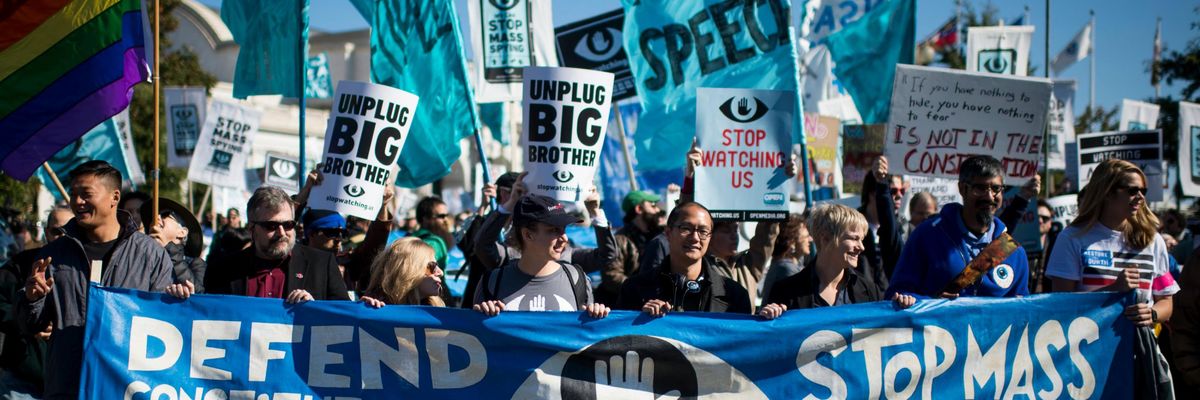
Demonstrators march in protest against government mass surveillance in Washington, D.C. on October 26, 2013. (Photo: Bill Clark/CQ-Roll Call, Inc. via Getty Images)
Over two dozen advocacy groups on Monday sent a letter urging members of Congress to back a measure that, if enacted, would close the so-called "backdoor search" loophole that allows warrantless surveillance of U.S. citizens' data by government agencies including the FBI and CIA.
"Right before its August recess, Congress might finally slam the FBI's warrantless backdoor in their faces."
--Fight for the Future
The letter (pdf), led by Demand Progress and signed by 27 groups, calls on House leaders to support an amendment to H.R. 4505--the Commerce, Justice, Science, and Related Agencies Appropriations Act for Fiscal Year 2022--proposed by Reps. Zoe Lofgren (D-Calif.), Pramila Jayapal (D-Wash.), Thomas Massie (R-Ky.), and Warren Davidson (R-Ohio).
If passed, the amendment would prohibit the use of funds for the warrantless search of Americans' communications acquired under Section 702 of the Foreign Intelligence Surveillance Act of 1978 (FISA), which the letter's authors call a "controversial foreign intelligence authority that acquires an untold number of Americans' Fourth Amendment-protected information."
The groups' letter comes a day before the House Rules Committee will decide whether the amendment will proceed to a floor vote.
"Ending this unconstitutional practice is imperative to ensure that foreign intelligence surveillance does not swallow Americans' privacy rights," the letter asserts. "Recently released opinions by the Foreign Intelligence Surveillance Court (FISC) underscore the need for a warrant requirement to protect the privacy of those whose communications are 'incidentally' collected."
"According to one opinion, the FBI, over the course of one year, conducted three million queries of a single database containing Section 702 communications, most of which presumably were U.S. person queries in light of the FBI's primarily domestic mission," the letter says. "Although Congress has required the FBI to obtain a FISC order for a small subset of these queries, the FISC found that the FBI has literally never complied with this statutory requirement and has violated it on at least dozens of occasions."
The letter continues:
Moreover, the FBI's own court-approved procedures place some limits on queries, yet several recent FISC decisions found that FBI agents simply ignore those rules in a shocking number of cases, conducting queries when they have no reason to believe it would return foreign intelligence or evidence of a crime.
Agents queried Section 702 data to find the communications of people who came to the FBI to perform repairs; victims who reported crimes; and business, religious, and community leaders applying to participate in the FBI's Citizens Academy. In a move that has disturbing echoes of the NSA's bulk collection of Americans' phone records, agents have also conducted so-called "batch queries," such as one that swept in the 70,000 people who have authorized access to FBI facilities.
According to the San Francisco-based digital rights group Electronic Frontier Foundation (EFF), one of the letter's signatories, "in this wide-sweeping dragnet approach to intelligence collection, companies allow access to and the government collects a large amount of 'incidental' communications--that is millions of untargeted communications of U.S. persons that are swept up with the intended data."
"The FBI has the ability to then bypass the Fourth Amendment requirement of a warrant and sift through these 'incidental' communications of Americans--effectively using Section 702 as a 'backdoor' around the Constitution," EFF added. "They've been told by the FISA Court this violates Americans' Fourth Amendment rights but--it has not seemed to stop them and the FISA Court has failed to take steps to ensure that they stop."
Sean Vitka, senior policy counsel for Demand Progress, said in a statement that "the right to privacy doesn't know party lines, and it is heartening to see progressives and libertarians come together to once again defend civil liberties in the United States. Given the repeated, systemic abuse of Section 702 to violate Americans' rights, it is clear we must fight together, or we will lose together."
Bob Goodlatte, senior policy advisor for the Project for Privacy and Surveillance Accountability and former chair of the House Judiciary Committee, said that "the FBI shouldn't be able to snoop on our conversations without getting a warrant, especially not after years of breaking the rules set by Congress and the courts. The Lofgren-Massie amendment would put an end to this dangerous and unconstitutional practice."
Dear Common Dreams reader, It’s been nearly 30 years since I co-founded Common Dreams with my late wife, Lina Newhouser. We had the radical notion that journalism should serve the public good, not corporate profits. It was clear to us from the outset what it would take to build such a project. No paid advertisements. No corporate sponsors. No millionaire publisher telling us what to think or do. Many people said we wouldn't last a year, but we proved those doubters wrong. Together with a tremendous team of journalists and dedicated staff, we built an independent media outlet free from the constraints of profits and corporate control. Our mission has always been simple: To inform. To inspire. To ignite change for the common good. Building Common Dreams was not easy. Our survival was never guaranteed. When you take on the most powerful forces—Wall Street greed, fossil fuel industry destruction, Big Tech lobbyists, and uber-rich oligarchs who have spent billions upon billions rigging the economy and democracy in their favor—the only bulwark you have is supporters who believe in your work. But here’s the urgent message from me today. It's never been this bad out there. And it's never been this hard to keep us going. At the very moment Common Dreams is most needed, the threats we face are intensifying. We need your support now more than ever. We don't accept corporate advertising and never will. We don't have a paywall because we don't think people should be blocked from critical news based on their ability to pay. Everything we do is funded by the donations of readers like you. When everyone does the little they can afford, we are strong. But if that support retreats or dries up, so do we. Will you donate now to make sure Common Dreams not only survives but thrives? —Craig Brown, Co-founder |
Over two dozen advocacy groups on Monday sent a letter urging members of Congress to back a measure that, if enacted, would close the so-called "backdoor search" loophole that allows warrantless surveillance of U.S. citizens' data by government agencies including the FBI and CIA.
"Right before its August recess, Congress might finally slam the FBI's warrantless backdoor in their faces."
--Fight for the Future
The letter (pdf), led by Demand Progress and signed by 27 groups, calls on House leaders to support an amendment to H.R. 4505--the Commerce, Justice, Science, and Related Agencies Appropriations Act for Fiscal Year 2022--proposed by Reps. Zoe Lofgren (D-Calif.), Pramila Jayapal (D-Wash.), Thomas Massie (R-Ky.), and Warren Davidson (R-Ohio).
If passed, the amendment would prohibit the use of funds for the warrantless search of Americans' communications acquired under Section 702 of the Foreign Intelligence Surveillance Act of 1978 (FISA), which the letter's authors call a "controversial foreign intelligence authority that acquires an untold number of Americans' Fourth Amendment-protected information."
The groups' letter comes a day before the House Rules Committee will decide whether the amendment will proceed to a floor vote.
"Ending this unconstitutional practice is imperative to ensure that foreign intelligence surveillance does not swallow Americans' privacy rights," the letter asserts. "Recently released opinions by the Foreign Intelligence Surveillance Court (FISC) underscore the need for a warrant requirement to protect the privacy of those whose communications are 'incidentally' collected."
"According to one opinion, the FBI, over the course of one year, conducted three million queries of a single database containing Section 702 communications, most of which presumably were U.S. person queries in light of the FBI's primarily domestic mission," the letter says. "Although Congress has required the FBI to obtain a FISC order for a small subset of these queries, the FISC found that the FBI has literally never complied with this statutory requirement and has violated it on at least dozens of occasions."
The letter continues:
Moreover, the FBI's own court-approved procedures place some limits on queries, yet several recent FISC decisions found that FBI agents simply ignore those rules in a shocking number of cases, conducting queries when they have no reason to believe it would return foreign intelligence or evidence of a crime.
Agents queried Section 702 data to find the communications of people who came to the FBI to perform repairs; victims who reported crimes; and business, religious, and community leaders applying to participate in the FBI's Citizens Academy. In a move that has disturbing echoes of the NSA's bulk collection of Americans' phone records, agents have also conducted so-called "batch queries," such as one that swept in the 70,000 people who have authorized access to FBI facilities.
According to the San Francisco-based digital rights group Electronic Frontier Foundation (EFF), one of the letter's signatories, "in this wide-sweeping dragnet approach to intelligence collection, companies allow access to and the government collects a large amount of 'incidental' communications--that is millions of untargeted communications of U.S. persons that are swept up with the intended data."
"The FBI has the ability to then bypass the Fourth Amendment requirement of a warrant and sift through these 'incidental' communications of Americans--effectively using Section 702 as a 'backdoor' around the Constitution," EFF added. "They've been told by the FISA Court this violates Americans' Fourth Amendment rights but--it has not seemed to stop them and the FISA Court has failed to take steps to ensure that they stop."
Sean Vitka, senior policy counsel for Demand Progress, said in a statement that "the right to privacy doesn't know party lines, and it is heartening to see progressives and libertarians come together to once again defend civil liberties in the United States. Given the repeated, systemic abuse of Section 702 to violate Americans' rights, it is clear we must fight together, or we will lose together."
Bob Goodlatte, senior policy advisor for the Project for Privacy and Surveillance Accountability and former chair of the House Judiciary Committee, said that "the FBI shouldn't be able to snoop on our conversations without getting a warrant, especially not after years of breaking the rules set by Congress and the courts. The Lofgren-Massie amendment would put an end to this dangerous and unconstitutional practice."
Over two dozen advocacy groups on Monday sent a letter urging members of Congress to back a measure that, if enacted, would close the so-called "backdoor search" loophole that allows warrantless surveillance of U.S. citizens' data by government agencies including the FBI and CIA.
"Right before its August recess, Congress might finally slam the FBI's warrantless backdoor in their faces."
--Fight for the Future
The letter (pdf), led by Demand Progress and signed by 27 groups, calls on House leaders to support an amendment to H.R. 4505--the Commerce, Justice, Science, and Related Agencies Appropriations Act for Fiscal Year 2022--proposed by Reps. Zoe Lofgren (D-Calif.), Pramila Jayapal (D-Wash.), Thomas Massie (R-Ky.), and Warren Davidson (R-Ohio).
If passed, the amendment would prohibit the use of funds for the warrantless search of Americans' communications acquired under Section 702 of the Foreign Intelligence Surveillance Act of 1978 (FISA), which the letter's authors call a "controversial foreign intelligence authority that acquires an untold number of Americans' Fourth Amendment-protected information."
The groups' letter comes a day before the House Rules Committee will decide whether the amendment will proceed to a floor vote.
"Ending this unconstitutional practice is imperative to ensure that foreign intelligence surveillance does not swallow Americans' privacy rights," the letter asserts. "Recently released opinions by the Foreign Intelligence Surveillance Court (FISC) underscore the need for a warrant requirement to protect the privacy of those whose communications are 'incidentally' collected."
"According to one opinion, the FBI, over the course of one year, conducted three million queries of a single database containing Section 702 communications, most of which presumably were U.S. person queries in light of the FBI's primarily domestic mission," the letter says. "Although Congress has required the FBI to obtain a FISC order for a small subset of these queries, the FISC found that the FBI has literally never complied with this statutory requirement and has violated it on at least dozens of occasions."
The letter continues:
Moreover, the FBI's own court-approved procedures place some limits on queries, yet several recent FISC decisions found that FBI agents simply ignore those rules in a shocking number of cases, conducting queries when they have no reason to believe it would return foreign intelligence or evidence of a crime.
Agents queried Section 702 data to find the communications of people who came to the FBI to perform repairs; victims who reported crimes; and business, religious, and community leaders applying to participate in the FBI's Citizens Academy. In a move that has disturbing echoes of the NSA's bulk collection of Americans' phone records, agents have also conducted so-called "batch queries," such as one that swept in the 70,000 people who have authorized access to FBI facilities.
According to the San Francisco-based digital rights group Electronic Frontier Foundation (EFF), one of the letter's signatories, "in this wide-sweeping dragnet approach to intelligence collection, companies allow access to and the government collects a large amount of 'incidental' communications--that is millions of untargeted communications of U.S. persons that are swept up with the intended data."
"The FBI has the ability to then bypass the Fourth Amendment requirement of a warrant and sift through these 'incidental' communications of Americans--effectively using Section 702 as a 'backdoor' around the Constitution," EFF added. "They've been told by the FISA Court this violates Americans' Fourth Amendment rights but--it has not seemed to stop them and the FISA Court has failed to take steps to ensure that they stop."
Sean Vitka, senior policy counsel for Demand Progress, said in a statement that "the right to privacy doesn't know party lines, and it is heartening to see progressives and libertarians come together to once again defend civil liberties in the United States. Given the repeated, systemic abuse of Section 702 to violate Americans' rights, it is clear we must fight together, or we will lose together."
Bob Goodlatte, senior policy advisor for the Project for Privacy and Surveillance Accountability and former chair of the House Judiciary Committee, said that "the FBI shouldn't be able to snoop on our conversations without getting a warrant, especially not after years of breaking the rules set by Congress and the courts. The Lofgren-Massie amendment would put an end to this dangerous and unconstitutional practice."