SUBSCRIBE TO OUR FREE NEWSLETTER
Daily news & progressive opinion—funded by the people, not the corporations—delivered straight to your inbox.
5
#000000
#FFFFFF
To donate by check, phone, or other method, see our More Ways to Give page.
Daily news & progressive opinion—funded by the people, not the corporations—delivered straight to your inbox.
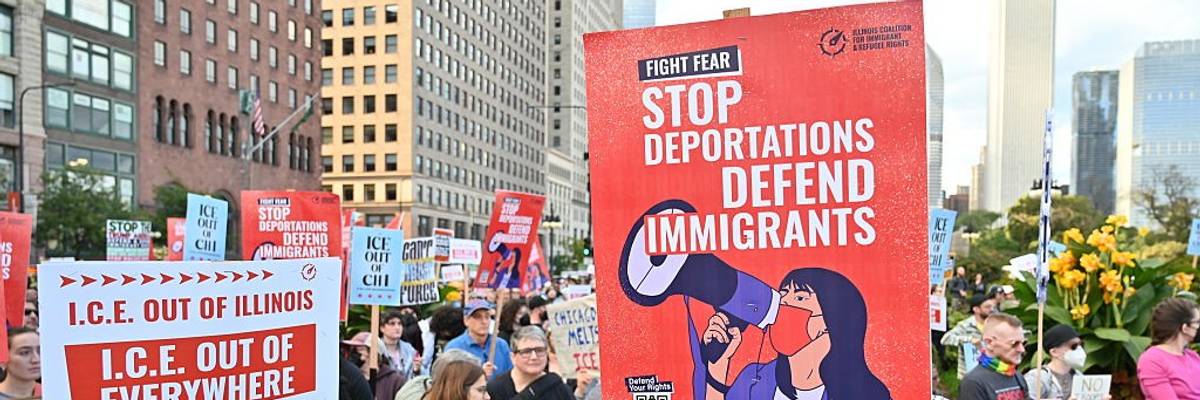
Demonstrators rally at Congress Plaza Garden in Chicago on September 6, 2025, to protest President Donald Trump's immigration policies.
"People who are entirely innocent of any wrongdoing can be subjected to surveillance or investigation," said one critic of the FBI memo. "That imposes stigma."
Rights groups are expressing alarm over new reporting about the FBI carrying out nationwide anti-terrorism probes against activists protesting against federal immigration enforcement officers.
The Guardian on Friday published a report detailing an internal FBI document that outlines "criminal and domestic terrorism investigations” into “threats against immigration enforcement activity” in 23 regions across the US.
The FBI document, which was dated November 14, is a response to National Security Presidential Memorandum-7 (NSPM-7), a directive signed by President Donald Trump in late September that demanded a “national strategy to investigate and disrupt networks, entities, and organizations that foment political violence so that law enforcement can intervene in criminal conspiracies before they result in violent political acts."
The FBI report cites two violent attacks against Immigration and Customs Enforcement (ICE) facilities in Texas to argue that there has been "an escalation in violence compared to past attacks, which primarily resulted in property damage."
Additionally, the FBI report directs agents to look for "indicators" that an anti-ICE activist may be planning to carry out an attack on immigration enforcement officials, including "stockpiling or distributing firearms," as well as using encrypted messaging apps and "conducting online research" about immigration agents' movements and locations.
The last two of these three "indicators" are raising red flags for rights groups, which are warning that they could be used as the pretext for mass infringement of constitutional rights to speak freely and protest peacefully.
Rachel Levinson-Waldman, director of the Liberty and National Security Program at the Brennan Center for Justice, told the Guardian that the FBI appeared to be treating US citizens with suspicion for engaging in activities protected by the First Amendment.
"It is not illegal to do online research about the publicly available movements of government officers or to communicate through encrypted apps like Signal or WhatsApp," she said. "While the document refers to using encrypted communications to ‘discuss operational planning’, that term is undefined and ambiguous, leaving it open what kinds of conversations might draw FBI scrutiny."
Hina Shamsi, director of the ACLU National Security Project, expressed concern to the Guardian that the FBI document is "infused with vague and over-broad language, which was exactly our concern about NSPM-7 in the first place."
"It invites law enforcement suspicion and investigation based on purely First Amendment-protected beliefs and activities," Shamsi explained. "People who are entirely innocent of any wrongdoing can be subjected to surveillance or investigation. That imposes stigma. It can wrongly immesh people in the criminal legal system."
Adam Goldstein, vice president of strategic initiatives at the Foundation for Individual Rights and Expression (FIRE), published an analysis on Thursday that criticized a recently unearthed memo from Attorney General Pam Bondi that fleshed out the concepts laid out in NSPM-7.
In particular, Goldstein argued that Bondi's memo risks using law enforcement to investigate people based on their political ideologies rather than on suspicion that they are engaging in criminal activity.
"People who conspire to engage in actual criminal behavior should be investigated, arrested, and prosecuted," Goldstein wrote. "But these memos aren’t narrowly focused on groups that exist for the purpose of ideologically motivated violence, which act to bring about violence; they broadly condemn particular viewpoints and lay a foundation for a government watchlist of American groups which share those viewpoints."
Dear Common Dreams reader, It’s been nearly 30 years since I co-founded Common Dreams with my late wife, Lina Newhouser. We had the radical notion that journalism should serve the public good, not corporate profits. It was clear to us from the outset what it would take to build such a project. No paid advertisements. No corporate sponsors. No millionaire publisher telling us what to think or do. Many people said we wouldn't last a year, but we proved those doubters wrong. Together with a tremendous team of journalists and dedicated staff, we built an independent media outlet free from the constraints of profits and corporate control. Our mission has always been simple: To inform. To inspire. To ignite change for the common good. Building Common Dreams was not easy. Our survival was never guaranteed. When you take on the most powerful forces—Wall Street greed, fossil fuel industry destruction, Big Tech lobbyists, and uber-rich oligarchs who have spent billions upon billions rigging the economy and democracy in their favor—the only bulwark you have is supporters who believe in your work. But here’s the urgent message from me today. It's never been this bad out there. And it's never been this hard to keep us going. At the very moment Common Dreams is most needed, the threats we face are intensifying. We need your support now more than ever. We don't accept corporate advertising and never will. We don't have a paywall because we don't think people should be blocked from critical news based on their ability to pay. Everything we do is funded by the donations of readers like you. When everyone does the little they can afford, we are strong. But if that support retreats or dries up, so do we. Will you donate now to make sure Common Dreams not only survives but thrives? —Craig Brown, Co-founder |
Rights groups are expressing alarm over new reporting about the FBI carrying out nationwide anti-terrorism probes against activists protesting against federal immigration enforcement officers.
The Guardian on Friday published a report detailing an internal FBI document that outlines "criminal and domestic terrorism investigations” into “threats against immigration enforcement activity” in 23 regions across the US.
The FBI document, which was dated November 14, is a response to National Security Presidential Memorandum-7 (NSPM-7), a directive signed by President Donald Trump in late September that demanded a “national strategy to investigate and disrupt networks, entities, and organizations that foment political violence so that law enforcement can intervene in criminal conspiracies before they result in violent political acts."
The FBI report cites two violent attacks against Immigration and Customs Enforcement (ICE) facilities in Texas to argue that there has been "an escalation in violence compared to past attacks, which primarily resulted in property damage."
Additionally, the FBI report directs agents to look for "indicators" that an anti-ICE activist may be planning to carry out an attack on immigration enforcement officials, including "stockpiling or distributing firearms," as well as using encrypted messaging apps and "conducting online research" about immigration agents' movements and locations.
The last two of these three "indicators" are raising red flags for rights groups, which are warning that they could be used as the pretext for mass infringement of constitutional rights to speak freely and protest peacefully.
Rachel Levinson-Waldman, director of the Liberty and National Security Program at the Brennan Center for Justice, told the Guardian that the FBI appeared to be treating US citizens with suspicion for engaging in activities protected by the First Amendment.
"It is not illegal to do online research about the publicly available movements of government officers or to communicate through encrypted apps like Signal or WhatsApp," she said. "While the document refers to using encrypted communications to ‘discuss operational planning’, that term is undefined and ambiguous, leaving it open what kinds of conversations might draw FBI scrutiny."
Hina Shamsi, director of the ACLU National Security Project, expressed concern to the Guardian that the FBI document is "infused with vague and over-broad language, which was exactly our concern about NSPM-7 in the first place."
"It invites law enforcement suspicion and investigation based on purely First Amendment-protected beliefs and activities," Shamsi explained. "People who are entirely innocent of any wrongdoing can be subjected to surveillance or investigation. That imposes stigma. It can wrongly immesh people in the criminal legal system."
Adam Goldstein, vice president of strategic initiatives at the Foundation for Individual Rights and Expression (FIRE), published an analysis on Thursday that criticized a recently unearthed memo from Attorney General Pam Bondi that fleshed out the concepts laid out in NSPM-7.
In particular, Goldstein argued that Bondi's memo risks using law enforcement to investigate people based on their political ideologies rather than on suspicion that they are engaging in criminal activity.
"People who conspire to engage in actual criminal behavior should be investigated, arrested, and prosecuted," Goldstein wrote. "But these memos aren’t narrowly focused on groups that exist for the purpose of ideologically motivated violence, which act to bring about violence; they broadly condemn particular viewpoints and lay a foundation for a government watchlist of American groups which share those viewpoints."
Rights groups are expressing alarm over new reporting about the FBI carrying out nationwide anti-terrorism probes against activists protesting against federal immigration enforcement officers.
The Guardian on Friday published a report detailing an internal FBI document that outlines "criminal and domestic terrorism investigations” into “threats against immigration enforcement activity” in 23 regions across the US.
The FBI document, which was dated November 14, is a response to National Security Presidential Memorandum-7 (NSPM-7), a directive signed by President Donald Trump in late September that demanded a “national strategy to investigate and disrupt networks, entities, and organizations that foment political violence so that law enforcement can intervene in criminal conspiracies before they result in violent political acts."
The FBI report cites two violent attacks against Immigration and Customs Enforcement (ICE) facilities in Texas to argue that there has been "an escalation in violence compared to past attacks, which primarily resulted in property damage."
Additionally, the FBI report directs agents to look for "indicators" that an anti-ICE activist may be planning to carry out an attack on immigration enforcement officials, including "stockpiling or distributing firearms," as well as using encrypted messaging apps and "conducting online research" about immigration agents' movements and locations.
The last two of these three "indicators" are raising red flags for rights groups, which are warning that they could be used as the pretext for mass infringement of constitutional rights to speak freely and protest peacefully.
Rachel Levinson-Waldman, director of the Liberty and National Security Program at the Brennan Center for Justice, told the Guardian that the FBI appeared to be treating US citizens with suspicion for engaging in activities protected by the First Amendment.
"It is not illegal to do online research about the publicly available movements of government officers or to communicate through encrypted apps like Signal or WhatsApp," she said. "While the document refers to using encrypted communications to ‘discuss operational planning’, that term is undefined and ambiguous, leaving it open what kinds of conversations might draw FBI scrutiny."
Hina Shamsi, director of the ACLU National Security Project, expressed concern to the Guardian that the FBI document is "infused with vague and over-broad language, which was exactly our concern about NSPM-7 in the first place."
"It invites law enforcement suspicion and investigation based on purely First Amendment-protected beliefs and activities," Shamsi explained. "People who are entirely innocent of any wrongdoing can be subjected to surveillance or investigation. That imposes stigma. It can wrongly immesh people in the criminal legal system."
Adam Goldstein, vice president of strategic initiatives at the Foundation for Individual Rights and Expression (FIRE), published an analysis on Thursday that criticized a recently unearthed memo from Attorney General Pam Bondi that fleshed out the concepts laid out in NSPM-7.
In particular, Goldstein argued that Bondi's memo risks using law enforcement to investigate people based on their political ideologies rather than on suspicion that they are engaging in criminal activity.
"People who conspire to engage in actual criminal behavior should be investigated, arrested, and prosecuted," Goldstein wrote. "But these memos aren’t narrowly focused on groups that exist for the purpose of ideologically motivated violence, which act to bring about violence; they broadly condemn particular viewpoints and lay a foundation for a government watchlist of American groups which share those viewpoints."