SUBSCRIBE TO OUR FREE NEWSLETTER
Daily news & progressive opinion—funded by the people, not the corporations—delivered straight to your inbox.
5
#000000
#FFFFFF
To donate by check, phone, or other method, see our More Ways to Give page.
Daily news & progressive opinion—funded by the people, not the corporations—delivered straight to your inbox.
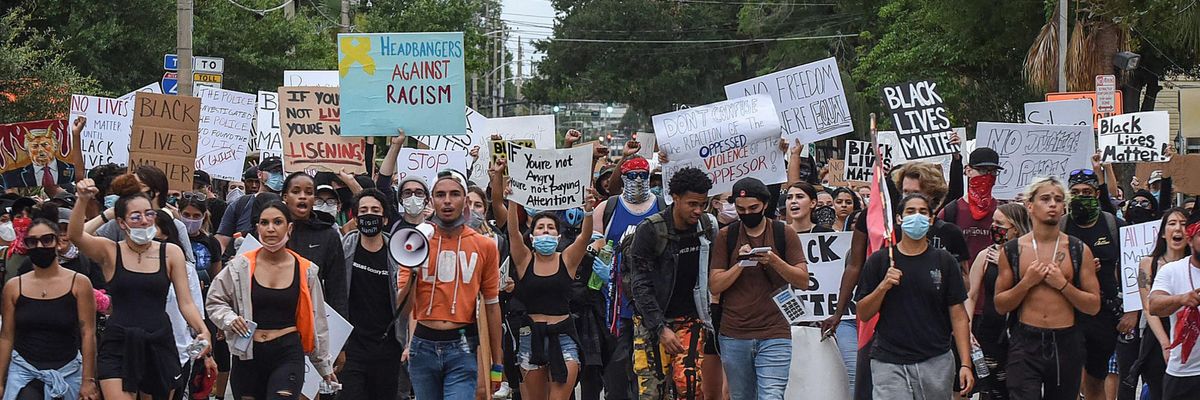
Demonstrators march in a Black Lives Matter protest on June 3, 2020 in Orlando, Florida following the Minneapolis police murder of unarmed Black man George Floyd.
A coalition of civil rights groups on Wednesday filed a motion in a Florida federal court seeking to block the state's recently enacted anti-protest law--which critics say targets racial justice demonstrators while letting right-wing protesters off the hook.
"We use protest as a vehicle for change and not only does this law silence our voices, but it puts our lives in danger."
--Nailah Summers, Dream Defenders
The ACLU of Florida, NAACP Legal Defense and Educational Fund, Inc. (LDF), and Community Justice Project (CJP), with Akin Gump Strauss Hauer & Feld LLP serving as counsel, filed a motion for preliminary injunction (pdf) in the U.S. District Court for the Northern District of Florida in a bid to block parts of H.B. 1, the so-called "anti-riot" bill introduced in the wake of last year's Black Lives Matter protests and signed into law by Republican Gov. Ron DeSantis in April.
The injunction was filed on behalf of Dream Defenders, the Black Collective, Chainless Change, Black Lives Matter Alliance of Broward, the Florida State Conference of the NAACP, and the Northside Coalition of Jacksonville.
"Among other things, the law risks criminalizing peaceful protest, shields those who injure or kill protestors (for example by ramming their vehicles into protestors) from civil penalties, discourages people from protesting, and otherwise infringes on First Amendment rights," the organizations filing the motion said in a statement. "The law was passed as a direct response to racial justice protests in 2020, and appears designed to target those who protest against police violence."
Critics argued that H.B. 1's civil legal immunity provision endangers lives and would have protected the neo-Nazi who murdered anti-racism protester Heather Heyer with his car in Charlottesville, Virginia in August 2017.
H.B. 1 is but one of scores of Republican-sponsored anti-protest bills introduced in dozens of states over the past year. As of late June, eight states have passed such laws.
The same groups that filed Wednesday's motion also sued DeSantis and other state officials in May over H.B. 1.
"This law has changed the landscape for what it means to organize and create safer conditions for our communities in Florida," said Nailah Summers, co-executive director of Dream Defenders, in a statement. "Protest has always been a vital tool for accountability for our public officials. We use protest as a vehicle for change and not only does this law silence our voices, but it puts our lives in danger."
"H.B. 1 is a punitive and unjust law created to silence communities, but protect vigilantes."
--Krystina Francois, The Black Collective
Krystina Francois, co-founder and board member of the Black Collective, said that "H.B. 1 is a punitive and unjust law created to silence communities, but protect vigilantes."
"Black Floridians deserve more than a law that continues to suppress their voices," asserted Francois. "Our constitutional right to assemble peacefully and demand justice from a society that would rather criminalize us than uplift our quality of life is necessary."
Ben Frazier, president of the Northside Coalition of Jacksonville, said that "H.B. 1 targets Black organizers, and their allies who stood up courageously to say 'Black Lives Matter!'"
"We protested against police brutality and against social, racial, and economic injustice," Frazier continued. "The enactment of H.B. 1 has frightened peaceful protesters from exercising their constitutional right to assemble and protest. Many of our supporters have declined to participate while expressing a fear of unfair arrests by law enforcement officers and the fear of potential bodily harm by vigilantes."
"The First Amendment, which guarantees our rights to voice our demands, is being muffled, strangled, and suffocated," he added. "H.B. 1 is undemocratic legislation that has stifled our constitutional rights by obstructing the activity of Black community organizers. H.B. 1 must be repealed, abolished, or simply outlawed."
Underscoring what critics of H.B. 1 say is the law's discriminatory intent, the editors of the Miami Herald on Tuesday published an editorial decrying the hypocritical leniency shown to Cuban-American demonstrators and their supporters who blocked a Miami expressway on Tuesday in a show of solidarity with anti-government protesters in Cuba.
According to the South Florida Sun-Sentinel, "Police encouraged people to disperse--to no avail." People at "SOS Cuba" demonstrations in Tampa and Orlando also blocked major thoroughfares and ignored police orders to disperse.
There were no arrests reported at the Miami protest. Three men were reportedly arrested in Tampa for assaulting or resisting officers, while one man was reportedly arrested in Orlando for disorderly conduct. There were no reported arrests for violations of H.B. 1.
Addressing DeSantis' dodging of reporters' questions about the uneven application of H.B. 1, the Herald editors wrote: "Honestly, we would have been more impressed if he had just responded: 'Nah, the Miami-Dade demonstrators seeking human rights in Cuba have nothing to fear from my anti-riot law. We created it to subdue Black folks seeking human rights in the United States.'"
Writing for Latino Rebels, Thomas Kennedy said: "Let's be clear here, the only thing that changed in terms of the protests are the demands and who is organizing them. When it was Black Lives Matter protests, DeSantis vowed to throw the book at them and condemned them profusely but when it was Cuban protestors, it became politically inconvenient to enforce the very same law he advocated for months ago."
This country and this world are at a monumental crossroads. US voters have an opportunity to beat back the forces of fascism and confront the billionaires who are rigging the economy, our media system, and our democracy, making it increasingly impossible for ordinary people to get by. We’re not just talking about the election. We’re talking about what must be done once these fascist elements are vanquished from power. We need a bolder set of solutions than what either major party has so far been willing to offer and a working-class movement ready to fight like hell for it. Trump didn't emerge from nowhere. The conditions that fueled MAGA authoritarianism were created by decades of radical neoliberal economic policies and a corrupt political system dominated by corporate interests. They slashed taxes on the super-rich, promising that the benefits would trickle down. They said giveaways to the corporate titans would make life more affordable for the rest of us. It was all bullshit. And when a bitter, betrayed populace searches for someone to blame, right-wing demagogues have little trouble finding scapegoats. People know when they're being lied to, but you won't hear any of this from the corporate media. Only independent journalism—powered and funded by people who believe in building a better world—can deliver truly trustworthy daily news. If you share our vision, please contribute whatever you can to sustain our work. |
A coalition of civil rights groups on Wednesday filed a motion in a Florida federal court seeking to block the state's recently enacted anti-protest law--which critics say targets racial justice demonstrators while letting right-wing protesters off the hook.
"We use protest as a vehicle for change and not only does this law silence our voices, but it puts our lives in danger."
--Nailah Summers, Dream Defenders
The ACLU of Florida, NAACP Legal Defense and Educational Fund, Inc. (LDF), and Community Justice Project (CJP), with Akin Gump Strauss Hauer & Feld LLP serving as counsel, filed a motion for preliminary injunction (pdf) in the U.S. District Court for the Northern District of Florida in a bid to block parts of H.B. 1, the so-called "anti-riot" bill introduced in the wake of last year's Black Lives Matter protests and signed into law by Republican Gov. Ron DeSantis in April.
The injunction was filed on behalf of Dream Defenders, the Black Collective, Chainless Change, Black Lives Matter Alliance of Broward, the Florida State Conference of the NAACP, and the Northside Coalition of Jacksonville.
"Among other things, the law risks criminalizing peaceful protest, shields those who injure or kill protestors (for example by ramming their vehicles into protestors) from civil penalties, discourages people from protesting, and otherwise infringes on First Amendment rights," the organizations filing the motion said in a statement. "The law was passed as a direct response to racial justice protests in 2020, and appears designed to target those who protest against police violence."
Critics argued that H.B. 1's civil legal immunity provision endangers lives and would have protected the neo-Nazi who murdered anti-racism protester Heather Heyer with his car in Charlottesville, Virginia in August 2017.
H.B. 1 is but one of scores of Republican-sponsored anti-protest bills introduced in dozens of states over the past year. As of late June, eight states have passed such laws.
The same groups that filed Wednesday's motion also sued DeSantis and other state officials in May over H.B. 1.
"This law has changed the landscape for what it means to organize and create safer conditions for our communities in Florida," said Nailah Summers, co-executive director of Dream Defenders, in a statement. "Protest has always been a vital tool for accountability for our public officials. We use protest as a vehicle for change and not only does this law silence our voices, but it puts our lives in danger."
"H.B. 1 is a punitive and unjust law created to silence communities, but protect vigilantes."
--Krystina Francois, The Black Collective
Krystina Francois, co-founder and board member of the Black Collective, said that "H.B. 1 is a punitive and unjust law created to silence communities, but protect vigilantes."
"Black Floridians deserve more than a law that continues to suppress their voices," asserted Francois. "Our constitutional right to assemble peacefully and demand justice from a society that would rather criminalize us than uplift our quality of life is necessary."
Ben Frazier, president of the Northside Coalition of Jacksonville, said that "H.B. 1 targets Black organizers, and their allies who stood up courageously to say 'Black Lives Matter!'"
"We protested against police brutality and against social, racial, and economic injustice," Frazier continued. "The enactment of H.B. 1 has frightened peaceful protesters from exercising their constitutional right to assemble and protest. Many of our supporters have declined to participate while expressing a fear of unfair arrests by law enforcement officers and the fear of potential bodily harm by vigilantes."
"The First Amendment, which guarantees our rights to voice our demands, is being muffled, strangled, and suffocated," he added. "H.B. 1 is undemocratic legislation that has stifled our constitutional rights by obstructing the activity of Black community organizers. H.B. 1 must be repealed, abolished, or simply outlawed."
Underscoring what critics of H.B. 1 say is the law's discriminatory intent, the editors of the Miami Herald on Tuesday published an editorial decrying the hypocritical leniency shown to Cuban-American demonstrators and their supporters who blocked a Miami expressway on Tuesday in a show of solidarity with anti-government protesters in Cuba.
According to the South Florida Sun-Sentinel, "Police encouraged people to disperse--to no avail." People at "SOS Cuba" demonstrations in Tampa and Orlando also blocked major thoroughfares and ignored police orders to disperse.
There were no arrests reported at the Miami protest. Three men were reportedly arrested in Tampa for assaulting or resisting officers, while one man was reportedly arrested in Orlando for disorderly conduct. There were no reported arrests for violations of H.B. 1.
Addressing DeSantis' dodging of reporters' questions about the uneven application of H.B. 1, the Herald editors wrote: "Honestly, we would have been more impressed if he had just responded: 'Nah, the Miami-Dade demonstrators seeking human rights in Cuba have nothing to fear from my anti-riot law. We created it to subdue Black folks seeking human rights in the United States.'"
Writing for Latino Rebels, Thomas Kennedy said: "Let's be clear here, the only thing that changed in terms of the protests are the demands and who is organizing them. When it was Black Lives Matter protests, DeSantis vowed to throw the book at them and condemned them profusely but when it was Cuban protestors, it became politically inconvenient to enforce the very same law he advocated for months ago."