
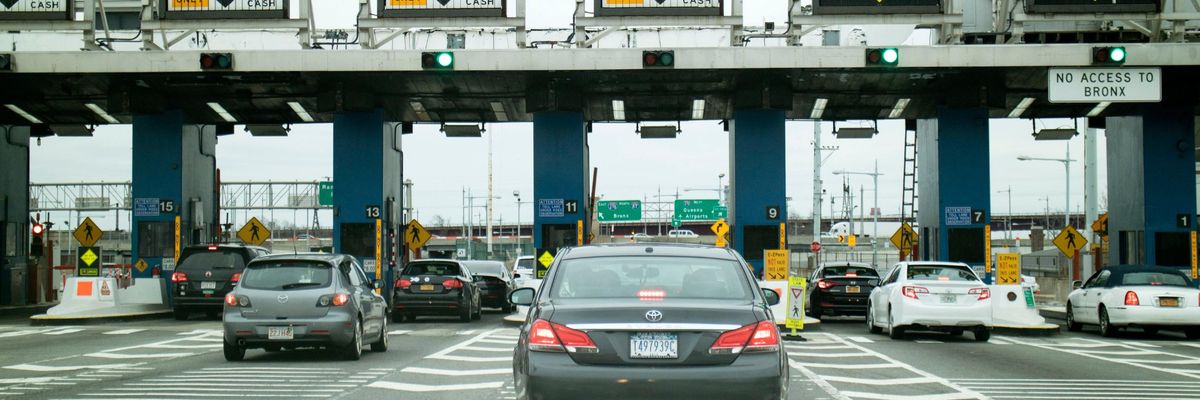
Cars wait to pass through a toll plaza at Robert F. Kennedy Bridge in New York. (Photo by: Education Images/Universal Images Group via Getty Images)
Progressives Alarmed by Privatization Dub Infrastructure Deal a 'Disaster in the Making'
"Communities across the country have been ripped off by public-private schemes that enrich corporations and Wall Street investors and leave the rest of us to pick up the tab."
After President Joe Biden and U.S. lawmakers on Thursday announced a bipartisan deal on infrastructure that Democrats say they will only support alongside a reconciliation bill, progressives doubled down on concerns about the compromise proposal's financing plans.
" Privatization is nothing more than an outrageously expensive way to borrow funds, with the ultimate bill paid back by households and local businesses in the form of higher rates."
--Mary Grant, Food & Water Watch
Rather than pushing for taxes targeting rich individuals and corporations, a White House fact sheet on the bipartisan package outlines various other potential financing sources, from unused unemployment insurance relief funds to reinstating Superfund fees for chemicals.
The proposal that has progressives alarmed is relying on "public-private partnerships, private activity bonds, direct pay bonds, and asset recycling for infrastructure investment."
Asset recycling involves the sale or lease of public assets to the private sector so the government can put that money toward new investments. The policy was previously encouraged by former U.S. President Donald Trump, despite lessons from Australia about its pitfalls.
As negotiations over the infrastructure deal dragged on last week, Rianna Eckel, an organizer with Food & Water Watch, cautioned that it could "facilitate a Wall Street takeover of public services like water." Mary Grant, the advocacy group's Public Water for All director, echoed that warning Thursday.
"This White House-approved infrastructure deal is a disaster in the making," Grant said in a statement. "It promotes privatization and so-called 'public-private partnerships' instead of making public investments in publicly owned infrastructure."
Grant noted that "communities across the country have been ripped off by public-private schemes that enrich corporations and Wall Street investors and leave the rest of us to pick up the tab."
One infamous example, as Common Dreams recently reported, is the privatization of Chicago's parking meters. Illinois drivers filed a class-action lawsuit on Thursday alleging that Chicago granted a private company "monopoly control over the city's parking meter system for an astonishing 75-year-long period, without regard for the changes in technology and innovations in transportation taking place now and for the rest of the century."
Grant charged that "privatization is nothing more than an outrageously expensive way to borrow funds, with the ultimate bill paid back by households and local businesses in the form of higher rates." She called the White House's decision to support the proposal "disappointing and outrageous."
"Communities need real support, not privatization scams," Grant said. "The most sensible infrastructure solution is to provide robust public funding for publicly owned projects, which would discourage price-gouging by corporate interests, protect public control over these precious assets, and save everyone money."
She urged federal lawmakers to push for a "better deal," declaring that "this package does not provide adequate funding to rebuild and repair our country's infrastructure, nor does it do nearly enough to combat the climate crisis."
The Food & Water Watch campaigner was far from alone in criticizing the bipartisan plan for both its financing proposal and its shortcomings in terms of tackling the climate emergency.
"We cannot fund infrastructure without unrigging our economy and taxing the rich," the group Patriotic Millionaires tweeted Thursday. "It's absurd to see funding for this skinny bill scrounged from over a dozen sources, some of which will negatively impact the lives and financial well-being of everyday Americans."
Rep. Jamaal Bowman (D-N.Y.) agreed with Biden and House Speaker Nancy Pelosi (D-Calif.) that the bipartisan deal can only advance if a reconciliation bill on "human infrastructure" investments the president promised also passes.
"The devil will be in the details--and how we fund this investment. It can't be through privatizing our existing roads and bridges."
--Rep. Jamaal Bowman
"But the devil will be in the details--and how we fund this investment," Bowman added. "It can't be through privatizing our existing roads and bridges."
Lauren Maunus, advocacy director for youth-led, climate-focused Sunrise Movement, concurred that "the 'Pelosi Plan' is right: the House must not vote on a bipartisan infrastructure bill until reconciliation has passed the Senate first."
"The top priority must be to pass the boldest budget resolution as soon as possible, go through reconciliation in July, and pass a robust infrastructure package by August recess," she said.
"Looking past the bureaucratic political noise, we recognize that Nancy Pelosi's decision today is the bare minimum of what she and others should be doing to pass the jobs and climate package we need," Maunus asserted. "The fact of the matter is that not a single proposed package meets the scale, scope, and speed of the crises we face."
In a pair of tweets Thursday, American Prospect staff writer Alex Sammon pointed out that "the bipartisan infrastructure bill is almost entirely investments in fossil fuel infrastructure--expanding airports, freeways, ports--along with some privatization. It goes backwards on climate. So a part 2 reconciliation bill would have to override bill 1."
"Except you don't get a redo once your public infrastructure is privatized," Sammon added. "Herein lies the absurdity of the arrangement: in order to get good climate stuff passed, first we're going to make more robust the stuff that will make the climate crisis worse."
This post has been updated with details about the Chicago lawsuit.
An Urgent Message From Our Co-Founder
Dear Common Dreams reader, It’s been nearly 30 years since I co-founded Common Dreams with my late wife, Lina Newhouser. We had the radical notion that journalism should serve the public good, not corporate profits. It was clear to us from the outset what it would take to build such a project. No paid advertisements. No corporate sponsors. No millionaire publisher telling us what to think or do. Many people said we wouldn't last a year, but we proved those doubters wrong. Together with a tremendous team of journalists and dedicated staff, we built an independent media outlet free from the constraints of profits and corporate control. Our mission has always been simple: To inform. To inspire. To ignite change for the common good. Building Common Dreams was not easy. Our survival was never guaranteed. When you take on the most powerful forces—Wall Street greed, fossil fuel industry destruction, Big Tech lobbyists, and uber-rich oligarchs who have spent billions upon billions rigging the economy and democracy in their favor—the only bulwark you have is supporters who believe in your work. But here’s the urgent message from me today. It's never been this bad out there. And it's never been this hard to keep us going. At the very moment Common Dreams is most needed, the threats we face are intensifying. We need your support now more than ever. We don't accept corporate advertising and never will. We don't have a paywall because we don't think people should be blocked from critical news based on their ability to pay. Everything we do is funded by the donations of readers like you. When everyone does the little they can afford, we are strong. But if that support retreats or dries up, so do we. Will you donate now to make sure Common Dreams not only survives but thrives? —Craig Brown, Co-founder |
After President Joe Biden and U.S. lawmakers on Thursday announced a bipartisan deal on infrastructure that Democrats say they will only support alongside a reconciliation bill, progressives doubled down on concerns about the compromise proposal's financing plans.
" Privatization is nothing more than an outrageously expensive way to borrow funds, with the ultimate bill paid back by households and local businesses in the form of higher rates."
--Mary Grant, Food & Water Watch
Rather than pushing for taxes targeting rich individuals and corporations, a White House fact sheet on the bipartisan package outlines various other potential financing sources, from unused unemployment insurance relief funds to reinstating Superfund fees for chemicals.
The proposal that has progressives alarmed is relying on "public-private partnerships, private activity bonds, direct pay bonds, and asset recycling for infrastructure investment."
Asset recycling involves the sale or lease of public assets to the private sector so the government can put that money toward new investments. The policy was previously encouraged by former U.S. President Donald Trump, despite lessons from Australia about its pitfalls.
As negotiations over the infrastructure deal dragged on last week, Rianna Eckel, an organizer with Food & Water Watch, cautioned that it could "facilitate a Wall Street takeover of public services like water." Mary Grant, the advocacy group's Public Water for All director, echoed that warning Thursday.
"This White House-approved infrastructure deal is a disaster in the making," Grant said in a statement. "It promotes privatization and so-called 'public-private partnerships' instead of making public investments in publicly owned infrastructure."
Grant noted that "communities across the country have been ripped off by public-private schemes that enrich corporations and Wall Street investors and leave the rest of us to pick up the tab."
One infamous example, as Common Dreams recently reported, is the privatization of Chicago's parking meters. Illinois drivers filed a class-action lawsuit on Thursday alleging that Chicago granted a private company "monopoly control over the city's parking meter system for an astonishing 75-year-long period, without regard for the changes in technology and innovations in transportation taking place now and for the rest of the century."
Grant charged that "privatization is nothing more than an outrageously expensive way to borrow funds, with the ultimate bill paid back by households and local businesses in the form of higher rates." She called the White House's decision to support the proposal "disappointing and outrageous."
"Communities need real support, not privatization scams," Grant said. "The most sensible infrastructure solution is to provide robust public funding for publicly owned projects, which would discourage price-gouging by corporate interests, protect public control over these precious assets, and save everyone money."
She urged federal lawmakers to push for a "better deal," declaring that "this package does not provide adequate funding to rebuild and repair our country's infrastructure, nor does it do nearly enough to combat the climate crisis."
The Food & Water Watch campaigner was far from alone in criticizing the bipartisan plan for both its financing proposal and its shortcomings in terms of tackling the climate emergency.
"We cannot fund infrastructure without unrigging our economy and taxing the rich," the group Patriotic Millionaires tweeted Thursday. "It's absurd to see funding for this skinny bill scrounged from over a dozen sources, some of which will negatively impact the lives and financial well-being of everyday Americans."
Rep. Jamaal Bowman (D-N.Y.) agreed with Biden and House Speaker Nancy Pelosi (D-Calif.) that the bipartisan deal can only advance if a reconciliation bill on "human infrastructure" investments the president promised also passes.
"The devil will be in the details--and how we fund this investment. It can't be through privatizing our existing roads and bridges."
--Rep. Jamaal Bowman
"But the devil will be in the details--and how we fund this investment," Bowman added. "It can't be through privatizing our existing roads and bridges."
Lauren Maunus, advocacy director for youth-led, climate-focused Sunrise Movement, concurred that "the 'Pelosi Plan' is right: the House must not vote on a bipartisan infrastructure bill until reconciliation has passed the Senate first."
"The top priority must be to pass the boldest budget resolution as soon as possible, go through reconciliation in July, and pass a robust infrastructure package by August recess," she said.
"Looking past the bureaucratic political noise, we recognize that Nancy Pelosi's decision today is the bare minimum of what she and others should be doing to pass the jobs and climate package we need," Maunus asserted. "The fact of the matter is that not a single proposed package meets the scale, scope, and speed of the crises we face."
In a pair of tweets Thursday, American Prospect staff writer Alex Sammon pointed out that "the bipartisan infrastructure bill is almost entirely investments in fossil fuel infrastructure--expanding airports, freeways, ports--along with some privatization. It goes backwards on climate. So a part 2 reconciliation bill would have to override bill 1."
"Except you don't get a redo once your public infrastructure is privatized," Sammon added. "Herein lies the absurdity of the arrangement: in order to get good climate stuff passed, first we're going to make more robust the stuff that will make the climate crisis worse."
This post has been updated with details about the Chicago lawsuit.
After President Joe Biden and U.S. lawmakers on Thursday announced a bipartisan deal on infrastructure that Democrats say they will only support alongside a reconciliation bill, progressives doubled down on concerns about the compromise proposal's financing plans.
" Privatization is nothing more than an outrageously expensive way to borrow funds, with the ultimate bill paid back by households and local businesses in the form of higher rates."
--Mary Grant, Food & Water Watch
Rather than pushing for taxes targeting rich individuals and corporations, a White House fact sheet on the bipartisan package outlines various other potential financing sources, from unused unemployment insurance relief funds to reinstating Superfund fees for chemicals.
The proposal that has progressives alarmed is relying on "public-private partnerships, private activity bonds, direct pay bonds, and asset recycling for infrastructure investment."
Asset recycling involves the sale or lease of public assets to the private sector so the government can put that money toward new investments. The policy was previously encouraged by former U.S. President Donald Trump, despite lessons from Australia about its pitfalls.
As negotiations over the infrastructure deal dragged on last week, Rianna Eckel, an organizer with Food & Water Watch, cautioned that it could "facilitate a Wall Street takeover of public services like water." Mary Grant, the advocacy group's Public Water for All director, echoed that warning Thursday.
"This White House-approved infrastructure deal is a disaster in the making," Grant said in a statement. "It promotes privatization and so-called 'public-private partnerships' instead of making public investments in publicly owned infrastructure."
Grant noted that "communities across the country have been ripped off by public-private schemes that enrich corporations and Wall Street investors and leave the rest of us to pick up the tab."
One infamous example, as Common Dreams recently reported, is the privatization of Chicago's parking meters. Illinois drivers filed a class-action lawsuit on Thursday alleging that Chicago granted a private company "monopoly control over the city's parking meter system for an astonishing 75-year-long period, without regard for the changes in technology and innovations in transportation taking place now and for the rest of the century."
Grant charged that "privatization is nothing more than an outrageously expensive way to borrow funds, with the ultimate bill paid back by households and local businesses in the form of higher rates." She called the White House's decision to support the proposal "disappointing and outrageous."
"Communities need real support, not privatization scams," Grant said. "The most sensible infrastructure solution is to provide robust public funding for publicly owned projects, which would discourage price-gouging by corporate interests, protect public control over these precious assets, and save everyone money."
She urged federal lawmakers to push for a "better deal," declaring that "this package does not provide adequate funding to rebuild and repair our country's infrastructure, nor does it do nearly enough to combat the climate crisis."
The Food & Water Watch campaigner was far from alone in criticizing the bipartisan plan for both its financing proposal and its shortcomings in terms of tackling the climate emergency.
"We cannot fund infrastructure without unrigging our economy and taxing the rich," the group Patriotic Millionaires tweeted Thursday. "It's absurd to see funding for this skinny bill scrounged from over a dozen sources, some of which will negatively impact the lives and financial well-being of everyday Americans."
Rep. Jamaal Bowman (D-N.Y.) agreed with Biden and House Speaker Nancy Pelosi (D-Calif.) that the bipartisan deal can only advance if a reconciliation bill on "human infrastructure" investments the president promised also passes.
"The devil will be in the details--and how we fund this investment. It can't be through privatizing our existing roads and bridges."
--Rep. Jamaal Bowman
"But the devil will be in the details--and how we fund this investment," Bowman added. "It can't be through privatizing our existing roads and bridges."
Lauren Maunus, advocacy director for youth-led, climate-focused Sunrise Movement, concurred that "the 'Pelosi Plan' is right: the House must not vote on a bipartisan infrastructure bill until reconciliation has passed the Senate first."
"The top priority must be to pass the boldest budget resolution as soon as possible, go through reconciliation in July, and pass a robust infrastructure package by August recess," she said.
"Looking past the bureaucratic political noise, we recognize that Nancy Pelosi's decision today is the bare minimum of what she and others should be doing to pass the jobs and climate package we need," Maunus asserted. "The fact of the matter is that not a single proposed package meets the scale, scope, and speed of the crises we face."
In a pair of tweets Thursday, American Prospect staff writer Alex Sammon pointed out that "the bipartisan infrastructure bill is almost entirely investments in fossil fuel infrastructure--expanding airports, freeways, ports--along with some privatization. It goes backwards on climate. So a part 2 reconciliation bill would have to override bill 1."
"Except you don't get a redo once your public infrastructure is privatized," Sammon added. "Herein lies the absurdity of the arrangement: in order to get good climate stuff passed, first we're going to make more robust the stuff that will make the climate crisis worse."
This post has been updated with details about the Chicago lawsuit.