SUBSCRIBE TO OUR FREE NEWSLETTER
Daily news & progressive opinion—funded by the people, not the corporations—delivered straight to your inbox.
5
#000000
#FFFFFF
To donate by check, phone, or other method, see our More Ways to Give page.
Daily news & progressive opinion—funded by the people, not the corporations—delivered straight to your inbox.
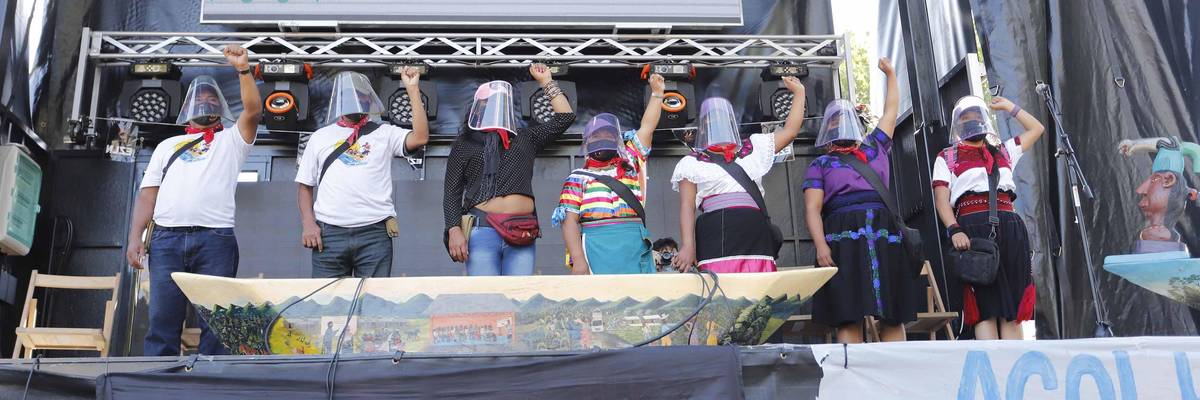
Members of the Zapatista Army of National Liberation (EZLN) take the stage during a party following their disembarkation in Vigo, Spain on June 22, 2021. (Photo: Marta Vazquez Rodriguez/Europa Press via Getty Images)
Five hundreds years after an army led by the genocidal Spanish invader Hernan Cortes conquered the Aztec capital of Tenochtitlan, a group of Indigenous-led members of Mexico's Zapatista movement disembarked in Spain on Tuesday following a seven-week sailing journey across the Atlantic Ocean.
"The Zapatistas have invaded Europe."
--Subcomandante Galeano, EZLN
"The Zapatistas have invaded Europe," declared Subcomandante Galeano, leader of the Zapatista Army of National Liberation (EZLN)--which in 1994 waged an armed rebellion in the southern state of Chiapas to resist Mexico's implementation of the North American Free Trade Agreement (NAFTA)--as the delegation arrived in Spain's northwestern Galicia region aboard the sailboat La Montana.
Although the delegation, which calls itself Squadron 421, arrived in the town of Baiona on Sunday, the activists' disembarkation in the port of Vigo was delayed until Tuesday due to "paperwork" issues, according to Galeano, who also said the group had to await the results of Covid-19 tests before entering Spain, as they did in Cuba and the Azores during their trans-Atlantic voyage.
"I mean, if we've already waited 500 years," Galeano quipped.
"This should demonstrate Squadron 421's responsibility toward those who are receiving us here, that is to say, to guarantee to them that we won't contaminate them with a virus that isn't one of resistance and rebellion," he said.
On Tuesday, the activists were welcomed by supporters and traditional Galician musicians as they disembarked from La Montana.
"On behalf of the women, children, men, elders, and other Zapatistas, I declare that this land--now called 'Europe'--will now be called... 'Insubordinate Land,'" proclaimed Squadron 421 member Marijose.
"Surrender, hetero-patriarchal palefaces!" joked Marijose, who is gender non-binary.
A party ensued after the Zapatistas left La Montana.
The activists set sail from Isla Mujeres in Quintana Roo state, Mexico on May 2. Subcomandante Moises, one of the activists, said at the time that "we are following the route taken 500 years ago; in this case to sow life, not like 500 years ago, which is the opposite."
Other delegation members were set to fly to Europe; however, they had difficulty obtaining passports in time.
Squadron 421 members plan to meet with progressive groups in 30 European countries and territories. In a previous statement, they said that "we are going to tell the people of Spain two simple things. One, they did not conquer us; we are still here resisting, in rebellion. Second, they do not have to ask that we forgive them for anything."
The Zapatistas' 1994 rebellion against neoliberal capitalism and globalization inspired leftists across the world. Predictions by former EZLN leader Subcomandante Marcos that NAFTA would devastate Mexico's Indigenous peoples proved true.
According to The Nation:
NAFTA [hastened] the dispossession of Indigenous people both by opening up the region to large-scale ranching and by driving down the prices small farmers received for their corn, beans, and coffee. Today, Mexico imports nearly half of the corn and beans it consumes, and is equally dependent on staple products such as American-produced pork, chicken, wheat, and powdered milk.
Although the Mexican government put down the rebellion, the EZLN still controls large swaths of Chiapas called caracoles, where aid from the central government in Mexico City is refused.
The Zapatistas are named after Emiliano Zapata, a key figure in the 1910-1919 Mexican Revolution who led an Indigenous peasants' revolt under the slogan !Tierra y Libertad!--land and liberty.
Dear Common Dreams reader, It’s been nearly 30 years since I co-founded Common Dreams with my late wife, Lina Newhouser. We had the radical notion that journalism should serve the public good, not corporate profits. It was clear to us from the outset what it would take to build such a project. No paid advertisements. No corporate sponsors. No millionaire publisher telling us what to think or do. Many people said we wouldn't last a year, but we proved those doubters wrong. Together with a tremendous team of journalists and dedicated staff, we built an independent media outlet free from the constraints of profits and corporate control. Our mission has always been simple: To inform. To inspire. To ignite change for the common good. Building Common Dreams was not easy. Our survival was never guaranteed. When you take on the most powerful forces—Wall Street greed, fossil fuel industry destruction, Big Tech lobbyists, and uber-rich oligarchs who have spent billions upon billions rigging the economy and democracy in their favor—the only bulwark you have is supporters who believe in your work. But here’s the urgent message from me today. It's never been this bad out there. And it's never been this hard to keep us going. At the very moment Common Dreams is most needed, the threats we face are intensifying. We need your support now more than ever. We don't accept corporate advertising and never will. We don't have a paywall because we don't think people should be blocked from critical news based on their ability to pay. Everything we do is funded by the donations of readers like you. When everyone does the little they can afford, we are strong. But if that support retreats or dries up, so do we. Will you donate now to make sure Common Dreams not only survives but thrives? —Craig Brown, Co-founder |
Five hundreds years after an army led by the genocidal Spanish invader Hernan Cortes conquered the Aztec capital of Tenochtitlan, a group of Indigenous-led members of Mexico's Zapatista movement disembarked in Spain on Tuesday following a seven-week sailing journey across the Atlantic Ocean.
"The Zapatistas have invaded Europe."
--Subcomandante Galeano, EZLN
"The Zapatistas have invaded Europe," declared Subcomandante Galeano, leader of the Zapatista Army of National Liberation (EZLN)--which in 1994 waged an armed rebellion in the southern state of Chiapas to resist Mexico's implementation of the North American Free Trade Agreement (NAFTA)--as the delegation arrived in Spain's northwestern Galicia region aboard the sailboat La Montana.
Although the delegation, which calls itself Squadron 421, arrived in the town of Baiona on Sunday, the activists' disembarkation in the port of Vigo was delayed until Tuesday due to "paperwork" issues, according to Galeano, who also said the group had to await the results of Covid-19 tests before entering Spain, as they did in Cuba and the Azores during their trans-Atlantic voyage.
"I mean, if we've already waited 500 years," Galeano quipped.
"This should demonstrate Squadron 421's responsibility toward those who are receiving us here, that is to say, to guarantee to them that we won't contaminate them with a virus that isn't one of resistance and rebellion," he said.
On Tuesday, the activists were welcomed by supporters and traditional Galician musicians as they disembarked from La Montana.
"On behalf of the women, children, men, elders, and other Zapatistas, I declare that this land--now called 'Europe'--will now be called... 'Insubordinate Land,'" proclaimed Squadron 421 member Marijose.
"Surrender, hetero-patriarchal palefaces!" joked Marijose, who is gender non-binary.
A party ensued after the Zapatistas left La Montana.
The activists set sail from Isla Mujeres in Quintana Roo state, Mexico on May 2. Subcomandante Moises, one of the activists, said at the time that "we are following the route taken 500 years ago; in this case to sow life, not like 500 years ago, which is the opposite."
Other delegation members were set to fly to Europe; however, they had difficulty obtaining passports in time.
Squadron 421 members plan to meet with progressive groups in 30 European countries and territories. In a previous statement, they said that "we are going to tell the people of Spain two simple things. One, they did not conquer us; we are still here resisting, in rebellion. Second, they do not have to ask that we forgive them for anything."
The Zapatistas' 1994 rebellion against neoliberal capitalism and globalization inspired leftists across the world. Predictions by former EZLN leader Subcomandante Marcos that NAFTA would devastate Mexico's Indigenous peoples proved true.
According to The Nation:
NAFTA [hastened] the dispossession of Indigenous people both by opening up the region to large-scale ranching and by driving down the prices small farmers received for their corn, beans, and coffee. Today, Mexico imports nearly half of the corn and beans it consumes, and is equally dependent on staple products such as American-produced pork, chicken, wheat, and powdered milk.
Although the Mexican government put down the rebellion, the EZLN still controls large swaths of Chiapas called caracoles, where aid from the central government in Mexico City is refused.
The Zapatistas are named after Emiliano Zapata, a key figure in the 1910-1919 Mexican Revolution who led an Indigenous peasants' revolt under the slogan !Tierra y Libertad!--land and liberty.
Five hundreds years after an army led by the genocidal Spanish invader Hernan Cortes conquered the Aztec capital of Tenochtitlan, a group of Indigenous-led members of Mexico's Zapatista movement disembarked in Spain on Tuesday following a seven-week sailing journey across the Atlantic Ocean.
"The Zapatistas have invaded Europe."
--Subcomandante Galeano, EZLN
"The Zapatistas have invaded Europe," declared Subcomandante Galeano, leader of the Zapatista Army of National Liberation (EZLN)--which in 1994 waged an armed rebellion in the southern state of Chiapas to resist Mexico's implementation of the North American Free Trade Agreement (NAFTA)--as the delegation arrived in Spain's northwestern Galicia region aboard the sailboat La Montana.
Although the delegation, which calls itself Squadron 421, arrived in the town of Baiona on Sunday, the activists' disembarkation in the port of Vigo was delayed until Tuesday due to "paperwork" issues, according to Galeano, who also said the group had to await the results of Covid-19 tests before entering Spain, as they did in Cuba and the Azores during their trans-Atlantic voyage.
"I mean, if we've already waited 500 years," Galeano quipped.
"This should demonstrate Squadron 421's responsibility toward those who are receiving us here, that is to say, to guarantee to them that we won't contaminate them with a virus that isn't one of resistance and rebellion," he said.
On Tuesday, the activists were welcomed by supporters and traditional Galician musicians as they disembarked from La Montana.
"On behalf of the women, children, men, elders, and other Zapatistas, I declare that this land--now called 'Europe'--will now be called... 'Insubordinate Land,'" proclaimed Squadron 421 member Marijose.
"Surrender, hetero-patriarchal palefaces!" joked Marijose, who is gender non-binary.
A party ensued after the Zapatistas left La Montana.
The activists set sail from Isla Mujeres in Quintana Roo state, Mexico on May 2. Subcomandante Moises, one of the activists, said at the time that "we are following the route taken 500 years ago; in this case to sow life, not like 500 years ago, which is the opposite."
Other delegation members were set to fly to Europe; however, they had difficulty obtaining passports in time.
Squadron 421 members plan to meet with progressive groups in 30 European countries and territories. In a previous statement, they said that "we are going to tell the people of Spain two simple things. One, they did not conquer us; we are still here resisting, in rebellion. Second, they do not have to ask that we forgive them for anything."
The Zapatistas' 1994 rebellion against neoliberal capitalism and globalization inspired leftists across the world. Predictions by former EZLN leader Subcomandante Marcos that NAFTA would devastate Mexico's Indigenous peoples proved true.
According to The Nation:
NAFTA [hastened] the dispossession of Indigenous people both by opening up the region to large-scale ranching and by driving down the prices small farmers received for their corn, beans, and coffee. Today, Mexico imports nearly half of the corn and beans it consumes, and is equally dependent on staple products such as American-produced pork, chicken, wheat, and powdered milk.
Although the Mexican government put down the rebellion, the EZLN still controls large swaths of Chiapas called caracoles, where aid from the central government in Mexico City is refused.
The Zapatistas are named after Emiliano Zapata, a key figure in the 1910-1919 Mexican Revolution who led an Indigenous peasants' revolt under the slogan !Tierra y Libertad!--land and liberty.