SUBSCRIBE TO OUR FREE NEWSLETTER
Daily news & progressive opinion—funded by the people, not the corporations—delivered straight to your inbox.
5
#000000
#FFFFFF
To donate by check, phone, or other method, see our More Ways to Give page.
Daily news & progressive opinion—funded by the people, not the corporations—delivered straight to your inbox.
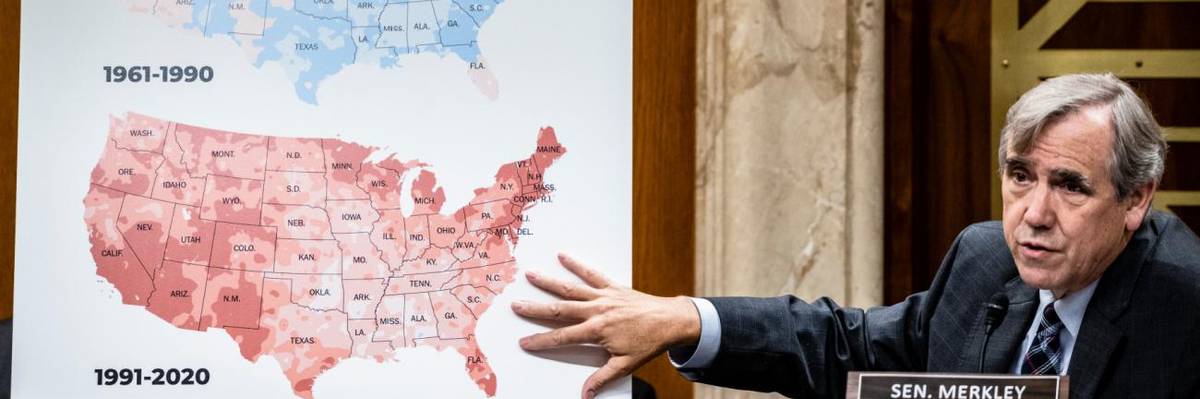
U.S. Sen. Jeff Merkley (D-Ore.) gestures to a chart showing warming temperatures in the United States during a Senate Appropriations Subcommittee on Interior, Environment, and Related Agencies hearing on June 16, 2021 in Washington, D.C. (Photo: Samuel Corum/Getty Images)
With states across the southern and western United States facing record high temperatures weeks before the hottest months of the year, scientists and progressive lawmakers on Wednesday doubled down on calls for green infrastructure to ensure the nation is prepared for increasing levels of extreme weather on a rapidly warming planet.
For the second time in four months, state regulators in Texas on Monday warned residents that the demand for energy was straining the state's power grid, asking millions to set their thermostats to 78 degrees or higher, turn off lights, and avoid washing clothes and cooking.
"If we talk about infrastructure without considering how that infrastructure needs to match the climate conditions from today on into the future, then we're building something that won't stand a chance." --Julie McNamara, Union of Concerned Scientists
Nevada and Arizona residents were also advised about drought conditions, wildfires, and extreme heat, and in California regulators on Tuesday warned people that they may soon be asked to conserve energy as parts of the state saw temperatures rising to 110 degrees and several wildfires burning.
Temperatures across Texas have reached the 90s this week, and the power demand on Monday came to 70 gigawatts--breaking the state's record for June and coming close to the maximum that the grid was able to offer with some power plants offline for reasons that were unclear.
The New York Times noted that in the state's deregulated energy system, power producers sometimes "simply choose not to offer electricity into the market because it might not prove economically beneficial, leaving customers short on energy and paying high prices for the power they do get."
Following the winter storm in Texas in February that left nearly five million homes and businesses without electricity for days and was linked to more than 100 deaths, state lawmakers introduced legislation to better weatherize the power grid, but critics said this week's heat wave has demonstrated how the plan is inadequate.
"If we talk about infrastructure without considering how that infrastructure needs to match the climate conditions from today on into the future, then we're building something that won't stand a chance," Julie McNamara, a senior energy analyst at the Union of Concerned Scientists, told the Times.
According to The Guardian, solar power generation--demand for which skyrocketed after February's power failure--has kept millions of Texans' lights from going out this week.
"We have over five times as much solar as we had a few years ago and that made the difference in having these afternoons when we've had calls for conservation," Dan Cohan, a civil engineering professor at Rice University, told The Guardian. "There likely would have been rolling blackouts if we didn't have solar farms online."
Kevin Doffing, a Houston resident who bought a solar energy system after the winter storm, told the Times, "I just don't see how we keep doing what we've been doing and expect different results."
The state's power grid was "deregulated and designed 20 years ago," said Mike Collier, a former adviser to President Joe Biden who is running for lieutenant governor in the state, and is now in "desperate need of modernization and simply hasn't kept up with technology."
Rep. Ro Khanna (D-Calif.) tweeted that the power grid's failure to provide for the state's needs in unseasonably cold and hot weather--both of which are expected to continue amid the climate emergency--underscores the need "to invest in clean and renewable energy infrastructure."
"The need to include climate action in any infrastructure package should not be in question," said Lori Lodes, executive director of Climate Power.
As February's storms left 69% of Texans without electricity, the state's Republican leaders were quick to blame progressives who have pushed for a Green New Deal and an infrastructure plan that includes clean energy investments--despite agreement among experts that failures of fossil fuel-powered energy sources were behind the crisis.
In fact, said Dan Lashof of the World Resources Institute, "investing in modernizing our electricity grid to make it more resilient" is one key component of rebuilding the nation's infrastructure, despite Republican claims that the proposal doesn't qualify as "traditional" infrastructure.
"Which provisions of the American Jobs Plan do opponents want to cut when they say they want to limit spending to 'traditional' infrastructure?" Lashof asked on social media.
"If we do all of these things fast enough and at large enough scale we will create millions of good jobs, reduce death and disease, and cut our emissions of heat-trapping pollution in half within a decade," said Lashof.
Dear Common Dreams reader, It’s been nearly 30 years since I co-founded Common Dreams with my late wife, Lina Newhouser. We had the radical notion that journalism should serve the public good, not corporate profits. It was clear to us from the outset what it would take to build such a project. No paid advertisements. No corporate sponsors. No millionaire publisher telling us what to think or do. Many people said we wouldn't last a year, but we proved those doubters wrong. Together with a tremendous team of journalists and dedicated staff, we built an independent media outlet free from the constraints of profits and corporate control. Our mission has always been simple: To inform. To inspire. To ignite change for the common good. Building Common Dreams was not easy. Our survival was never guaranteed. When you take on the most powerful forces—Wall Street greed, fossil fuel industry destruction, Big Tech lobbyists, and uber-rich oligarchs who have spent billions upon billions rigging the economy and democracy in their favor—the only bulwark you have is supporters who believe in your work. But here’s the urgent message from me today. It's never been this bad out there. And it's never been this hard to keep us going. At the very moment Common Dreams is most needed, the threats we face are intensifying. We need your support now more than ever. We don't accept corporate advertising and never will. We don't have a paywall because we don't think people should be blocked from critical news based on their ability to pay. Everything we do is funded by the donations of readers like you. When everyone does the little they can afford, we are strong. But if that support retreats or dries up, so do we. Will you donate now to make sure Common Dreams not only survives but thrives? —Craig Brown, Co-founder |
With states across the southern and western United States facing record high temperatures weeks before the hottest months of the year, scientists and progressive lawmakers on Wednesday doubled down on calls for green infrastructure to ensure the nation is prepared for increasing levels of extreme weather on a rapidly warming planet.
For the second time in four months, state regulators in Texas on Monday warned residents that the demand for energy was straining the state's power grid, asking millions to set their thermostats to 78 degrees or higher, turn off lights, and avoid washing clothes and cooking.
"If we talk about infrastructure without considering how that infrastructure needs to match the climate conditions from today on into the future, then we're building something that won't stand a chance." --Julie McNamara, Union of Concerned Scientists
Nevada and Arizona residents were also advised about drought conditions, wildfires, and extreme heat, and in California regulators on Tuesday warned people that they may soon be asked to conserve energy as parts of the state saw temperatures rising to 110 degrees and several wildfires burning.
Temperatures across Texas have reached the 90s this week, and the power demand on Monday came to 70 gigawatts--breaking the state's record for June and coming close to the maximum that the grid was able to offer with some power plants offline for reasons that were unclear.
The New York Times noted that in the state's deregulated energy system, power producers sometimes "simply choose not to offer electricity into the market because it might not prove economically beneficial, leaving customers short on energy and paying high prices for the power they do get."
Following the winter storm in Texas in February that left nearly five million homes and businesses without electricity for days and was linked to more than 100 deaths, state lawmakers introduced legislation to better weatherize the power grid, but critics said this week's heat wave has demonstrated how the plan is inadequate.
"If we talk about infrastructure without considering how that infrastructure needs to match the climate conditions from today on into the future, then we're building something that won't stand a chance," Julie McNamara, a senior energy analyst at the Union of Concerned Scientists, told the Times.
According to The Guardian, solar power generation--demand for which skyrocketed after February's power failure--has kept millions of Texans' lights from going out this week.
"We have over five times as much solar as we had a few years ago and that made the difference in having these afternoons when we've had calls for conservation," Dan Cohan, a civil engineering professor at Rice University, told The Guardian. "There likely would have been rolling blackouts if we didn't have solar farms online."
Kevin Doffing, a Houston resident who bought a solar energy system after the winter storm, told the Times, "I just don't see how we keep doing what we've been doing and expect different results."
The state's power grid was "deregulated and designed 20 years ago," said Mike Collier, a former adviser to President Joe Biden who is running for lieutenant governor in the state, and is now in "desperate need of modernization and simply hasn't kept up with technology."
Rep. Ro Khanna (D-Calif.) tweeted that the power grid's failure to provide for the state's needs in unseasonably cold and hot weather--both of which are expected to continue amid the climate emergency--underscores the need "to invest in clean and renewable energy infrastructure."
"The need to include climate action in any infrastructure package should not be in question," said Lori Lodes, executive director of Climate Power.
As February's storms left 69% of Texans without electricity, the state's Republican leaders were quick to blame progressives who have pushed for a Green New Deal and an infrastructure plan that includes clean energy investments--despite agreement among experts that failures of fossil fuel-powered energy sources were behind the crisis.
In fact, said Dan Lashof of the World Resources Institute, "investing in modernizing our electricity grid to make it more resilient" is one key component of rebuilding the nation's infrastructure, despite Republican claims that the proposal doesn't qualify as "traditional" infrastructure.
"Which provisions of the American Jobs Plan do opponents want to cut when they say they want to limit spending to 'traditional' infrastructure?" Lashof asked on social media.
"If we do all of these things fast enough and at large enough scale we will create millions of good jobs, reduce death and disease, and cut our emissions of heat-trapping pollution in half within a decade," said Lashof.
With states across the southern and western United States facing record high temperatures weeks before the hottest months of the year, scientists and progressive lawmakers on Wednesday doubled down on calls for green infrastructure to ensure the nation is prepared for increasing levels of extreme weather on a rapidly warming planet.
For the second time in four months, state regulators in Texas on Monday warned residents that the demand for energy was straining the state's power grid, asking millions to set their thermostats to 78 degrees or higher, turn off lights, and avoid washing clothes and cooking.
"If we talk about infrastructure without considering how that infrastructure needs to match the climate conditions from today on into the future, then we're building something that won't stand a chance." --Julie McNamara, Union of Concerned Scientists
Nevada and Arizona residents were also advised about drought conditions, wildfires, and extreme heat, and in California regulators on Tuesday warned people that they may soon be asked to conserve energy as parts of the state saw temperatures rising to 110 degrees and several wildfires burning.
Temperatures across Texas have reached the 90s this week, and the power demand on Monday came to 70 gigawatts--breaking the state's record for June and coming close to the maximum that the grid was able to offer with some power plants offline for reasons that were unclear.
The New York Times noted that in the state's deregulated energy system, power producers sometimes "simply choose not to offer electricity into the market because it might not prove economically beneficial, leaving customers short on energy and paying high prices for the power they do get."
Following the winter storm in Texas in February that left nearly five million homes and businesses without electricity for days and was linked to more than 100 deaths, state lawmakers introduced legislation to better weatherize the power grid, but critics said this week's heat wave has demonstrated how the plan is inadequate.
"If we talk about infrastructure without considering how that infrastructure needs to match the climate conditions from today on into the future, then we're building something that won't stand a chance," Julie McNamara, a senior energy analyst at the Union of Concerned Scientists, told the Times.
According to The Guardian, solar power generation--demand for which skyrocketed after February's power failure--has kept millions of Texans' lights from going out this week.
"We have over five times as much solar as we had a few years ago and that made the difference in having these afternoons when we've had calls for conservation," Dan Cohan, a civil engineering professor at Rice University, told The Guardian. "There likely would have been rolling blackouts if we didn't have solar farms online."
Kevin Doffing, a Houston resident who bought a solar energy system after the winter storm, told the Times, "I just don't see how we keep doing what we've been doing and expect different results."
The state's power grid was "deregulated and designed 20 years ago," said Mike Collier, a former adviser to President Joe Biden who is running for lieutenant governor in the state, and is now in "desperate need of modernization and simply hasn't kept up with technology."
Rep. Ro Khanna (D-Calif.) tweeted that the power grid's failure to provide for the state's needs in unseasonably cold and hot weather--both of which are expected to continue amid the climate emergency--underscores the need "to invest in clean and renewable energy infrastructure."
"The need to include climate action in any infrastructure package should not be in question," said Lori Lodes, executive director of Climate Power.
As February's storms left 69% of Texans without electricity, the state's Republican leaders were quick to blame progressives who have pushed for a Green New Deal and an infrastructure plan that includes clean energy investments--despite agreement among experts that failures of fossil fuel-powered energy sources were behind the crisis.
In fact, said Dan Lashof of the World Resources Institute, "investing in modernizing our electricity grid to make it more resilient" is one key component of rebuilding the nation's infrastructure, despite Republican claims that the proposal doesn't qualify as "traditional" infrastructure.
"Which provisions of the American Jobs Plan do opponents want to cut when they say they want to limit spending to 'traditional' infrastructure?" Lashof asked on social media.
"If we do all of these things fast enough and at large enough scale we will create millions of good jobs, reduce death and disease, and cut our emissions of heat-trapping pollution in half within a decade," said Lashof.