SUBSCRIBE TO OUR FREE NEWSLETTER
Daily news & progressive opinion—funded by the people, not the corporations—delivered straight to your inbox.
5
#000000
#FFFFFF
To donate by check, phone, or other method, see our More Ways to Give page.
Daily news & progressive opinion—funded by the people, not the corporations—delivered straight to your inbox.
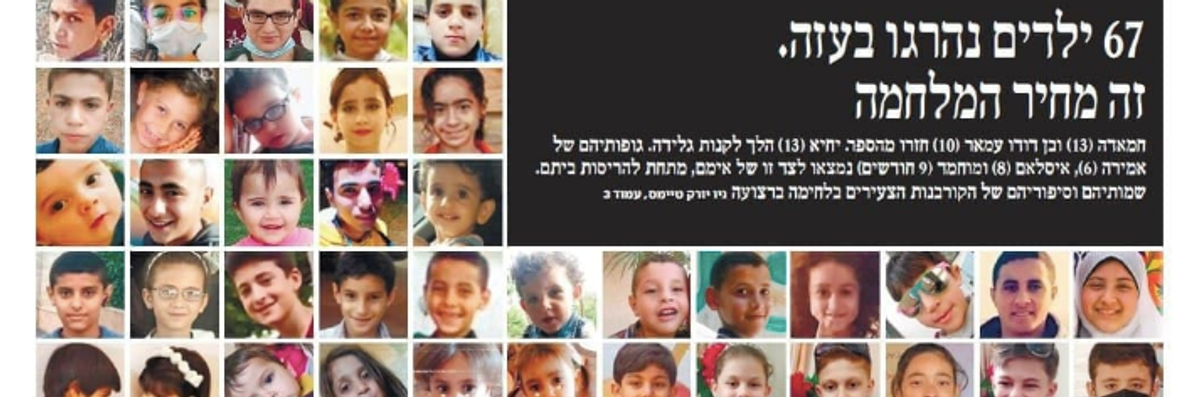
The Israeli newspaper Haaretz published the photos of 67 children who were killed in Gaza in the recent 11-day bombardment campaign by the Israel Defense Forces. (Photo: Haaretz)
Human rights advocates and journalists applauded the Israeli newspaper Haaretz for its "unprecedented" cover story Thursday--one featuring the photos and stories of 67 Palestinian children killed in the latest bombardment campaign by the Israel Defense Forces.
"This is the price of war," the headline read.
The article came a day after the New York Times published its own extensive account of the youngest victims of Israel's most recent 11-day offensive, in which the IDF frequently targeted residential areas of Gaza, known as the world's largest open-air prison.
Haaretz's focus on the children killed in Gaza was especially noteworthy, said author and Brooklyn College professor Louis Fishman, considering the newspaper's "readers also send their children to fight in Israel's wars."
"This is unprecedented," Fishman tweeted.
While Haaretz leans to the center-left editorially, Israeli's mainstream media has traditionally not covered the Palestinian casualties of the IDF's military campaigns and the Israeli government's violent policies, said journalist Khaled Diab.
As Diab tweeted, previous attempts by organizations in Israel to publicize the human cost of the IDF's assaults have been repressed.
Haaretz's front page represented "a bold move," tweeted journalist Saima Mohsin, adding, "Will it make a difference?"
Others on social media took note of the unprecedented cover story.
"Conversations around Israel/Palestine are changing in Jewish communities across the globe," tweeted rabbi and author Abby Stein. "It's about time."
As Jewish Currents editor-in-chief Arielle Angell wrote last week in The Guardian, since Israel's 2014 50-day assault on Gaza, which killed more than 2,100 Palestinians, rights advocates have "seen the growth of a small but committed Jewish anti-occupation movement [and] the last week and a half have brought an even larger circle of the community to a place of reckoning."
We've seen Jewish politicians, celebrities, rabbinical students and others speak up loudly for Palestine. We've seen a powerful display of solidarity from Jewish Google employees, asking their company to sever ties with the IDF. At Jewish Currents, the leftwing magazine where I am now editor-in-chief, we asked for questions from readers struggling to understand the recent violence. We've been deluged. These questions taken in aggregate paint a striking portrait of a community at a turning point.
In Israel the Haaretz front page appeared to touch a nerve, garnering at least one outraged response from Oded Revivi, head of the Efrat Regional Council in an Israeli settlement in the West Bank, who said Haaretz's article was evidence that "people pity the wrong mothers."
On social media, Mairav Zonszein of the International Crisis Group said rather than the "price of war," the Haaretz front page specifically shows the price of "Israel's "continued military rule, dispossession, discrimination, and violence."
Dear Common Dreams reader, It’s been nearly 30 years since I co-founded Common Dreams with my late wife, Lina Newhouser. We had the radical notion that journalism should serve the public good, not corporate profits. It was clear to us from the outset what it would take to build such a project. No paid advertisements. No corporate sponsors. No millionaire publisher telling us what to think or do. Many people said we wouldn't last a year, but we proved those doubters wrong. Together with a tremendous team of journalists and dedicated staff, we built an independent media outlet free from the constraints of profits and corporate control. Our mission has always been simple: To inform. To inspire. To ignite change for the common good. Building Common Dreams was not easy. Our survival was never guaranteed. When you take on the most powerful forces—Wall Street greed, fossil fuel industry destruction, Big Tech lobbyists, and uber-rich oligarchs who have spent billions upon billions rigging the economy and democracy in their favor—the only bulwark you have is supporters who believe in your work. But here’s the urgent message from me today. It's never been this bad out there. And it's never been this hard to keep us going. At the very moment Common Dreams is most needed, the threats we face are intensifying. We need your support now more than ever. We don't accept corporate advertising and never will. We don't have a paywall because we don't think people should be blocked from critical news based on their ability to pay. Everything we do is funded by the donations of readers like you. When everyone does the little they can afford, we are strong. But if that support retreats or dries up, so do we. Will you donate now to make sure Common Dreams not only survives but thrives? —Craig Brown, Co-founder |
Human rights advocates and journalists applauded the Israeli newspaper Haaretz for its "unprecedented" cover story Thursday--one featuring the photos and stories of 67 Palestinian children killed in the latest bombardment campaign by the Israel Defense Forces.
"This is the price of war," the headline read.
The article came a day after the New York Times published its own extensive account of the youngest victims of Israel's most recent 11-day offensive, in which the IDF frequently targeted residential areas of Gaza, known as the world's largest open-air prison.
Haaretz's focus on the children killed in Gaza was especially noteworthy, said author and Brooklyn College professor Louis Fishman, considering the newspaper's "readers also send their children to fight in Israel's wars."
"This is unprecedented," Fishman tweeted.
While Haaretz leans to the center-left editorially, Israeli's mainstream media has traditionally not covered the Palestinian casualties of the IDF's military campaigns and the Israeli government's violent policies, said journalist Khaled Diab.
As Diab tweeted, previous attempts by organizations in Israel to publicize the human cost of the IDF's assaults have been repressed.
Haaretz's front page represented "a bold move," tweeted journalist Saima Mohsin, adding, "Will it make a difference?"
Others on social media took note of the unprecedented cover story.
"Conversations around Israel/Palestine are changing in Jewish communities across the globe," tweeted rabbi and author Abby Stein. "It's about time."
As Jewish Currents editor-in-chief Arielle Angell wrote last week in The Guardian, since Israel's 2014 50-day assault on Gaza, which killed more than 2,100 Palestinians, rights advocates have "seen the growth of a small but committed Jewish anti-occupation movement [and] the last week and a half have brought an even larger circle of the community to a place of reckoning."
We've seen Jewish politicians, celebrities, rabbinical students and others speak up loudly for Palestine. We've seen a powerful display of solidarity from Jewish Google employees, asking their company to sever ties with the IDF. At Jewish Currents, the leftwing magazine where I am now editor-in-chief, we asked for questions from readers struggling to understand the recent violence. We've been deluged. These questions taken in aggregate paint a striking portrait of a community at a turning point.
In Israel the Haaretz front page appeared to touch a nerve, garnering at least one outraged response from Oded Revivi, head of the Efrat Regional Council in an Israeli settlement in the West Bank, who said Haaretz's article was evidence that "people pity the wrong mothers."
On social media, Mairav Zonszein of the International Crisis Group said rather than the "price of war," the Haaretz front page specifically shows the price of "Israel's "continued military rule, dispossession, discrimination, and violence."
Human rights advocates and journalists applauded the Israeli newspaper Haaretz for its "unprecedented" cover story Thursday--one featuring the photos and stories of 67 Palestinian children killed in the latest bombardment campaign by the Israel Defense Forces.
"This is the price of war," the headline read.
The article came a day after the New York Times published its own extensive account of the youngest victims of Israel's most recent 11-day offensive, in which the IDF frequently targeted residential areas of Gaza, known as the world's largest open-air prison.
Haaretz's focus on the children killed in Gaza was especially noteworthy, said author and Brooklyn College professor Louis Fishman, considering the newspaper's "readers also send their children to fight in Israel's wars."
"This is unprecedented," Fishman tweeted.
While Haaretz leans to the center-left editorially, Israeli's mainstream media has traditionally not covered the Palestinian casualties of the IDF's military campaigns and the Israeli government's violent policies, said journalist Khaled Diab.
As Diab tweeted, previous attempts by organizations in Israel to publicize the human cost of the IDF's assaults have been repressed.
Haaretz's front page represented "a bold move," tweeted journalist Saima Mohsin, adding, "Will it make a difference?"
Others on social media took note of the unprecedented cover story.
"Conversations around Israel/Palestine are changing in Jewish communities across the globe," tweeted rabbi and author Abby Stein. "It's about time."
As Jewish Currents editor-in-chief Arielle Angell wrote last week in The Guardian, since Israel's 2014 50-day assault on Gaza, which killed more than 2,100 Palestinians, rights advocates have "seen the growth of a small but committed Jewish anti-occupation movement [and] the last week and a half have brought an even larger circle of the community to a place of reckoning."
We've seen Jewish politicians, celebrities, rabbinical students and others speak up loudly for Palestine. We've seen a powerful display of solidarity from Jewish Google employees, asking their company to sever ties with the IDF. At Jewish Currents, the leftwing magazine where I am now editor-in-chief, we asked for questions from readers struggling to understand the recent violence. We've been deluged. These questions taken in aggregate paint a striking portrait of a community at a turning point.
In Israel the Haaretz front page appeared to touch a nerve, garnering at least one outraged response from Oded Revivi, head of the Efrat Regional Council in an Israeli settlement in the West Bank, who said Haaretz's article was evidence that "people pity the wrong mothers."
On social media, Mairav Zonszein of the International Crisis Group said rather than the "price of war," the Haaretz front page specifically shows the price of "Israel's "continued military rule, dispossession, discrimination, and violence."