SUBSCRIBE TO OUR FREE NEWSLETTER
Daily news & progressive opinion—funded by the people, not the corporations—delivered straight to your inbox.
5
#000000
#FFFFFF
To donate by check, phone, or other method, see our More Ways to Give page.
Daily news & progressive opinion—funded by the people, not the corporations—delivered straight to your inbox.
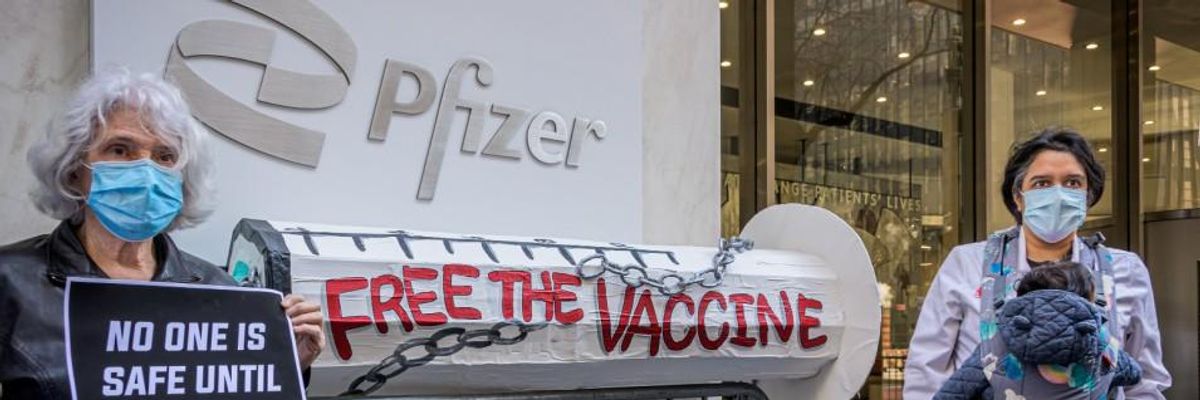
A coalition of healthcare advocacy organizations rallied outside Pfizer Worldwide Headquarters in Manhattan on March 11, 2021. (Photo: Erik McGregor/LightRocket via Getty Images)
Pfizer, Johnson & Johnson, and AstraZeneca--three of the world's top coronavirus vaccine manufacturers--have paid out a combined $26 billion in dividends and stock buybacks to their shareholders over the past year, a sum that could fully fund the cost of inoculating Africa's entire 1.3 billion-person population.
That's according to an analysis released Thursday morning by the People's Vaccine Alliance, a coalition of advocacy organizations campaigning to end massive inequities in the distribution of life-saving coronavirus vaccines.
"It's morally bankrupt for rich country leaders to allow a small group of corporations to keep the vaccine technology and know-how under lock and key while selling their limited doses to the highest bidder."
--Heidi Chow, Global Justice Now
Unveiled just ahead of Pfizer and Johnson & Johnson's annual shareholder meetings on Thursday, the new report notes that Pfizer/BioNTech and Moderna are projecting revenues of $33.5 billion this year from their mRNA vaccines, which have largely been sold to rich nations.
"One of the reasons Pharma companies have been able to generate such large profits is because of intellectual property rules that restrict production to a handful of companies," the report notes, alluding to an international agreement that bars generic manufacturers from replicating vaccine formulas.
Wealthy countries, including the U.S. and European Union members, are standing in the way of an effort to temporarily waive the rules at the World Trade Organization.
"These vaccines were funded by public money and are desperately needed worldwide if we are to end this pandemic," Heidi Chow, senior campaigns and policy manager at Global Justice Now, said in a statement. "It's morally bankrupt for rich country leaders to allow a small group of corporations to keep the vaccine technology and know-how under lock and key while selling their limited doses to the highest bidder."
The new analysis estimates that Pfizer and BioNTech received a total of $2.5 billion in public funding for their vaccine, and that Pfizer has paid out $8.44 billion in dividends over the past 12 months. Johnson & Johnson, which received $1.5 billion in public money, paid out $10.5 billion in dividends.
Maaza Seyoum, who is leading the People's Vaccine Alliance's Africa campaign, called on President Joe Biden to "put the health of all of humanity and shared economic prosperity ahead of the private profits of a few corporations" by ending U.S. opposition to the proposed intellectual property waiver.
"Big business as usual will not end this pandemic," said Seyoum. "This is clearer now more than ever."
As wealthy nations swallow up much of the existing supply, developing countries are left largely without access to vaccines as coronavirus infections continue to surge globally, fueling warnings that vaccine-resistant strains could spread widely and prolong the deadly pandemic.
According to the World Health Organization (WHO), less than 2% of the hundreds of millions of coronavirus vaccine doses that have been administered globally have gone to people in Africa, the world's second-most populous continent. More broadly, the WHO said earlier this month that just one in 500 people in low-income countries have been vaccinated, compared to nearly one in four people in rich nations.
"We should not be letting corporations decide who lives and who dies while boosting their profits. We need a people's vaccine, not a profit vaccine."
--Anna Marriott, Oxfam International
"Vaccine apartheid is not a natural phenomenon but the result of governments stepping back and allowing corporations to call the shots," said Anna Marriott, health policy manager at Oxfam International. "It is appalling that Big Pharma is making huge payouts to wealthy shareholders in the face of this global health emergency."
In its new report, the People's Vaccine Alliance notes that "while the global economy remains frozen due to the slow and uneven vaccine rollout worldwide, the soaring shares of vaccine makers has created a new wave of billionaires."
BioNTech founder Ugur Sahin is now worth $5.9 billion and Moderna CEO Stephane Bancel is worth $5.2 billion, the coalition observes.
"This is a public health emergency, not a private profit opportunity," Marriott said. "We should not be letting corporations decide who lives and who dies while boosting their profits. We need a people's vaccine, not a profit vaccine."
"Instead of creating new vaccine billionaires," Marriott added, "we need to be vaccinating billions in developing countries."
Dear Common Dreams reader, It’s been nearly 30 years since I co-founded Common Dreams with my late wife, Lina Newhouser. We had the radical notion that journalism should serve the public good, not corporate profits. It was clear to us from the outset what it would take to build such a project. No paid advertisements. No corporate sponsors. No millionaire publisher telling us what to think or do. Many people said we wouldn't last a year, but we proved those doubters wrong. Together with a tremendous team of journalists and dedicated staff, we built an independent media outlet free from the constraints of profits and corporate control. Our mission has always been simple: To inform. To inspire. To ignite change for the common good. Building Common Dreams was not easy. Our survival was never guaranteed. When you take on the most powerful forces—Wall Street greed, fossil fuel industry destruction, Big Tech lobbyists, and uber-rich oligarchs who have spent billions upon billions rigging the economy and democracy in their favor—the only bulwark you have is supporters who believe in your work. But here’s the urgent message from me today. It's never been this bad out there. And it's never been this hard to keep us going. At the very moment Common Dreams is most needed, the threats we face are intensifying. We need your support now more than ever. We don't accept corporate advertising and never will. We don't have a paywall because we don't think people should be blocked from critical news based on their ability to pay. Everything we do is funded by the donations of readers like you. When everyone does the little they can afford, we are strong. But if that support retreats or dries up, so do we. Will you donate now to make sure Common Dreams not only survives but thrives? —Craig Brown, Co-founder |
Pfizer, Johnson & Johnson, and AstraZeneca--three of the world's top coronavirus vaccine manufacturers--have paid out a combined $26 billion in dividends and stock buybacks to their shareholders over the past year, a sum that could fully fund the cost of inoculating Africa's entire 1.3 billion-person population.
That's according to an analysis released Thursday morning by the People's Vaccine Alliance, a coalition of advocacy organizations campaigning to end massive inequities in the distribution of life-saving coronavirus vaccines.
"It's morally bankrupt for rich country leaders to allow a small group of corporations to keep the vaccine technology and know-how under lock and key while selling their limited doses to the highest bidder."
--Heidi Chow, Global Justice Now
Unveiled just ahead of Pfizer and Johnson & Johnson's annual shareholder meetings on Thursday, the new report notes that Pfizer/BioNTech and Moderna are projecting revenues of $33.5 billion this year from their mRNA vaccines, which have largely been sold to rich nations.
"One of the reasons Pharma companies have been able to generate such large profits is because of intellectual property rules that restrict production to a handful of companies," the report notes, alluding to an international agreement that bars generic manufacturers from replicating vaccine formulas.
Wealthy countries, including the U.S. and European Union members, are standing in the way of an effort to temporarily waive the rules at the World Trade Organization.
"These vaccines were funded by public money and are desperately needed worldwide if we are to end this pandemic," Heidi Chow, senior campaigns and policy manager at Global Justice Now, said in a statement. "It's morally bankrupt for rich country leaders to allow a small group of corporations to keep the vaccine technology and know-how under lock and key while selling their limited doses to the highest bidder."
The new analysis estimates that Pfizer and BioNTech received a total of $2.5 billion in public funding for their vaccine, and that Pfizer has paid out $8.44 billion in dividends over the past 12 months. Johnson & Johnson, which received $1.5 billion in public money, paid out $10.5 billion in dividends.
Maaza Seyoum, who is leading the People's Vaccine Alliance's Africa campaign, called on President Joe Biden to "put the health of all of humanity and shared economic prosperity ahead of the private profits of a few corporations" by ending U.S. opposition to the proposed intellectual property waiver.
"Big business as usual will not end this pandemic," said Seyoum. "This is clearer now more than ever."
As wealthy nations swallow up much of the existing supply, developing countries are left largely without access to vaccines as coronavirus infections continue to surge globally, fueling warnings that vaccine-resistant strains could spread widely and prolong the deadly pandemic.
According to the World Health Organization (WHO), less than 2% of the hundreds of millions of coronavirus vaccine doses that have been administered globally have gone to people in Africa, the world's second-most populous continent. More broadly, the WHO said earlier this month that just one in 500 people in low-income countries have been vaccinated, compared to nearly one in four people in rich nations.
"We should not be letting corporations decide who lives and who dies while boosting their profits. We need a people's vaccine, not a profit vaccine."
--Anna Marriott, Oxfam International
"Vaccine apartheid is not a natural phenomenon but the result of governments stepping back and allowing corporations to call the shots," said Anna Marriott, health policy manager at Oxfam International. "It is appalling that Big Pharma is making huge payouts to wealthy shareholders in the face of this global health emergency."
In its new report, the People's Vaccine Alliance notes that "while the global economy remains frozen due to the slow and uneven vaccine rollout worldwide, the soaring shares of vaccine makers has created a new wave of billionaires."
BioNTech founder Ugur Sahin is now worth $5.9 billion and Moderna CEO Stephane Bancel is worth $5.2 billion, the coalition observes.
"This is a public health emergency, not a private profit opportunity," Marriott said. "We should not be letting corporations decide who lives and who dies while boosting their profits. We need a people's vaccine, not a profit vaccine."
"Instead of creating new vaccine billionaires," Marriott added, "we need to be vaccinating billions in developing countries."
Pfizer, Johnson & Johnson, and AstraZeneca--three of the world's top coronavirus vaccine manufacturers--have paid out a combined $26 billion in dividends and stock buybacks to their shareholders over the past year, a sum that could fully fund the cost of inoculating Africa's entire 1.3 billion-person population.
That's according to an analysis released Thursday morning by the People's Vaccine Alliance, a coalition of advocacy organizations campaigning to end massive inequities in the distribution of life-saving coronavirus vaccines.
"It's morally bankrupt for rich country leaders to allow a small group of corporations to keep the vaccine technology and know-how under lock and key while selling their limited doses to the highest bidder."
--Heidi Chow, Global Justice Now
Unveiled just ahead of Pfizer and Johnson & Johnson's annual shareholder meetings on Thursday, the new report notes that Pfizer/BioNTech and Moderna are projecting revenues of $33.5 billion this year from their mRNA vaccines, which have largely been sold to rich nations.
"One of the reasons Pharma companies have been able to generate such large profits is because of intellectual property rules that restrict production to a handful of companies," the report notes, alluding to an international agreement that bars generic manufacturers from replicating vaccine formulas.
Wealthy countries, including the U.S. and European Union members, are standing in the way of an effort to temporarily waive the rules at the World Trade Organization.
"These vaccines were funded by public money and are desperately needed worldwide if we are to end this pandemic," Heidi Chow, senior campaigns and policy manager at Global Justice Now, said in a statement. "It's morally bankrupt for rich country leaders to allow a small group of corporations to keep the vaccine technology and know-how under lock and key while selling their limited doses to the highest bidder."
The new analysis estimates that Pfizer and BioNTech received a total of $2.5 billion in public funding for their vaccine, and that Pfizer has paid out $8.44 billion in dividends over the past 12 months. Johnson & Johnson, which received $1.5 billion in public money, paid out $10.5 billion in dividends.
Maaza Seyoum, who is leading the People's Vaccine Alliance's Africa campaign, called on President Joe Biden to "put the health of all of humanity and shared economic prosperity ahead of the private profits of a few corporations" by ending U.S. opposition to the proposed intellectual property waiver.
"Big business as usual will not end this pandemic," said Seyoum. "This is clearer now more than ever."
As wealthy nations swallow up much of the existing supply, developing countries are left largely without access to vaccines as coronavirus infections continue to surge globally, fueling warnings that vaccine-resistant strains could spread widely and prolong the deadly pandemic.
According to the World Health Organization (WHO), less than 2% of the hundreds of millions of coronavirus vaccine doses that have been administered globally have gone to people in Africa, the world's second-most populous continent. More broadly, the WHO said earlier this month that just one in 500 people in low-income countries have been vaccinated, compared to nearly one in four people in rich nations.
"We should not be letting corporations decide who lives and who dies while boosting their profits. We need a people's vaccine, not a profit vaccine."
--Anna Marriott, Oxfam International
"Vaccine apartheid is not a natural phenomenon but the result of governments stepping back and allowing corporations to call the shots," said Anna Marriott, health policy manager at Oxfam International. "It is appalling that Big Pharma is making huge payouts to wealthy shareholders in the face of this global health emergency."
In its new report, the People's Vaccine Alliance notes that "while the global economy remains frozen due to the slow and uneven vaccine rollout worldwide, the soaring shares of vaccine makers has created a new wave of billionaires."
BioNTech founder Ugur Sahin is now worth $5.9 billion and Moderna CEO Stephane Bancel is worth $5.2 billion, the coalition observes.
"This is a public health emergency, not a private profit opportunity," Marriott said. "We should not be letting corporations decide who lives and who dies while boosting their profits. We need a people's vaccine, not a profit vaccine."
"Instead of creating new vaccine billionaires," Marriott added, "we need to be vaccinating billions in developing countries."