SUBSCRIBE TO OUR FREE NEWSLETTER
Daily news & progressive opinion—funded by the people, not the corporations—delivered straight to your inbox.
5
#000000
#FFFFFF
To donate by check, phone, or other method, see our More Ways to Give page.
Daily news & progressive opinion—funded by the people, not the corporations—delivered straight to your inbox.
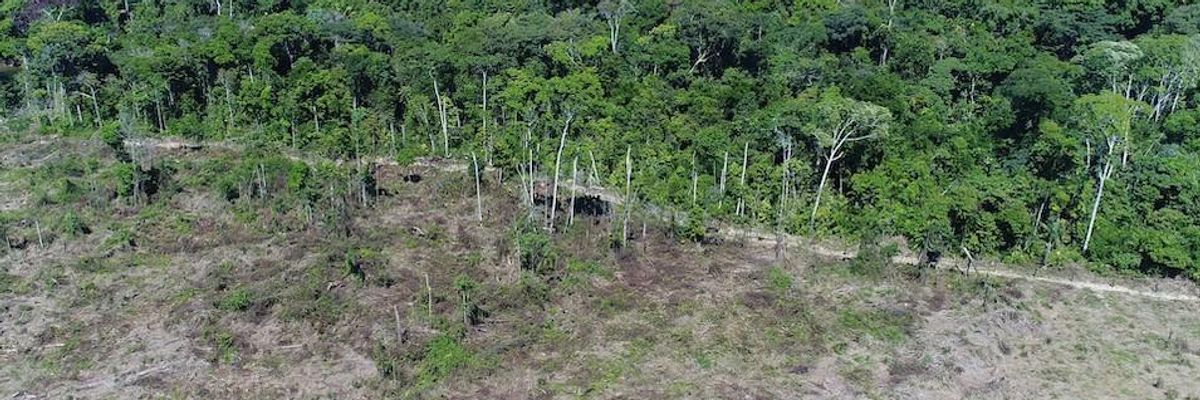
A photo from Mercy for Animals' drone investigation of Amazon deforestation. (Image: Mercy for Animals)
Ecologists and environmental advocates on Thursday called for swift action to reintroduce species into the wild as scientists at the University of Cambridge in England found that 97% of the planet's land area no longer qualifies as ecologically intact.
"Conservation is simply not enough anymore," said financier and activist Ben Goldsmith. "We need restoration."
The authors of the study, published in the journal Frontiers in Forests and Global Change, expressed alarm at their findings, which showed that of the 3% of fully intact land, much lies in northern areas which weren't rich in biodiversity to begin with, such as boreal forests in Canada or tundra in Greenland.
The amount of ecologically intact land "was much lower than we were expecting," Dr. Andrew Plumptre, head of the Key Biodiversity Areas Secretariat at Cambridge and lead author of the study, told Science News.
"Going in, I'd guessed that it would be 8 to 10%," he added. "It just shows how huge an impact we've had."
The researchers examined whether natural habitats had retained the number of species which were present in the year 1500--the standard used by the International Union for the Conservation of Nature to assess species' extinction.
Earlier research using satellite imagery led to estimates that 20 to 40% of the planet had retained its natural biodiversity. But areas including dense forests, which can appear intact from above, were found to be missing numerous species.
The researchers linked the loss of unscathed land to hunting and other destructive human activities, disease, and the impact of invasive species. According to The Guardian, the study may underestimate the intact regions because it does not "take account of the impacts of the climate crisis, which is changing the ranges of species."
Only 11% of the land still considered intact was found to be in officially protected areas, but much of the intact regions "coincide with territories managed by indigenous communities, who have played a vital role in maintaining the ecological integrity of these areas," the researchers wrote.
In light of the study, advocates including author George Monbiot and ecologist Alan Watson Featherstone called for "rewilding," or species reintroduction in affected areas.
The reintroduction of up to five species could help restore 20% of the planet to previous levels of biodiversity, the study found.
"Examples would include reintroducing forest elephants in areas of the Congo Basin where they have been extirpated, or reintroducing some of the large ungulates that have been lost from much of Africa's woodlands and savannas because of overhunting (e.g., buffalo, giraffe, zebras etc.), as long as overhunting has ceased," the researchers wrote.
Previously, the rewilding of gray wolves in Yellowstone National Park in the U.S. led to a resurgence in the park's ecosystem.
Dear Common Dreams reader, It’s been nearly 30 years since I co-founded Common Dreams with my late wife, Lina Newhouser. We had the radical notion that journalism should serve the public good, not corporate profits. It was clear to us from the outset what it would take to build such a project. No paid advertisements. No corporate sponsors. No millionaire publisher telling us what to think or do. Many people said we wouldn't last a year, but we proved those doubters wrong. Together with a tremendous team of journalists and dedicated staff, we built an independent media outlet free from the constraints of profits and corporate control. Our mission has always been simple: To inform. To inspire. To ignite change for the common good. Building Common Dreams was not easy. Our survival was never guaranteed. When you take on the most powerful forces—Wall Street greed, fossil fuel industry destruction, Big Tech lobbyists, and uber-rich oligarchs who have spent billions upon billions rigging the economy and democracy in their favor—the only bulwark you have is supporters who believe in your work. But here’s the urgent message from me today. It's never been this bad out there. And it's never been this hard to keep us going. At the very moment Common Dreams is most needed, the threats we face are intensifying. We need your support now more than ever. We don't accept corporate advertising and never will. We don't have a paywall because we don't think people should be blocked from critical news based on their ability to pay. Everything we do is funded by the donations of readers like you. When everyone does the little they can afford, we are strong. But if that support retreats or dries up, so do we. Will you donate now to make sure Common Dreams not only survives but thrives? —Craig Brown, Co-founder |
Ecologists and environmental advocates on Thursday called for swift action to reintroduce species into the wild as scientists at the University of Cambridge in England found that 97% of the planet's land area no longer qualifies as ecologically intact.
"Conservation is simply not enough anymore," said financier and activist Ben Goldsmith. "We need restoration."
The authors of the study, published in the journal Frontiers in Forests and Global Change, expressed alarm at their findings, which showed that of the 3% of fully intact land, much lies in northern areas which weren't rich in biodiversity to begin with, such as boreal forests in Canada or tundra in Greenland.
The amount of ecologically intact land "was much lower than we were expecting," Dr. Andrew Plumptre, head of the Key Biodiversity Areas Secretariat at Cambridge and lead author of the study, told Science News.
"Going in, I'd guessed that it would be 8 to 10%," he added. "It just shows how huge an impact we've had."
The researchers examined whether natural habitats had retained the number of species which were present in the year 1500--the standard used by the International Union for the Conservation of Nature to assess species' extinction.
Earlier research using satellite imagery led to estimates that 20 to 40% of the planet had retained its natural biodiversity. But areas including dense forests, which can appear intact from above, were found to be missing numerous species.
The researchers linked the loss of unscathed land to hunting and other destructive human activities, disease, and the impact of invasive species. According to The Guardian, the study may underestimate the intact regions because it does not "take account of the impacts of the climate crisis, which is changing the ranges of species."
Only 11% of the land still considered intact was found to be in officially protected areas, but much of the intact regions "coincide with territories managed by indigenous communities, who have played a vital role in maintaining the ecological integrity of these areas," the researchers wrote.
In light of the study, advocates including author George Monbiot and ecologist Alan Watson Featherstone called for "rewilding," or species reintroduction in affected areas.
The reintroduction of up to five species could help restore 20% of the planet to previous levels of biodiversity, the study found.
"Examples would include reintroducing forest elephants in areas of the Congo Basin where they have been extirpated, or reintroducing some of the large ungulates that have been lost from much of Africa's woodlands and savannas because of overhunting (e.g., buffalo, giraffe, zebras etc.), as long as overhunting has ceased," the researchers wrote.
Previously, the rewilding of gray wolves in Yellowstone National Park in the U.S. led to a resurgence in the park's ecosystem.
Ecologists and environmental advocates on Thursday called for swift action to reintroduce species into the wild as scientists at the University of Cambridge in England found that 97% of the planet's land area no longer qualifies as ecologically intact.
"Conservation is simply not enough anymore," said financier and activist Ben Goldsmith. "We need restoration."
The authors of the study, published in the journal Frontiers in Forests and Global Change, expressed alarm at their findings, which showed that of the 3% of fully intact land, much lies in northern areas which weren't rich in biodiversity to begin with, such as boreal forests in Canada or tundra in Greenland.
The amount of ecologically intact land "was much lower than we were expecting," Dr. Andrew Plumptre, head of the Key Biodiversity Areas Secretariat at Cambridge and lead author of the study, told Science News.
"Going in, I'd guessed that it would be 8 to 10%," he added. "It just shows how huge an impact we've had."
The researchers examined whether natural habitats had retained the number of species which were present in the year 1500--the standard used by the International Union for the Conservation of Nature to assess species' extinction.
Earlier research using satellite imagery led to estimates that 20 to 40% of the planet had retained its natural biodiversity. But areas including dense forests, which can appear intact from above, were found to be missing numerous species.
The researchers linked the loss of unscathed land to hunting and other destructive human activities, disease, and the impact of invasive species. According to The Guardian, the study may underestimate the intact regions because it does not "take account of the impacts of the climate crisis, which is changing the ranges of species."
Only 11% of the land still considered intact was found to be in officially protected areas, but much of the intact regions "coincide with territories managed by indigenous communities, who have played a vital role in maintaining the ecological integrity of these areas," the researchers wrote.
In light of the study, advocates including author George Monbiot and ecologist Alan Watson Featherstone called for "rewilding," or species reintroduction in affected areas.
The reintroduction of up to five species could help restore 20% of the planet to previous levels of biodiversity, the study found.
"Examples would include reintroducing forest elephants in areas of the Congo Basin where they have been extirpated, or reintroducing some of the large ungulates that have been lost from much of Africa's woodlands and savannas because of overhunting (e.g., buffalo, giraffe, zebras etc.), as long as overhunting has ceased," the researchers wrote.
Previously, the rewilding of gray wolves in Yellowstone National Park in the U.S. led to a resurgence in the park's ecosystem.