SUBSCRIBE TO OUR FREE NEWSLETTER
Daily news & progressive opinion—funded by the people, not the corporations—delivered straight to your inbox.
5
#000000
#FFFFFF
To donate by check, phone, or other method, see our More Ways to Give page.
Daily news & progressive opinion—funded by the people, not the corporations—delivered straight to your inbox.
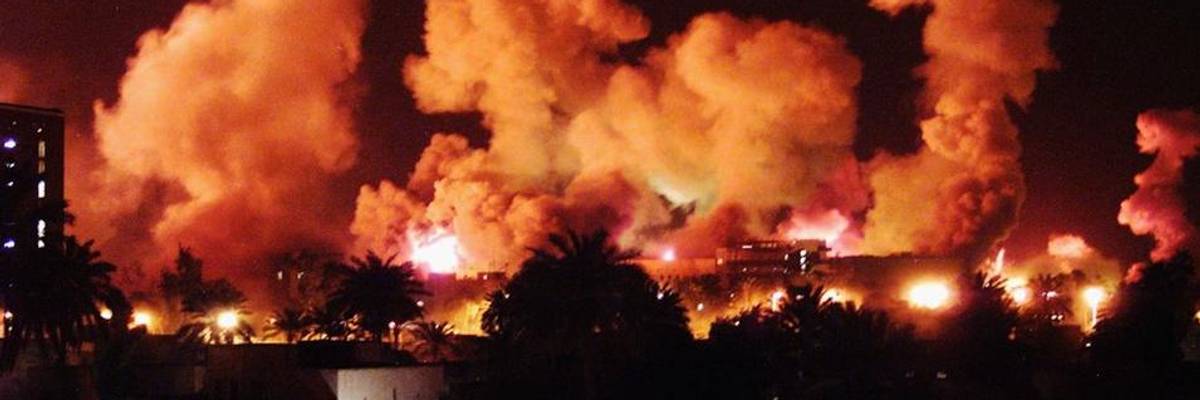
The U.S. aerial bombardment of downtown Baghdad--dubbed "shock-and-awe" by Pentagon planners--lights up the night sky of the Iraqi capital on March 21, 2003. (Photo: Wathiq Khuzaie/Getty Images)
Human rights and anti-war activists marked the 18th anniversary of the second of three American-led invasions of Iraq by renewing calls for the U.S.--this time the Biden administration--to pay reparations for 30 years of nonstop aggression against the Iraqi people.
"We call on the Biden administration to finally provide remedies and reparations for generations of endless war."
--CCR
"Eighteen years after the United States invaded Iraq on a patently false basis, we uplift the work of Iraqi activists, civil society, and their partners building local and transnational social justice movements under extremely precarious conditions," the Center for Constitutional Rights (CCR) said in a statement.
CCR also condemned President Joe Biden--who voted for the Iraq war and who bombed the country just days after taking office--"for carrying on the legacy of illegal bombings."
Jared Keyel, a researcher whose work focuses on Iraqi refugee resettlement, wrote for Common Dreams that Biden must "end the American war against Iraq without precondition or caveat," bring the war's "planners and perpetrators" to justice, "vastly expand" financial support for refugee resettlement, and pay reparations to Iraqis.
"Reparation funding must be allocated to provide individual Iraqis with monetary compensation for the extreme pain and suffering we have caused them and to (re)build their lives however they see fit," wrote Keyel.
Waged on the bogus premise of weapons of mass destruction that didn't exist, the U.S. invasion of Iraq--originally dubbed Operation Iraqi Liberation (OIL) by the George W. Bush administration--began on March 20, 2003 with the seizure of oil terminals in the Persian Gulf. This was followed by a "shock-and-awe" bombing campaign that claimed the first few thousand of what would ultimately be at least 100,000 and perhaps as many as 500,000 Iraqi lives.
The eight-year U.S.-led war and occupation--during which the American invaders committed massacres, torture, rape, and numerous other atrocities--would leave Iraq largely in ruins. But that wasn't the end, or even the beginning, of the matter.
In 1991, the U.S.-led Gulf War not only killed thousands of Iraqi civilians, it also led to a U.S.-imposed sanctions regime that, according to a United Nations agency, was responsible for the premature deaths of 576,000 Iraqi children. Asked in 1996 whether she thought that was too high a price to pay, Madeleine Albright, then secretary of state under President Bill Clinton, said that "the price is worth it."
Twenty-three years later, and three years after he withdrew most U.S. troops from Iraq, then-President Barack Obama launched the U.S.-led war against Islamic State in Iraq and Syria (ISIS). Thousands of U.S. airstrikes under Obama and former President Donald Trump--who fulfilled his campaign promise to "bomb the shit out of" ISIS militants and "take out their families"--left thousands more Iraqi men, women, and children dead and entire cities in ruins.
Since 1991 the people of Iraq have been subjected to ceaseless U.S. invasion, occupation, bombardment, and sanctions. In addition to a wrecked infrastructure and devastated economy, less visible damage includes millions of Iraqis afflicted with psychological trauma and countless people--especially babies and children--suffering from a surge in cancers, birth defects, and other ailments believed to be caused by U.S. use of depleted uranium and other toxic weapons and materials.
Meanwhile, the corporations and their owners who make up the military-industrial complex have profited handsomely every step of the way.
"Americans can demonstrate contrition, and work to ameliorate... the suffering their government and military have caused by making that government make reparations to the people of Iraq."
--Jared Keyel
Advocates say that these are some of the wrongs that reparations can begin to right.
"We call on the Biden administration to finally provide remedies and reparations for generations of endless war," urged CCR. "Biden must lead a shift away from the unlawful policies of endless war and militarization toward rights-based policies and practices consistent with constitutional and international law obligations, centering those most impacted--Iraqis calling for justice and liberation from U.S. militarism and its legacies of sectarianism and violence."
"Americans owe a debt to the people of Iraq that can never be repaid in full," wrote Keyel. "However, it is incumbent and imperative that we try."
"No amount of money can ever fully heal the physical and psychic wounds that the American war against Iraq has caused," he added. "But, on the inauspicious 30th anniversary of this conflict, Americans can demonstrate contrition, and work to ameliorate, if only partially, the suffering their government and military have caused by making that government make reparations to the people of Iraq."
Dear Common Dreams reader, It’s been nearly 30 years since I co-founded Common Dreams with my late wife, Lina Newhouser. We had the radical notion that journalism should serve the public good, not corporate profits. It was clear to us from the outset what it would take to build such a project. No paid advertisements. No corporate sponsors. No millionaire publisher telling us what to think or do. Many people said we wouldn't last a year, but we proved those doubters wrong. Together with a tremendous team of journalists and dedicated staff, we built an independent media outlet free from the constraints of profits and corporate control. Our mission has always been simple: To inform. To inspire. To ignite change for the common good. Building Common Dreams was not easy. Our survival was never guaranteed. When you take on the most powerful forces—Wall Street greed, fossil fuel industry destruction, Big Tech lobbyists, and uber-rich oligarchs who have spent billions upon billions rigging the economy and democracy in their favor—the only bulwark you have is supporters who believe in your work. But here’s the urgent message from me today. It's never been this bad out there. And it's never been this hard to keep us going. At the very moment Common Dreams is most needed, the threats we face are intensifying. We need your support now more than ever. We don't accept corporate advertising and never will. We don't have a paywall because we don't think people should be blocked from critical news based on their ability to pay. Everything we do is funded by the donations of readers like you. When everyone does the little they can afford, we are strong. But if that support retreats or dries up, so do we. Will you donate now to make sure Common Dreams not only survives but thrives? —Craig Brown, Co-founder |
Human rights and anti-war activists marked the 18th anniversary of the second of three American-led invasions of Iraq by renewing calls for the U.S.--this time the Biden administration--to pay reparations for 30 years of nonstop aggression against the Iraqi people.
"We call on the Biden administration to finally provide remedies and reparations for generations of endless war."
--CCR
"Eighteen years after the United States invaded Iraq on a patently false basis, we uplift the work of Iraqi activists, civil society, and their partners building local and transnational social justice movements under extremely precarious conditions," the Center for Constitutional Rights (CCR) said in a statement.
CCR also condemned President Joe Biden--who voted for the Iraq war and who bombed the country just days after taking office--"for carrying on the legacy of illegal bombings."
Jared Keyel, a researcher whose work focuses on Iraqi refugee resettlement, wrote for Common Dreams that Biden must "end the American war against Iraq without precondition or caveat," bring the war's "planners and perpetrators" to justice, "vastly expand" financial support for refugee resettlement, and pay reparations to Iraqis.
"Reparation funding must be allocated to provide individual Iraqis with monetary compensation for the extreme pain and suffering we have caused them and to (re)build their lives however they see fit," wrote Keyel.
Waged on the bogus premise of weapons of mass destruction that didn't exist, the U.S. invasion of Iraq--originally dubbed Operation Iraqi Liberation (OIL) by the George W. Bush administration--began on March 20, 2003 with the seizure of oil terminals in the Persian Gulf. This was followed by a "shock-and-awe" bombing campaign that claimed the first few thousand of what would ultimately be at least 100,000 and perhaps as many as 500,000 Iraqi lives.
The eight-year U.S.-led war and occupation--during which the American invaders committed massacres, torture, rape, and numerous other atrocities--would leave Iraq largely in ruins. But that wasn't the end, or even the beginning, of the matter.
In 1991, the U.S.-led Gulf War not only killed thousands of Iraqi civilians, it also led to a U.S.-imposed sanctions regime that, according to a United Nations agency, was responsible for the premature deaths of 576,000 Iraqi children. Asked in 1996 whether she thought that was too high a price to pay, Madeleine Albright, then secretary of state under President Bill Clinton, said that "the price is worth it."
Twenty-three years later, and three years after he withdrew most U.S. troops from Iraq, then-President Barack Obama launched the U.S.-led war against Islamic State in Iraq and Syria (ISIS). Thousands of U.S. airstrikes under Obama and former President Donald Trump--who fulfilled his campaign promise to "bomb the shit out of" ISIS militants and "take out their families"--left thousands more Iraqi men, women, and children dead and entire cities in ruins.
Since 1991 the people of Iraq have been subjected to ceaseless U.S. invasion, occupation, bombardment, and sanctions. In addition to a wrecked infrastructure and devastated economy, less visible damage includes millions of Iraqis afflicted with psychological trauma and countless people--especially babies and children--suffering from a surge in cancers, birth defects, and other ailments believed to be caused by U.S. use of depleted uranium and other toxic weapons and materials.
Meanwhile, the corporations and their owners who make up the military-industrial complex have profited handsomely every step of the way.
"Americans can demonstrate contrition, and work to ameliorate... the suffering their government and military have caused by making that government make reparations to the people of Iraq."
--Jared Keyel
Advocates say that these are some of the wrongs that reparations can begin to right.
"We call on the Biden administration to finally provide remedies and reparations for generations of endless war," urged CCR. "Biden must lead a shift away from the unlawful policies of endless war and militarization toward rights-based policies and practices consistent with constitutional and international law obligations, centering those most impacted--Iraqis calling for justice and liberation from U.S. militarism and its legacies of sectarianism and violence."
"Americans owe a debt to the people of Iraq that can never be repaid in full," wrote Keyel. "However, it is incumbent and imperative that we try."
"No amount of money can ever fully heal the physical and psychic wounds that the American war against Iraq has caused," he added. "But, on the inauspicious 30th anniversary of this conflict, Americans can demonstrate contrition, and work to ameliorate, if only partially, the suffering their government and military have caused by making that government make reparations to the people of Iraq."
Human rights and anti-war activists marked the 18th anniversary of the second of three American-led invasions of Iraq by renewing calls for the U.S.--this time the Biden administration--to pay reparations for 30 years of nonstop aggression against the Iraqi people.
"We call on the Biden administration to finally provide remedies and reparations for generations of endless war."
--CCR
"Eighteen years after the United States invaded Iraq on a patently false basis, we uplift the work of Iraqi activists, civil society, and their partners building local and transnational social justice movements under extremely precarious conditions," the Center for Constitutional Rights (CCR) said in a statement.
CCR also condemned President Joe Biden--who voted for the Iraq war and who bombed the country just days after taking office--"for carrying on the legacy of illegal bombings."
Jared Keyel, a researcher whose work focuses on Iraqi refugee resettlement, wrote for Common Dreams that Biden must "end the American war against Iraq without precondition or caveat," bring the war's "planners and perpetrators" to justice, "vastly expand" financial support for refugee resettlement, and pay reparations to Iraqis.
"Reparation funding must be allocated to provide individual Iraqis with monetary compensation for the extreme pain and suffering we have caused them and to (re)build their lives however they see fit," wrote Keyel.
Waged on the bogus premise of weapons of mass destruction that didn't exist, the U.S. invasion of Iraq--originally dubbed Operation Iraqi Liberation (OIL) by the George W. Bush administration--began on March 20, 2003 with the seizure of oil terminals in the Persian Gulf. This was followed by a "shock-and-awe" bombing campaign that claimed the first few thousand of what would ultimately be at least 100,000 and perhaps as many as 500,000 Iraqi lives.
The eight-year U.S.-led war and occupation--during which the American invaders committed massacres, torture, rape, and numerous other atrocities--would leave Iraq largely in ruins. But that wasn't the end, or even the beginning, of the matter.
In 1991, the U.S.-led Gulf War not only killed thousands of Iraqi civilians, it also led to a U.S.-imposed sanctions regime that, according to a United Nations agency, was responsible for the premature deaths of 576,000 Iraqi children. Asked in 1996 whether she thought that was too high a price to pay, Madeleine Albright, then secretary of state under President Bill Clinton, said that "the price is worth it."
Twenty-three years later, and three years after he withdrew most U.S. troops from Iraq, then-President Barack Obama launched the U.S.-led war against Islamic State in Iraq and Syria (ISIS). Thousands of U.S. airstrikes under Obama and former President Donald Trump--who fulfilled his campaign promise to "bomb the shit out of" ISIS militants and "take out their families"--left thousands more Iraqi men, women, and children dead and entire cities in ruins.
Since 1991 the people of Iraq have been subjected to ceaseless U.S. invasion, occupation, bombardment, and sanctions. In addition to a wrecked infrastructure and devastated economy, less visible damage includes millions of Iraqis afflicted with psychological trauma and countless people--especially babies and children--suffering from a surge in cancers, birth defects, and other ailments believed to be caused by U.S. use of depleted uranium and other toxic weapons and materials.
Meanwhile, the corporations and their owners who make up the military-industrial complex have profited handsomely every step of the way.
"Americans can demonstrate contrition, and work to ameliorate... the suffering their government and military have caused by making that government make reparations to the people of Iraq."
--Jared Keyel
Advocates say that these are some of the wrongs that reparations can begin to right.
"We call on the Biden administration to finally provide remedies and reparations for generations of endless war," urged CCR. "Biden must lead a shift away from the unlawful policies of endless war and militarization toward rights-based policies and practices consistent with constitutional and international law obligations, centering those most impacted--Iraqis calling for justice and liberation from U.S. militarism and its legacies of sectarianism and violence."
"Americans owe a debt to the people of Iraq that can never be repaid in full," wrote Keyel. "However, it is incumbent and imperative that we try."
"No amount of money can ever fully heal the physical and psychic wounds that the American war against Iraq has caused," he added. "But, on the inauspicious 30th anniversary of this conflict, Americans can demonstrate contrition, and work to ameliorate, if only partially, the suffering their government and military have caused by making that government make reparations to the people of Iraq."