

SUBSCRIBE TO OUR FREE NEWSLETTER
Daily news & progressive opinion—funded by the people, not the corporations—delivered straight to your inbox.
5
#000000
#FFFFFF
To donate by check, phone, or other method, see our More Ways to Give page.
Daily news & progressive opinion—funded by the people, not the corporations—delivered straight to your inbox.
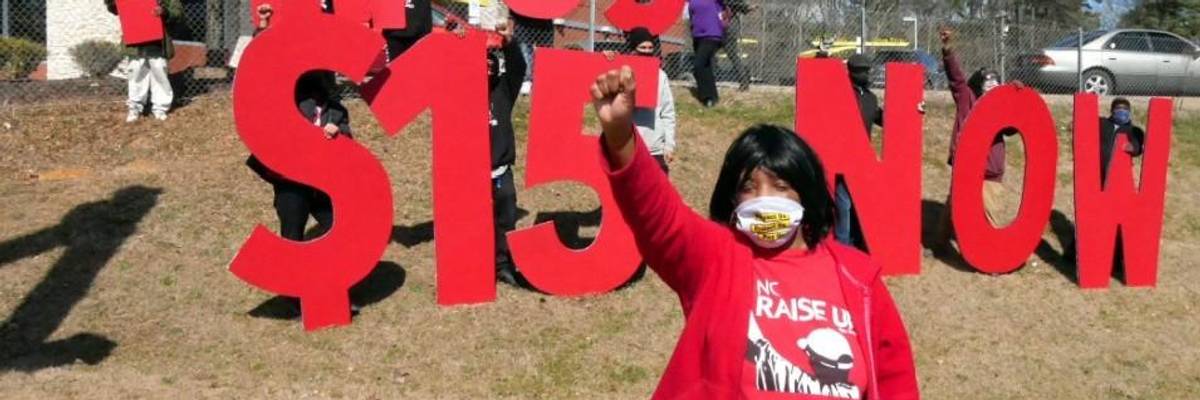
Workers in Durham, North Carolina go on strike to demand a $15 minimum wage on February 16, 2020. (Photo: NC Raise Up/Twitter)
With the U.S. House preparing to vote on President Joe Biden's $1.9 trillion coronavirus pandemic relief plan, the Economic Policy Institute on Tuesday released a report detailing the potential impact of a provision that Senate Republicans and eight members of the Democratic caucus recently blocked from the package--a gradual increase of the federal minimum wage from just $7.25 to $15 per hour.
"A $15 minimum wage would help eliminate poverty-level wages and deliver broad benefits to workers and the economy."
--Ben Zipperer, EPI
Raising the nation's hourly minimum wage to $15 by 2025 would boost the pay of 32 million people--or over a fifth of the U.S. workforce, according to the think tank. Three-quarters of workers who would see their pay rise are represented by senators who helped blocks its inclusion in the relief package.
EPI found that if a wage increase were implemented, "on average, an affected worker who works year round would see an annual pay increase of about $3,300." In 2025, workers would receive a total of $108 billion in additional wages, according to the report, authored by EPI economist Ben Zipperer, data analyst Zane Mokhiber, and senior economic analyst David Cooper.
"A $15 minimum wage would raise the pay of essential and frontline workers, reduce the number of people living in poverty, narrow racial pay gaps, and boost the economy," said Cooper, also deputy director of the Economic Analysis and Research Network. "Raising the minimum wage is a no-brainer--and long overdue."
However, such an increase requires action by Congress--and, as Zipperer pointed out, not only have lawmakers failed to raise the minimum wage in over a decade, but "their inaction has effectively given minimum wage workers a pay cut."
The report explains that "in 1968, a minimum wage worker earned $10.59 per hour in inflation-adjusted terms, 46% more than today's $7.25 federal minimum wage. The minimum wage today would be over $22 per hour had it tracked productivity increases over the last five decades."
A full-time worker making the federal minimum wage now "earns 18% less than what their counterpart earned at the time of the last increase," Zipperer noted, "and 32% less than they earned five decades ago after adjusting for rising costs of living."
"A $15 minimum wage would help eliminate poverty-level wages and deliver broad benefits to workers and the economy," he said. "The Senate must take up and pass the Raise the Wage Act as soon as possible."
Though some municipalities and states have raised hourly pay to or beyond $15, workers and advocates have long demanded federal action. Shortly after Biden unveiled his American Rescue Plan in January, Sen. Bernie Sanders (I-Vt.) and Rep. Bobby Scott (D-Va.) reintroduced the Raise the Wage Act--which is backed by House Speaker Nancy Pelosi (D-Calif.) and Senate Majority Leader Chuck Schumer (D-N.Y.).
Although Democratic congressional leaders and Biden support a wage increase, the White House made clear that Vice President Kamala Harris would not use her authority to override the opinion of the unelected Senate parliamentarian that the proposal violated rules for the budget reconciliation process that Democrats are using for the relief package--meaning the measure must pass both chambers as a separate bill.
After senators voted last week to kill an amendment from Sanders--the Senate Budget Committee chair--to reattached the wage hike to the relief legislation, he promised that "we're going to keep bringing it up, and we're going to get it done because it is what the American people demand and need."
Rep. Pramila Jayapal (D-Wash.) said over the weekend that the Congressional Progressive Caucus, which she chairs, was "extremely disappointed that the minimum wage bill was not included" in the relief package. The wage hike "remains essential policy and we must deliver on this issue," she added, calling on the president to lay out a plan to do so.
Bolstering lawmakers' vows and calls to action, EPI emphasizes that evidence shows minimum wage raises "have not led to significant job losses," despite claims by opponents. Rather than resulting in more underemployment, a national wage increase "would ensure that more low-wage workers are paid enough to cover basic living expenses," specifically assisting "adults in their career-building years who are helping to support their families--with woman disproportionately benefiting from a pay boost."
Women of color, along with Black and Hispanic workers more broadly, would notably benefit from the policy, according to EPI.
"Due to occupational segregation, discrimination, and other impacts of systemic racism, racial pay disparities are one of the persistent, structural features of the U.S. labor market," the report says. "Our analysis of shares of workers affected, combined with recent research on minimum wages and racial income and earnings gaps, indicates that raising the minimum wage to $15 by 2025 would substantially reduce racial pay inequality."
The wage increase would also reduce the number of people across the U.S. living in poverty by up to 3.7 million. The report notes that "if we assume the age distribution of poverty reduction is similar to the actual poverty distribution, the Raise the Wage Act would raise 1.3 million children out of poverty."
Breaking down expected impacts by states and congressional districts, the economists found that of the 32 million workers who would would benefit from raising the minimum wage, 24 million--or 75%--are represented by the 58 senators who voted against Sanders' $15 by 2025 amendment last week.
Dear Common Dreams reader, It’s been nearly 30 years since I co-founded Common Dreams with my late wife, Lina Newhouser. We had the radical notion that journalism should serve the public good, not corporate profits. It was clear to us from the outset what it would take to build such a project. No paid advertisements. No corporate sponsors. No millionaire publisher telling us what to think or do. Many people said we wouldn't last a year, but we proved those doubters wrong. Together with a tremendous team of journalists and dedicated staff, we built an independent media outlet free from the constraints of profits and corporate control. Our mission has always been simple: To inform. To inspire. To ignite change for the common good. Building Common Dreams was not easy. Our survival was never guaranteed. When you take on the most powerful forces—Wall Street greed, fossil fuel industry destruction, Big Tech lobbyists, and uber-rich oligarchs who have spent billions upon billions rigging the economy and democracy in their favor—the only bulwark you have is supporters who believe in your work. But here’s the urgent message from me today. It's never been this bad out there. And it's never been this hard to keep us going. At the very moment Common Dreams is most needed, the threats we face are intensifying. We need your support now more than ever. We don't accept corporate advertising and never will. We don't have a paywall because we don't think people should be blocked from critical news based on their ability to pay. Everything we do is funded by the donations of readers like you. When everyone does the little they can afford, we are strong. But if that support retreats or dries up, so do we. Will you donate now to make sure Common Dreams not only survives but thrives? —Craig Brown, Co-founder |
With the U.S. House preparing to vote on President Joe Biden's $1.9 trillion coronavirus pandemic relief plan, the Economic Policy Institute on Tuesday released a report detailing the potential impact of a provision that Senate Republicans and eight members of the Democratic caucus recently blocked from the package--a gradual increase of the federal minimum wage from just $7.25 to $15 per hour.
"A $15 minimum wage would help eliminate poverty-level wages and deliver broad benefits to workers and the economy."
--Ben Zipperer, EPI
Raising the nation's hourly minimum wage to $15 by 2025 would boost the pay of 32 million people--or over a fifth of the U.S. workforce, according to the think tank. Three-quarters of workers who would see their pay rise are represented by senators who helped blocks its inclusion in the relief package.
EPI found that if a wage increase were implemented, "on average, an affected worker who works year round would see an annual pay increase of about $3,300." In 2025, workers would receive a total of $108 billion in additional wages, according to the report, authored by EPI economist Ben Zipperer, data analyst Zane Mokhiber, and senior economic analyst David Cooper.
"A $15 minimum wage would raise the pay of essential and frontline workers, reduce the number of people living in poverty, narrow racial pay gaps, and boost the economy," said Cooper, also deputy director of the Economic Analysis and Research Network. "Raising the minimum wage is a no-brainer--and long overdue."
However, such an increase requires action by Congress--and, as Zipperer pointed out, not only have lawmakers failed to raise the minimum wage in over a decade, but "their inaction has effectively given minimum wage workers a pay cut."
The report explains that "in 1968, a minimum wage worker earned $10.59 per hour in inflation-adjusted terms, 46% more than today's $7.25 federal minimum wage. The minimum wage today would be over $22 per hour had it tracked productivity increases over the last five decades."
A full-time worker making the federal minimum wage now "earns 18% less than what their counterpart earned at the time of the last increase," Zipperer noted, "and 32% less than they earned five decades ago after adjusting for rising costs of living."
"A $15 minimum wage would help eliminate poverty-level wages and deliver broad benefits to workers and the economy," he said. "The Senate must take up and pass the Raise the Wage Act as soon as possible."
Though some municipalities and states have raised hourly pay to or beyond $15, workers and advocates have long demanded federal action. Shortly after Biden unveiled his American Rescue Plan in January, Sen. Bernie Sanders (I-Vt.) and Rep. Bobby Scott (D-Va.) reintroduced the Raise the Wage Act--which is backed by House Speaker Nancy Pelosi (D-Calif.) and Senate Majority Leader Chuck Schumer (D-N.Y.).
Although Democratic congressional leaders and Biden support a wage increase, the White House made clear that Vice President Kamala Harris would not use her authority to override the opinion of the unelected Senate parliamentarian that the proposal violated rules for the budget reconciliation process that Democrats are using for the relief package--meaning the measure must pass both chambers as a separate bill.
After senators voted last week to kill an amendment from Sanders--the Senate Budget Committee chair--to reattached the wage hike to the relief legislation, he promised that "we're going to keep bringing it up, and we're going to get it done because it is what the American people demand and need."
Rep. Pramila Jayapal (D-Wash.) said over the weekend that the Congressional Progressive Caucus, which she chairs, was "extremely disappointed that the minimum wage bill was not included" in the relief package. The wage hike "remains essential policy and we must deliver on this issue," she added, calling on the president to lay out a plan to do so.
Bolstering lawmakers' vows and calls to action, EPI emphasizes that evidence shows minimum wage raises "have not led to significant job losses," despite claims by opponents. Rather than resulting in more underemployment, a national wage increase "would ensure that more low-wage workers are paid enough to cover basic living expenses," specifically assisting "adults in their career-building years who are helping to support their families--with woman disproportionately benefiting from a pay boost."
Women of color, along with Black and Hispanic workers more broadly, would notably benefit from the policy, according to EPI.
"Due to occupational segregation, discrimination, and other impacts of systemic racism, racial pay disparities are one of the persistent, structural features of the U.S. labor market," the report says. "Our analysis of shares of workers affected, combined with recent research on minimum wages and racial income and earnings gaps, indicates that raising the minimum wage to $15 by 2025 would substantially reduce racial pay inequality."
The wage increase would also reduce the number of people across the U.S. living in poverty by up to 3.7 million. The report notes that "if we assume the age distribution of poverty reduction is similar to the actual poverty distribution, the Raise the Wage Act would raise 1.3 million children out of poverty."
Breaking down expected impacts by states and congressional districts, the economists found that of the 32 million workers who would would benefit from raising the minimum wage, 24 million--or 75%--are represented by the 58 senators who voted against Sanders' $15 by 2025 amendment last week.
With the U.S. House preparing to vote on President Joe Biden's $1.9 trillion coronavirus pandemic relief plan, the Economic Policy Institute on Tuesday released a report detailing the potential impact of a provision that Senate Republicans and eight members of the Democratic caucus recently blocked from the package--a gradual increase of the federal minimum wage from just $7.25 to $15 per hour.
"A $15 minimum wage would help eliminate poverty-level wages and deliver broad benefits to workers and the economy."
--Ben Zipperer, EPI
Raising the nation's hourly minimum wage to $15 by 2025 would boost the pay of 32 million people--or over a fifth of the U.S. workforce, according to the think tank. Three-quarters of workers who would see their pay rise are represented by senators who helped blocks its inclusion in the relief package.
EPI found that if a wage increase were implemented, "on average, an affected worker who works year round would see an annual pay increase of about $3,300." In 2025, workers would receive a total of $108 billion in additional wages, according to the report, authored by EPI economist Ben Zipperer, data analyst Zane Mokhiber, and senior economic analyst David Cooper.
"A $15 minimum wage would raise the pay of essential and frontline workers, reduce the number of people living in poverty, narrow racial pay gaps, and boost the economy," said Cooper, also deputy director of the Economic Analysis and Research Network. "Raising the minimum wage is a no-brainer--and long overdue."
However, such an increase requires action by Congress--and, as Zipperer pointed out, not only have lawmakers failed to raise the minimum wage in over a decade, but "their inaction has effectively given minimum wage workers a pay cut."
The report explains that "in 1968, a minimum wage worker earned $10.59 per hour in inflation-adjusted terms, 46% more than today's $7.25 federal minimum wage. The minimum wage today would be over $22 per hour had it tracked productivity increases over the last five decades."
A full-time worker making the federal minimum wage now "earns 18% less than what their counterpart earned at the time of the last increase," Zipperer noted, "and 32% less than they earned five decades ago after adjusting for rising costs of living."
"A $15 minimum wage would help eliminate poverty-level wages and deliver broad benefits to workers and the economy," he said. "The Senate must take up and pass the Raise the Wage Act as soon as possible."
Though some municipalities and states have raised hourly pay to or beyond $15, workers and advocates have long demanded federal action. Shortly after Biden unveiled his American Rescue Plan in January, Sen. Bernie Sanders (I-Vt.) and Rep. Bobby Scott (D-Va.) reintroduced the Raise the Wage Act--which is backed by House Speaker Nancy Pelosi (D-Calif.) and Senate Majority Leader Chuck Schumer (D-N.Y.).
Although Democratic congressional leaders and Biden support a wage increase, the White House made clear that Vice President Kamala Harris would not use her authority to override the opinion of the unelected Senate parliamentarian that the proposal violated rules for the budget reconciliation process that Democrats are using for the relief package--meaning the measure must pass both chambers as a separate bill.
After senators voted last week to kill an amendment from Sanders--the Senate Budget Committee chair--to reattached the wage hike to the relief legislation, he promised that "we're going to keep bringing it up, and we're going to get it done because it is what the American people demand and need."
Rep. Pramila Jayapal (D-Wash.) said over the weekend that the Congressional Progressive Caucus, which she chairs, was "extremely disappointed that the minimum wage bill was not included" in the relief package. The wage hike "remains essential policy and we must deliver on this issue," she added, calling on the president to lay out a plan to do so.
Bolstering lawmakers' vows and calls to action, EPI emphasizes that evidence shows minimum wage raises "have not led to significant job losses," despite claims by opponents. Rather than resulting in more underemployment, a national wage increase "would ensure that more low-wage workers are paid enough to cover basic living expenses," specifically assisting "adults in their career-building years who are helping to support their families--with woman disproportionately benefiting from a pay boost."
Women of color, along with Black and Hispanic workers more broadly, would notably benefit from the policy, according to EPI.
"Due to occupational segregation, discrimination, and other impacts of systemic racism, racial pay disparities are one of the persistent, structural features of the U.S. labor market," the report says. "Our analysis of shares of workers affected, combined with recent research on minimum wages and racial income and earnings gaps, indicates that raising the minimum wage to $15 by 2025 would substantially reduce racial pay inequality."
The wage increase would also reduce the number of people across the U.S. living in poverty by up to 3.7 million. The report notes that "if we assume the age distribution of poverty reduction is similar to the actual poverty distribution, the Raise the Wage Act would raise 1.3 million children out of poverty."
Breaking down expected impacts by states and congressional districts, the economists found that of the 32 million workers who would would benefit from raising the minimum wage, 24 million--or 75%--are represented by the 58 senators who voted against Sanders' $15 by 2025 amendment last week.

