SUBSCRIBE TO OUR FREE NEWSLETTER
Daily news & progressive opinion—funded by the people, not the corporations—delivered straight to your inbox.
5
#000000
#FFFFFF
To donate by check, phone, or other method, see our More Ways to Give page.
Daily news & progressive opinion—funded by the people, not the corporations—delivered straight to your inbox.
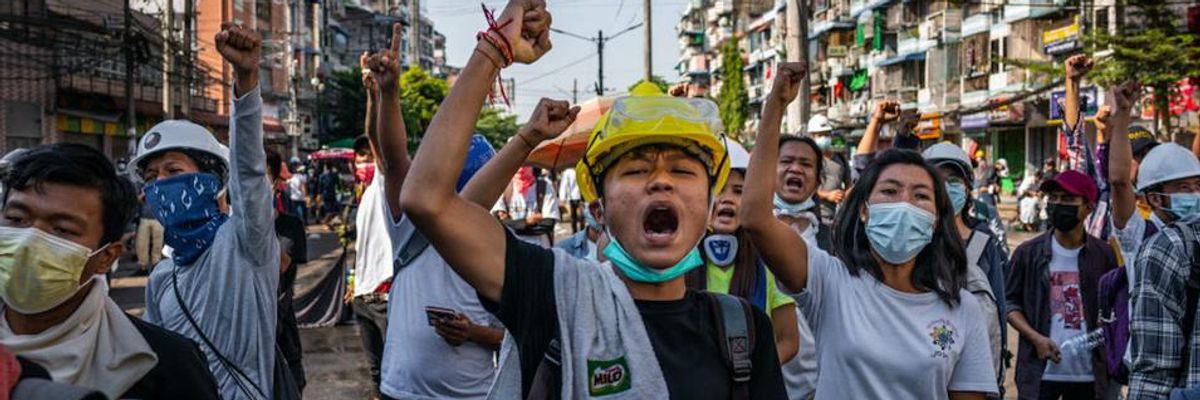
Protesters returned to the streets of Yangon and other cities in Myanmar on Monday, March 1, 2021, a day after coup regime forces killed at least 18 demonstrators demanding a return to civilian rule. (Photo: Hkun Lat/Getty Images)
United Nations leaders on Sunday condemned the Myanmar coup regime's crackdown on peaceful protesters--which killed at least 18 people--in cities across the Southeast Asian nation over the weekend as demonstrators defiantly took to the streets again on Monday to demand a return to civilian rule.
"The people of Myanmar have the right to assemble peacefully and demand the restoration of democracy."
--Ravina Shamdasani, OHCHR
In a Sunday statement, Stephane Dujarric, a spokesperson for Secretary-General Antonio Guterres, said the U.N. chief "strongly condemned" the regime's repression and "is deeply disturbed by the increase in deaths and serious injuries."
"The use of lethal force against peaceful protestors and arbitrary arrests are unacceptable," Dujarric added. "The secretary-general urges the international community to come together and send a clear signal to the military that it must respect the will of the people of Myanmar as expressed through the election and stop the repression."
Ravina Shamdasani, a spokesperson for the Office of the United Nations High Commissioner for Human Rights, said Sunday that "the people of Myanmar have the right to assemble peacefully and demand the restoration of democracy."
"These fundamental rights must be respected by the military and police, not met with violent and bloody repression," Shamdasani continued, adding that "use of lethal force against nonviolent demonstrators is never justifiable under international human rights norms."
"The international community must stand in solidarity with the protestors and all those seeking a return to democracy in Myanmar," Shamdasani added.
Tom Andrews, the U.N.'s special rapporteur on the situation of human rights in Myanmar, issued a statement Sunday outlining a series of steps he said member nations of the world body could take to oppose the coup regime and its crackdown.
World leaders also condemned the crackdown, with U.S. Secretary of State Antony Blinken tweeting Sunday that the United States "condemn[s] the Burmese security forces' abhorrent violence against the people of Burma [and] will continue to promote accountability for those responsible."
The Associated Press reports police in Yangon, Myanmar's largest city, fired tear gas at protesters who returned to the streets Monday to protest the February 1 military coup. This, a day after security forces opened fire on demonstrators with live ammunition and "less-lethal" projectiles, killing at least 18 people, and wounding at least 30 others.
According to the AP, at least five people were killed in Yangon on Sunday, while another five demonstrators were killed in the small southeastern city of Dawei. An AP journalist, Thein Zaw, was among the 1,000 people reportedly arrested over the weekend.
Myanmar's ousted civilian leader Aung San Suu Kyi was charged with two more "crimes"--including publishing information that causes "fear or alarm"--by the coup regime on Monday, Reuters reports.
Suu Kyi--a Nobel laureate who defended Myanmar's government and military against accusations of genocide of the country's Rohingya minority--was arrested on the first day of the coup under the pretext of violating import-export laws for having walkie-talkies in her home.
Dear Common Dreams reader, It’s been nearly 30 years since I co-founded Common Dreams with my late wife, Lina Newhouser. We had the radical notion that journalism should serve the public good, not corporate profits. It was clear to us from the outset what it would take to build such a project. No paid advertisements. No corporate sponsors. No millionaire publisher telling us what to think or do. Many people said we wouldn't last a year, but we proved those doubters wrong. Together with a tremendous team of journalists and dedicated staff, we built an independent media outlet free from the constraints of profits and corporate control. Our mission has always been simple: To inform. To inspire. To ignite change for the common good. Building Common Dreams was not easy. Our survival was never guaranteed. When you take on the most powerful forces—Wall Street greed, fossil fuel industry destruction, Big Tech lobbyists, and uber-rich oligarchs who have spent billions upon billions rigging the economy and democracy in their favor—the only bulwark you have is supporters who believe in your work. But here’s the urgent message from me today. It's never been this bad out there. And it's never been this hard to keep us going. At the very moment Common Dreams is most needed, the threats we face are intensifying. We need your support now more than ever. We don't accept corporate advertising and never will. We don't have a paywall because we don't think people should be blocked from critical news based on their ability to pay. Everything we do is funded by the donations of readers like you. When everyone does the little they can afford, we are strong. But if that support retreats or dries up, so do we. Will you donate now to make sure Common Dreams not only survives but thrives? —Craig Brown, Co-founder |
United Nations leaders on Sunday condemned the Myanmar coup regime's crackdown on peaceful protesters--which killed at least 18 people--in cities across the Southeast Asian nation over the weekend as demonstrators defiantly took to the streets again on Monday to demand a return to civilian rule.
"The people of Myanmar have the right to assemble peacefully and demand the restoration of democracy."
--Ravina Shamdasani, OHCHR
In a Sunday statement, Stephane Dujarric, a spokesperson for Secretary-General Antonio Guterres, said the U.N. chief "strongly condemned" the regime's repression and "is deeply disturbed by the increase in deaths and serious injuries."
"The use of lethal force against peaceful protestors and arbitrary arrests are unacceptable," Dujarric added. "The secretary-general urges the international community to come together and send a clear signal to the military that it must respect the will of the people of Myanmar as expressed through the election and stop the repression."
Ravina Shamdasani, a spokesperson for the Office of the United Nations High Commissioner for Human Rights, said Sunday that "the people of Myanmar have the right to assemble peacefully and demand the restoration of democracy."
"These fundamental rights must be respected by the military and police, not met with violent and bloody repression," Shamdasani continued, adding that "use of lethal force against nonviolent demonstrators is never justifiable under international human rights norms."
"The international community must stand in solidarity with the protestors and all those seeking a return to democracy in Myanmar," Shamdasani added.
Tom Andrews, the U.N.'s special rapporteur on the situation of human rights in Myanmar, issued a statement Sunday outlining a series of steps he said member nations of the world body could take to oppose the coup regime and its crackdown.
World leaders also condemned the crackdown, with U.S. Secretary of State Antony Blinken tweeting Sunday that the United States "condemn[s] the Burmese security forces' abhorrent violence against the people of Burma [and] will continue to promote accountability for those responsible."
The Associated Press reports police in Yangon, Myanmar's largest city, fired tear gas at protesters who returned to the streets Monday to protest the February 1 military coup. This, a day after security forces opened fire on demonstrators with live ammunition and "less-lethal" projectiles, killing at least 18 people, and wounding at least 30 others.
According to the AP, at least five people were killed in Yangon on Sunday, while another five demonstrators were killed in the small southeastern city of Dawei. An AP journalist, Thein Zaw, was among the 1,000 people reportedly arrested over the weekend.
Myanmar's ousted civilian leader Aung San Suu Kyi was charged with two more "crimes"--including publishing information that causes "fear or alarm"--by the coup regime on Monday, Reuters reports.
Suu Kyi--a Nobel laureate who defended Myanmar's government and military against accusations of genocide of the country's Rohingya minority--was arrested on the first day of the coup under the pretext of violating import-export laws for having walkie-talkies in her home.
United Nations leaders on Sunday condemned the Myanmar coup regime's crackdown on peaceful protesters--which killed at least 18 people--in cities across the Southeast Asian nation over the weekend as demonstrators defiantly took to the streets again on Monday to demand a return to civilian rule.
"The people of Myanmar have the right to assemble peacefully and demand the restoration of democracy."
--Ravina Shamdasani, OHCHR
In a Sunday statement, Stephane Dujarric, a spokesperson for Secretary-General Antonio Guterres, said the U.N. chief "strongly condemned" the regime's repression and "is deeply disturbed by the increase in deaths and serious injuries."
"The use of lethal force against peaceful protestors and arbitrary arrests are unacceptable," Dujarric added. "The secretary-general urges the international community to come together and send a clear signal to the military that it must respect the will of the people of Myanmar as expressed through the election and stop the repression."
Ravina Shamdasani, a spokesperson for the Office of the United Nations High Commissioner for Human Rights, said Sunday that "the people of Myanmar have the right to assemble peacefully and demand the restoration of democracy."
"These fundamental rights must be respected by the military and police, not met with violent and bloody repression," Shamdasani continued, adding that "use of lethal force against nonviolent demonstrators is never justifiable under international human rights norms."
"The international community must stand in solidarity with the protestors and all those seeking a return to democracy in Myanmar," Shamdasani added.
Tom Andrews, the U.N.'s special rapporteur on the situation of human rights in Myanmar, issued a statement Sunday outlining a series of steps he said member nations of the world body could take to oppose the coup regime and its crackdown.
World leaders also condemned the crackdown, with U.S. Secretary of State Antony Blinken tweeting Sunday that the United States "condemn[s] the Burmese security forces' abhorrent violence against the people of Burma [and] will continue to promote accountability for those responsible."
The Associated Press reports police in Yangon, Myanmar's largest city, fired tear gas at protesters who returned to the streets Monday to protest the February 1 military coup. This, a day after security forces opened fire on demonstrators with live ammunition and "less-lethal" projectiles, killing at least 18 people, and wounding at least 30 others.
According to the AP, at least five people were killed in Yangon on Sunday, while another five demonstrators were killed in the small southeastern city of Dawei. An AP journalist, Thein Zaw, was among the 1,000 people reportedly arrested over the weekend.
Myanmar's ousted civilian leader Aung San Suu Kyi was charged with two more "crimes"--including publishing information that causes "fear or alarm"--by the coup regime on Monday, Reuters reports.
Suu Kyi--a Nobel laureate who defended Myanmar's government and military against accusations of genocide of the country's Rohingya minority--was arrested on the first day of the coup under the pretext of violating import-export laws for having walkie-talkies in her home.