SUBSCRIBE TO OUR FREE NEWSLETTER
Daily news & progressive opinion—funded by the people, not the corporations—delivered straight to your inbox.
5
#000000
#FFFFFF
To donate by check, phone, or other method, see our More Ways to Give page.
Daily news & progressive opinion—funded by the people, not the corporations—delivered straight to your inbox.
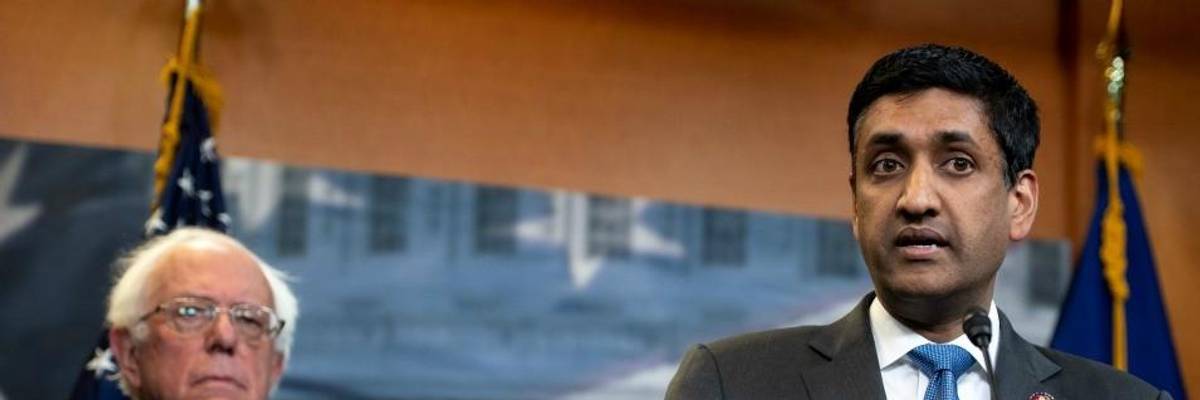
Rep. Ro Khanna (D-Calif., right) and Sen. Bernie Sanders (I-Vt.) have been two of the most outspoken congressional critics of U.S. involvement in the Saudi-led war in Yemen. (Photo: Saul Loeb/AFP via Getty Images)
While welcoming President Joe Biden's recent moves to end much of the U.S. support for the Saudi-led war in Yemen, Rep. Ro Khanna on Thursday stressed that "our work to support a brighter future for the people of Yemen is just beginning."
"We need to confirm we've ended all arms sales to the Saudis, and that we won't fulfill any outstanding weapons contracts. We need to press for additional humanitarian aid in all parts of Yemen."
--Rep. Ro Khanna
In a Twitter thread, Khanna (D-Calif.) praised Biden's reversals of Trump administration policies in Yemen as "a huge commitment to end U.S. support" for the war, which the United Nations estimates has claimed nearly a quarter million lives since late 2014.
Biden's moves include his January 27 temporary arms sale freeze to Saudi Arabia and the United Arab Emirates, his February 4 declaration ending U.S. support for "offensive operations" in the Saudi-led war, and his announcement the following day that he would reverse the Trump administration's designation of the Houthi rebels as terrorists.
However, Khanna also said that "we need further clarification on what specific military support we'll be ending, and, just as importantly, what support Biden still plans to provide to the Saudis."
"Ending U.S. complicity in the Yemen war is NOT ending the war," Khanna stressed. "The bombing continues. The threat of famine for 16 million continues. Given our responsibility, we must call on all foreign parties to stop the bombing, funding, and intervention. Only then can we resolve the civil war."
"We need a commitment from Biden to use all of his leverage to end the Saudi-led de facto blockade of Yemen," Khanna added. "We need to confirm we've ended all arms sales to the Saudis, and that we won't fulfill any outstanding weapons contracts. We need to press for additional humanitarian aid in all parts of Yemen."
In an interview with The Intercept's Ryan Grim on the "Deconstructed" podcast posted Friday morning, Khanna again praised Biden. However, he also cautioned against inferring too much from the president's words.
"Biden has come out and said that the U.S. will no longer assist with offensive operations in the war on on Yemen," said Khanna."But then I want to read to you what Biden says after that. He says: 'at the same time, Saudi Arabia faces missile attacks... and other threats from Iranian-supplied forces in multiple countries. We're going to continue to support and help Saudi Arabia defend its sovereignty and its territorial integrity and its people.'"
Khanna said that Saudi forces "basically launch missiles into residential sites in Yemen to target the Houthis, claiming that they were doing that in a defensive posture to prevent an attack on Saudi Arabia. So their explanation is not going to fly. And the Congress needs to make sure that it's actually a defensive and not offensive strikes into Yemen. And we have to be vigilant to make sure that the Saudis aren't able to exploit that definition."
Yemen remains what the U.N. calls the "world's worst humanitarian crisis." Underscoring this designation is a Friday report from multiple U.N. agencies warning that nearly 2.3 million children under the age of five are projected to suffer from acute malnutrition this year, 400,000 of whom could die if they do not receive urgent treatment.
Dear Common Dreams reader, It’s been nearly 30 years since I co-founded Common Dreams with my late wife, Lina Newhouser. We had the radical notion that journalism should serve the public good, not corporate profits. It was clear to us from the outset what it would take to build such a project. No paid advertisements. No corporate sponsors. No millionaire publisher telling us what to think or do. Many people said we wouldn't last a year, but we proved those doubters wrong. Together with a tremendous team of journalists and dedicated staff, we built an independent media outlet free from the constraints of profits and corporate control. Our mission has always been simple: To inform. To inspire. To ignite change for the common good. Building Common Dreams was not easy. Our survival was never guaranteed. When you take on the most powerful forces—Wall Street greed, fossil fuel industry destruction, Big Tech lobbyists, and uber-rich oligarchs who have spent billions upon billions rigging the economy and democracy in their favor—the only bulwark you have is supporters who believe in your work. But here’s the urgent message from me today. It's never been this bad out there. And it's never been this hard to keep us going. At the very moment Common Dreams is most needed, the threats we face are intensifying. We need your support now more than ever. We don't accept corporate advertising and never will. We don't have a paywall because we don't think people should be blocked from critical news based on their ability to pay. Everything we do is funded by the donations of readers like you. When everyone does the little they can afford, we are strong. But if that support retreats or dries up, so do we. Will you donate now to make sure Common Dreams not only survives but thrives? —Craig Brown, Co-founder |
While welcoming President Joe Biden's recent moves to end much of the U.S. support for the Saudi-led war in Yemen, Rep. Ro Khanna on Thursday stressed that "our work to support a brighter future for the people of Yemen is just beginning."
"We need to confirm we've ended all arms sales to the Saudis, and that we won't fulfill any outstanding weapons contracts. We need to press for additional humanitarian aid in all parts of Yemen."
--Rep. Ro Khanna
In a Twitter thread, Khanna (D-Calif.) praised Biden's reversals of Trump administration policies in Yemen as "a huge commitment to end U.S. support" for the war, which the United Nations estimates has claimed nearly a quarter million lives since late 2014.
Biden's moves include his January 27 temporary arms sale freeze to Saudi Arabia and the United Arab Emirates, his February 4 declaration ending U.S. support for "offensive operations" in the Saudi-led war, and his announcement the following day that he would reverse the Trump administration's designation of the Houthi rebels as terrorists.
However, Khanna also said that "we need further clarification on what specific military support we'll be ending, and, just as importantly, what support Biden still plans to provide to the Saudis."
"Ending U.S. complicity in the Yemen war is NOT ending the war," Khanna stressed. "The bombing continues. The threat of famine for 16 million continues. Given our responsibility, we must call on all foreign parties to stop the bombing, funding, and intervention. Only then can we resolve the civil war."
"We need a commitment from Biden to use all of his leverage to end the Saudi-led de facto blockade of Yemen," Khanna added. "We need to confirm we've ended all arms sales to the Saudis, and that we won't fulfill any outstanding weapons contracts. We need to press for additional humanitarian aid in all parts of Yemen."
In an interview with The Intercept's Ryan Grim on the "Deconstructed" podcast posted Friday morning, Khanna again praised Biden. However, he also cautioned against inferring too much from the president's words.
"Biden has come out and said that the U.S. will no longer assist with offensive operations in the war on on Yemen," said Khanna."But then I want to read to you what Biden says after that. He says: 'at the same time, Saudi Arabia faces missile attacks... and other threats from Iranian-supplied forces in multiple countries. We're going to continue to support and help Saudi Arabia defend its sovereignty and its territorial integrity and its people.'"
Khanna said that Saudi forces "basically launch missiles into residential sites in Yemen to target the Houthis, claiming that they were doing that in a defensive posture to prevent an attack on Saudi Arabia. So their explanation is not going to fly. And the Congress needs to make sure that it's actually a defensive and not offensive strikes into Yemen. And we have to be vigilant to make sure that the Saudis aren't able to exploit that definition."
Yemen remains what the U.N. calls the "world's worst humanitarian crisis." Underscoring this designation is a Friday report from multiple U.N. agencies warning that nearly 2.3 million children under the age of five are projected to suffer from acute malnutrition this year, 400,000 of whom could die if they do not receive urgent treatment.
While welcoming President Joe Biden's recent moves to end much of the U.S. support for the Saudi-led war in Yemen, Rep. Ro Khanna on Thursday stressed that "our work to support a brighter future for the people of Yemen is just beginning."
"We need to confirm we've ended all arms sales to the Saudis, and that we won't fulfill any outstanding weapons contracts. We need to press for additional humanitarian aid in all parts of Yemen."
--Rep. Ro Khanna
In a Twitter thread, Khanna (D-Calif.) praised Biden's reversals of Trump administration policies in Yemen as "a huge commitment to end U.S. support" for the war, which the United Nations estimates has claimed nearly a quarter million lives since late 2014.
Biden's moves include his January 27 temporary arms sale freeze to Saudi Arabia and the United Arab Emirates, his February 4 declaration ending U.S. support for "offensive operations" in the Saudi-led war, and his announcement the following day that he would reverse the Trump administration's designation of the Houthi rebels as terrorists.
However, Khanna also said that "we need further clarification on what specific military support we'll be ending, and, just as importantly, what support Biden still plans to provide to the Saudis."
"Ending U.S. complicity in the Yemen war is NOT ending the war," Khanna stressed. "The bombing continues. The threat of famine for 16 million continues. Given our responsibility, we must call on all foreign parties to stop the bombing, funding, and intervention. Only then can we resolve the civil war."
"We need a commitment from Biden to use all of his leverage to end the Saudi-led de facto blockade of Yemen," Khanna added. "We need to confirm we've ended all arms sales to the Saudis, and that we won't fulfill any outstanding weapons contracts. We need to press for additional humanitarian aid in all parts of Yemen."
In an interview with The Intercept's Ryan Grim on the "Deconstructed" podcast posted Friday morning, Khanna again praised Biden. However, he also cautioned against inferring too much from the president's words.
"Biden has come out and said that the U.S. will no longer assist with offensive operations in the war on on Yemen," said Khanna."But then I want to read to you what Biden says after that. He says: 'at the same time, Saudi Arabia faces missile attacks... and other threats from Iranian-supplied forces in multiple countries. We're going to continue to support and help Saudi Arabia defend its sovereignty and its territorial integrity and its people.'"
Khanna said that Saudi forces "basically launch missiles into residential sites in Yemen to target the Houthis, claiming that they were doing that in a defensive posture to prevent an attack on Saudi Arabia. So their explanation is not going to fly. And the Congress needs to make sure that it's actually a defensive and not offensive strikes into Yemen. And we have to be vigilant to make sure that the Saudis aren't able to exploit that definition."
Yemen remains what the U.N. calls the "world's worst humanitarian crisis." Underscoring this designation is a Friday report from multiple U.N. agencies warning that nearly 2.3 million children under the age of five are projected to suffer from acute malnutrition this year, 400,000 of whom could die if they do not receive urgent treatment.