SUBSCRIBE TO OUR FREE NEWSLETTER
Daily news & progressive opinion—funded by the people, not the corporations—delivered straight to your inbox.
5
#000000
#FFFFFF
To donate by check, phone, or other method, see our More Ways to Give page.
Daily news & progressive opinion—funded by the people, not the corporations—delivered straight to your inbox.
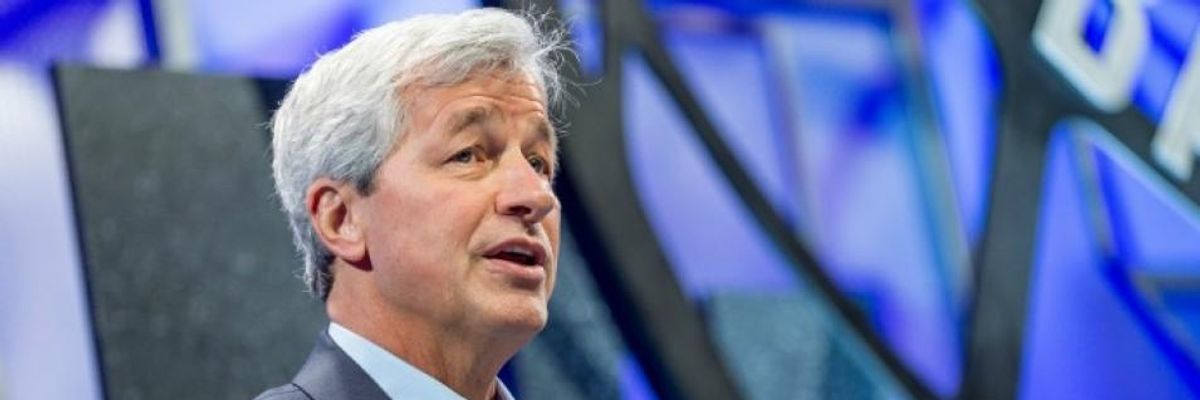
JPMorgan Chase CEO Jamie Dimon speaks at the Fortune Global Forum. (Photo: FORTUNE Global Forum/Flickr/cc)
Sen. Bernie Sanders sent a message late Monday to the Wall Street banks that are temporarily pausing their financial contributions to political campaigns amid public outrage over the role Republican lawmakers played in inciting the violent attack on the U.S. Capitol last week: Make the donation moratoriums permanent.
"If Wall Street really believed in defending our democracy, they would commit to never making another campaign donation--period," the Vermont senator tweeted in response to a Bloomberg report detailing how major U.S. financial institutions--including Morgan Stanley, Bank of America, JPMorgan Chase, Citigroup, and Goldman Sachs--are "reassessing, reducing, and in many cases suspending their campaign contributions."
"Corporations are trying to launder their reputations by temporarily suspending small PAC donations to insurrectionist Republicans--but the real cash fueling the radical right is dark money."
--David Sirota, The Daily Poster
According to Bloomberg, "Morgan Stanley singled out members of Congress who opposed the move to certify President-elect Joe Biden's election win, pausing its contributions to them. Goldman Sachs Group Inc. will probably curtail donations to leaders who tried to block the election result as well. JPMorgan Chase & Co. and Citigroup Inc. took a broader swipe, suspending all their donations for now."
Other large and profitable American corporations have similarly committed to adjusting their political giving in the wake of the mob attack, which was encouraged by Trump and abetted by Republican lawmakers who readily echoed the president's lies about the November election.
The companies' moves were met with skepticism from critics who warned that profit-motivated corporations are simply doing public relations to avoid being connected to seditionist lawmakers, not stepping back from influencing the political system out of genuine concern for the state of U.S. democracy.
"The banks and corporations that have annihilated our social fabric, toppled governments, polluted our environment, and exploited us are now trying to get some good PR by pausing their political donations," tweeted The Gravel Institute, a progressive think tank. "Their evil influence has not stopped in the slightest. Don't buy it."
As the New York Times pointed out Monday, the donation suspensions "coincide with the first quarter after a presidential election, which is typically light on fundraising anyway."
"Efforts by some companies to pause PAC donations to all lawmakers--those who voted to uphold the election as well as those who sought to overturn it--are raising eyebrows," the Times reported. "And companies can still give to 'dark money' groups that don't disclose their donors but often raise far more money than corporate PACs."
Emphasizing that point and outlining steps Democrats can take to curtail dark money, The Daily Poster's Andrew Perez and David Sirota wrote Monday that "if you are a billionaire or a corporation in America today, you can bankroll seditious politicians and the radical right-wing movement that staged last week's violent insurrection at the U.S. Capitol--and you can do so with impunity."
"Right now, an increasing portion of resources flooding into politics is going into dark money groups that do not have to disclose their donors," Sirota and Perez noted. "OpenSecrets estimated that dark money groups injected more than $750 million into the 2020 elections--and that does not account for other dark money that funds propaganda, misinformation, and astroturf organizing."
While some companies provided specific timelines for their donation pauses, many did not specify how long the suspensions will last, leaving an opening for a quiet return to political giving in the near future.
"What would probably prove more significant for American elections would be if these donation bans become more permanent, or if corporations dissolve their PACs entirely."
--Theodore Schleifer, Recode
As Popular Information reported earlier this week, Dow Inc. vowed that its pause of "all corporate and employee political action committee (PAC) contributions to any member of Congress who voted to object to the certification of the presidential election" will "remain in place for a period of one election cycle (two years for House members; up to six years for senators)."
JPMorgan Chase, meanwhile, said its suspension of donations to both Republicans and Democrats in Congress will only last six months. Citigroup's pause of all political contributions will last only until the end of the current quarter.
Theodore Schleifer, money and influence reporter for Recode, argued Monday that "beyond the symbolism, the impact of these corporations' decisions could prove relatively minor."
"What would probably prove more significant for American elections," Schleifer wrote, "would be if these donation bans become more permanent, or if corporations dissolve their PACs entirely; if companies' billionaire executives and board members pledge to follow their corporate policies in their own disclosed and undisclosed personal giving; or if they fundamentally reshaped their lobbying strategies to not engage with GOP legislators or the entire Republican Party in Washington."
"Last week could serve as a broader reset in how big business approaches Washington," added Schleifer. "But the pause in corporate PAC giving would just be the beginning."
Dear Common Dreams reader, It’s been nearly 30 years since I co-founded Common Dreams with my late wife, Lina Newhouser. We had the radical notion that journalism should serve the public good, not corporate profits. It was clear to us from the outset what it would take to build such a project. No paid advertisements. No corporate sponsors. No millionaire publisher telling us what to think or do. Many people said we wouldn't last a year, but we proved those doubters wrong. Together with a tremendous team of journalists and dedicated staff, we built an independent media outlet free from the constraints of profits and corporate control. Our mission has always been simple: To inform. To inspire. To ignite change for the common good. Building Common Dreams was not easy. Our survival was never guaranteed. When you take on the most powerful forces—Wall Street greed, fossil fuel industry destruction, Big Tech lobbyists, and uber-rich oligarchs who have spent billions upon billions rigging the economy and democracy in their favor—the only bulwark you have is supporters who believe in your work. But here’s the urgent message from me today. It's never been this bad out there. And it's never been this hard to keep us going. At the very moment Common Dreams is most needed, the threats we face are intensifying. We need your support now more than ever. We don't accept corporate advertising and never will. We don't have a paywall because we don't think people should be blocked from critical news based on their ability to pay. Everything we do is funded by the donations of readers like you. When everyone does the little they can afford, we are strong. But if that support retreats or dries up, so do we. Will you donate now to make sure Common Dreams not only survives but thrives? —Craig Brown, Co-founder |
Sen. Bernie Sanders sent a message late Monday to the Wall Street banks that are temporarily pausing their financial contributions to political campaigns amid public outrage over the role Republican lawmakers played in inciting the violent attack on the U.S. Capitol last week: Make the donation moratoriums permanent.
"If Wall Street really believed in defending our democracy, they would commit to never making another campaign donation--period," the Vermont senator tweeted in response to a Bloomberg report detailing how major U.S. financial institutions--including Morgan Stanley, Bank of America, JPMorgan Chase, Citigroup, and Goldman Sachs--are "reassessing, reducing, and in many cases suspending their campaign contributions."
"Corporations are trying to launder their reputations by temporarily suspending small PAC donations to insurrectionist Republicans--but the real cash fueling the radical right is dark money."
--David Sirota, The Daily Poster
According to Bloomberg, "Morgan Stanley singled out members of Congress who opposed the move to certify President-elect Joe Biden's election win, pausing its contributions to them. Goldman Sachs Group Inc. will probably curtail donations to leaders who tried to block the election result as well. JPMorgan Chase & Co. and Citigroup Inc. took a broader swipe, suspending all their donations for now."
Other large and profitable American corporations have similarly committed to adjusting their political giving in the wake of the mob attack, which was encouraged by Trump and abetted by Republican lawmakers who readily echoed the president's lies about the November election.
The companies' moves were met with skepticism from critics who warned that profit-motivated corporations are simply doing public relations to avoid being connected to seditionist lawmakers, not stepping back from influencing the political system out of genuine concern for the state of U.S. democracy.
"The banks and corporations that have annihilated our social fabric, toppled governments, polluted our environment, and exploited us are now trying to get some good PR by pausing their political donations," tweeted The Gravel Institute, a progressive think tank. "Their evil influence has not stopped in the slightest. Don't buy it."
As the New York Times pointed out Monday, the donation suspensions "coincide with the first quarter after a presidential election, which is typically light on fundraising anyway."
"Efforts by some companies to pause PAC donations to all lawmakers--those who voted to uphold the election as well as those who sought to overturn it--are raising eyebrows," the Times reported. "And companies can still give to 'dark money' groups that don't disclose their donors but often raise far more money than corporate PACs."
Emphasizing that point and outlining steps Democrats can take to curtail dark money, The Daily Poster's Andrew Perez and David Sirota wrote Monday that "if you are a billionaire or a corporation in America today, you can bankroll seditious politicians and the radical right-wing movement that staged last week's violent insurrection at the U.S. Capitol--and you can do so with impunity."
"Right now, an increasing portion of resources flooding into politics is going into dark money groups that do not have to disclose their donors," Sirota and Perez noted. "OpenSecrets estimated that dark money groups injected more than $750 million into the 2020 elections--and that does not account for other dark money that funds propaganda, misinformation, and astroturf organizing."
While some companies provided specific timelines for their donation pauses, many did not specify how long the suspensions will last, leaving an opening for a quiet return to political giving in the near future.
"What would probably prove more significant for American elections would be if these donation bans become more permanent, or if corporations dissolve their PACs entirely."
--Theodore Schleifer, Recode
As Popular Information reported earlier this week, Dow Inc. vowed that its pause of "all corporate and employee political action committee (PAC) contributions to any member of Congress who voted to object to the certification of the presidential election" will "remain in place for a period of one election cycle (two years for House members; up to six years for senators)."
JPMorgan Chase, meanwhile, said its suspension of donations to both Republicans and Democrats in Congress will only last six months. Citigroup's pause of all political contributions will last only until the end of the current quarter.
Theodore Schleifer, money and influence reporter for Recode, argued Monday that "beyond the symbolism, the impact of these corporations' decisions could prove relatively minor."
"What would probably prove more significant for American elections," Schleifer wrote, "would be if these donation bans become more permanent, or if corporations dissolve their PACs entirely; if companies' billionaire executives and board members pledge to follow their corporate policies in their own disclosed and undisclosed personal giving; or if they fundamentally reshaped their lobbying strategies to not engage with GOP legislators or the entire Republican Party in Washington."
"Last week could serve as a broader reset in how big business approaches Washington," added Schleifer. "But the pause in corporate PAC giving would just be the beginning."
Sen. Bernie Sanders sent a message late Monday to the Wall Street banks that are temporarily pausing their financial contributions to political campaigns amid public outrage over the role Republican lawmakers played in inciting the violent attack on the U.S. Capitol last week: Make the donation moratoriums permanent.
"If Wall Street really believed in defending our democracy, they would commit to never making another campaign donation--period," the Vermont senator tweeted in response to a Bloomberg report detailing how major U.S. financial institutions--including Morgan Stanley, Bank of America, JPMorgan Chase, Citigroup, and Goldman Sachs--are "reassessing, reducing, and in many cases suspending their campaign contributions."
"Corporations are trying to launder their reputations by temporarily suspending small PAC donations to insurrectionist Republicans--but the real cash fueling the radical right is dark money."
--David Sirota, The Daily Poster
According to Bloomberg, "Morgan Stanley singled out members of Congress who opposed the move to certify President-elect Joe Biden's election win, pausing its contributions to them. Goldman Sachs Group Inc. will probably curtail donations to leaders who tried to block the election result as well. JPMorgan Chase & Co. and Citigroup Inc. took a broader swipe, suspending all their donations for now."
Other large and profitable American corporations have similarly committed to adjusting their political giving in the wake of the mob attack, which was encouraged by Trump and abetted by Republican lawmakers who readily echoed the president's lies about the November election.
The companies' moves were met with skepticism from critics who warned that profit-motivated corporations are simply doing public relations to avoid being connected to seditionist lawmakers, not stepping back from influencing the political system out of genuine concern for the state of U.S. democracy.
"The banks and corporations that have annihilated our social fabric, toppled governments, polluted our environment, and exploited us are now trying to get some good PR by pausing their political donations," tweeted The Gravel Institute, a progressive think tank. "Their evil influence has not stopped in the slightest. Don't buy it."
As the New York Times pointed out Monday, the donation suspensions "coincide with the first quarter after a presidential election, which is typically light on fundraising anyway."
"Efforts by some companies to pause PAC donations to all lawmakers--those who voted to uphold the election as well as those who sought to overturn it--are raising eyebrows," the Times reported. "And companies can still give to 'dark money' groups that don't disclose their donors but often raise far more money than corporate PACs."
Emphasizing that point and outlining steps Democrats can take to curtail dark money, The Daily Poster's Andrew Perez and David Sirota wrote Monday that "if you are a billionaire or a corporation in America today, you can bankroll seditious politicians and the radical right-wing movement that staged last week's violent insurrection at the U.S. Capitol--and you can do so with impunity."
"Right now, an increasing portion of resources flooding into politics is going into dark money groups that do not have to disclose their donors," Sirota and Perez noted. "OpenSecrets estimated that dark money groups injected more than $750 million into the 2020 elections--and that does not account for other dark money that funds propaganda, misinformation, and astroturf organizing."
While some companies provided specific timelines for their donation pauses, many did not specify how long the suspensions will last, leaving an opening for a quiet return to political giving in the near future.
"What would probably prove more significant for American elections would be if these donation bans become more permanent, or if corporations dissolve their PACs entirely."
--Theodore Schleifer, Recode
As Popular Information reported earlier this week, Dow Inc. vowed that its pause of "all corporate and employee political action committee (PAC) contributions to any member of Congress who voted to object to the certification of the presidential election" will "remain in place for a period of one election cycle (two years for House members; up to six years for senators)."
JPMorgan Chase, meanwhile, said its suspension of donations to both Republicans and Democrats in Congress will only last six months. Citigroup's pause of all political contributions will last only until the end of the current quarter.
Theodore Schleifer, money and influence reporter for Recode, argued Monday that "beyond the symbolism, the impact of these corporations' decisions could prove relatively minor."
"What would probably prove more significant for American elections," Schleifer wrote, "would be if these donation bans become more permanent, or if corporations dissolve their PACs entirely; if companies' billionaire executives and board members pledge to follow their corporate policies in their own disclosed and undisclosed personal giving; or if they fundamentally reshaped their lobbying strategies to not engage with GOP legislators or the entire Republican Party in Washington."
"Last week could serve as a broader reset in how big business approaches Washington," added Schleifer. "But the pause in corporate PAC giving would just be the beginning."