SUBSCRIBE TO OUR FREE NEWSLETTER
Daily news & progressive opinion—funded by the people, not the corporations—delivered straight to your inbox.
5
#000000
#FFFFFF
To donate by check, phone, or other method, see our More Ways to Give page.
Daily news & progressive opinion—funded by the people, not the corporations—delivered straight to your inbox.
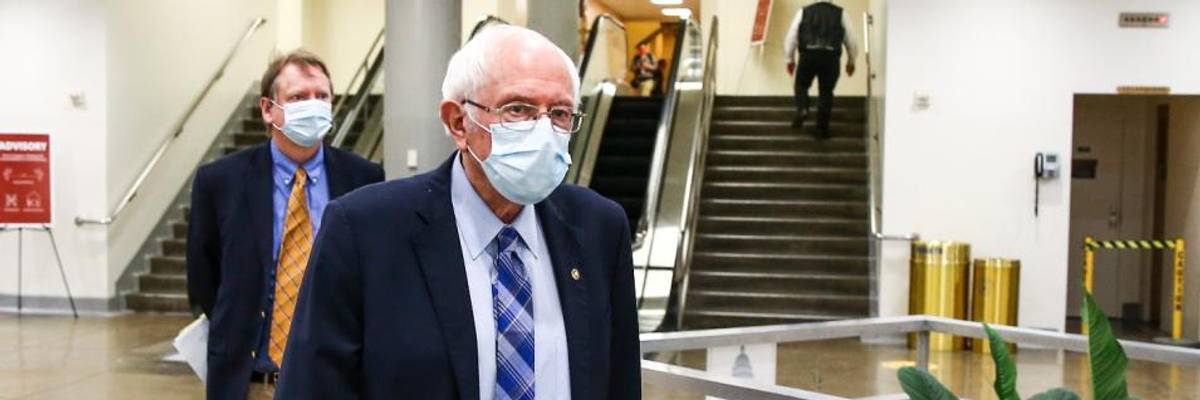
Sen. Bernie Sanders (I-Vt.) walks after speaking on the Senate floor on Capitol Hill on December 29, 2020 in Washington, D.C. (Photo: Tasos Katopodis/Getty Images)
Sen. Bernie Sanders late Thursday implored President-elect Joe Biden and the incoming Democrat-controlled Congress to make a robust coronavirus relief bill containing $2,000 direct payments the "first order of business" upon taking power, warning that failure to quickly deliver real material aid in the midst of devastating crises could lead to electoral backlash on the scale of the 2010 midterms.
"Remember what happened in 2010? Democrats got wiped out," Sanders (I-Vt.), the incoming chairman of the Senate Budget Committee, said in an appearance on CNN Thursday evening. "They had the power, but they did not deliver for the American people."
To avoid a repeat of 2010--when Republicans won control of the House and gained seats in the Senate, ending a brief period of unified Democratic control during the Obama presidency--Sanders said the new Congress must urgently pursue "an aggressive agenda that says we understand that millions of people... are lining up in their cars in order to get emergency food, people can't pay their medical bills, people are going deeper and deeper into debt, people are facing eviction."
"We have to act and act now," Sanders said, arguing that Democrats must be "bold in a way that we have not seen since FDR in the 1930s."
"The first order of business, by the way," the Vermont senator continued, "is to pass an emergency Covid-19 bill which, among many other things, says to working-class Americans, 'We know you're in pain, and we're gonna get you a $2,000 check... We are on your side.'"
Watch:
Sanders' remarks came days after Raphael Warnock and Jon Ossoff won their runoff races in Georgia, positioning Democrats to take control of the U.S. Senate by the narrowest possible margin.
The Democratic victories in Georgia were credited in part to a last-minute push for $2,000 direct payments in the days leading up to the pivotal runoffs, an effort led by Sanders and members of the Congressional Progressive Caucus.
While Senate Republicans ultimately blocked Sanders' attempt to force a vote on a House-passed bill that would have provided one-time $2,000 payments to most Americans, Warnock and Ossoff both embraced the checks on the campaign trail and slammed their GOP opponents for standing in the way of desperately needed relief. President-elect Joe Biden also backed the demand, promising that the election of Warnock and Ossoff would "put an end to the block in Washington on that $2,000 stimulus check."
Following the Democrats' victories, soon-to-be Senate Majority Leader Chuck Schumer (D-N.Y.) told reporters Wednesday that "one of the first things that I want to do when our new senators are seated is deliver the $2,000 checks to the American families."
The Washington Post reported Wednesday that "it's unclear how quickly Congress could actually vote on the checks. That depends on when the elections in Georgia are certified, which could be delayed by GOP challenges, making the timing uncertain."
The certification deadline for Georgia counties is January 15, and the state deadline is January 22--two days after Biden's inauguration.
"Additionally, it's not clear whether the House and Senate would vote on the checks as stand-alone legislation, or as part of a larger package that could also include items like state and local aid and an extension of unemployment benefits," the Post noted. "Congressional aides cautioned that discussions with the Biden team over how to proceed were in early stages."
Dear Common Dreams reader, It’s been nearly 30 years since I co-founded Common Dreams with my late wife, Lina Newhouser. We had the radical notion that journalism should serve the public good, not corporate profits. It was clear to us from the outset what it would take to build such a project. No paid advertisements. No corporate sponsors. No millionaire publisher telling us what to think or do. Many people said we wouldn't last a year, but we proved those doubters wrong. Together with a tremendous team of journalists and dedicated staff, we built an independent media outlet free from the constraints of profits and corporate control. Our mission has always been simple: To inform. To inspire. To ignite change for the common good. Building Common Dreams was not easy. Our survival was never guaranteed. When you take on the most powerful forces—Wall Street greed, fossil fuel industry destruction, Big Tech lobbyists, and uber-rich oligarchs who have spent billions upon billions rigging the economy and democracy in their favor—the only bulwark you have is supporters who believe in your work. But here’s the urgent message from me today. It's never been this bad out there. And it's never been this hard to keep us going. At the very moment Common Dreams is most needed, the threats we face are intensifying. We need your support now more than ever. We don't accept corporate advertising and never will. We don't have a paywall because we don't think people should be blocked from critical news based on their ability to pay. Everything we do is funded by the donations of readers like you. When everyone does the little they can afford, we are strong. But if that support retreats or dries up, so do we. Will you donate now to make sure Common Dreams not only survives but thrives? —Craig Brown, Co-founder |
Sen. Bernie Sanders late Thursday implored President-elect Joe Biden and the incoming Democrat-controlled Congress to make a robust coronavirus relief bill containing $2,000 direct payments the "first order of business" upon taking power, warning that failure to quickly deliver real material aid in the midst of devastating crises could lead to electoral backlash on the scale of the 2010 midterms.
"Remember what happened in 2010? Democrats got wiped out," Sanders (I-Vt.), the incoming chairman of the Senate Budget Committee, said in an appearance on CNN Thursday evening. "They had the power, but they did not deliver for the American people."
To avoid a repeat of 2010--when Republicans won control of the House and gained seats in the Senate, ending a brief period of unified Democratic control during the Obama presidency--Sanders said the new Congress must urgently pursue "an aggressive agenda that says we understand that millions of people... are lining up in their cars in order to get emergency food, people can't pay their medical bills, people are going deeper and deeper into debt, people are facing eviction."
"We have to act and act now," Sanders said, arguing that Democrats must be "bold in a way that we have not seen since FDR in the 1930s."
"The first order of business, by the way," the Vermont senator continued, "is to pass an emergency Covid-19 bill which, among many other things, says to working-class Americans, 'We know you're in pain, and we're gonna get you a $2,000 check... We are on your side.'"
Watch:
Sanders' remarks came days after Raphael Warnock and Jon Ossoff won their runoff races in Georgia, positioning Democrats to take control of the U.S. Senate by the narrowest possible margin.
The Democratic victories in Georgia were credited in part to a last-minute push for $2,000 direct payments in the days leading up to the pivotal runoffs, an effort led by Sanders and members of the Congressional Progressive Caucus.
While Senate Republicans ultimately blocked Sanders' attempt to force a vote on a House-passed bill that would have provided one-time $2,000 payments to most Americans, Warnock and Ossoff both embraced the checks on the campaign trail and slammed their GOP opponents for standing in the way of desperately needed relief. President-elect Joe Biden also backed the demand, promising that the election of Warnock and Ossoff would "put an end to the block in Washington on that $2,000 stimulus check."
Following the Democrats' victories, soon-to-be Senate Majority Leader Chuck Schumer (D-N.Y.) told reporters Wednesday that "one of the first things that I want to do when our new senators are seated is deliver the $2,000 checks to the American families."
The Washington Post reported Wednesday that "it's unclear how quickly Congress could actually vote on the checks. That depends on when the elections in Georgia are certified, which could be delayed by GOP challenges, making the timing uncertain."
The certification deadline for Georgia counties is January 15, and the state deadline is January 22--two days after Biden's inauguration.
"Additionally, it's not clear whether the House and Senate would vote on the checks as stand-alone legislation, or as part of a larger package that could also include items like state and local aid and an extension of unemployment benefits," the Post noted. "Congressional aides cautioned that discussions with the Biden team over how to proceed were in early stages."
Sen. Bernie Sanders late Thursday implored President-elect Joe Biden and the incoming Democrat-controlled Congress to make a robust coronavirus relief bill containing $2,000 direct payments the "first order of business" upon taking power, warning that failure to quickly deliver real material aid in the midst of devastating crises could lead to electoral backlash on the scale of the 2010 midterms.
"Remember what happened in 2010? Democrats got wiped out," Sanders (I-Vt.), the incoming chairman of the Senate Budget Committee, said in an appearance on CNN Thursday evening. "They had the power, but they did not deliver for the American people."
To avoid a repeat of 2010--when Republicans won control of the House and gained seats in the Senate, ending a brief period of unified Democratic control during the Obama presidency--Sanders said the new Congress must urgently pursue "an aggressive agenda that says we understand that millions of people... are lining up in their cars in order to get emergency food, people can't pay their medical bills, people are going deeper and deeper into debt, people are facing eviction."
"We have to act and act now," Sanders said, arguing that Democrats must be "bold in a way that we have not seen since FDR in the 1930s."
"The first order of business, by the way," the Vermont senator continued, "is to pass an emergency Covid-19 bill which, among many other things, says to working-class Americans, 'We know you're in pain, and we're gonna get you a $2,000 check... We are on your side.'"
Watch:
Sanders' remarks came days after Raphael Warnock and Jon Ossoff won their runoff races in Georgia, positioning Democrats to take control of the U.S. Senate by the narrowest possible margin.
The Democratic victories in Georgia were credited in part to a last-minute push for $2,000 direct payments in the days leading up to the pivotal runoffs, an effort led by Sanders and members of the Congressional Progressive Caucus.
While Senate Republicans ultimately blocked Sanders' attempt to force a vote on a House-passed bill that would have provided one-time $2,000 payments to most Americans, Warnock and Ossoff both embraced the checks on the campaign trail and slammed their GOP opponents for standing in the way of desperately needed relief. President-elect Joe Biden also backed the demand, promising that the election of Warnock and Ossoff would "put an end to the block in Washington on that $2,000 stimulus check."
Following the Democrats' victories, soon-to-be Senate Majority Leader Chuck Schumer (D-N.Y.) told reporters Wednesday that "one of the first things that I want to do when our new senators are seated is deliver the $2,000 checks to the American families."
The Washington Post reported Wednesday that "it's unclear how quickly Congress could actually vote on the checks. That depends on when the elections in Georgia are certified, which could be delayed by GOP challenges, making the timing uncertain."
The certification deadline for Georgia counties is January 15, and the state deadline is January 22--two days after Biden's inauguration.
"Additionally, it's not clear whether the House and Senate would vote on the checks as stand-alone legislation, or as part of a larger package that could also include items like state and local aid and an extension of unemployment benefits," the Post noted. "Congressional aides cautioned that discussions with the Biden team over how to proceed were in early stages."