SUBSCRIBE TO OUR FREE NEWSLETTER
Daily news & progressive opinion—funded by the people, not the corporations—delivered straight to your inbox.
5
#000000
#FFFFFF
To donate by check, phone, or other method, see our More Ways to Give page.
Daily news & progressive opinion—funded by the people, not the corporations—delivered straight to your inbox.
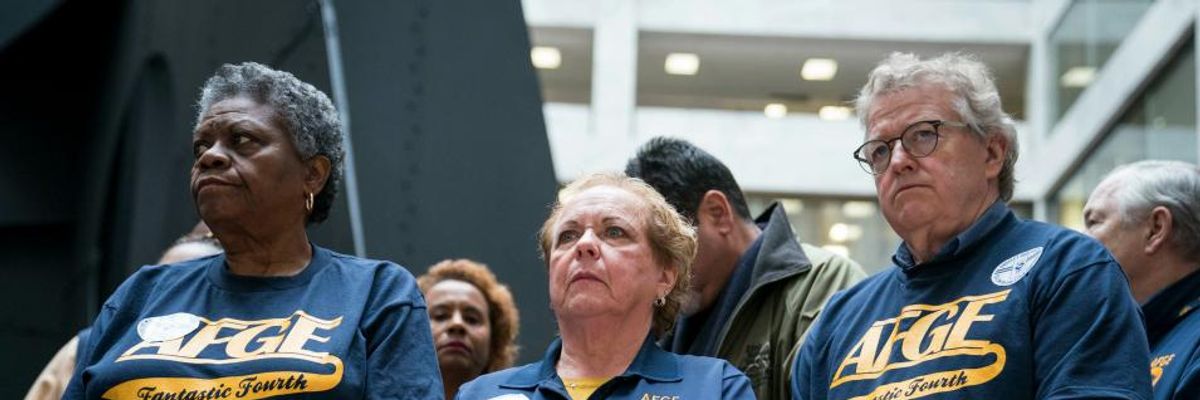
Members and supporters of the American Federation of Government Employees (AFGE) participate in a protest in the Hart Senate Office Building Atrium on February 11, 2020 in Washington, D.C. (Photo: Sarah Silbiger/Getty Images)
After fattening the pockets of wealthy Americans and big corporations with tax cuts and deregulation during his four years in the White House, President Donald Trump is ramping up his assault on workers on his way out the door by backing the Senate GOP's attempt to freeze the pay of civilian federal employees in 2021.
In a letter (pdf) earlier this week to Sen. Richard Shelby (R-Ala.), the chairman of the Senate Appropriations Committee, Trump's budget director said that the White House "supports the policy in the bill to maintain for 2021 the current level of federal civilian employee pay," pointing to "budgetary constraints and recent, pandemic-related impacts on non-federal labor markets."
The letter by Russ Vought, director of the Office of Management and Budget (OMB), was sent around three weeks after Republicans on the Senate Appropriations Committee proposed freezing the pay of federal workers in 2021 as part of their omnibus spending package.
The GOP plan has drawn fierce pushback from Democratic lawmakers and union leaders, who denounced the proposal as a "cruel slap in the face" in the middle of a raging pandemic and economic crisis. The push for a pay freeze comes on top of Trump's effort to gut civil service protections via executive order, a move that has been condemned as an all-out war on the federal workforce.
"Federal employees are the backbone of our functioning democracy and they have continued serving the American people with honor and distinction despite facing tremendous challenges due to the coronavirus pandemic."
--Everett Kelley, AFGE
As Government Executive's Erich Wagner reported Wednesday, the White House's decision to throw its support behind the proposed pay freeze "marks a reversal for the administration, which had previously proposed a 1% across-the-board pay increase for federal workers as part of its fiscal 2021 budget plan."
"If enacted," Wagner noted, "a pay freeze next year would effectively serve as a pay cut for many federal employees, in light of the fact that the Office of Personnel Management has announced that feds will pay an average of 4.9% more toward their insurance premiums in the Federal Employees Health Benefits Program."
Ken Thomas, national president of the National Active and Retired Federal Employees Association, said in a statement late Tuesday that "in a year when federal employees have stepped up to respond to a global pandemic, with tens of thousands on the frontlines working on behalf of the American people and contracting Covid-19 in the process, a 1% pay increase was the least our nation could do to honor the commitment of feds."
"But now, the White House has come out in support of a proposal... which would freeze federal pay at 2020 levels, while at the same time, the administration affirmed its support for a 3% pay increase for military members," said Thomas. "This disparity devalues the contributions of civil servants, who tirelessly and expertly meet the needs of not only our military, but also of our nation as it struggles through this historic crisis and attendant rocky economic conditions."
The fight over the proposed pay freeze comes as House and Senate continue to negotiate a sweeping $1.4 trillion spending deal to prevent the federal government from shutting down on December 11.
"Lawmakers likely need to reach an agreement in the coming days, with text of the omnibus spending package finalized by early next week in order to give the House and Senate enough time to set the procedural gears in motion for passage in both chambers," Politico reported Wednesday.
In a statement, Everett Kelley, national president of the American Federation of Government Employees, demanded that lawmakers reject the Senate GOP's "insulting" pay freeze and grant federal workers "a decent pay increase next year."
"Federal employees are the backbone of our functioning democracy," said Kelley, "and they have continued serving the American people with honor and distinction despite facing tremendous challenges due to the coronavirus pandemic."
Dear Common Dreams reader, It’s been nearly 30 years since I co-founded Common Dreams with my late wife, Lina Newhouser. We had the radical notion that journalism should serve the public good, not corporate profits. It was clear to us from the outset what it would take to build such a project. No paid advertisements. No corporate sponsors. No millionaire publisher telling us what to think or do. Many people said we wouldn't last a year, but we proved those doubters wrong. Together with a tremendous team of journalists and dedicated staff, we built an independent media outlet free from the constraints of profits and corporate control. Our mission has always been simple: To inform. To inspire. To ignite change for the common good. Building Common Dreams was not easy. Our survival was never guaranteed. When you take on the most powerful forces—Wall Street greed, fossil fuel industry destruction, Big Tech lobbyists, and uber-rich oligarchs who have spent billions upon billions rigging the economy and democracy in their favor—the only bulwark you have is supporters who believe in your work. But here’s the urgent message from me today. It's never been this bad out there. And it's never been this hard to keep us going. At the very moment Common Dreams is most needed, the threats we face are intensifying. We need your support now more than ever. We don't accept corporate advertising and never will. We don't have a paywall because we don't think people should be blocked from critical news based on their ability to pay. Everything we do is funded by the donations of readers like you. When everyone does the little they can afford, we are strong. But if that support retreats or dries up, so do we. Will you donate now to make sure Common Dreams not only survives but thrives? —Craig Brown, Co-founder |
After fattening the pockets of wealthy Americans and big corporations with tax cuts and deregulation during his four years in the White House, President Donald Trump is ramping up his assault on workers on his way out the door by backing the Senate GOP's attempt to freeze the pay of civilian federal employees in 2021.
In a letter (pdf) earlier this week to Sen. Richard Shelby (R-Ala.), the chairman of the Senate Appropriations Committee, Trump's budget director said that the White House "supports the policy in the bill to maintain for 2021 the current level of federal civilian employee pay," pointing to "budgetary constraints and recent, pandemic-related impacts on non-federal labor markets."
The letter by Russ Vought, director of the Office of Management and Budget (OMB), was sent around three weeks after Republicans on the Senate Appropriations Committee proposed freezing the pay of federal workers in 2021 as part of their omnibus spending package.
The GOP plan has drawn fierce pushback from Democratic lawmakers and union leaders, who denounced the proposal as a "cruel slap in the face" in the middle of a raging pandemic and economic crisis. The push for a pay freeze comes on top of Trump's effort to gut civil service protections via executive order, a move that has been condemned as an all-out war on the federal workforce.
"Federal employees are the backbone of our functioning democracy and they have continued serving the American people with honor and distinction despite facing tremendous challenges due to the coronavirus pandemic."
--Everett Kelley, AFGE
As Government Executive's Erich Wagner reported Wednesday, the White House's decision to throw its support behind the proposed pay freeze "marks a reversal for the administration, which had previously proposed a 1% across-the-board pay increase for federal workers as part of its fiscal 2021 budget plan."
"If enacted," Wagner noted, "a pay freeze next year would effectively serve as a pay cut for many federal employees, in light of the fact that the Office of Personnel Management has announced that feds will pay an average of 4.9% more toward their insurance premiums in the Federal Employees Health Benefits Program."
Ken Thomas, national president of the National Active and Retired Federal Employees Association, said in a statement late Tuesday that "in a year when federal employees have stepped up to respond to a global pandemic, with tens of thousands on the frontlines working on behalf of the American people and contracting Covid-19 in the process, a 1% pay increase was the least our nation could do to honor the commitment of feds."
"But now, the White House has come out in support of a proposal... which would freeze federal pay at 2020 levels, while at the same time, the administration affirmed its support for a 3% pay increase for military members," said Thomas. "This disparity devalues the contributions of civil servants, who tirelessly and expertly meet the needs of not only our military, but also of our nation as it struggles through this historic crisis and attendant rocky economic conditions."
The fight over the proposed pay freeze comes as House and Senate continue to negotiate a sweeping $1.4 trillion spending deal to prevent the federal government from shutting down on December 11.
"Lawmakers likely need to reach an agreement in the coming days, with text of the omnibus spending package finalized by early next week in order to give the House and Senate enough time to set the procedural gears in motion for passage in both chambers," Politico reported Wednesday.
In a statement, Everett Kelley, national president of the American Federation of Government Employees, demanded that lawmakers reject the Senate GOP's "insulting" pay freeze and grant federal workers "a decent pay increase next year."
"Federal employees are the backbone of our functioning democracy," said Kelley, "and they have continued serving the American people with honor and distinction despite facing tremendous challenges due to the coronavirus pandemic."
After fattening the pockets of wealthy Americans and big corporations with tax cuts and deregulation during his four years in the White House, President Donald Trump is ramping up his assault on workers on his way out the door by backing the Senate GOP's attempt to freeze the pay of civilian federal employees in 2021.
In a letter (pdf) earlier this week to Sen. Richard Shelby (R-Ala.), the chairman of the Senate Appropriations Committee, Trump's budget director said that the White House "supports the policy in the bill to maintain for 2021 the current level of federal civilian employee pay," pointing to "budgetary constraints and recent, pandemic-related impacts on non-federal labor markets."
The letter by Russ Vought, director of the Office of Management and Budget (OMB), was sent around three weeks after Republicans on the Senate Appropriations Committee proposed freezing the pay of federal workers in 2021 as part of their omnibus spending package.
The GOP plan has drawn fierce pushback from Democratic lawmakers and union leaders, who denounced the proposal as a "cruel slap in the face" in the middle of a raging pandemic and economic crisis. The push for a pay freeze comes on top of Trump's effort to gut civil service protections via executive order, a move that has been condemned as an all-out war on the federal workforce.
"Federal employees are the backbone of our functioning democracy and they have continued serving the American people with honor and distinction despite facing tremendous challenges due to the coronavirus pandemic."
--Everett Kelley, AFGE
As Government Executive's Erich Wagner reported Wednesday, the White House's decision to throw its support behind the proposed pay freeze "marks a reversal for the administration, which had previously proposed a 1% across-the-board pay increase for federal workers as part of its fiscal 2021 budget plan."
"If enacted," Wagner noted, "a pay freeze next year would effectively serve as a pay cut for many federal employees, in light of the fact that the Office of Personnel Management has announced that feds will pay an average of 4.9% more toward their insurance premiums in the Federal Employees Health Benefits Program."
Ken Thomas, national president of the National Active and Retired Federal Employees Association, said in a statement late Tuesday that "in a year when federal employees have stepped up to respond to a global pandemic, with tens of thousands on the frontlines working on behalf of the American people and contracting Covid-19 in the process, a 1% pay increase was the least our nation could do to honor the commitment of feds."
"But now, the White House has come out in support of a proposal... which would freeze federal pay at 2020 levels, while at the same time, the administration affirmed its support for a 3% pay increase for military members," said Thomas. "This disparity devalues the contributions of civil servants, who tirelessly and expertly meet the needs of not only our military, but also of our nation as it struggles through this historic crisis and attendant rocky economic conditions."
The fight over the proposed pay freeze comes as House and Senate continue to negotiate a sweeping $1.4 trillion spending deal to prevent the federal government from shutting down on December 11.
"Lawmakers likely need to reach an agreement in the coming days, with text of the omnibus spending package finalized by early next week in order to give the House and Senate enough time to set the procedural gears in motion for passage in both chambers," Politico reported Wednesday.
In a statement, Everett Kelley, national president of the American Federation of Government Employees, demanded that lawmakers reject the Senate GOP's "insulting" pay freeze and grant federal workers "a decent pay increase next year."
"Federal employees are the backbone of our functioning democracy," said Kelley, "and they have continued serving the American people with honor and distinction despite facing tremendous challenges due to the coronavirus pandemic."