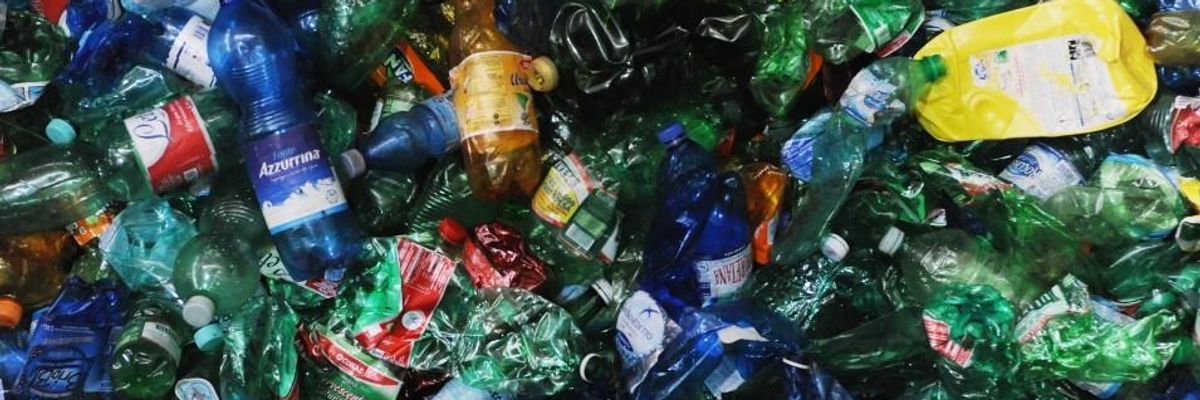
Despite being the world's biggest contributors to plastic pollution, the U.S. and U.K. have so far declined to join a global treaty pledging to tackle the problem.
More Than Two-Thirds of UN Members Embrace Global Plastic Pollution Treaty--But Not the US
"Support for a global treaty on plastic pollution is a critical action that the Biden administration can take to correct the wrongs of the Trump era."
Despite being one of the world's biggest contributors to plastic pollution, the U.S. has so far shown no signs of joining an international treaty aimed at stopping plastics from flowing into the world's oceans and other natural habitats--leaving the country in a small minority as more than two-thirds of United Nations member states signal that a treaty is forthcoming.
At a virtual conference attended last week by the U.N.'s working group on ocean pollution and microplastics, countries in Africa, the Pacific, the Baltic region, and throughout Europe confirmed that they are open to signing a treaty aimed at sharply reducing marine plastic pollution and potentially all plastic waste.
The U.S. was joined by the United Kingdom in declining to participate in the treaty, although the two countries are the biggest per capita plastic polluters in the world. British environmental minister Zac Goldsmith is expected to announce soon whether the country is open to a new treaty or to strengthening the existing international framework governing plastic pollution, while the Trump administration has indicated it is not open to a global treaty on plastics.
"Support for a global treaty on plastic pollution is a critical action that the Biden administration can take to correct the wrongs of the Trump era," Tim Grabiel, senior lawyer at the Environmental Investigations Agency (EIA), told The Guardian on Monday. "Over the last four years, we have continually encountered opposition from the Trump administration to truly address plastic pollution, slowing down progress and watering down international efforts. We are hopeful that, with a change in leadership at the top, the U.S. will join its allies and support a global treaty on plastic pollution at [the U.N. Environmental Assembly's 5th conference]."
The EIA has called for a legally binding global agreement including four pillars to combat plastic pollution from all sources. The group says any treaty ultimately agreed upon by U.N. countries must include:
- Monitoring and reporting on the state of plastic pollution and each nation's progress toward a "circular economy" in which plastic leakage into the environment is kept to a minimum
- Prevention of plastic waste through bans on single-use plastic products and restrictions on plastic production
- Coordination between existing anti-plastic pollution frameworks including the 2001 Stockholm Convention, under which countries agreed to limit or ban the use of certain toxic chemicals including some used in plastics, and the 1989 Basel Convention, which aimed to reduce hazardous waste production and the transboundary movement of such waste
- Technical and financial support for developing countries from wealthier countries
The U.N. Environmental Assembly concluded in 2017 that the Stockholm and Basel Conventions are "fragmented and ineffective" as they are currently implemented, according to The Guardian. The U.S. is only a party to the Basel Convention.
The assembly is currently expected to meet in Kenya in February 2021 for its fifth conference, or in 2022 if the summit is postponed due to the coronavirus pandemic.
Even without the participation of the U.S. and U.K., the EIA called the commitment of a majority of U.N. countries to a new treaty "heartening."
"Maintaining the status quo is not only untenable, it would have catastrophic implications for planet Earth," Christina Dixon, senior ocean campaigner at EIA, told The Guardian.
Global plastic pollution efforts implemented so far are expected to reduce plastic pollution by just 7%, while the oceans are expected to be inundated with 29 million metric tons per year by 2040--triple the amount the currently flows into marine habitats annually.
As the U.N. working group was meeting last week, the World Wildlife Federation (WWF) circulated a petition--signed by two million people so far--calling for a global anti-plastic pollution treaty.
"We are drowning in plastic, but we can resurface," the WWF tweeted. "World leaders urgently need to vote for a U.N. treaty to tackle this crisis."
We are at a crossroads
This country and this world are at a monumental crossroads. In a few short weeks, US voters will have an opportunity to beat back the forces of fascism and confront the billionaires who are rigging the economy, our media system, and our democracy, making it increasingly impossible for ordinary people to get by. We’re not just talking about the election. We’re talking about what must be done once these fascist elements are vanquished from power. We need a bolder set of solutions than what either major party has so far been willing to offer and a working-class movement ready to fight like hell for it. Trump didn't emerge from nowhere. The conditions that fueled MAGA authoritarianism were created by decades of radical neoliberal economic policies and a corrupt political system dominated by corporate interests. They slashed taxes on the super-rich, promising that the benefits would trickle down. They said giveaways to the corporate titans would make life more affordable for the rest of us. It was all bullshit. And when a bitter, betrayed populace searches for someone to blame, right-wing demagogues have little trouble finding scapegoats. People know when they're being lied to, but you won't hear any of this from the corporate media. Only independent journalism—powered and funded by people who believe in building a better world—can deliver truly trustworthy daily news. Our Fall Campaign is underway, and we need your help. To power our newsroom through the rest of the year, we need to raise $125,000 by midnight on October 31. So if you share our vision, please contribute whatever you can to sustain our work. |
Despite being one of the world's biggest contributors to plastic pollution, the U.S. has so far shown no signs of joining an international treaty aimed at stopping plastics from flowing into the world's oceans and other natural habitats--leaving the country in a small minority as more than two-thirds of United Nations member states signal that a treaty is forthcoming.
At a virtual conference attended last week by the U.N.'s working group on ocean pollution and microplastics, countries in Africa, the Pacific, the Baltic region, and throughout Europe confirmed that they are open to signing a treaty aimed at sharply reducing marine plastic pollution and potentially all plastic waste.
The U.S. was joined by the United Kingdom in declining to participate in the treaty, although the two countries are the biggest per capita plastic polluters in the world. British environmental minister Zac Goldsmith is expected to announce soon whether the country is open to a new treaty or to strengthening the existing international framework governing plastic pollution, while the Trump administration has indicated it is not open to a global treaty on plastics.
"Support for a global treaty on plastic pollution is a critical action that the Biden administration can take to correct the wrongs of the Trump era," Tim Grabiel, senior lawyer at the Environmental Investigations Agency (EIA), told The Guardian on Monday. "Over the last four years, we have continually encountered opposition from the Trump administration to truly address plastic pollution, slowing down progress and watering down international efforts. We are hopeful that, with a change in leadership at the top, the U.S. will join its allies and support a global treaty on plastic pollution at [the U.N. Environmental Assembly's 5th conference]."
The EIA has called for a legally binding global agreement including four pillars to combat plastic pollution from all sources. The group says any treaty ultimately agreed upon by U.N. countries must include:
- Monitoring and reporting on the state of plastic pollution and each nation's progress toward a "circular economy" in which plastic leakage into the environment is kept to a minimum
- Prevention of plastic waste through bans on single-use plastic products and restrictions on plastic production
- Coordination between existing anti-plastic pollution frameworks including the 2001 Stockholm Convention, under which countries agreed to limit or ban the use of certain toxic chemicals including some used in plastics, and the 1989 Basel Convention, which aimed to reduce hazardous waste production and the transboundary movement of such waste
- Technical and financial support for developing countries from wealthier countries
The U.N. Environmental Assembly concluded in 2017 that the Stockholm and Basel Conventions are "fragmented and ineffective" as they are currently implemented, according to The Guardian. The U.S. is only a party to the Basel Convention.
The assembly is currently expected to meet in Kenya in February 2021 for its fifth conference, or in 2022 if the summit is postponed due to the coronavirus pandemic.
Even without the participation of the U.S. and U.K., the EIA called the commitment of a majority of U.N. countries to a new treaty "heartening."
"Maintaining the status quo is not only untenable, it would have catastrophic implications for planet Earth," Christina Dixon, senior ocean campaigner at EIA, told The Guardian.
Global plastic pollution efforts implemented so far are expected to reduce plastic pollution by just 7%, while the oceans are expected to be inundated with 29 million metric tons per year by 2040--triple the amount the currently flows into marine habitats annually.
As the U.N. working group was meeting last week, the World Wildlife Federation (WWF) circulated a petition--signed by two million people so far--calling for a global anti-plastic pollution treaty.
"We are drowning in plastic, but we can resurface," the WWF tweeted. "World leaders urgently need to vote for a U.N. treaty to tackle this crisis."
Despite being one of the world's biggest contributors to plastic pollution, the U.S. has so far shown no signs of joining an international treaty aimed at stopping plastics from flowing into the world's oceans and other natural habitats--leaving the country in a small minority as more than two-thirds of United Nations member states signal that a treaty is forthcoming.
At a virtual conference attended last week by the U.N.'s working group on ocean pollution and microplastics, countries in Africa, the Pacific, the Baltic region, and throughout Europe confirmed that they are open to signing a treaty aimed at sharply reducing marine plastic pollution and potentially all plastic waste.
The U.S. was joined by the United Kingdom in declining to participate in the treaty, although the two countries are the biggest per capita plastic polluters in the world. British environmental minister Zac Goldsmith is expected to announce soon whether the country is open to a new treaty or to strengthening the existing international framework governing plastic pollution, while the Trump administration has indicated it is not open to a global treaty on plastics.
"Support for a global treaty on plastic pollution is a critical action that the Biden administration can take to correct the wrongs of the Trump era," Tim Grabiel, senior lawyer at the Environmental Investigations Agency (EIA), told The Guardian on Monday. "Over the last four years, we have continually encountered opposition from the Trump administration to truly address plastic pollution, slowing down progress and watering down international efforts. We are hopeful that, with a change in leadership at the top, the U.S. will join its allies and support a global treaty on plastic pollution at [the U.N. Environmental Assembly's 5th conference]."
The EIA has called for a legally binding global agreement including four pillars to combat plastic pollution from all sources. The group says any treaty ultimately agreed upon by U.N. countries must include:
- Monitoring and reporting on the state of plastic pollution and each nation's progress toward a "circular economy" in which plastic leakage into the environment is kept to a minimum
- Prevention of plastic waste through bans on single-use plastic products and restrictions on plastic production
- Coordination between existing anti-plastic pollution frameworks including the 2001 Stockholm Convention, under which countries agreed to limit or ban the use of certain toxic chemicals including some used in plastics, and the 1989 Basel Convention, which aimed to reduce hazardous waste production and the transboundary movement of such waste
- Technical and financial support for developing countries from wealthier countries
The U.N. Environmental Assembly concluded in 2017 that the Stockholm and Basel Conventions are "fragmented and ineffective" as they are currently implemented, according to The Guardian. The U.S. is only a party to the Basel Convention.
The assembly is currently expected to meet in Kenya in February 2021 for its fifth conference, or in 2022 if the summit is postponed due to the coronavirus pandemic.
Even without the participation of the U.S. and U.K., the EIA called the commitment of a majority of U.N. countries to a new treaty "heartening."
"Maintaining the status quo is not only untenable, it would have catastrophic implications for planet Earth," Christina Dixon, senior ocean campaigner at EIA, told The Guardian.
Global plastic pollution efforts implemented so far are expected to reduce plastic pollution by just 7%, while the oceans are expected to be inundated with 29 million metric tons per year by 2040--triple the amount the currently flows into marine habitats annually.
As the U.N. working group was meeting last week, the World Wildlife Federation (WWF) circulated a petition--signed by two million people so far--calling for a global anti-plastic pollution treaty.
"We are drowning in plastic, but we can resurface," the WWF tweeted. "World leaders urgently need to vote for a U.N. treaty to tackle this crisis."