SUBSCRIBE TO OUR FREE NEWSLETTER
Daily news & progressive opinion—funded by the people, not the corporations—delivered straight to your inbox.
5
#000000
#FFFFFF
To donate by check, phone, or other method, see our More Ways to Give page.
Daily news & progressive opinion—funded by the people, not the corporations—delivered straight to your inbox.
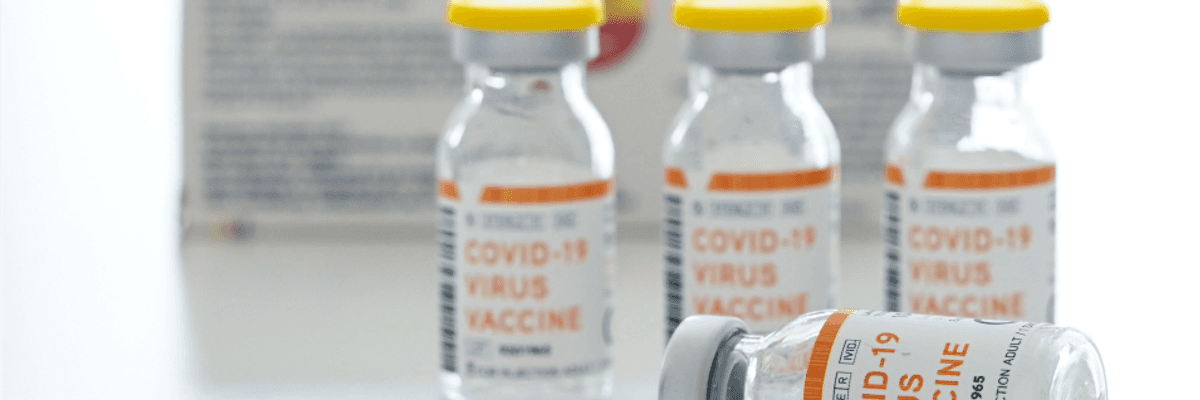
Bottles of a trial Covid-19 vaccine on a table in a lab in Brussels on June 18, 2020. (Photo: Vincent Kalut/Photonews via Getty Images)
Campaigners in the United Kingdom on Wednesday warned that just two days after pharmaceutical giant Pfizer shared positive early results of its coronavirus vaccine trial, mass purchases of the vaccine by the world's richest countries have left more than 85% of the global population--namely, the world's poorest--without any way to access it.
Pfizer says it can produce 1.35 billion doses of the vaccine, which was shown according to Pfizer's first formal review to be 90% effective at preventing coronavirus infection in patients who have never had the virus, by the end of 2021. More than one billion of those doses--82% of the supply--have already been purchased by wealthy countries.
The U.S. has purchased 100 million doses with an option to buy 500 million, enough to potentially immunize its entire population against the coronavirus with hundreds of millions of doses left over. Since Monday Pfizer has also sold 40 million doses to the U.K. and 200 million doses to the E.U., with an option to buy 100 million more.
"Unless we break the stranglehold of these massive corporations over our medicines, the injustice will continue."
--Nick Dearden, Global Justice Now
In a statement, the British campaign group Global Justice Now noted that Pfizer's partner in the development of the vaccine, German manufacturer BioNTech, has received financing of EUR375 million ($441 million) from the German government and EUR100 million ($117 million) from the European Investment Bank.
"Pfizer claims not to have had any state support, but the advance purchase of a billion doses of an unproven drug, not to mention the tax breaks and direct public funding of Pfizer's partner suggests their claim is misleading at best," said Global Justice Now director Nick Dearden. "Unless we break the stranglehold of these massive corporations over our medicines, the injustice will continue."
Global Justice Now noted that Pfizer is likely to give some doses to developing countries through the World Health Organization's Covid-19 Vaccines Global Access Facility (COVAX). However, those doses are expected to make up a small fraction of those produced by Pfizer, leaving billions of people without access to the vaccine.
COVAX has been undermined by the refusal of some wealthy countries, including the U.S., to take part in the global effort to ensure vaccine access, and now by mass purchases by some of those same countries.
"You couldn't get a clearer example of how unequal the pharmaceutical system is--some make billions of pounds, while many others die because they cannot afford treatments or there are no more left for them to buy," Dearden said. "It's got to change."
Global Justice Now repeated its call from earlier this week for the suspension of global patent rules to make it possible for poor countries to develop generic versions of Pfizer's vaccine. South Africa and India last month proposed that the World Trade Organization suspend the rules on intellectual property for vaccines and treatments related to Covid-19.
"It is imperative that we end the vaccine nationalism and that sufficient supply is made available to all, on a fair basis, as a matter of urgency," said Dearden. "That can be helped by supporting governments like South Africa and India who are trying to suspend intellectual property rules at the WTO during this global emergency."
Dear Common Dreams reader, It’s been nearly 30 years since I co-founded Common Dreams with my late wife, Lina Newhouser. We had the radical notion that journalism should serve the public good, not corporate profits. It was clear to us from the outset what it would take to build such a project. No paid advertisements. No corporate sponsors. No millionaire publisher telling us what to think or do. Many people said we wouldn't last a year, but we proved those doubters wrong. Together with a tremendous team of journalists and dedicated staff, we built an independent media outlet free from the constraints of profits and corporate control. Our mission has always been simple: To inform. To inspire. To ignite change for the common good. Building Common Dreams was not easy. Our survival was never guaranteed. When you take on the most powerful forces—Wall Street greed, fossil fuel industry destruction, Big Tech lobbyists, and uber-rich oligarchs who have spent billions upon billions rigging the economy and democracy in their favor—the only bulwark you have is supporters who believe in your work. But here’s the urgent message from me today. It's never been this bad out there. And it's never been this hard to keep us going. At the very moment Common Dreams is most needed, the threats we face are intensifying. We need your support now more than ever. We don't accept corporate advertising and never will. We don't have a paywall because we don't think people should be blocked from critical news based on their ability to pay. Everything we do is funded by the donations of readers like you. When everyone does the little they can afford, we are strong. But if that support retreats or dries up, so do we. Will you donate now to make sure Common Dreams not only survives but thrives? —Craig Brown, Co-founder |
Campaigners in the United Kingdom on Wednesday warned that just two days after pharmaceutical giant Pfizer shared positive early results of its coronavirus vaccine trial, mass purchases of the vaccine by the world's richest countries have left more than 85% of the global population--namely, the world's poorest--without any way to access it.
Pfizer says it can produce 1.35 billion doses of the vaccine, which was shown according to Pfizer's first formal review to be 90% effective at preventing coronavirus infection in patients who have never had the virus, by the end of 2021. More than one billion of those doses--82% of the supply--have already been purchased by wealthy countries.
The U.S. has purchased 100 million doses with an option to buy 500 million, enough to potentially immunize its entire population against the coronavirus with hundreds of millions of doses left over. Since Monday Pfizer has also sold 40 million doses to the U.K. and 200 million doses to the E.U., with an option to buy 100 million more.
"Unless we break the stranglehold of these massive corporations over our medicines, the injustice will continue."
--Nick Dearden, Global Justice Now
In a statement, the British campaign group Global Justice Now noted that Pfizer's partner in the development of the vaccine, German manufacturer BioNTech, has received financing of EUR375 million ($441 million) from the German government and EUR100 million ($117 million) from the European Investment Bank.
"Pfizer claims not to have had any state support, but the advance purchase of a billion doses of an unproven drug, not to mention the tax breaks and direct public funding of Pfizer's partner suggests their claim is misleading at best," said Global Justice Now director Nick Dearden. "Unless we break the stranglehold of these massive corporations over our medicines, the injustice will continue."
Global Justice Now noted that Pfizer is likely to give some doses to developing countries through the World Health Organization's Covid-19 Vaccines Global Access Facility (COVAX). However, those doses are expected to make up a small fraction of those produced by Pfizer, leaving billions of people without access to the vaccine.
COVAX has been undermined by the refusal of some wealthy countries, including the U.S., to take part in the global effort to ensure vaccine access, and now by mass purchases by some of those same countries.
"You couldn't get a clearer example of how unequal the pharmaceutical system is--some make billions of pounds, while many others die because they cannot afford treatments or there are no more left for them to buy," Dearden said. "It's got to change."
Global Justice Now repeated its call from earlier this week for the suspension of global patent rules to make it possible for poor countries to develop generic versions of Pfizer's vaccine. South Africa and India last month proposed that the World Trade Organization suspend the rules on intellectual property for vaccines and treatments related to Covid-19.
"It is imperative that we end the vaccine nationalism and that sufficient supply is made available to all, on a fair basis, as a matter of urgency," said Dearden. "That can be helped by supporting governments like South Africa and India who are trying to suspend intellectual property rules at the WTO during this global emergency."
Campaigners in the United Kingdom on Wednesday warned that just two days after pharmaceutical giant Pfizer shared positive early results of its coronavirus vaccine trial, mass purchases of the vaccine by the world's richest countries have left more than 85% of the global population--namely, the world's poorest--without any way to access it.
Pfizer says it can produce 1.35 billion doses of the vaccine, which was shown according to Pfizer's first formal review to be 90% effective at preventing coronavirus infection in patients who have never had the virus, by the end of 2021. More than one billion of those doses--82% of the supply--have already been purchased by wealthy countries.
The U.S. has purchased 100 million doses with an option to buy 500 million, enough to potentially immunize its entire population against the coronavirus with hundreds of millions of doses left over. Since Monday Pfizer has also sold 40 million doses to the U.K. and 200 million doses to the E.U., with an option to buy 100 million more.
"Unless we break the stranglehold of these massive corporations over our medicines, the injustice will continue."
--Nick Dearden, Global Justice Now
In a statement, the British campaign group Global Justice Now noted that Pfizer's partner in the development of the vaccine, German manufacturer BioNTech, has received financing of EUR375 million ($441 million) from the German government and EUR100 million ($117 million) from the European Investment Bank.
"Pfizer claims not to have had any state support, but the advance purchase of a billion doses of an unproven drug, not to mention the tax breaks and direct public funding of Pfizer's partner suggests their claim is misleading at best," said Global Justice Now director Nick Dearden. "Unless we break the stranglehold of these massive corporations over our medicines, the injustice will continue."
Global Justice Now noted that Pfizer is likely to give some doses to developing countries through the World Health Organization's Covid-19 Vaccines Global Access Facility (COVAX). However, those doses are expected to make up a small fraction of those produced by Pfizer, leaving billions of people without access to the vaccine.
COVAX has been undermined by the refusal of some wealthy countries, including the U.S., to take part in the global effort to ensure vaccine access, and now by mass purchases by some of those same countries.
"You couldn't get a clearer example of how unequal the pharmaceutical system is--some make billions of pounds, while many others die because they cannot afford treatments or there are no more left for them to buy," Dearden said. "It's got to change."
Global Justice Now repeated its call from earlier this week for the suspension of global patent rules to make it possible for poor countries to develop generic versions of Pfizer's vaccine. South Africa and India last month proposed that the World Trade Organization suspend the rules on intellectual property for vaccines and treatments related to Covid-19.
"It is imperative that we end the vaccine nationalism and that sufficient supply is made available to all, on a fair basis, as a matter of urgency," said Dearden. "That can be helped by supporting governments like South Africa and India who are trying to suspend intellectual property rules at the WTO during this global emergency."