SUBSCRIBE TO OUR FREE NEWSLETTER
Daily news & progressive opinion—funded by the people, not the corporations—delivered straight to your inbox.
5
#000000
#FFFFFF
To donate by check, phone, or other method, see our More Ways to Give page.
Daily news & progressive opinion—funded by the people, not the corporations—delivered straight to your inbox.
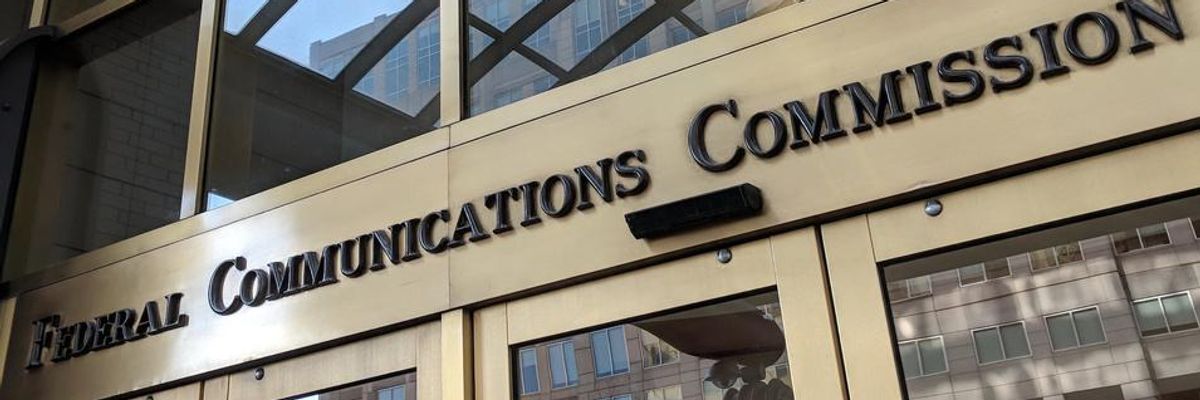
The entrance to the Federal Communications Commission headquarters in Washington, D.C. (Photo: Rob Pegoraro/Flickr cc)
President Donald Trump's Republican nominee to the Federal Communications Commission on Tuesday failed to disclose to the Senate his support for an effort backed by the president to gut what one leading advocacy group called "the most important law protecting internet speech."
Nathan Simington, currently an adviser at the National Telecommunications and Information Administration (NTIA) and a former telecommunications attorney, submitted written testimony ahead of his Tuesday afternoon Senate hearing.
Reuters reports Simington said in his testimony that his "first principle is regulatory stability," while asserting that the FCC "must be thoughtful about potential chilling effects on development if its regulatory efforts go over the line and become intrusive, disruptive, and burdensome."
Simington also stressed the need to bridge the digital divide, warning that "if some Americans are denied access to advanced technologies, we are... denying ourselves the benefit of their contributions."
But it wasn't what Simington said that his critics noticed most, it was what he didn't mention--namely, Section 230 of the Communications Decency Act, the lightning rod issue of his potential confirmation.
The law--which states that "no provider or user of an interactive computer service shall be treated as the publisher or speaker of any information provided by another information content provider"--largely protects websites, including social media platforms, from being held responsible or legally liable for content posted by third-party users.
The digital rights group Electronic Frontier Foundation calls Section 230 "the most important law protecting internet speech." According to EFF:
This legal and policy framework has allowed for YouTube and Vimeo users to upload their own videos, Amazon and Yelp to offer countless user reviews, Craigslist to host classified ads, and Facebook and Twitter to offer social networking to hundreds of millions of Internet users. Given the sheer size of user-generated websites... it would be infeasible for online intermediaries to prevent objectionable content from cropping up on their site. Rather than face potential liability for their users' actions, most would likely not host any user content at all or would need to protect themselves by being actively engaged in censoring what we say, what we see, and what we do online. In short, [Section] 230 is perhaps the most influential law to protect the kind of innovation that has allowed the internet to thrive since 1996.
Simington has supported Trump's May 2020 executive order to reinterpret Section 230, ostensibly in the name of protecting free speech online. However, critics called this claim highly dubious, noting the president issued the order after Twitter placed warnings on two of his tweets for the first time, labeling his lies about mail-in voting as "potentially misleading."
If Simington is confirmed for a seat on the FCC, he would join two other Republicans, Chairman Ajit Pai and Brendan Carr, who have expressed oppenness to weakening Section 230's protections. Pai--who is well known for destroying net neutrality--claims there is bipartisan support for reforming the law.
In January 2020, President-elect Joe Biden proposed revoking Section 230 not because social media and other sites were censoring free speech but rather due to their "propagating falsehoods they know to be false."
Trump tapped Simington after Republican FCC Commissioner Michael O'Rielly's nomination for a new term was withdrawn in August after he expressed skepticism over whether the agency even had the constitutional authority to issue new social media regulations.
Digital rights advocates sounded the alarm on Simington's potential confirmation.
"This guy is even worse than Ajit Pai," warned Evan Greer, deputy director of the advocacy group Fight for the Future. "His only qualifications are his steadfast loyalty to an outgoing wannabe tyrant and his undying love for convoluted attacks on Internet freedom. Simington literally helped write the Trump administration's deeply silly proposal to blow up Section 230 and put the FCC in charge of policing online speech. And he's being supported by the same companies that spent mountains of money lobbying to gut net neutrality."
Greer added that "we are in the middle of a crushing pandemic where hundreds of millions of people are at the mercy of their internet service providers while they work from home and send their kids to school online. It's unthinkable that in this moment, especially in light of the election results, that the Senate would confirm an unqualified crony to the agency that is supposed to provide basic oversight."
"The Senate should reject Simington's nomination post haste," added Greer. "Ajit Pai should step down and fade into obscurity as a cautionary Internet meme. And the Biden/Harris administration should act quickly to appoint a new chair of the FCC who will restore net neutrality, defend the First Amendment, and fight for Internet access, freedom, and privacy for all."
Dear Common Dreams reader, It’s been nearly 30 years since I co-founded Common Dreams with my late wife, Lina Newhouser. We had the radical notion that journalism should serve the public good, not corporate profits. It was clear to us from the outset what it would take to build such a project. No paid advertisements. No corporate sponsors. No millionaire publisher telling us what to think or do. Many people said we wouldn't last a year, but we proved those doubters wrong. Together with a tremendous team of journalists and dedicated staff, we built an independent media outlet free from the constraints of profits and corporate control. Our mission has always been simple: To inform. To inspire. To ignite change for the common good. Building Common Dreams was not easy. Our survival was never guaranteed. When you take on the most powerful forces—Wall Street greed, fossil fuel industry destruction, Big Tech lobbyists, and uber-rich oligarchs who have spent billions upon billions rigging the economy and democracy in their favor—the only bulwark you have is supporters who believe in your work. But here’s the urgent message from me today. It's never been this bad out there. And it's never been this hard to keep us going. At the very moment Common Dreams is most needed, the threats we face are intensifying. We need your support now more than ever. We don't accept corporate advertising and never will. We don't have a paywall because we don't think people should be blocked from critical news based on their ability to pay. Everything we do is funded by the donations of readers like you. When everyone does the little they can afford, we are strong. But if that support retreats or dries up, so do we. Will you donate now to make sure Common Dreams not only survives but thrives? —Craig Brown, Co-founder |
President Donald Trump's Republican nominee to the Federal Communications Commission on Tuesday failed to disclose to the Senate his support for an effort backed by the president to gut what one leading advocacy group called "the most important law protecting internet speech."
Nathan Simington, currently an adviser at the National Telecommunications and Information Administration (NTIA) and a former telecommunications attorney, submitted written testimony ahead of his Tuesday afternoon Senate hearing.
Reuters reports Simington said in his testimony that his "first principle is regulatory stability," while asserting that the FCC "must be thoughtful about potential chilling effects on development if its regulatory efforts go over the line and become intrusive, disruptive, and burdensome."
Simington also stressed the need to bridge the digital divide, warning that "if some Americans are denied access to advanced technologies, we are... denying ourselves the benefit of their contributions."
But it wasn't what Simington said that his critics noticed most, it was what he didn't mention--namely, Section 230 of the Communications Decency Act, the lightning rod issue of his potential confirmation.
The law--which states that "no provider or user of an interactive computer service shall be treated as the publisher or speaker of any information provided by another information content provider"--largely protects websites, including social media platforms, from being held responsible or legally liable for content posted by third-party users.
The digital rights group Electronic Frontier Foundation calls Section 230 "the most important law protecting internet speech." According to EFF:
This legal and policy framework has allowed for YouTube and Vimeo users to upload their own videos, Amazon and Yelp to offer countless user reviews, Craigslist to host classified ads, and Facebook and Twitter to offer social networking to hundreds of millions of Internet users. Given the sheer size of user-generated websites... it would be infeasible for online intermediaries to prevent objectionable content from cropping up on their site. Rather than face potential liability for their users' actions, most would likely not host any user content at all or would need to protect themselves by being actively engaged in censoring what we say, what we see, and what we do online. In short, [Section] 230 is perhaps the most influential law to protect the kind of innovation that has allowed the internet to thrive since 1996.
Simington has supported Trump's May 2020 executive order to reinterpret Section 230, ostensibly in the name of protecting free speech online. However, critics called this claim highly dubious, noting the president issued the order after Twitter placed warnings on two of his tweets for the first time, labeling his lies about mail-in voting as "potentially misleading."
If Simington is confirmed for a seat on the FCC, he would join two other Republicans, Chairman Ajit Pai and Brendan Carr, who have expressed oppenness to weakening Section 230's protections. Pai--who is well known for destroying net neutrality--claims there is bipartisan support for reforming the law.
In January 2020, President-elect Joe Biden proposed revoking Section 230 not because social media and other sites were censoring free speech but rather due to their "propagating falsehoods they know to be false."
Trump tapped Simington after Republican FCC Commissioner Michael O'Rielly's nomination for a new term was withdrawn in August after he expressed skepticism over whether the agency even had the constitutional authority to issue new social media regulations.
Digital rights advocates sounded the alarm on Simington's potential confirmation.
"This guy is even worse than Ajit Pai," warned Evan Greer, deputy director of the advocacy group Fight for the Future. "His only qualifications are his steadfast loyalty to an outgoing wannabe tyrant and his undying love for convoluted attacks on Internet freedom. Simington literally helped write the Trump administration's deeply silly proposal to blow up Section 230 and put the FCC in charge of policing online speech. And he's being supported by the same companies that spent mountains of money lobbying to gut net neutrality."
Greer added that "we are in the middle of a crushing pandemic where hundreds of millions of people are at the mercy of their internet service providers while they work from home and send their kids to school online. It's unthinkable that in this moment, especially in light of the election results, that the Senate would confirm an unqualified crony to the agency that is supposed to provide basic oversight."
"The Senate should reject Simington's nomination post haste," added Greer. "Ajit Pai should step down and fade into obscurity as a cautionary Internet meme. And the Biden/Harris administration should act quickly to appoint a new chair of the FCC who will restore net neutrality, defend the First Amendment, and fight for Internet access, freedom, and privacy for all."
President Donald Trump's Republican nominee to the Federal Communications Commission on Tuesday failed to disclose to the Senate his support for an effort backed by the president to gut what one leading advocacy group called "the most important law protecting internet speech."
Nathan Simington, currently an adviser at the National Telecommunications and Information Administration (NTIA) and a former telecommunications attorney, submitted written testimony ahead of his Tuesday afternoon Senate hearing.
Reuters reports Simington said in his testimony that his "first principle is regulatory stability," while asserting that the FCC "must be thoughtful about potential chilling effects on development if its regulatory efforts go over the line and become intrusive, disruptive, and burdensome."
Simington also stressed the need to bridge the digital divide, warning that "if some Americans are denied access to advanced technologies, we are... denying ourselves the benefit of their contributions."
But it wasn't what Simington said that his critics noticed most, it was what he didn't mention--namely, Section 230 of the Communications Decency Act, the lightning rod issue of his potential confirmation.
The law--which states that "no provider or user of an interactive computer service shall be treated as the publisher or speaker of any information provided by another information content provider"--largely protects websites, including social media platforms, from being held responsible or legally liable for content posted by third-party users.
The digital rights group Electronic Frontier Foundation calls Section 230 "the most important law protecting internet speech." According to EFF:
This legal and policy framework has allowed for YouTube and Vimeo users to upload their own videos, Amazon and Yelp to offer countless user reviews, Craigslist to host classified ads, and Facebook and Twitter to offer social networking to hundreds of millions of Internet users. Given the sheer size of user-generated websites... it would be infeasible for online intermediaries to prevent objectionable content from cropping up on their site. Rather than face potential liability for their users' actions, most would likely not host any user content at all or would need to protect themselves by being actively engaged in censoring what we say, what we see, and what we do online. In short, [Section] 230 is perhaps the most influential law to protect the kind of innovation that has allowed the internet to thrive since 1996.
Simington has supported Trump's May 2020 executive order to reinterpret Section 230, ostensibly in the name of protecting free speech online. However, critics called this claim highly dubious, noting the president issued the order after Twitter placed warnings on two of his tweets for the first time, labeling his lies about mail-in voting as "potentially misleading."
If Simington is confirmed for a seat on the FCC, he would join two other Republicans, Chairman Ajit Pai and Brendan Carr, who have expressed oppenness to weakening Section 230's protections. Pai--who is well known for destroying net neutrality--claims there is bipartisan support for reforming the law.
In January 2020, President-elect Joe Biden proposed revoking Section 230 not because social media and other sites were censoring free speech but rather due to their "propagating falsehoods they know to be false."
Trump tapped Simington after Republican FCC Commissioner Michael O'Rielly's nomination for a new term was withdrawn in August after he expressed skepticism over whether the agency even had the constitutional authority to issue new social media regulations.
Digital rights advocates sounded the alarm on Simington's potential confirmation.
"This guy is even worse than Ajit Pai," warned Evan Greer, deputy director of the advocacy group Fight for the Future. "His only qualifications are his steadfast loyalty to an outgoing wannabe tyrant and his undying love for convoluted attacks on Internet freedom. Simington literally helped write the Trump administration's deeply silly proposal to blow up Section 230 and put the FCC in charge of policing online speech. And he's being supported by the same companies that spent mountains of money lobbying to gut net neutrality."
Greer added that "we are in the middle of a crushing pandemic where hundreds of millions of people are at the mercy of their internet service providers while they work from home and send their kids to school online. It's unthinkable that in this moment, especially in light of the election results, that the Senate would confirm an unqualified crony to the agency that is supposed to provide basic oversight."
"The Senate should reject Simington's nomination post haste," added Greer. "Ajit Pai should step down and fade into obscurity as a cautionary Internet meme. And the Biden/Harris administration should act quickly to appoint a new chair of the FCC who will restore net neutrality, defend the First Amendment, and fight for Internet access, freedom, and privacy for all."