SUBSCRIBE TO OUR FREE NEWSLETTER
Daily news & progressive opinion—funded by the people, not the corporations—delivered straight to your inbox.
5
#000000
#FFFFFF
To donate by check, phone, or other method, see our More Ways to Give page.
Daily news & progressive opinion—funded by the people, not the corporations—delivered straight to your inbox.
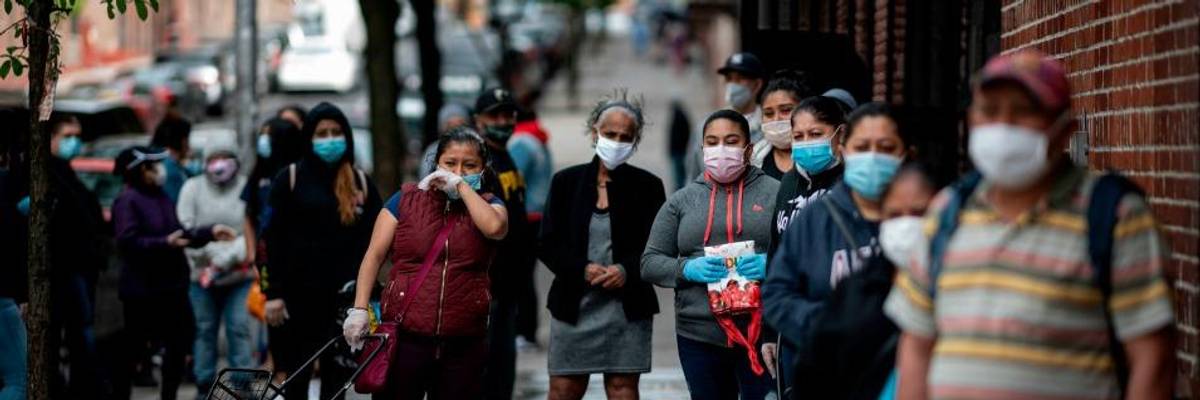
People in need line up for food donations on May 19, 2020 in the Bronx borough of New York City. (Photo by Johannes Eisele / AFP via Getty Images)
In addition to imposing likely delays in the delivery of mail-in ballots during the November elections through its sabotage of the U.S. Postal Service, the Trump administration appears intent on jeopardizing elections and marginalized communities for decades to come, critics said Sunday of the president's abrupt change to the U.S. census deadline.
When the coronavirus pandemic began, the deadline for the 2020 census was extended from mid-August to late October. When the Census Bureau announced last week that it would require the survey to end September 30, advocates for marginalized communities warned that the new deadline could result in a severe undercount of people in largely Black and Latino neighborhoods, rural areas, and other often-overlooked parts of the country.
Federal funding for elections, education, free and reduced lunch programs, and other community programs is determined based on census data, and an inaccurate count of people in under-represented areas could result in years of insufficient funding, experts say.
In a Washington Post report, advocates on Sunday pointed to largely Black, Latino, and Indigenous communities which were already facing an undercount even before the deadline was changed.
"If certain areas are not represented with their full accurate count, that means their funding will be diminished as well," Diana Elliott, principal research associate at the Urban Institute, told the Post. "I think, for example, of the Rio Grande Valley. That area of Texas will get less money than, say, the suburbs of Dallas. And that's not really a fair and equitable distribution of resources."
So far, as few as 37% of households in the Rio Grande Valley, where Starr County has the highest percentage of Latino households in the country, have filled out the census. With about seven weeks to go, only 63% of the U.S. population has filled out the survey.
On social media, journalist Jamil Smith wrote that the shortening of the deadline, particularly during a pandemic that's driven response rates down, will be catastrophic for political representation as well as community funding.
Census data is used to draw boundaries for legislative districts and to determine who represents communities in the U.S. House.
"This will likely undermine Latino and Democratic representation in redistricting for a decade and potentially beyond because lawmakers elected under 2020s districts in many states will be the ones drawing 2030s districts," tweeted Stephen Wolf of Daily Kos Elections.
Census experts are concerned about the counting of people in rural areas where broadband access is limited, low-income neighborhoods, immigrant communities, and other places where government distrust is prevalent as census-takers begin collecting data door-to-door on Tuesday, following an online survey.
The changing of the census deadline came days after Trump was sued by the ACLU, Common Cause, and a coalition of 21 states over his memo advising that undocumented immigrants should not be counted for the purpose of congressional seat apportionment.
Leaving undocumented people out--and giving census-takers less time to reach them--could significantly affect Latino communities because many immigrant families have members of mixed status regarding documentation.
"We're in the middle of a global pandemic, and they might be shortchanging every Latino community for 10 years to come. This is cruel," Lizette Escobedo of NALEO Educational Fund, a Latino rights group, told the Post.
The Lawyers' Committee for Civil Rights Under Law on Saturday warned that Postmaster General Louis DeJoy's "Friday Night Massacre" at the USPS will further undermine an accurate count of people living in the United States.
"The postal service helps ensure that our nation's most vulnerable communities are receiving medications and resources during the pandemic," said Kristen Clarke, president of the group. "It is also critical to the efforts to achieve a full and accurate 2020 Census."
Dear Common Dreams reader, It’s been nearly 30 years since I co-founded Common Dreams with my late wife, Lina Newhouser. We had the radical notion that journalism should serve the public good, not corporate profits. It was clear to us from the outset what it would take to build such a project. No paid advertisements. No corporate sponsors. No millionaire publisher telling us what to think or do. Many people said we wouldn't last a year, but we proved those doubters wrong. Together with a tremendous team of journalists and dedicated staff, we built an independent media outlet free from the constraints of profits and corporate control. Our mission has always been simple: To inform. To inspire. To ignite change for the common good. Building Common Dreams was not easy. Our survival was never guaranteed. When you take on the most powerful forces—Wall Street greed, fossil fuel industry destruction, Big Tech lobbyists, and uber-rich oligarchs who have spent billions upon billions rigging the economy and democracy in their favor—the only bulwark you have is supporters who believe in your work. But here’s the urgent message from me today. It's never been this bad out there. And it's never been this hard to keep us going. At the very moment Common Dreams is most needed, the threats we face are intensifying. We need your support now more than ever. We don't accept corporate advertising and never will. We don't have a paywall because we don't think people should be blocked from critical news based on their ability to pay. Everything we do is funded by the donations of readers like you. When everyone does the little they can afford, we are strong. But if that support retreats or dries up, so do we. Will you donate now to make sure Common Dreams not only survives but thrives? —Craig Brown, Co-founder |
In addition to imposing likely delays in the delivery of mail-in ballots during the November elections through its sabotage of the U.S. Postal Service, the Trump administration appears intent on jeopardizing elections and marginalized communities for decades to come, critics said Sunday of the president's abrupt change to the U.S. census deadline.
When the coronavirus pandemic began, the deadline for the 2020 census was extended from mid-August to late October. When the Census Bureau announced last week that it would require the survey to end September 30, advocates for marginalized communities warned that the new deadline could result in a severe undercount of people in largely Black and Latino neighborhoods, rural areas, and other often-overlooked parts of the country.
Federal funding for elections, education, free and reduced lunch programs, and other community programs is determined based on census data, and an inaccurate count of people in under-represented areas could result in years of insufficient funding, experts say.
In a Washington Post report, advocates on Sunday pointed to largely Black, Latino, and Indigenous communities which were already facing an undercount even before the deadline was changed.
"If certain areas are not represented with their full accurate count, that means their funding will be diminished as well," Diana Elliott, principal research associate at the Urban Institute, told the Post. "I think, for example, of the Rio Grande Valley. That area of Texas will get less money than, say, the suburbs of Dallas. And that's not really a fair and equitable distribution of resources."
So far, as few as 37% of households in the Rio Grande Valley, where Starr County has the highest percentage of Latino households in the country, have filled out the census. With about seven weeks to go, only 63% of the U.S. population has filled out the survey.
On social media, journalist Jamil Smith wrote that the shortening of the deadline, particularly during a pandemic that's driven response rates down, will be catastrophic for political representation as well as community funding.
Census data is used to draw boundaries for legislative districts and to determine who represents communities in the U.S. House.
"This will likely undermine Latino and Democratic representation in redistricting for a decade and potentially beyond because lawmakers elected under 2020s districts in many states will be the ones drawing 2030s districts," tweeted Stephen Wolf of Daily Kos Elections.
Census experts are concerned about the counting of people in rural areas where broadband access is limited, low-income neighborhoods, immigrant communities, and other places where government distrust is prevalent as census-takers begin collecting data door-to-door on Tuesday, following an online survey.
The changing of the census deadline came days after Trump was sued by the ACLU, Common Cause, and a coalition of 21 states over his memo advising that undocumented immigrants should not be counted for the purpose of congressional seat apportionment.
Leaving undocumented people out--and giving census-takers less time to reach them--could significantly affect Latino communities because many immigrant families have members of mixed status regarding documentation.
"We're in the middle of a global pandemic, and they might be shortchanging every Latino community for 10 years to come. This is cruel," Lizette Escobedo of NALEO Educational Fund, a Latino rights group, told the Post.
The Lawyers' Committee for Civil Rights Under Law on Saturday warned that Postmaster General Louis DeJoy's "Friday Night Massacre" at the USPS will further undermine an accurate count of people living in the United States.
"The postal service helps ensure that our nation's most vulnerable communities are receiving medications and resources during the pandemic," said Kristen Clarke, president of the group. "It is also critical to the efforts to achieve a full and accurate 2020 Census."
In addition to imposing likely delays in the delivery of mail-in ballots during the November elections through its sabotage of the U.S. Postal Service, the Trump administration appears intent on jeopardizing elections and marginalized communities for decades to come, critics said Sunday of the president's abrupt change to the U.S. census deadline.
When the coronavirus pandemic began, the deadline for the 2020 census was extended from mid-August to late October. When the Census Bureau announced last week that it would require the survey to end September 30, advocates for marginalized communities warned that the new deadline could result in a severe undercount of people in largely Black and Latino neighborhoods, rural areas, and other often-overlooked parts of the country.
Federal funding for elections, education, free and reduced lunch programs, and other community programs is determined based on census data, and an inaccurate count of people in under-represented areas could result in years of insufficient funding, experts say.
In a Washington Post report, advocates on Sunday pointed to largely Black, Latino, and Indigenous communities which were already facing an undercount even before the deadline was changed.
"If certain areas are not represented with their full accurate count, that means their funding will be diminished as well," Diana Elliott, principal research associate at the Urban Institute, told the Post. "I think, for example, of the Rio Grande Valley. That area of Texas will get less money than, say, the suburbs of Dallas. And that's not really a fair and equitable distribution of resources."
So far, as few as 37% of households in the Rio Grande Valley, where Starr County has the highest percentage of Latino households in the country, have filled out the census. With about seven weeks to go, only 63% of the U.S. population has filled out the survey.
On social media, journalist Jamil Smith wrote that the shortening of the deadline, particularly during a pandemic that's driven response rates down, will be catastrophic for political representation as well as community funding.
Census data is used to draw boundaries for legislative districts and to determine who represents communities in the U.S. House.
"This will likely undermine Latino and Democratic representation in redistricting for a decade and potentially beyond because lawmakers elected under 2020s districts in many states will be the ones drawing 2030s districts," tweeted Stephen Wolf of Daily Kos Elections.
Census experts are concerned about the counting of people in rural areas where broadband access is limited, low-income neighborhoods, immigrant communities, and other places where government distrust is prevalent as census-takers begin collecting data door-to-door on Tuesday, following an online survey.
The changing of the census deadline came days after Trump was sued by the ACLU, Common Cause, and a coalition of 21 states over his memo advising that undocumented immigrants should not be counted for the purpose of congressional seat apportionment.
Leaving undocumented people out--and giving census-takers less time to reach them--could significantly affect Latino communities because many immigrant families have members of mixed status regarding documentation.
"We're in the middle of a global pandemic, and they might be shortchanging every Latino community for 10 years to come. This is cruel," Lizette Escobedo of NALEO Educational Fund, a Latino rights group, told the Post.
The Lawyers' Committee for Civil Rights Under Law on Saturday warned that Postmaster General Louis DeJoy's "Friday Night Massacre" at the USPS will further undermine an accurate count of people living in the United States.
"The postal service helps ensure that our nation's most vulnerable communities are receiving medications and resources during the pandemic," said Kristen Clarke, president of the group. "It is also critical to the efforts to achieve a full and accurate 2020 Census."