SUBSCRIBE TO OUR FREE NEWSLETTER
Daily news & progressive opinion—funded by the people, not the corporations—delivered straight to your inbox.
5
#000000
#FFFFFF
To donate by check, phone, or other method, see our More Ways to Give page.
Daily news & progressive opinion—funded by the people, not the corporations—delivered straight to your inbox.
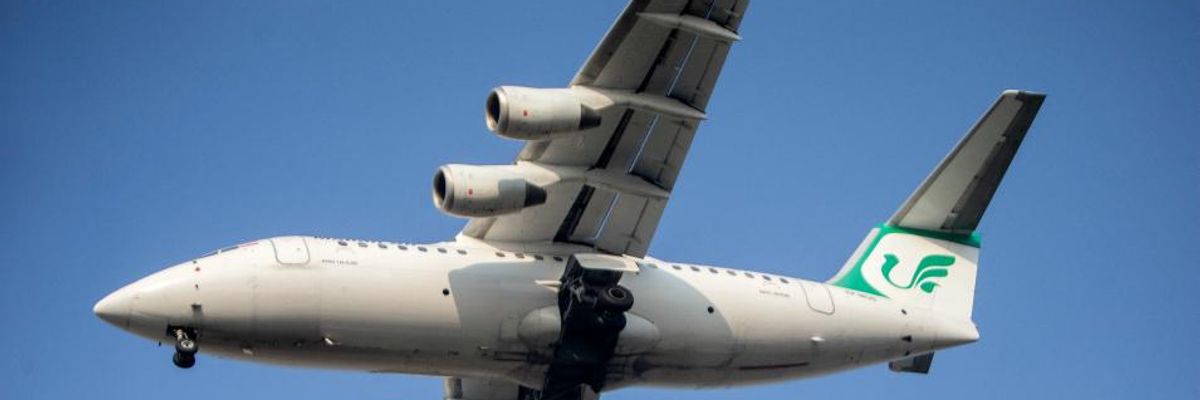
An Airbus A340 of Mahan Air approaches the Mehrabad International Airport in Tehran, Iran, on December 14, 2019. (Photo: Ahmad Halabisaz/Xinhua via Getty Images)
In yet another display of the heightened tension between Iran and the United States under President Donald Trump, several passengers on an Iranian commercial plane were reportedly injured Thursday when the aircraft swiftly dropped altitude after being approached by at least one U.S. military fighter jet over Syrian airspace.
Iranian media reported Thursday that two fighter jets flew near the Mahan Air passenger plane, forcing the pilot to quickly descend. Video footage from Iranian state broadcasting network IRIB showed one passenger with blood on his face and another lying on the floor of the aircraft.
Although initial reports out of Iran suggested Israel could be responsible, security sources told an Israeli public broadcaster that the country "had nothing to do with the incident," and a spokesperson for U.S. Central Command confirmed late Thursday that an American military aircraft was involved.
The U.S. CENTCOM spokesperson, Capt. Bill Urban, said that "a U.S. F-15 on a routine air mission in the vicinity of the [American-led joint task force against ISIS] At Tanf garrison in Syria conducted a standard visual inspection of a Mahan Air passenger airliner at a safe distance of approximately 1,000 meters from the airliner this evening."
"The visual inspection occurred to ensure the safety of coalition personnel at At Tanf garrison," Urban said. "Once the F-15 pilot identified the aircraft as a Mahan Air passenger plane, the F-15 safely opened distance from the aircraft. The professional intercept was conducted in accordance with international standards."
As Al Jazeera reported:
On Friday, Iran dismissed the U.S. explanation as "unjustified and unconvincing."
"The harassment of a passenger plane on the territory of a third country is a clear violation of aviation security and freedom of civilian aircraft," Laya Joneydi, vice president for legal affairs, was quoted as saying by Iranian media.
Iranian Foreign Minister Mohammad Javad Zarif took to Twitter to similarly accuse the U.S. government of harassment:
Critics in the U.S. envisioned how the Trump administration would have reacted had an Iranian fighter jet approached an American passenger plane:
The Mahan Air plane was traveling from Tehran to Beirut. Rodger Shanahan, a research fellow at the Lowy Institute for International Policy in Australia, told Al Jazeera that "what the Pentagon hasn't said is why they sent up an aircraft to look at this passenger plane whereas other passenger planes [fly] this route and they haven't been intercepted in the past."
Noting that United States and Israel have long accused the airline of transporting weapons to Iran-backed armed groups in Syria, Shanahan added, "that may well have been one of the reasons why the U.S. chose to take a closer look at the aircraft to check whether there were passengers on board."
Thursday's encounter with the F-15 was not the first time Mahan Air--a private Iranian airline established in 1991--has had issues with the U.S. government. In 2011, Washington imposed sanctions on the company, accusing it of providing support to Iran's Islamic Revolutionary Guard Corps.
Some countries have banned the airline from operating at their airports. U.S. Secretary Steven Mnuchin said in May that the Trump administration "will not hesitate to target those entities that continue to maintain commercial relationships with Mahan Air."
According to the New York Times, after the American "inspection" over Syria,
Abbas Mousavi, a spokesman for Iran's Foreign Ministry, said Iran had contacted the Swiss Embassy in Tehran, which protects American interests in Iran, to warn that the United States would be held accountable if anything happened to the Mahan Air flight, which later left Beirut empty to return to Iran.
Mr. Mousavi said Iran's mission to the United Nations had also conveyed this message to the U.N. secretary general, Antonio Guterres.
"We are investigating the details of this incident and after information is complete we will take necessary legal and political measures," Mr. Mousavi said.
Tensions have continued to build between Washington and Tehran since Trump withdrew from the Iran nuclear deal over two years ago--but particularly since the U.S. assassinated Iranian Gen. Qasem Soleimani in January. Agnes Callamard, the U.N. special rapporteur on extrajudicial, summary, or arbitrary executions, concluded earlier this month that killing the general violated international law.
Dear Common Dreams reader, It’s been nearly 30 years since I co-founded Common Dreams with my late wife, Lina Newhouser. We had the radical notion that journalism should serve the public good, not corporate profits. It was clear to us from the outset what it would take to build such a project. No paid advertisements. No corporate sponsors. No millionaire publisher telling us what to think or do. Many people said we wouldn't last a year, but we proved those doubters wrong. Together with a tremendous team of journalists and dedicated staff, we built an independent media outlet free from the constraints of profits and corporate control. Our mission has always been simple: To inform. To inspire. To ignite change for the common good. Building Common Dreams was not easy. Our survival was never guaranteed. When you take on the most powerful forces—Wall Street greed, fossil fuel industry destruction, Big Tech lobbyists, and uber-rich oligarchs who have spent billions upon billions rigging the economy and democracy in their favor—the only bulwark you have is supporters who believe in your work. But here’s the urgent message from me today. It's never been this bad out there. And it's never been this hard to keep us going. At the very moment Common Dreams is most needed, the threats we face are intensifying. We need your support now more than ever. We don't accept corporate advertising and never will. We don't have a paywall because we don't think people should be blocked from critical news based on their ability to pay. Everything we do is funded by the donations of readers like you. When everyone does the little they can afford, we are strong. But if that support retreats or dries up, so do we. Will you donate now to make sure Common Dreams not only survives but thrives? —Craig Brown, Co-founder |
In yet another display of the heightened tension between Iran and the United States under President Donald Trump, several passengers on an Iranian commercial plane were reportedly injured Thursday when the aircraft swiftly dropped altitude after being approached by at least one U.S. military fighter jet over Syrian airspace.
Iranian media reported Thursday that two fighter jets flew near the Mahan Air passenger plane, forcing the pilot to quickly descend. Video footage from Iranian state broadcasting network IRIB showed one passenger with blood on his face and another lying on the floor of the aircraft.
Although initial reports out of Iran suggested Israel could be responsible, security sources told an Israeli public broadcaster that the country "had nothing to do with the incident," and a spokesperson for U.S. Central Command confirmed late Thursday that an American military aircraft was involved.
The U.S. CENTCOM spokesperson, Capt. Bill Urban, said that "a U.S. F-15 on a routine air mission in the vicinity of the [American-led joint task force against ISIS] At Tanf garrison in Syria conducted a standard visual inspection of a Mahan Air passenger airliner at a safe distance of approximately 1,000 meters from the airliner this evening."
"The visual inspection occurred to ensure the safety of coalition personnel at At Tanf garrison," Urban said. "Once the F-15 pilot identified the aircraft as a Mahan Air passenger plane, the F-15 safely opened distance from the aircraft. The professional intercept was conducted in accordance with international standards."
As Al Jazeera reported:
On Friday, Iran dismissed the U.S. explanation as "unjustified and unconvincing."
"The harassment of a passenger plane on the territory of a third country is a clear violation of aviation security and freedom of civilian aircraft," Laya Joneydi, vice president for legal affairs, was quoted as saying by Iranian media.
Iranian Foreign Minister Mohammad Javad Zarif took to Twitter to similarly accuse the U.S. government of harassment:
Critics in the U.S. envisioned how the Trump administration would have reacted had an Iranian fighter jet approached an American passenger plane:
The Mahan Air plane was traveling from Tehran to Beirut. Rodger Shanahan, a research fellow at the Lowy Institute for International Policy in Australia, told Al Jazeera that "what the Pentagon hasn't said is why they sent up an aircraft to look at this passenger plane whereas other passenger planes [fly] this route and they haven't been intercepted in the past."
Noting that United States and Israel have long accused the airline of transporting weapons to Iran-backed armed groups in Syria, Shanahan added, "that may well have been one of the reasons why the U.S. chose to take a closer look at the aircraft to check whether there were passengers on board."
Thursday's encounter with the F-15 was not the first time Mahan Air--a private Iranian airline established in 1991--has had issues with the U.S. government. In 2011, Washington imposed sanctions on the company, accusing it of providing support to Iran's Islamic Revolutionary Guard Corps.
Some countries have banned the airline from operating at their airports. U.S. Secretary Steven Mnuchin said in May that the Trump administration "will not hesitate to target those entities that continue to maintain commercial relationships with Mahan Air."
According to the New York Times, after the American "inspection" over Syria,
Abbas Mousavi, a spokesman for Iran's Foreign Ministry, said Iran had contacted the Swiss Embassy in Tehran, which protects American interests in Iran, to warn that the United States would be held accountable if anything happened to the Mahan Air flight, which later left Beirut empty to return to Iran.
Mr. Mousavi said Iran's mission to the United Nations had also conveyed this message to the U.N. secretary general, Antonio Guterres.
"We are investigating the details of this incident and after information is complete we will take necessary legal and political measures," Mr. Mousavi said.
Tensions have continued to build between Washington and Tehran since Trump withdrew from the Iran nuclear deal over two years ago--but particularly since the U.S. assassinated Iranian Gen. Qasem Soleimani in January. Agnes Callamard, the U.N. special rapporteur on extrajudicial, summary, or arbitrary executions, concluded earlier this month that killing the general violated international law.
In yet another display of the heightened tension between Iran and the United States under President Donald Trump, several passengers on an Iranian commercial plane were reportedly injured Thursday when the aircraft swiftly dropped altitude after being approached by at least one U.S. military fighter jet over Syrian airspace.
Iranian media reported Thursday that two fighter jets flew near the Mahan Air passenger plane, forcing the pilot to quickly descend. Video footage from Iranian state broadcasting network IRIB showed one passenger with blood on his face and another lying on the floor of the aircraft.
Although initial reports out of Iran suggested Israel could be responsible, security sources told an Israeli public broadcaster that the country "had nothing to do with the incident," and a spokesperson for U.S. Central Command confirmed late Thursday that an American military aircraft was involved.
The U.S. CENTCOM spokesperson, Capt. Bill Urban, said that "a U.S. F-15 on a routine air mission in the vicinity of the [American-led joint task force against ISIS] At Tanf garrison in Syria conducted a standard visual inspection of a Mahan Air passenger airliner at a safe distance of approximately 1,000 meters from the airliner this evening."
"The visual inspection occurred to ensure the safety of coalition personnel at At Tanf garrison," Urban said. "Once the F-15 pilot identified the aircraft as a Mahan Air passenger plane, the F-15 safely opened distance from the aircraft. The professional intercept was conducted in accordance with international standards."
As Al Jazeera reported:
On Friday, Iran dismissed the U.S. explanation as "unjustified and unconvincing."
"The harassment of a passenger plane on the territory of a third country is a clear violation of aviation security and freedom of civilian aircraft," Laya Joneydi, vice president for legal affairs, was quoted as saying by Iranian media.
Iranian Foreign Minister Mohammad Javad Zarif took to Twitter to similarly accuse the U.S. government of harassment:
Critics in the U.S. envisioned how the Trump administration would have reacted had an Iranian fighter jet approached an American passenger plane:
The Mahan Air plane was traveling from Tehran to Beirut. Rodger Shanahan, a research fellow at the Lowy Institute for International Policy in Australia, told Al Jazeera that "what the Pentagon hasn't said is why they sent up an aircraft to look at this passenger plane whereas other passenger planes [fly] this route and they haven't been intercepted in the past."
Noting that United States and Israel have long accused the airline of transporting weapons to Iran-backed armed groups in Syria, Shanahan added, "that may well have been one of the reasons why the U.S. chose to take a closer look at the aircraft to check whether there were passengers on board."
Thursday's encounter with the F-15 was not the first time Mahan Air--a private Iranian airline established in 1991--has had issues with the U.S. government. In 2011, Washington imposed sanctions on the company, accusing it of providing support to Iran's Islamic Revolutionary Guard Corps.
Some countries have banned the airline from operating at their airports. U.S. Secretary Steven Mnuchin said in May that the Trump administration "will not hesitate to target those entities that continue to maintain commercial relationships with Mahan Air."
According to the New York Times, after the American "inspection" over Syria,
Abbas Mousavi, a spokesman for Iran's Foreign Ministry, said Iran had contacted the Swiss Embassy in Tehran, which protects American interests in Iran, to warn that the United States would be held accountable if anything happened to the Mahan Air flight, which later left Beirut empty to return to Iran.
Mr. Mousavi said Iran's mission to the United Nations had also conveyed this message to the U.N. secretary general, Antonio Guterres.
"We are investigating the details of this incident and after information is complete we will take necessary legal and political measures," Mr. Mousavi said.
Tensions have continued to build between Washington and Tehran since Trump withdrew from the Iran nuclear deal over two years ago--but particularly since the U.S. assassinated Iranian Gen. Qasem Soleimani in January. Agnes Callamard, the U.N. special rapporteur on extrajudicial, summary, or arbitrary executions, concluded earlier this month that killing the general violated international law.