SUBSCRIBE TO OUR FREE NEWSLETTER
Daily news & progressive opinion—funded by the people, not the corporations—delivered straight to your inbox.
5
#000000
#FFFFFF
To donate by check, phone, or other method, see our More Ways to Give page.
Daily news & progressive opinion—funded by the people, not the corporations—delivered straight to your inbox.
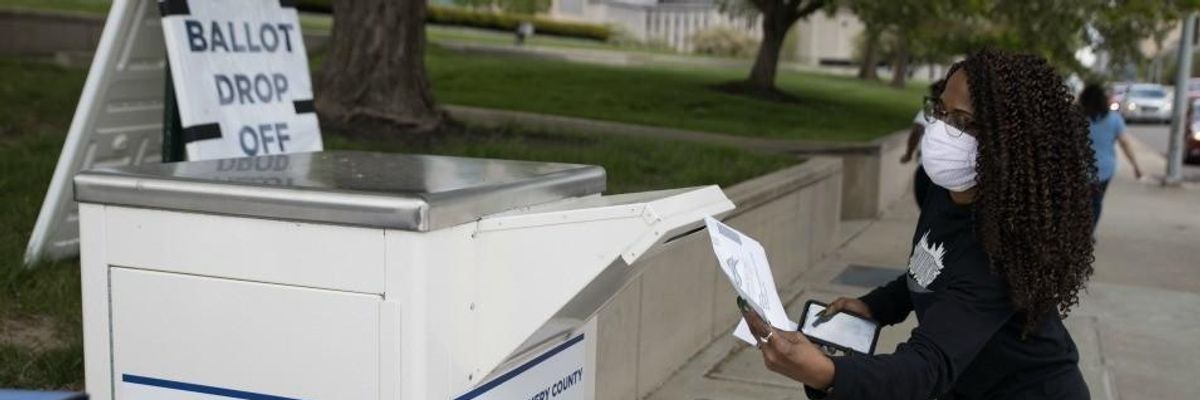
A voter drops off her ballot at the Board of Elections in Dayton, Ohio on April 28, 2020. (Photo: Megan Jelinger / AFP via Getty Images)
Civil rights advocates applauded a victory for voting rights Monday after a federal judge denied a right-wing group's request to restrict the use of absentee ballots in Virginia.
The Lawyer's Committee for Civil Rights Under Law argued last week in favor of upholding the law, passed by Democratic legislators in February, which would allow Virginia voters to use absentee ballots in the 2020 election without providing an excuse.
Previously, voters were required to prove that they couldn't vote in person because they had an illness or disability; had a work, school, or family obligation; or were traveling.
Allowing people to use absentee ballots is especially important in light of the coronavirus pandemic, the Lawyers' Committee argued, weeks after in-person voting in Wisconsin was linked to dozens of Covid-19 cases.
"No voter should have to choose between their health and their right to vote during the pandemic," tweeted Kristen Clarke, president of the Lawyers' Committee.
The lawsuit was brought on behalf of six voters by True the Vote, a group that trains volunteers to "monitor" election sites in the interest of stopping so-called voter fraud--which numerous studies have found to be "vanishingly rare." The group's activities have drawn accusations of voter intimidation.
True the Vote claimed that if Virginia voters are allowed to vote absentee even if they are not sick or living with a disability that prevents them from leaving home, voters will be encouraged to make false statements on their ballots.
"Conservative activists tried to use a deadly pandemic as a way to suppress voter turnout and disenfranchise tens of thousands of Virginians who fear that their health and safety would be jeopardized by voting in person, but they failed," said Virginia Attorney General Mark Herring.
The ruling comes as President Donald Trump continues to wage attacks on vote-by-mail efforts, saying the use of mail-in ballots is ripe for rampant "cheating" by Democrats--despite the fact that five states, including solidly red Utah, already exclusively conduct elections by mail.
"Like it or not, more people will have the opportunity to vote in Virginia this year," wrote Democratic attorney Adam Bear.
In recent weeks, a number of states have moved to expand voting-by-mail and absentee voting for the 2020 elections, including Michigan, Iowa, Georgia, and West Virginia.
The federal judge who handed down the ruling in Virginia on Friday, Judge Rossie Alston Jr., is a Trump appointee and said his court was "constrained at this time from remedying these constitutional grievances."
The Lawyers' Committee vowed to continue fighting challenges to voting rights in Virginia and around the country.
"We will keep fighting groups like Judicial Watch and True the Vote that are mounting voter suppression efforts to deny people access to the ballot this season," Clarke wrote. "All voters deserve [a] voice in our democracy."
Dear Common Dreams reader, It’s been nearly 30 years since I co-founded Common Dreams with my late wife, Lina Newhouser. We had the radical notion that journalism should serve the public good, not corporate profits. It was clear to us from the outset what it would take to build such a project. No paid advertisements. No corporate sponsors. No millionaire publisher telling us what to think or do. Many people said we wouldn't last a year, but we proved those doubters wrong. Together with a tremendous team of journalists and dedicated staff, we built an independent media outlet free from the constraints of profits and corporate control. Our mission has always been simple: To inform. To inspire. To ignite change for the common good. Building Common Dreams was not easy. Our survival was never guaranteed. When you take on the most powerful forces—Wall Street greed, fossil fuel industry destruction, Big Tech lobbyists, and uber-rich oligarchs who have spent billions upon billions rigging the economy and democracy in their favor—the only bulwark you have is supporters who believe in your work. But here’s the urgent message from me today. It's never been this bad out there. And it's never been this hard to keep us going. At the very moment Common Dreams is most needed, the threats we face are intensifying. We need your support now more than ever. We don't accept corporate advertising and never will. We don't have a paywall because we don't think people should be blocked from critical news based on their ability to pay. Everything we do is funded by the donations of readers like you. When everyone does the little they can afford, we are strong. But if that support retreats or dries up, so do we. Will you donate now to make sure Common Dreams not only survives but thrives? —Craig Brown, Co-founder |
Civil rights advocates applauded a victory for voting rights Monday after a federal judge denied a right-wing group's request to restrict the use of absentee ballots in Virginia.
The Lawyer's Committee for Civil Rights Under Law argued last week in favor of upholding the law, passed by Democratic legislators in February, which would allow Virginia voters to use absentee ballots in the 2020 election without providing an excuse.
Previously, voters were required to prove that they couldn't vote in person because they had an illness or disability; had a work, school, or family obligation; or were traveling.
Allowing people to use absentee ballots is especially important in light of the coronavirus pandemic, the Lawyers' Committee argued, weeks after in-person voting in Wisconsin was linked to dozens of Covid-19 cases.
"No voter should have to choose between their health and their right to vote during the pandemic," tweeted Kristen Clarke, president of the Lawyers' Committee.
The lawsuit was brought on behalf of six voters by True the Vote, a group that trains volunteers to "monitor" election sites in the interest of stopping so-called voter fraud--which numerous studies have found to be "vanishingly rare." The group's activities have drawn accusations of voter intimidation.
True the Vote claimed that if Virginia voters are allowed to vote absentee even if they are not sick or living with a disability that prevents them from leaving home, voters will be encouraged to make false statements on their ballots.
"Conservative activists tried to use a deadly pandemic as a way to suppress voter turnout and disenfranchise tens of thousands of Virginians who fear that their health and safety would be jeopardized by voting in person, but they failed," said Virginia Attorney General Mark Herring.
The ruling comes as President Donald Trump continues to wage attacks on vote-by-mail efforts, saying the use of mail-in ballots is ripe for rampant "cheating" by Democrats--despite the fact that five states, including solidly red Utah, already exclusively conduct elections by mail.
"Like it or not, more people will have the opportunity to vote in Virginia this year," wrote Democratic attorney Adam Bear.
In recent weeks, a number of states have moved to expand voting-by-mail and absentee voting for the 2020 elections, including Michigan, Iowa, Georgia, and West Virginia.
The federal judge who handed down the ruling in Virginia on Friday, Judge Rossie Alston Jr., is a Trump appointee and said his court was "constrained at this time from remedying these constitutional grievances."
The Lawyers' Committee vowed to continue fighting challenges to voting rights in Virginia and around the country.
"We will keep fighting groups like Judicial Watch and True the Vote that are mounting voter suppression efforts to deny people access to the ballot this season," Clarke wrote. "All voters deserve [a] voice in our democracy."
Civil rights advocates applauded a victory for voting rights Monday after a federal judge denied a right-wing group's request to restrict the use of absentee ballots in Virginia.
The Lawyer's Committee for Civil Rights Under Law argued last week in favor of upholding the law, passed by Democratic legislators in February, which would allow Virginia voters to use absentee ballots in the 2020 election without providing an excuse.
Previously, voters were required to prove that they couldn't vote in person because they had an illness or disability; had a work, school, or family obligation; or were traveling.
Allowing people to use absentee ballots is especially important in light of the coronavirus pandemic, the Lawyers' Committee argued, weeks after in-person voting in Wisconsin was linked to dozens of Covid-19 cases.
"No voter should have to choose between their health and their right to vote during the pandemic," tweeted Kristen Clarke, president of the Lawyers' Committee.
The lawsuit was brought on behalf of six voters by True the Vote, a group that trains volunteers to "monitor" election sites in the interest of stopping so-called voter fraud--which numerous studies have found to be "vanishingly rare." The group's activities have drawn accusations of voter intimidation.
True the Vote claimed that if Virginia voters are allowed to vote absentee even if they are not sick or living with a disability that prevents them from leaving home, voters will be encouraged to make false statements on their ballots.
"Conservative activists tried to use a deadly pandemic as a way to suppress voter turnout and disenfranchise tens of thousands of Virginians who fear that their health and safety would be jeopardized by voting in person, but they failed," said Virginia Attorney General Mark Herring.
The ruling comes as President Donald Trump continues to wage attacks on vote-by-mail efforts, saying the use of mail-in ballots is ripe for rampant "cheating" by Democrats--despite the fact that five states, including solidly red Utah, already exclusively conduct elections by mail.
"Like it or not, more people will have the opportunity to vote in Virginia this year," wrote Democratic attorney Adam Bear.
In recent weeks, a number of states have moved to expand voting-by-mail and absentee voting for the 2020 elections, including Michigan, Iowa, Georgia, and West Virginia.
The federal judge who handed down the ruling in Virginia on Friday, Judge Rossie Alston Jr., is a Trump appointee and said his court was "constrained at this time from remedying these constitutional grievances."
The Lawyers' Committee vowed to continue fighting challenges to voting rights in Virginia and around the country.
"We will keep fighting groups like Judicial Watch and True the Vote that are mounting voter suppression efforts to deny people access to the ballot this season," Clarke wrote. "All voters deserve [a] voice in our democracy."