SUBSCRIBE TO OUR FREE NEWSLETTER
Daily news & progressive opinion—funded by the people, not the corporations—delivered straight to your inbox.
5
#000000
#FFFFFF
To donate by check, phone, or other method, see our More Ways to Give page.
Daily news & progressive opinion—funded by the people, not the corporations—delivered straight to your inbox.
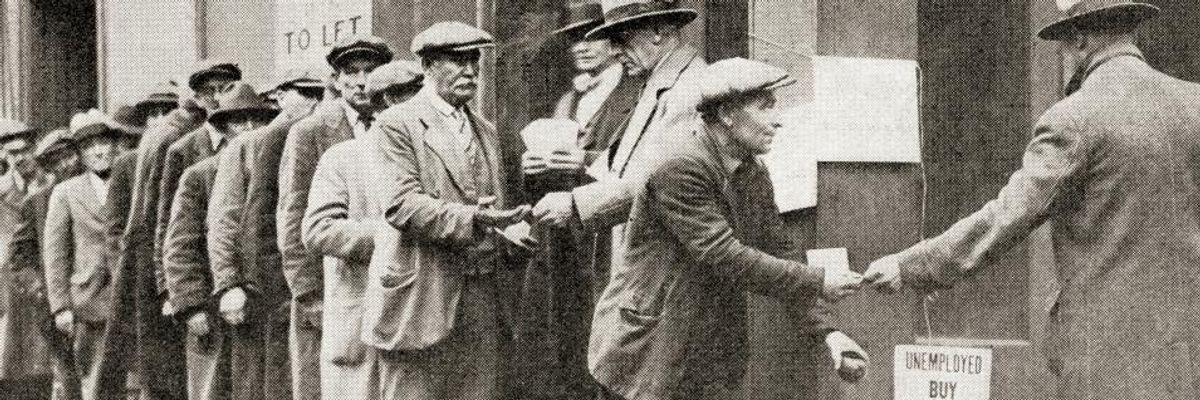
A line of unemployed men buy apples for 5 cents during the Great Depression.
Nobel Prize-winning economist Joseph Stiglitz on Wednesday offered a scathing assessment of President Donald Trump's response to the deadly Covid-19 pandemic and warned that the U.S. economy could rapidly descend into a second Great Depression without sweeping and urgent legislative action from Congress.
"It is like a third world country," Stiglitz said in an interview with The Guardian, pointing to the number of people in the U.S. who have been forced to rely on food banks to survive amid the ongoing coronavirus outbreak.
"We were unprepared but, even given the degree of unpreparedness, Trump's decision to make this about politics rather than about science has meant we have responded far more poorly."
--Joseph Stiglitz, Columbia University
Stiglitz, a professor at Columbia University, said America's existing inequities and fragmented social safety net made it far more difficult for the nation to respond quickly and effectively to the coronavirus outbreak, which has infected more than 800,000 people in the U.S.
"The inequality in the U.S. is so large," said Stiglitz. "This disease has targeted those with the poorest health. In the advanced world, the U.S. is one of the countries with the poorest health overall and the greatest health inequality... The safety net is not adequate and is propagating the disease."
Stiglitz warned that if Trump and Senate Majority Leader Mitch McConnell (R-Ky.) are allowed to continue dictating the federal government's response to the coronavirus outbreak, "we will have a Great Depression."
"If we had the right policy structure in place we could avoid it easily," said Stiglitz. "We were unprepared but, even given the degree of unpreparedness, Trump's decision to make this about politics rather than about science has meant we have responded far more poorly."
Congress has thus far passed three relief packages in response to the coronavirus crisis. An additional interim measure passed the Senate Tuesday and is expected to be approved by the House as early as Thursday.
Stiglitz was an outspoken critic of the $2.2 trillion CARES Act that Trump signed into law last month, warning the package would not be enough to stem massive job losses and stave off a recession. According to the U.S. Department of Labor latest data, 22 million Americans have filed jobless claims since the middle of March.
"So much wealth has been destroyed on people's balance sheet," Stiglitz said in an interview on Democratic Now! last month. "When the economy recovers, when the disease gets under control, people may be not in position to spend in the way that they were before. And so, it could help prolong the economic downturn, unless we take appropriate measures."
Dear Common Dreams reader, It’s been nearly 30 years since I co-founded Common Dreams with my late wife, Lina Newhouser. We had the radical notion that journalism should serve the public good, not corporate profits. It was clear to us from the outset what it would take to build such a project. No paid advertisements. No corporate sponsors. No millionaire publisher telling us what to think or do. Many people said we wouldn't last a year, but we proved those doubters wrong. Together with a tremendous team of journalists and dedicated staff, we built an independent media outlet free from the constraints of profits and corporate control. Our mission has always been simple: To inform. To inspire. To ignite change for the common good. Building Common Dreams was not easy. Our survival was never guaranteed. When you take on the most powerful forces—Wall Street greed, fossil fuel industry destruction, Big Tech lobbyists, and uber-rich oligarchs who have spent billions upon billions rigging the economy and democracy in their favor—the only bulwark you have is supporters who believe in your work. But here’s the urgent message from me today. It's never been this bad out there. And it's never been this hard to keep us going. At the very moment Common Dreams is most needed, the threats we face are intensifying. We need your support now more than ever. We don't accept corporate advertising and never will. We don't have a paywall because we don't think people should be blocked from critical news based on their ability to pay. Everything we do is funded by the donations of readers like you. When everyone does the little they can afford, we are strong. But if that support retreats or dries up, so do we. Will you donate now to make sure Common Dreams not only survives but thrives? —Craig Brown, Co-founder |
Nobel Prize-winning economist Joseph Stiglitz on Wednesday offered a scathing assessment of President Donald Trump's response to the deadly Covid-19 pandemic and warned that the U.S. economy could rapidly descend into a second Great Depression without sweeping and urgent legislative action from Congress.
"It is like a third world country," Stiglitz said in an interview with The Guardian, pointing to the number of people in the U.S. who have been forced to rely on food banks to survive amid the ongoing coronavirus outbreak.
"We were unprepared but, even given the degree of unpreparedness, Trump's decision to make this about politics rather than about science has meant we have responded far more poorly."
--Joseph Stiglitz, Columbia University
Stiglitz, a professor at Columbia University, said America's existing inequities and fragmented social safety net made it far more difficult for the nation to respond quickly and effectively to the coronavirus outbreak, which has infected more than 800,000 people in the U.S.
"The inequality in the U.S. is so large," said Stiglitz. "This disease has targeted those with the poorest health. In the advanced world, the U.S. is one of the countries with the poorest health overall and the greatest health inequality... The safety net is not adequate and is propagating the disease."
Stiglitz warned that if Trump and Senate Majority Leader Mitch McConnell (R-Ky.) are allowed to continue dictating the federal government's response to the coronavirus outbreak, "we will have a Great Depression."
"If we had the right policy structure in place we could avoid it easily," said Stiglitz. "We were unprepared but, even given the degree of unpreparedness, Trump's decision to make this about politics rather than about science has meant we have responded far more poorly."
Congress has thus far passed three relief packages in response to the coronavirus crisis. An additional interim measure passed the Senate Tuesday and is expected to be approved by the House as early as Thursday.
Stiglitz was an outspoken critic of the $2.2 trillion CARES Act that Trump signed into law last month, warning the package would not be enough to stem massive job losses and stave off a recession. According to the U.S. Department of Labor latest data, 22 million Americans have filed jobless claims since the middle of March.
"So much wealth has been destroyed on people's balance sheet," Stiglitz said in an interview on Democratic Now! last month. "When the economy recovers, when the disease gets under control, people may be not in position to spend in the way that they were before. And so, it could help prolong the economic downturn, unless we take appropriate measures."
Nobel Prize-winning economist Joseph Stiglitz on Wednesday offered a scathing assessment of President Donald Trump's response to the deadly Covid-19 pandemic and warned that the U.S. economy could rapidly descend into a second Great Depression without sweeping and urgent legislative action from Congress.
"It is like a third world country," Stiglitz said in an interview with The Guardian, pointing to the number of people in the U.S. who have been forced to rely on food banks to survive amid the ongoing coronavirus outbreak.
"We were unprepared but, even given the degree of unpreparedness, Trump's decision to make this about politics rather than about science has meant we have responded far more poorly."
--Joseph Stiglitz, Columbia University
Stiglitz, a professor at Columbia University, said America's existing inequities and fragmented social safety net made it far more difficult for the nation to respond quickly and effectively to the coronavirus outbreak, which has infected more than 800,000 people in the U.S.
"The inequality in the U.S. is so large," said Stiglitz. "This disease has targeted those with the poorest health. In the advanced world, the U.S. is one of the countries with the poorest health overall and the greatest health inequality... The safety net is not adequate and is propagating the disease."
Stiglitz warned that if Trump and Senate Majority Leader Mitch McConnell (R-Ky.) are allowed to continue dictating the federal government's response to the coronavirus outbreak, "we will have a Great Depression."
"If we had the right policy structure in place we could avoid it easily," said Stiglitz. "We were unprepared but, even given the degree of unpreparedness, Trump's decision to make this about politics rather than about science has meant we have responded far more poorly."
Congress has thus far passed three relief packages in response to the coronavirus crisis. An additional interim measure passed the Senate Tuesday and is expected to be approved by the House as early as Thursday.
Stiglitz was an outspoken critic of the $2.2 trillion CARES Act that Trump signed into law last month, warning the package would not be enough to stem massive job losses and stave off a recession. According to the U.S. Department of Labor latest data, 22 million Americans have filed jobless claims since the middle of March.
"So much wealth has been destroyed on people's balance sheet," Stiglitz said in an interview on Democratic Now! last month. "When the economy recovers, when the disease gets under control, people may be not in position to spend in the way that they were before. And so, it could help prolong the economic downturn, unless we take appropriate measures."