SUBSCRIBE TO OUR FREE NEWSLETTER
Daily news & progressive opinion—funded by the people, not the corporations—delivered straight to your inbox.
5
#000000
#FFFFFF
To donate by check, phone, or other method, see our More Ways to Give page.
Daily news & progressive opinion—funded by the people, not the corporations—delivered straight to your inbox.
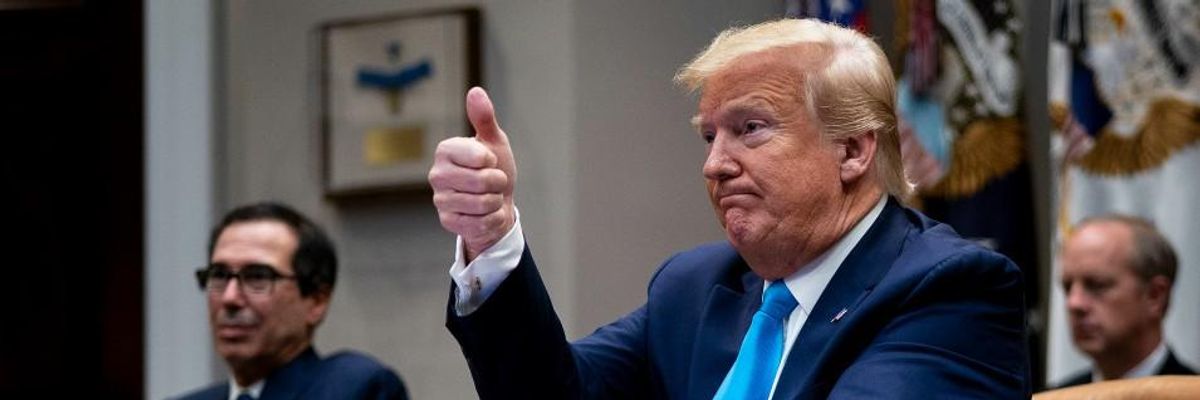
President Donald Trump and Treasury Secretary Steven Mnuchin participate in a video conference with representatives of large banks and credit card companies about more financial assistance for small businesses in the Roosevelt Room at the White House April 7, 2020 in Washington, D.C. (Photo: Doug Mills-Pool/Getty Images)
As small business owners struggle to obtain desperately needed money from a first-come-first-served federal coronavirus relief program, some wealthy hedge fund managers are attempting snag a share of the $350 billion taxpayer fund with the help of high-powered legal firms that know how to quickly navigate the confusing application process.
"Some hedge funds already have applied" for a loan under the Paycheck Protection Program (PPP), Bloomberg reported Tuesday. PPP is a relief fund for small businesses established by the CARES Act, the sweeping coronavirus stimulus legislation that President Donald Trump signed into law last month.
"Without oversight, this is what's happening with the $2 trillion coronavirus bailout: hedge fund managers are claiming relief funds as 'small businesses.'"
--American Oversight
"Since early April, law firms have hosted Webinars and sent out alerts, and accounting firms have reached out to clients, all with the goal of explaining how they might be able to tap into the Paycheck Protection Program," Bloomberg reported. "The loans can convert to grants if recipients retain or rehire their workers."
Companies are eligible for PPP funds if they have fewer than 500 employees and the "current economic uncertainty makes this loan request necessary to support the ongoing operations."
Hedge funds "are designed to employ as few people as possible so star traders don't have to share millions of dollars in fees," Bloomberg noted, meaning they often have a low enough number of employees to qualify for PPP loans. But whether a taxpayer-backed loan is "necessary" for them to maintain operations is another matter entirely.
"The question of whether to partake in the program is dividing members of the money management community," Bloomberg reported. "Some traders have called it morally corrupt, while others insist they are small businesses--just like hair salons, restaurants, and dry cleaners--that could use a helping hand after global markets tumbled and cost them money."
Donald Motschwiller, CEO of First New York, a hedge fund that manages $2.9 billion in assets, told Bloomberg that while he hasn't decided whether to apply for federal relief for his firm, none of the 15 hedge funds in his circle he asked about the program said they would object to applying for loans.
Other hedge fund managers feel differently.
"It's a complete abomination," Nate Koppikar, a partner at San Francisco-based hedge fund Orso Partners, told Bloomberg.
"While we recognize that every manager must make their own decision about the viability of their firm, we have provided guidance to our members that we do not believe the money in this program was intended for managers general partnership interests," Bryan Corbett, president and CEO of the Managed Funds Association, an industry trade group, said in a statement to Bloomberg.
Critics warn that a lack of oversight of the sprawling stimulus package could mean that the public won't know which companies are benefiting from taxpayer funds that were meant to help small businesses keep workers on payroll amid the ongoing coronavirus pandemic.
Hedge fund titans are not the only wealthy people attempting to profit off the small business program.
As Common Dreams reported last week, some of the nation's most profitable private equity firms are pressuring the Trump administration and members of Congress to tweak federal regulations to allow them to benefit from PPP.
Attempts by wealthy money managers to obtain small business loans come as Congress is considering pumping $250 billion more into the program, which got off to a disastrous start earlier this month as business owners without access to savvy legal teams experienced difficulties applying for relief.
"Many firms are still struggling to apply for the money as they face technical glitches and confusion about lending terms," USA Today reported Monday. "Hundreds of thousands of others have gotten approval but still haven't received funding."
Dear Common Dreams reader, It’s been nearly 30 years since I co-founded Common Dreams with my late wife, Lina Newhouser. We had the radical notion that journalism should serve the public good, not corporate profits. It was clear to us from the outset what it would take to build such a project. No paid advertisements. No corporate sponsors. No millionaire publisher telling us what to think or do. Many people said we wouldn't last a year, but we proved those doubters wrong. Together with a tremendous team of journalists and dedicated staff, we built an independent media outlet free from the constraints of profits and corporate control. Our mission has always been simple: To inform. To inspire. To ignite change for the common good. Building Common Dreams was not easy. Our survival was never guaranteed. When you take on the most powerful forces—Wall Street greed, fossil fuel industry destruction, Big Tech lobbyists, and uber-rich oligarchs who have spent billions upon billions rigging the economy and democracy in their favor—the only bulwark you have is supporters who believe in your work. But here’s the urgent message from me today. It's never been this bad out there. And it's never been this hard to keep us going. At the very moment Common Dreams is most needed, the threats we face are intensifying. We need your support now more than ever. We don't accept corporate advertising and never will. We don't have a paywall because we don't think people should be blocked from critical news based on their ability to pay. Everything we do is funded by the donations of readers like you. When everyone does the little they can afford, we are strong. But if that support retreats or dries up, so do we. Will you donate now to make sure Common Dreams not only survives but thrives? —Craig Brown, Co-founder |
As small business owners struggle to obtain desperately needed money from a first-come-first-served federal coronavirus relief program, some wealthy hedge fund managers are attempting snag a share of the $350 billion taxpayer fund with the help of high-powered legal firms that know how to quickly navigate the confusing application process.
"Some hedge funds already have applied" for a loan under the Paycheck Protection Program (PPP), Bloomberg reported Tuesday. PPP is a relief fund for small businesses established by the CARES Act, the sweeping coronavirus stimulus legislation that President Donald Trump signed into law last month.
"Without oversight, this is what's happening with the $2 trillion coronavirus bailout: hedge fund managers are claiming relief funds as 'small businesses.'"
--American Oversight
"Since early April, law firms have hosted Webinars and sent out alerts, and accounting firms have reached out to clients, all with the goal of explaining how they might be able to tap into the Paycheck Protection Program," Bloomberg reported. "The loans can convert to grants if recipients retain or rehire their workers."
Companies are eligible for PPP funds if they have fewer than 500 employees and the "current economic uncertainty makes this loan request necessary to support the ongoing operations."
Hedge funds "are designed to employ as few people as possible so star traders don't have to share millions of dollars in fees," Bloomberg noted, meaning they often have a low enough number of employees to qualify for PPP loans. But whether a taxpayer-backed loan is "necessary" for them to maintain operations is another matter entirely.
"The question of whether to partake in the program is dividing members of the money management community," Bloomberg reported. "Some traders have called it morally corrupt, while others insist they are small businesses--just like hair salons, restaurants, and dry cleaners--that could use a helping hand after global markets tumbled and cost them money."
Donald Motschwiller, CEO of First New York, a hedge fund that manages $2.9 billion in assets, told Bloomberg that while he hasn't decided whether to apply for federal relief for his firm, none of the 15 hedge funds in his circle he asked about the program said they would object to applying for loans.
Other hedge fund managers feel differently.
"It's a complete abomination," Nate Koppikar, a partner at San Francisco-based hedge fund Orso Partners, told Bloomberg.
"While we recognize that every manager must make their own decision about the viability of their firm, we have provided guidance to our members that we do not believe the money in this program was intended for managers general partnership interests," Bryan Corbett, president and CEO of the Managed Funds Association, an industry trade group, said in a statement to Bloomberg.
Critics warn that a lack of oversight of the sprawling stimulus package could mean that the public won't know which companies are benefiting from taxpayer funds that were meant to help small businesses keep workers on payroll amid the ongoing coronavirus pandemic.
Hedge fund titans are not the only wealthy people attempting to profit off the small business program.
As Common Dreams reported last week, some of the nation's most profitable private equity firms are pressuring the Trump administration and members of Congress to tweak federal regulations to allow them to benefit from PPP.
Attempts by wealthy money managers to obtain small business loans come as Congress is considering pumping $250 billion more into the program, which got off to a disastrous start earlier this month as business owners without access to savvy legal teams experienced difficulties applying for relief.
"Many firms are still struggling to apply for the money as they face technical glitches and confusion about lending terms," USA Today reported Monday. "Hundreds of thousands of others have gotten approval but still haven't received funding."
As small business owners struggle to obtain desperately needed money from a first-come-first-served federal coronavirus relief program, some wealthy hedge fund managers are attempting snag a share of the $350 billion taxpayer fund with the help of high-powered legal firms that know how to quickly navigate the confusing application process.
"Some hedge funds already have applied" for a loan under the Paycheck Protection Program (PPP), Bloomberg reported Tuesday. PPP is a relief fund for small businesses established by the CARES Act, the sweeping coronavirus stimulus legislation that President Donald Trump signed into law last month.
"Without oversight, this is what's happening with the $2 trillion coronavirus bailout: hedge fund managers are claiming relief funds as 'small businesses.'"
--American Oversight
"Since early April, law firms have hosted Webinars and sent out alerts, and accounting firms have reached out to clients, all with the goal of explaining how they might be able to tap into the Paycheck Protection Program," Bloomberg reported. "The loans can convert to grants if recipients retain or rehire their workers."
Companies are eligible for PPP funds if they have fewer than 500 employees and the "current economic uncertainty makes this loan request necessary to support the ongoing operations."
Hedge funds "are designed to employ as few people as possible so star traders don't have to share millions of dollars in fees," Bloomberg noted, meaning they often have a low enough number of employees to qualify for PPP loans. But whether a taxpayer-backed loan is "necessary" for them to maintain operations is another matter entirely.
"The question of whether to partake in the program is dividing members of the money management community," Bloomberg reported. "Some traders have called it morally corrupt, while others insist they are small businesses--just like hair salons, restaurants, and dry cleaners--that could use a helping hand after global markets tumbled and cost them money."
Donald Motschwiller, CEO of First New York, a hedge fund that manages $2.9 billion in assets, told Bloomberg that while he hasn't decided whether to apply for federal relief for his firm, none of the 15 hedge funds in his circle he asked about the program said they would object to applying for loans.
Other hedge fund managers feel differently.
"It's a complete abomination," Nate Koppikar, a partner at San Francisco-based hedge fund Orso Partners, told Bloomberg.
"While we recognize that every manager must make their own decision about the viability of their firm, we have provided guidance to our members that we do not believe the money in this program was intended for managers general partnership interests," Bryan Corbett, president and CEO of the Managed Funds Association, an industry trade group, said in a statement to Bloomberg.
Critics warn that a lack of oversight of the sprawling stimulus package could mean that the public won't know which companies are benefiting from taxpayer funds that were meant to help small businesses keep workers on payroll amid the ongoing coronavirus pandemic.
Hedge fund titans are not the only wealthy people attempting to profit off the small business program.
As Common Dreams reported last week, some of the nation's most profitable private equity firms are pressuring the Trump administration and members of Congress to tweak federal regulations to allow them to benefit from PPP.
Attempts by wealthy money managers to obtain small business loans come as Congress is considering pumping $250 billion more into the program, which got off to a disastrous start earlier this month as business owners without access to savvy legal teams experienced difficulties applying for relief.
"Many firms are still struggling to apply for the money as they face technical glitches and confusion about lending terms," USA Today reported Monday. "Hundreds of thousands of others have gotten approval but still haven't received funding."