SUBSCRIBE TO OUR FREE NEWSLETTER
Daily news & progressive opinion—funded by the people, not the corporations—delivered straight to your inbox.
5
#000000
#FFFFFF
To donate by check, phone, or other method, see our More Ways to Give page.
Daily news & progressive opinion—funded by the people, not the corporations—delivered straight to your inbox.
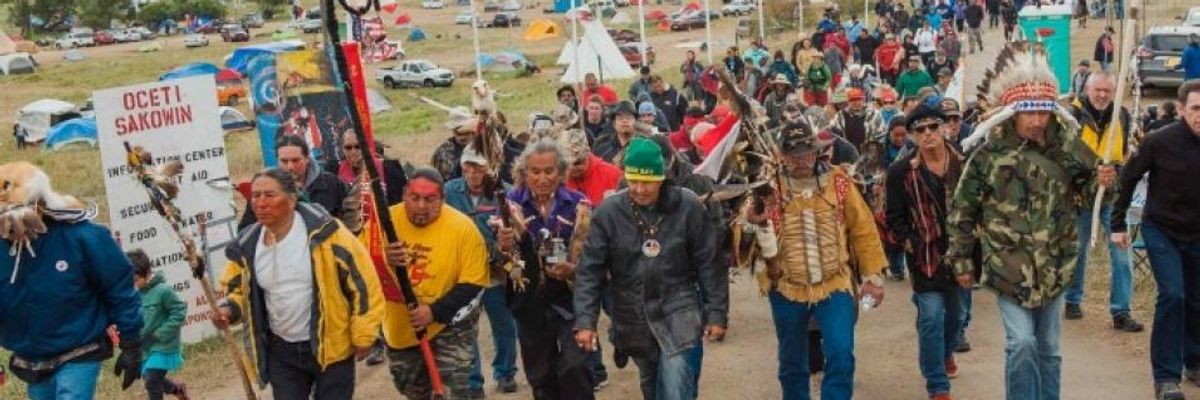
Thousands of water protectors and allies spent weeks at the Oceti Sakowin camp in North Dakota in 2016 to protest the construction of the Dakota Access Pipeline. (Photo: Reuters)
A federal judge handed down a major victory for the Standing Rock Sioux tribe of North Dakota on Wednesday, ruling that the U.S. Army Corps of Engineers violated the National Environmental Policy Act by approving federal permits for the Dakota Access Pipeline.
The USACE must complete a full environmental impact study of the pipeline, including full consideration of concerns presented by the Standing Rock Tribe, the judge ruled. The tribe has asked the court to ultimately shut the pipeline down.
The court chastised the USACE for moving ahead with affirming the permits in 2016 and allowing the construction of the Dakota Access Pipeline (DAPL) crossing the Missouri River after President Donald Trump assumed office in 2017, without considering the expert analysis put forward by the tribe.
"After years of commitment to defending our water and earth, we welcome this news of a significant legal win. It's humbling to see how actions we took four years ago to defend our ancestral homeland continue to inspire national conversations about how our choices ultimately affect this planet."
--Mike Faith, Standing Rock Sioux Tribe
The Standing Rock Sioux had raised concerns regarding the likelihood and danger of potential oil spills, DAPL's leak-detection system, and the safety record of Sunoco Logistics, the company behind the pipeline. Sunoco "has experienced 276 incidents resulting in over $53 million in property damage from 2006 to 2016" and has "one of the lowest performing safety records of any operator in the industry," the tribe's experts found.
The federal ruling "validates everything the Tribe has been saying all along about the risk of oil spills to the people of Standing Rock," said Earthjustice attorney Jan Hasselman in a statement. "The Obama administration had it right when it moved to deny the permits in 2016, and this is the second time the court has ruled that the government ran afoul of environmental laws when it permitted this pipeline. We will continue to see this through until DAPL has finally been shut down."
DAPL and the fight against the pipeline was the subject of international attention in 2016 when thousands of water defenders gathered at camps in North Dakota, facing a highly militarized police force armed with tanks, riot gear, rubber bullets, and other weapons.
Since Trump reversed former President Barack Obama's December 2016 order denying the permits and allowed the construction to be completed in June 2017, the tribe has challenged the permits and demanded the USACE conduct a full environmental analysis.
Wednesday's ruling represented a "huge victory" for the tribe, 350.org co-founder Bill McKibben tweeted.
"Such thanks to all who fight!" he wrote.
"After years of commitment to defending our water and earth, we welcome this news of a significant legal win," said Standing Rock Sioux Tribe Chairman Mike Faith. "It's humbling to see how actions we took four years ago to defend our ancestral homeland continue to inspire national conversations about how our choices ultimately affect this planet. Perhaps in the wake of this court ruling the federal government will begin to catch on, too, starting by actually listening to us when we voice our concerns."
Others on social media celebrated the victory and applauded the "tireless efforts" of the campaigners, with the East Bay Democratic Socialists of America calling the decision the "absolute best possible outcome" of the court battle.
"This is why we never stop fighting," Earthjustice president Abbie Dillen said.
Dear Common Dreams reader, It’s been nearly 30 years since I co-founded Common Dreams with my late wife, Lina Newhouser. We had the radical notion that journalism should serve the public good, not corporate profits. It was clear to us from the outset what it would take to build such a project. No paid advertisements. No corporate sponsors. No millionaire publisher telling us what to think or do. Many people said we wouldn't last a year, but we proved those doubters wrong. Together with a tremendous team of journalists and dedicated staff, we built an independent media outlet free from the constraints of profits and corporate control. Our mission has always been simple: To inform. To inspire. To ignite change for the common good. Building Common Dreams was not easy. Our survival was never guaranteed. When you take on the most powerful forces—Wall Street greed, fossil fuel industry destruction, Big Tech lobbyists, and uber-rich oligarchs who have spent billions upon billions rigging the economy and democracy in their favor—the only bulwark you have is supporters who believe in your work. But here’s the urgent message from me today. It's never been this bad out there. And it's never been this hard to keep us going. At the very moment Common Dreams is most needed, the threats we face are intensifying. We need your support now more than ever. We don't accept corporate advertising and never will. We don't have a paywall because we don't think people should be blocked from critical news based on their ability to pay. Everything we do is funded by the donations of readers like you. When everyone does the little they can afford, we are strong. But if that support retreats or dries up, so do we. Will you donate now to make sure Common Dreams not only survives but thrives? —Craig Brown, Co-founder |
A federal judge handed down a major victory for the Standing Rock Sioux tribe of North Dakota on Wednesday, ruling that the U.S. Army Corps of Engineers violated the National Environmental Policy Act by approving federal permits for the Dakota Access Pipeline.
The USACE must complete a full environmental impact study of the pipeline, including full consideration of concerns presented by the Standing Rock Tribe, the judge ruled. The tribe has asked the court to ultimately shut the pipeline down.
The court chastised the USACE for moving ahead with affirming the permits in 2016 and allowing the construction of the Dakota Access Pipeline (DAPL) crossing the Missouri River after President Donald Trump assumed office in 2017, without considering the expert analysis put forward by the tribe.
"After years of commitment to defending our water and earth, we welcome this news of a significant legal win. It's humbling to see how actions we took four years ago to defend our ancestral homeland continue to inspire national conversations about how our choices ultimately affect this planet."
--Mike Faith, Standing Rock Sioux Tribe
The Standing Rock Sioux had raised concerns regarding the likelihood and danger of potential oil spills, DAPL's leak-detection system, and the safety record of Sunoco Logistics, the company behind the pipeline. Sunoco "has experienced 276 incidents resulting in over $53 million in property damage from 2006 to 2016" and has "one of the lowest performing safety records of any operator in the industry," the tribe's experts found.
The federal ruling "validates everything the Tribe has been saying all along about the risk of oil spills to the people of Standing Rock," said Earthjustice attorney Jan Hasselman in a statement. "The Obama administration had it right when it moved to deny the permits in 2016, and this is the second time the court has ruled that the government ran afoul of environmental laws when it permitted this pipeline. We will continue to see this through until DAPL has finally been shut down."
DAPL and the fight against the pipeline was the subject of international attention in 2016 when thousands of water defenders gathered at camps in North Dakota, facing a highly militarized police force armed with tanks, riot gear, rubber bullets, and other weapons.
Since Trump reversed former President Barack Obama's December 2016 order denying the permits and allowed the construction to be completed in June 2017, the tribe has challenged the permits and demanded the USACE conduct a full environmental analysis.
Wednesday's ruling represented a "huge victory" for the tribe, 350.org co-founder Bill McKibben tweeted.
"Such thanks to all who fight!" he wrote.
"After years of commitment to defending our water and earth, we welcome this news of a significant legal win," said Standing Rock Sioux Tribe Chairman Mike Faith. "It's humbling to see how actions we took four years ago to defend our ancestral homeland continue to inspire national conversations about how our choices ultimately affect this planet. Perhaps in the wake of this court ruling the federal government will begin to catch on, too, starting by actually listening to us when we voice our concerns."
Others on social media celebrated the victory and applauded the "tireless efforts" of the campaigners, with the East Bay Democratic Socialists of America calling the decision the "absolute best possible outcome" of the court battle.
"This is why we never stop fighting," Earthjustice president Abbie Dillen said.
A federal judge handed down a major victory for the Standing Rock Sioux tribe of North Dakota on Wednesday, ruling that the U.S. Army Corps of Engineers violated the National Environmental Policy Act by approving federal permits for the Dakota Access Pipeline.
The USACE must complete a full environmental impact study of the pipeline, including full consideration of concerns presented by the Standing Rock Tribe, the judge ruled. The tribe has asked the court to ultimately shut the pipeline down.
The court chastised the USACE for moving ahead with affirming the permits in 2016 and allowing the construction of the Dakota Access Pipeline (DAPL) crossing the Missouri River after President Donald Trump assumed office in 2017, without considering the expert analysis put forward by the tribe.
"After years of commitment to defending our water and earth, we welcome this news of a significant legal win. It's humbling to see how actions we took four years ago to defend our ancestral homeland continue to inspire national conversations about how our choices ultimately affect this planet."
--Mike Faith, Standing Rock Sioux Tribe
The Standing Rock Sioux had raised concerns regarding the likelihood and danger of potential oil spills, DAPL's leak-detection system, and the safety record of Sunoco Logistics, the company behind the pipeline. Sunoco "has experienced 276 incidents resulting in over $53 million in property damage from 2006 to 2016" and has "one of the lowest performing safety records of any operator in the industry," the tribe's experts found.
The federal ruling "validates everything the Tribe has been saying all along about the risk of oil spills to the people of Standing Rock," said Earthjustice attorney Jan Hasselman in a statement. "The Obama administration had it right when it moved to deny the permits in 2016, and this is the second time the court has ruled that the government ran afoul of environmental laws when it permitted this pipeline. We will continue to see this through until DAPL has finally been shut down."
DAPL and the fight against the pipeline was the subject of international attention in 2016 when thousands of water defenders gathered at camps in North Dakota, facing a highly militarized police force armed with tanks, riot gear, rubber bullets, and other weapons.
Since Trump reversed former President Barack Obama's December 2016 order denying the permits and allowed the construction to be completed in June 2017, the tribe has challenged the permits and demanded the USACE conduct a full environmental analysis.
Wednesday's ruling represented a "huge victory" for the tribe, 350.org co-founder Bill McKibben tweeted.
"Such thanks to all who fight!" he wrote.
"After years of commitment to defending our water and earth, we welcome this news of a significant legal win," said Standing Rock Sioux Tribe Chairman Mike Faith. "It's humbling to see how actions we took four years ago to defend our ancestral homeland continue to inspire national conversations about how our choices ultimately affect this planet. Perhaps in the wake of this court ruling the federal government will begin to catch on, too, starting by actually listening to us when we voice our concerns."
Others on social media celebrated the victory and applauded the "tireless efforts" of the campaigners, with the East Bay Democratic Socialists of America calling the decision the "absolute best possible outcome" of the court battle.
"This is why we never stop fighting," Earthjustice president Abbie Dillen said.