SUBSCRIBE TO OUR FREE NEWSLETTER
Daily news & progressive opinion—funded by the people, not the corporations—delivered straight to your inbox.
5
#000000
#FFFFFF
To donate by check, phone, or other method, see our More Ways to Give page.
Daily news & progressive opinion—funded by the people, not the corporations—delivered straight to your inbox.
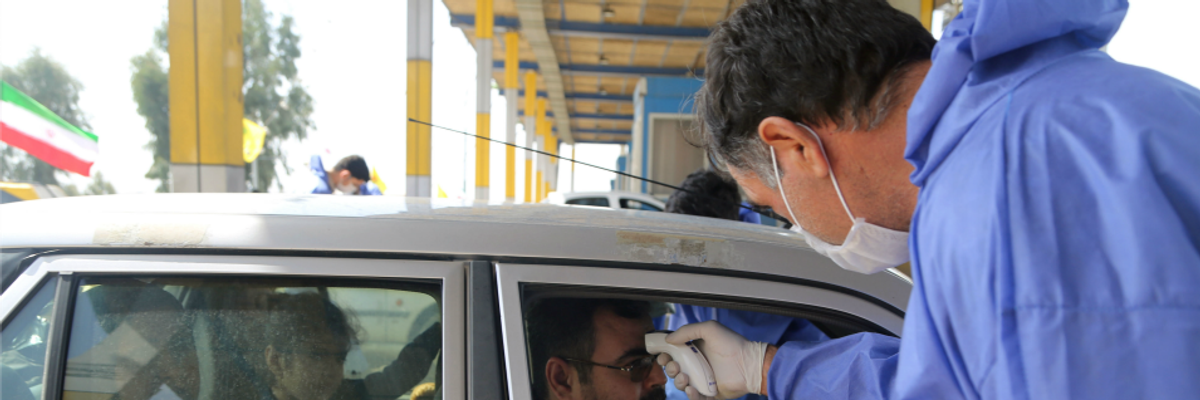
Health workers measure the body temperatures of passengers as a precaution against the coronavirus in Qom, Iran on March 17, 2020. (Photo: Fatemah Bahrami/Anadolu Agency via Getty Images)
A group of economists and policy experts on Wednesday called on President Donald Trump to immediately lift the United States' crippling sanctions against Iran, Venezuela, Cuba, and other countries, warning that the economic warfare--in addition to being cruel in itself--is "feeding the coronavirus epidemic" by hampering nations' capacity to respond.
"This policy is unconscionable and flagrantly against international law. It is imperative that the U.S. lift these immoral and illegal sanctions to enable Iran and Venezuela to confront the epidemic as effectively and rapidly as possible," Columbia University professor Jeffrey Sachs said in a statement just hours after the Trump administration intensified sanctions against Iran, which has been devastated by COVID-19.
"Economic sanctions, as the U.S. is applying against Iran, Cuba, Venezuela, and other countries, cause immense harm."
-- Mark Weisbrot, Center for Economic and Policy Research
Mark Weisbrot, co-director of the Center for Economic and Policy Research (CEPR), said "there is no doubt that Iran's capacity to respond to the novel coronavirus has been hampered by the Trump administration's economic sanctions, and the death toll is likely much higher than it would have been as a result."
Weisbrot warned that continued sanctions against Iran could have devastating consequences for other nations in the region as they work to stop the spread of the virus.
"There can... be no question that the sanctions have affected Iran's ability to contain the outbreak," said Weisbrot, "leading in turn to more infections, and possibly to the virus' spread beyond Iran's borders."
"If the U.S. government is going to assist other countries, let alone provide some kind of leadership role during this global crisis, the first thing it should do is 'cause no harm,'" Weisbrot added. "Economic sanctions, as the U.S. is applying against Iran, Cuba, Venezuela, and other countries, cause immense harm."
Pressure on the U.S. to lift its international economic sanctions came as the official coronavirus death toll in Iran surpassed 1,100. Meanwhile, Venezuela remains on lockdown after dozens of people tested positive for the virus and Cuba confirmed its first cases of COVID-19 last week.
Economist Francisco Rodriguez, a leading expert on the Venezuelan economy, said that U.S. sanctions against Venezuela and other nations have severely hindered their ability to respond to the pandemic, which has infected nearly 220,000 people worldwide.
"This has dramatic consequences on the lives of their citizens and exacerbates a major global health risk," said Rodriguez.
Dear Common Dreams reader, It’s been nearly 30 years since I co-founded Common Dreams with my late wife, Lina Newhouser. We had the radical notion that journalism should serve the public good, not corporate profits. It was clear to us from the outset what it would take to build such a project. No paid advertisements. No corporate sponsors. No millionaire publisher telling us what to think or do. Many people said we wouldn't last a year, but we proved those doubters wrong. Together with a tremendous team of journalists and dedicated staff, we built an independent media outlet free from the constraints of profits and corporate control. Our mission has always been simple: To inform. To inspire. To ignite change for the common good. Building Common Dreams was not easy. Our survival was never guaranteed. When you take on the most powerful forces—Wall Street greed, fossil fuel industry destruction, Big Tech lobbyists, and uber-rich oligarchs who have spent billions upon billions rigging the economy and democracy in their favor—the only bulwark you have is supporters who believe in your work. But here’s the urgent message from me today. It's never been this bad out there. And it's never been this hard to keep us going. At the very moment Common Dreams is most needed, the threats we face are intensifying. We need your support now more than ever. We don't accept corporate advertising and never will. We don't have a paywall because we don't think people should be blocked from critical news based on their ability to pay. Everything we do is funded by the donations of readers like you. When everyone does the little they can afford, we are strong. But if that support retreats or dries up, so do we. Will you donate now to make sure Common Dreams not only survives but thrives? —Craig Brown, Co-founder |
A group of economists and policy experts on Wednesday called on President Donald Trump to immediately lift the United States' crippling sanctions against Iran, Venezuela, Cuba, and other countries, warning that the economic warfare--in addition to being cruel in itself--is "feeding the coronavirus epidemic" by hampering nations' capacity to respond.
"This policy is unconscionable and flagrantly against international law. It is imperative that the U.S. lift these immoral and illegal sanctions to enable Iran and Venezuela to confront the epidemic as effectively and rapidly as possible," Columbia University professor Jeffrey Sachs said in a statement just hours after the Trump administration intensified sanctions against Iran, which has been devastated by COVID-19.
"Economic sanctions, as the U.S. is applying against Iran, Cuba, Venezuela, and other countries, cause immense harm."
-- Mark Weisbrot, Center for Economic and Policy Research
Mark Weisbrot, co-director of the Center for Economic and Policy Research (CEPR), said "there is no doubt that Iran's capacity to respond to the novel coronavirus has been hampered by the Trump administration's economic sanctions, and the death toll is likely much higher than it would have been as a result."
Weisbrot warned that continued sanctions against Iran could have devastating consequences for other nations in the region as they work to stop the spread of the virus.
"There can... be no question that the sanctions have affected Iran's ability to contain the outbreak," said Weisbrot, "leading in turn to more infections, and possibly to the virus' spread beyond Iran's borders."
"If the U.S. government is going to assist other countries, let alone provide some kind of leadership role during this global crisis, the first thing it should do is 'cause no harm,'" Weisbrot added. "Economic sanctions, as the U.S. is applying against Iran, Cuba, Venezuela, and other countries, cause immense harm."
Pressure on the U.S. to lift its international economic sanctions came as the official coronavirus death toll in Iran surpassed 1,100. Meanwhile, Venezuela remains on lockdown after dozens of people tested positive for the virus and Cuba confirmed its first cases of COVID-19 last week.
Economist Francisco Rodriguez, a leading expert on the Venezuelan economy, said that U.S. sanctions against Venezuela and other nations have severely hindered their ability to respond to the pandemic, which has infected nearly 220,000 people worldwide.
"This has dramatic consequences on the lives of their citizens and exacerbates a major global health risk," said Rodriguez.
A group of economists and policy experts on Wednesday called on President Donald Trump to immediately lift the United States' crippling sanctions against Iran, Venezuela, Cuba, and other countries, warning that the economic warfare--in addition to being cruel in itself--is "feeding the coronavirus epidemic" by hampering nations' capacity to respond.
"This policy is unconscionable and flagrantly against international law. It is imperative that the U.S. lift these immoral and illegal sanctions to enable Iran and Venezuela to confront the epidemic as effectively and rapidly as possible," Columbia University professor Jeffrey Sachs said in a statement just hours after the Trump administration intensified sanctions against Iran, which has been devastated by COVID-19.
"Economic sanctions, as the U.S. is applying against Iran, Cuba, Venezuela, and other countries, cause immense harm."
-- Mark Weisbrot, Center for Economic and Policy Research
Mark Weisbrot, co-director of the Center for Economic and Policy Research (CEPR), said "there is no doubt that Iran's capacity to respond to the novel coronavirus has been hampered by the Trump administration's economic sanctions, and the death toll is likely much higher than it would have been as a result."
Weisbrot warned that continued sanctions against Iran could have devastating consequences for other nations in the region as they work to stop the spread of the virus.
"There can... be no question that the sanctions have affected Iran's ability to contain the outbreak," said Weisbrot, "leading in turn to more infections, and possibly to the virus' spread beyond Iran's borders."
"If the U.S. government is going to assist other countries, let alone provide some kind of leadership role during this global crisis, the first thing it should do is 'cause no harm,'" Weisbrot added. "Economic sanctions, as the U.S. is applying against Iran, Cuba, Venezuela, and other countries, cause immense harm."
Pressure on the U.S. to lift its international economic sanctions came as the official coronavirus death toll in Iran surpassed 1,100. Meanwhile, Venezuela remains on lockdown after dozens of people tested positive for the virus and Cuba confirmed its first cases of COVID-19 last week.
Economist Francisco Rodriguez, a leading expert on the Venezuelan economy, said that U.S. sanctions against Venezuela and other nations have severely hindered their ability to respond to the pandemic, which has infected nearly 220,000 people worldwide.
"This has dramatic consequences on the lives of their citizens and exacerbates a major global health risk," said Rodriguez.