SUBSCRIBE TO OUR FREE NEWSLETTER
Daily news & progressive opinion—funded by the people, not the corporations—delivered straight to your inbox.
5
#000000
#FFFFFF
To donate by check, phone, or other method, see our More Ways to Give page.
Daily news & progressive opinion—funded by the people, not the corporations—delivered straight to your inbox.
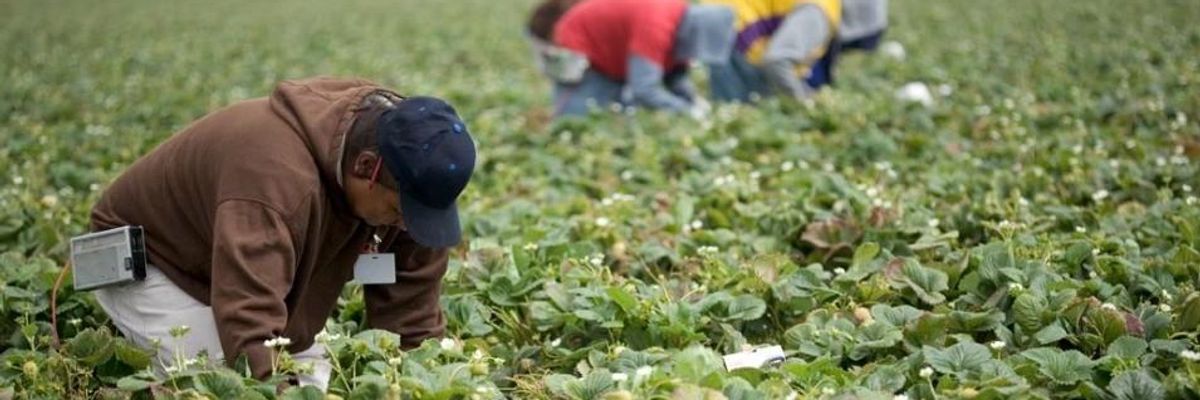
Agricultural workers work in Salinas, California. (Photo: Michael Davidson/Flickr/cc)
While images of barren grocery store shelves grab headlines and circulate on social media as people worldwide stock up on staples to get through the ongoing coronavirus outbreak, farmers in the United States are warning that the Trump administration's decision to limit seasonal workers from Mexico could soon lead to labor and food shortages.
"Under the new restrictions, American farmers will not have access to all of the skilled immigrant labor needed at a critical time in the planting season. This threatens our ability to put food on Americans' tables."
--Zippy Duvall, American Farm Bureau Federation
The U.S. government announced Monday that "in response to the global pandemic COVID-19, and in line with the Mexican government's call to increase social distancing, the U.S. Embassy in Mexico City and all U.S. consulates in Mexico will suspend routine immigrant and nonimmigrant visa services starting March 18, 2020, and until further notice."
U.S. Agriculture Secretary Sonny Perdue reportedly told growers on a call Tuesday that consulates in Mexico will continue processing applications for returning guest workers under the H2A program--long criticized as exploitive--but will no longer process applications for new applicants, who represent up to 60% of the needed laborers.
The U.S. Department of Agriculture told multiple news outlets that it is "directly engaged with the State Department and working diligently to ensure minimal disruption in H2A visa applications during these uncertain times."
According to Reuters, "Farmworker visas and other seasonal guest worker visas are still being processed in smaller countries including El Salvador and Guatemala."
Reuters reported Tuesday on U.S. fruit and vegetable growers "bracing for dramatic disruptions to their labor force" because of the guest worker changes:
While the harvesting of grains like wheat and corn is mostly automated in the United States, fruit and vegetable farmers rely on seasonal guest workers to pick their crops.
"When the process is stopped midstream, it likely means those crews won't be there exactly when they're needed, if they get there at all. That means lost crops. That means lost food," said Dave Puglia, president of the Western Growers Association, which represents fruit and vegetable growers in states including California and Arizona.
"Increasingly... we just don't have the labor force domestically. We're turning more and more to H2A workers because there's no other way to get our crops harvested and packed and off to consumers," he said.
Puglia warned foods that could soon be affected by the low guest worker numbers include broccoli, cauliflower, celery, leafy greens, melons, and radishes.
Robert Guenther, senior vice president for public policy at the United Fresh Produce Association, told Bloomberg that berries, cucumbers, and leafy greens will likely be impacted first but tree fruit like citrus, nectarines, peaches, and plums could be affected in May and June. He was frank in his assessment of the anticipated fallout of the new visa policy.
"There won't be anyone to harvest the crops," Guenther said. "It will be devastating to growers and ultimately to the supply chain and consumers. They won't have the food."
In a statement Tuesday, Zippy Duvall, president of the lobbying group American Farm Bureau Federation, emphasized that growers "remain committed to doing the work in the fields, orchards, and barns across the country to ensure Americans have access to healthy, affordable food," but also expressed concern about the labor limitations.
"The decision to halt visa application processing in Mexico will restrict the number of immigrant workers being allowed to enter the country," said Duvall. "Under the new restrictions, American farmers will not have access to all of the skilled immigrant labor needed at a critical time in the planting season. This threatens our ability to put food on Americans' tables."
"We fully support the administration's efforts to protect the public during this health crisis," Duvall added. "We are in constant contact with USDA, the State Department, and the White House. We have urged them to find safe, practical ways to admit farm laborers as emergency workers for visa purposes while still protecting public health."
Purdue said in a statement Tuesday that "if you have ideas or solutions for USDA, I urge you to reach out--we want to hear from the experts in the field."
"Food is essential all year round, but in the face of a pandemic it is critical the shelves remain stocked and supplies remain plentiful," Purdue acknowledged. "America's farmers and ranchers, and those on the front lines in the food service industry are doing their part."
In a video Tuesday, Purdue urged Americans to refrain from "hoarding" shelf-stable foods and claimed that U.S. food supply chains "remain strong."
The limits on guest workers from Mexico aren't the only immigration-related moves the federal government has made in response to the COVID-19 pandemic. The New York Times reported Tuesday that the Trump administration will soon announce plans to send back to Mexico all asylum-seekers and undocumented immigrants who attempt to cross the southern border between ports of entry.
Although "the ports of entry would remain open to American citizens, green card holders, and some foreigners with proper documentation," according to the Times, "some foreigners would be blocked, including Europeans currently subject to earlier travel restrictions enacted by the administration. The entryways will also be open to commercial traffic."
Amnesty International USA advocacy director for the Americas Charanya Krishnaswami charged Wednesday that "the Trump administration's ban on asylum-seekers coming from Mexico has nothing to do with making Americans safer from the coronavirus pandemic." She accused the president of "engaging in fear-mongering to justify racist and discriminatory policies whose only purpose is to demonize people seeking safety."
"The Trump administration has already sent tens of thousands of asylum-seekers to harm's way in Mexico, forcing them to survive in dangerous and precarious conditions and exposing them to appalling risks of kidnapping, torture, and other abuses," Krishnaswami added. "Instead of doubling down on these failed tactics, the Trump administration should reverse these cruel and punitive policies and allow people to seek safety following the process required by U.S. and international law."
Dear Common Dreams reader, It’s been nearly 30 years since I co-founded Common Dreams with my late wife, Lina Newhouser. We had the radical notion that journalism should serve the public good, not corporate profits. It was clear to us from the outset what it would take to build such a project. No paid advertisements. No corporate sponsors. No millionaire publisher telling us what to think or do. Many people said we wouldn't last a year, but we proved those doubters wrong. Together with a tremendous team of journalists and dedicated staff, we built an independent media outlet free from the constraints of profits and corporate control. Our mission has always been simple: To inform. To inspire. To ignite change for the common good. Building Common Dreams was not easy. Our survival was never guaranteed. When you take on the most powerful forces—Wall Street greed, fossil fuel industry destruction, Big Tech lobbyists, and uber-rich oligarchs who have spent billions upon billions rigging the economy and democracy in their favor—the only bulwark you have is supporters who believe in your work. But here’s the urgent message from me today. It's never been this bad out there. And it's never been this hard to keep us going. At the very moment Common Dreams is most needed, the threats we face are intensifying. We need your support now more than ever. We don't accept corporate advertising and never will. We don't have a paywall because we don't think people should be blocked from critical news based on their ability to pay. Everything we do is funded by the donations of readers like you. When everyone does the little they can afford, we are strong. But if that support retreats or dries up, so do we. Will you donate now to make sure Common Dreams not only survives but thrives? —Craig Brown, Co-founder |
While images of barren grocery store shelves grab headlines and circulate on social media as people worldwide stock up on staples to get through the ongoing coronavirus outbreak, farmers in the United States are warning that the Trump administration's decision to limit seasonal workers from Mexico could soon lead to labor and food shortages.
"Under the new restrictions, American farmers will not have access to all of the skilled immigrant labor needed at a critical time in the planting season. This threatens our ability to put food on Americans' tables."
--Zippy Duvall, American Farm Bureau Federation
The U.S. government announced Monday that "in response to the global pandemic COVID-19, and in line with the Mexican government's call to increase social distancing, the U.S. Embassy in Mexico City and all U.S. consulates in Mexico will suspend routine immigrant and nonimmigrant visa services starting March 18, 2020, and until further notice."
U.S. Agriculture Secretary Sonny Perdue reportedly told growers on a call Tuesday that consulates in Mexico will continue processing applications for returning guest workers under the H2A program--long criticized as exploitive--but will no longer process applications for new applicants, who represent up to 60% of the needed laborers.
The U.S. Department of Agriculture told multiple news outlets that it is "directly engaged with the State Department and working diligently to ensure minimal disruption in H2A visa applications during these uncertain times."
According to Reuters, "Farmworker visas and other seasonal guest worker visas are still being processed in smaller countries including El Salvador and Guatemala."
Reuters reported Tuesday on U.S. fruit and vegetable growers "bracing for dramatic disruptions to their labor force" because of the guest worker changes:
While the harvesting of grains like wheat and corn is mostly automated in the United States, fruit and vegetable farmers rely on seasonal guest workers to pick their crops.
"When the process is stopped midstream, it likely means those crews won't be there exactly when they're needed, if they get there at all. That means lost crops. That means lost food," said Dave Puglia, president of the Western Growers Association, which represents fruit and vegetable growers in states including California and Arizona.
"Increasingly... we just don't have the labor force domestically. We're turning more and more to H2A workers because there's no other way to get our crops harvested and packed and off to consumers," he said.
Puglia warned foods that could soon be affected by the low guest worker numbers include broccoli, cauliflower, celery, leafy greens, melons, and radishes.
Robert Guenther, senior vice president for public policy at the United Fresh Produce Association, told Bloomberg that berries, cucumbers, and leafy greens will likely be impacted first but tree fruit like citrus, nectarines, peaches, and plums could be affected in May and June. He was frank in his assessment of the anticipated fallout of the new visa policy.
"There won't be anyone to harvest the crops," Guenther said. "It will be devastating to growers and ultimately to the supply chain and consumers. They won't have the food."
In a statement Tuesday, Zippy Duvall, president of the lobbying group American Farm Bureau Federation, emphasized that growers "remain committed to doing the work in the fields, orchards, and barns across the country to ensure Americans have access to healthy, affordable food," but also expressed concern about the labor limitations.
"The decision to halt visa application processing in Mexico will restrict the number of immigrant workers being allowed to enter the country," said Duvall. "Under the new restrictions, American farmers will not have access to all of the skilled immigrant labor needed at a critical time in the planting season. This threatens our ability to put food on Americans' tables."
"We fully support the administration's efforts to protect the public during this health crisis," Duvall added. "We are in constant contact with USDA, the State Department, and the White House. We have urged them to find safe, practical ways to admit farm laborers as emergency workers for visa purposes while still protecting public health."
Purdue said in a statement Tuesday that "if you have ideas or solutions for USDA, I urge you to reach out--we want to hear from the experts in the field."
"Food is essential all year round, but in the face of a pandemic it is critical the shelves remain stocked and supplies remain plentiful," Purdue acknowledged. "America's farmers and ranchers, and those on the front lines in the food service industry are doing their part."
In a video Tuesday, Purdue urged Americans to refrain from "hoarding" shelf-stable foods and claimed that U.S. food supply chains "remain strong."
The limits on guest workers from Mexico aren't the only immigration-related moves the federal government has made in response to the COVID-19 pandemic. The New York Times reported Tuesday that the Trump administration will soon announce plans to send back to Mexico all asylum-seekers and undocumented immigrants who attempt to cross the southern border between ports of entry.
Although "the ports of entry would remain open to American citizens, green card holders, and some foreigners with proper documentation," according to the Times, "some foreigners would be blocked, including Europeans currently subject to earlier travel restrictions enacted by the administration. The entryways will also be open to commercial traffic."
Amnesty International USA advocacy director for the Americas Charanya Krishnaswami charged Wednesday that "the Trump administration's ban on asylum-seekers coming from Mexico has nothing to do with making Americans safer from the coronavirus pandemic." She accused the president of "engaging in fear-mongering to justify racist and discriminatory policies whose only purpose is to demonize people seeking safety."
"The Trump administration has already sent tens of thousands of asylum-seekers to harm's way in Mexico, forcing them to survive in dangerous and precarious conditions and exposing them to appalling risks of kidnapping, torture, and other abuses," Krishnaswami added. "Instead of doubling down on these failed tactics, the Trump administration should reverse these cruel and punitive policies and allow people to seek safety following the process required by U.S. and international law."
While images of barren grocery store shelves grab headlines and circulate on social media as people worldwide stock up on staples to get through the ongoing coronavirus outbreak, farmers in the United States are warning that the Trump administration's decision to limit seasonal workers from Mexico could soon lead to labor and food shortages.
"Under the new restrictions, American farmers will not have access to all of the skilled immigrant labor needed at a critical time in the planting season. This threatens our ability to put food on Americans' tables."
--Zippy Duvall, American Farm Bureau Federation
The U.S. government announced Monday that "in response to the global pandemic COVID-19, and in line with the Mexican government's call to increase social distancing, the U.S. Embassy in Mexico City and all U.S. consulates in Mexico will suspend routine immigrant and nonimmigrant visa services starting March 18, 2020, and until further notice."
U.S. Agriculture Secretary Sonny Perdue reportedly told growers on a call Tuesday that consulates in Mexico will continue processing applications for returning guest workers under the H2A program--long criticized as exploitive--but will no longer process applications for new applicants, who represent up to 60% of the needed laborers.
The U.S. Department of Agriculture told multiple news outlets that it is "directly engaged with the State Department and working diligently to ensure minimal disruption in H2A visa applications during these uncertain times."
According to Reuters, "Farmworker visas and other seasonal guest worker visas are still being processed in smaller countries including El Salvador and Guatemala."
Reuters reported Tuesday on U.S. fruit and vegetable growers "bracing for dramatic disruptions to their labor force" because of the guest worker changes:
While the harvesting of grains like wheat and corn is mostly automated in the United States, fruit and vegetable farmers rely on seasonal guest workers to pick their crops.
"When the process is stopped midstream, it likely means those crews won't be there exactly when they're needed, if they get there at all. That means lost crops. That means lost food," said Dave Puglia, president of the Western Growers Association, which represents fruit and vegetable growers in states including California and Arizona.
"Increasingly... we just don't have the labor force domestically. We're turning more and more to H2A workers because there's no other way to get our crops harvested and packed and off to consumers," he said.
Puglia warned foods that could soon be affected by the low guest worker numbers include broccoli, cauliflower, celery, leafy greens, melons, and radishes.
Robert Guenther, senior vice president for public policy at the United Fresh Produce Association, told Bloomberg that berries, cucumbers, and leafy greens will likely be impacted first but tree fruit like citrus, nectarines, peaches, and plums could be affected in May and June. He was frank in his assessment of the anticipated fallout of the new visa policy.
"There won't be anyone to harvest the crops," Guenther said. "It will be devastating to growers and ultimately to the supply chain and consumers. They won't have the food."
In a statement Tuesday, Zippy Duvall, president of the lobbying group American Farm Bureau Federation, emphasized that growers "remain committed to doing the work in the fields, orchards, and barns across the country to ensure Americans have access to healthy, affordable food," but also expressed concern about the labor limitations.
"The decision to halt visa application processing in Mexico will restrict the number of immigrant workers being allowed to enter the country," said Duvall. "Under the new restrictions, American farmers will not have access to all of the skilled immigrant labor needed at a critical time in the planting season. This threatens our ability to put food on Americans' tables."
"We fully support the administration's efforts to protect the public during this health crisis," Duvall added. "We are in constant contact with USDA, the State Department, and the White House. We have urged them to find safe, practical ways to admit farm laborers as emergency workers for visa purposes while still protecting public health."
Purdue said in a statement Tuesday that "if you have ideas or solutions for USDA, I urge you to reach out--we want to hear from the experts in the field."
"Food is essential all year round, but in the face of a pandemic it is critical the shelves remain stocked and supplies remain plentiful," Purdue acknowledged. "America's farmers and ranchers, and those on the front lines in the food service industry are doing their part."
In a video Tuesday, Purdue urged Americans to refrain from "hoarding" shelf-stable foods and claimed that U.S. food supply chains "remain strong."
The limits on guest workers from Mexico aren't the only immigration-related moves the federal government has made in response to the COVID-19 pandemic. The New York Times reported Tuesday that the Trump administration will soon announce plans to send back to Mexico all asylum-seekers and undocumented immigrants who attempt to cross the southern border between ports of entry.
Although "the ports of entry would remain open to American citizens, green card holders, and some foreigners with proper documentation," according to the Times, "some foreigners would be blocked, including Europeans currently subject to earlier travel restrictions enacted by the administration. The entryways will also be open to commercial traffic."
Amnesty International USA advocacy director for the Americas Charanya Krishnaswami charged Wednesday that "the Trump administration's ban on asylum-seekers coming from Mexico has nothing to do with making Americans safer from the coronavirus pandemic." She accused the president of "engaging in fear-mongering to justify racist and discriminatory policies whose only purpose is to demonize people seeking safety."
"The Trump administration has already sent tens of thousands of asylum-seekers to harm's way in Mexico, forcing them to survive in dangerous and precarious conditions and exposing them to appalling risks of kidnapping, torture, and other abuses," Krishnaswami added. "Instead of doubling down on these failed tactics, the Trump administration should reverse these cruel and punitive policies and allow people to seek safety following the process required by U.S. and international law."