SUBSCRIBE TO OUR FREE NEWSLETTER
Daily news & progressive opinion—funded by the people, not the corporations—delivered straight to your inbox.
5
#000000
#FFFFFF
To donate by check, phone, or other method, see our More Ways to Give page.
Daily news & progressive opinion—funded by the people, not the corporations—delivered straight to your inbox.
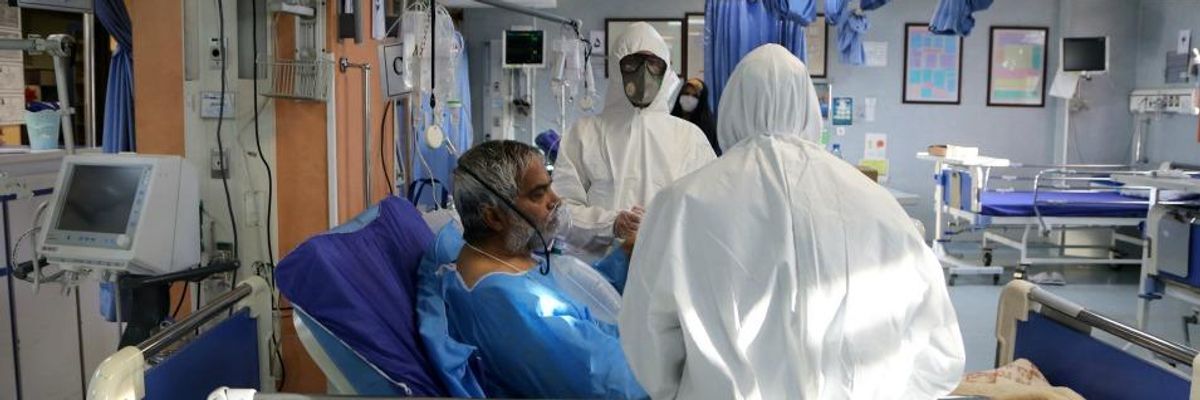
General view of a hospital where health officers, wearing masks and special protective suits, take care of a patient infected by the coronavirus (COVID-19) at a hospital in Tehran, Iran on March 02, 2020. (Photo: Fatemeh Bahrami/Anadolu Agency via Getty Images)
"How evil and heartless can this government get?" peace activist Medea Benjamin asked Wednesday after the State Department announced it would impose new sanctions on Iran as the country faces one of the worst coronavirus outbreaks in the world.
The move by the U.S. government flew in the face of demands from advocacy groups and the Iranian government to suspend sanctions to ensure Iranians can access life-saving medication and supplies.
Secretary of State Mike Pompeo announced the U.S. will introduce fresh sanctions on nine entities and three individuals who the U.S. says provide the Iranian government with revenue, in order to "deprive the regime of critical income from its petrochemical industry and further Iran's economic and diplomatic isolation."
The move follows rocket attacks on U.S. forces in Iraq, which the Trump administration claims were linked to Iran-backed forces.
Benjamin, co-founder of the anti-war group CODEPINK, called the State Department's move "unconscionable."
"Pure evil," wrote journalist Ben Norton. "This is Nazi behavior."
Iran is one of the hardest-hit countries in the world by the coronavirus pandemic. More than 17,300 people had tested positive for the respiratory disease at press time, and more than 1,100 have died.
Under normal circumstances, U.S. sanctions on Iran--which were last strengthened last year--have kept people in the country from accessing medication as well as raising prices on food and rent.
As Iran faces the coronavirus outbreak, however, the impacts of the sanctions have been heightened, as Iran is left without sufficient testing kits, ventilators, antiviral medicine, and other life-saving supplies.
As the death toll in Iran rose Wednesday, Sen. Bernie Sanders (I-Vt.) tweeted that the U.S. "should not be contributing to this humanitarian disaster."
On Tuesday, Iranian Foreign Minister Javad Zarif called the United States' refusal to lift sanctions "medical terrorism," as CODEPINK called on European countries to disregard the sanctions.
The imposition of fresh sanctions as the country battles the outbreak amounts to the U.S. "literally weaponizing the coronavirus," said human rights lawyer Arjun Sethi.
Assal Rad, research fellow at the National Iranian American Council (NIAC), said the new sanctions would make the U.S. "complicit" in the deaths of an untold number of Iranians, while Trita Parsi of the Quincy Institute accused the Trump administration of "inhumanity."
Benjamin called on Americans to loudly reject the new sanctions, circulating a petition on social media.
"Are we, the American people, really going to stand by and watch as the U.S. administration makes it more and more difficult for Iranians to--literally--breathe?" Benjamin wrote. "Adding even more sanctions today is immoral and wicked."
Dear Common Dreams reader, It’s been nearly 30 years since I co-founded Common Dreams with my late wife, Lina Newhouser. We had the radical notion that journalism should serve the public good, not corporate profits. It was clear to us from the outset what it would take to build such a project. No paid advertisements. No corporate sponsors. No millionaire publisher telling us what to think or do. Many people said we wouldn't last a year, but we proved those doubters wrong. Together with a tremendous team of journalists and dedicated staff, we built an independent media outlet free from the constraints of profits and corporate control. Our mission has always been simple: To inform. To inspire. To ignite change for the common good. Building Common Dreams was not easy. Our survival was never guaranteed. When you take on the most powerful forces—Wall Street greed, fossil fuel industry destruction, Big Tech lobbyists, and uber-rich oligarchs who have spent billions upon billions rigging the economy and democracy in their favor—the only bulwark you have is supporters who believe in your work. But here’s the urgent message from me today. It's never been this bad out there. And it's never been this hard to keep us going. At the very moment Common Dreams is most needed, the threats we face are intensifying. We need your support now more than ever. We don't accept corporate advertising and never will. We don't have a paywall because we don't think people should be blocked from critical news based on their ability to pay. Everything we do is funded by the donations of readers like you. When everyone does the little they can afford, we are strong. But if that support retreats or dries up, so do we. Will you donate now to make sure Common Dreams not only survives but thrives? —Craig Brown, Co-founder |
"How evil and heartless can this government get?" peace activist Medea Benjamin asked Wednesday after the State Department announced it would impose new sanctions on Iran as the country faces one of the worst coronavirus outbreaks in the world.
The move by the U.S. government flew in the face of demands from advocacy groups and the Iranian government to suspend sanctions to ensure Iranians can access life-saving medication and supplies.
Secretary of State Mike Pompeo announced the U.S. will introduce fresh sanctions on nine entities and three individuals who the U.S. says provide the Iranian government with revenue, in order to "deprive the regime of critical income from its petrochemical industry and further Iran's economic and diplomatic isolation."
The move follows rocket attacks on U.S. forces in Iraq, which the Trump administration claims were linked to Iran-backed forces.
Benjamin, co-founder of the anti-war group CODEPINK, called the State Department's move "unconscionable."
"Pure evil," wrote journalist Ben Norton. "This is Nazi behavior."
Iran is one of the hardest-hit countries in the world by the coronavirus pandemic. More than 17,300 people had tested positive for the respiratory disease at press time, and more than 1,100 have died.
Under normal circumstances, U.S. sanctions on Iran--which were last strengthened last year--have kept people in the country from accessing medication as well as raising prices on food and rent.
As Iran faces the coronavirus outbreak, however, the impacts of the sanctions have been heightened, as Iran is left without sufficient testing kits, ventilators, antiviral medicine, and other life-saving supplies.
As the death toll in Iran rose Wednesday, Sen. Bernie Sanders (I-Vt.) tweeted that the U.S. "should not be contributing to this humanitarian disaster."
On Tuesday, Iranian Foreign Minister Javad Zarif called the United States' refusal to lift sanctions "medical terrorism," as CODEPINK called on European countries to disregard the sanctions.
The imposition of fresh sanctions as the country battles the outbreak amounts to the U.S. "literally weaponizing the coronavirus," said human rights lawyer Arjun Sethi.
Assal Rad, research fellow at the National Iranian American Council (NIAC), said the new sanctions would make the U.S. "complicit" in the deaths of an untold number of Iranians, while Trita Parsi of the Quincy Institute accused the Trump administration of "inhumanity."
Benjamin called on Americans to loudly reject the new sanctions, circulating a petition on social media.
"Are we, the American people, really going to stand by and watch as the U.S. administration makes it more and more difficult for Iranians to--literally--breathe?" Benjamin wrote. "Adding even more sanctions today is immoral and wicked."
"How evil and heartless can this government get?" peace activist Medea Benjamin asked Wednesday after the State Department announced it would impose new sanctions on Iran as the country faces one of the worst coronavirus outbreaks in the world.
The move by the U.S. government flew in the face of demands from advocacy groups and the Iranian government to suspend sanctions to ensure Iranians can access life-saving medication and supplies.
Secretary of State Mike Pompeo announced the U.S. will introduce fresh sanctions on nine entities and three individuals who the U.S. says provide the Iranian government with revenue, in order to "deprive the regime of critical income from its petrochemical industry and further Iran's economic and diplomatic isolation."
The move follows rocket attacks on U.S. forces in Iraq, which the Trump administration claims were linked to Iran-backed forces.
Benjamin, co-founder of the anti-war group CODEPINK, called the State Department's move "unconscionable."
"Pure evil," wrote journalist Ben Norton. "This is Nazi behavior."
Iran is one of the hardest-hit countries in the world by the coronavirus pandemic. More than 17,300 people had tested positive for the respiratory disease at press time, and more than 1,100 have died.
Under normal circumstances, U.S. sanctions on Iran--which were last strengthened last year--have kept people in the country from accessing medication as well as raising prices on food and rent.
As Iran faces the coronavirus outbreak, however, the impacts of the sanctions have been heightened, as Iran is left without sufficient testing kits, ventilators, antiviral medicine, and other life-saving supplies.
As the death toll in Iran rose Wednesday, Sen. Bernie Sanders (I-Vt.) tweeted that the U.S. "should not be contributing to this humanitarian disaster."
On Tuesday, Iranian Foreign Minister Javad Zarif called the United States' refusal to lift sanctions "medical terrorism," as CODEPINK called on European countries to disregard the sanctions.
The imposition of fresh sanctions as the country battles the outbreak amounts to the U.S. "literally weaponizing the coronavirus," said human rights lawyer Arjun Sethi.
Assal Rad, research fellow at the National Iranian American Council (NIAC), said the new sanctions would make the U.S. "complicit" in the deaths of an untold number of Iranians, while Trita Parsi of the Quincy Institute accused the Trump administration of "inhumanity."
Benjamin called on Americans to loudly reject the new sanctions, circulating a petition on social media.
"Are we, the American people, really going to stand by and watch as the U.S. administration makes it more and more difficult for Iranians to--literally--breathe?" Benjamin wrote. "Adding even more sanctions today is immoral and wicked."