
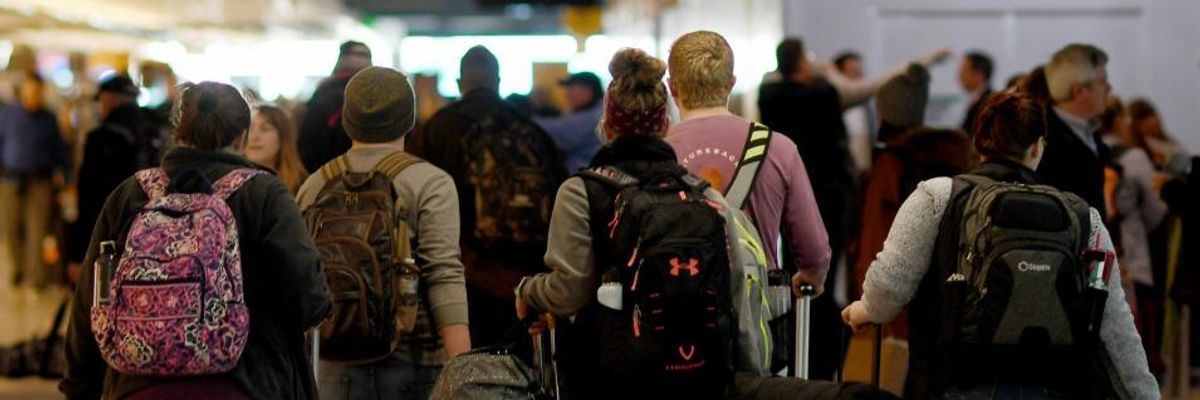
Passengers at Denver International Airport on February 26, 2020 in Denver. (Photo: RJ Sangosti/MediaNews Group/The Denver Post via Getty Images)
Norway University Calls On Students to Return Home From Countries With 'Poorly Developed Health Systems'--Such as the US
"Norway is correct... the U.S. is a poorly developed country."
As the coronavirus pandemic lays bare a number of major weaknesses in the U.S. medical system, one university in Norway went as far on Sunday as to specifically advise all students studying abroad to come home in order to avoid having to rely on American healthcare if they become ill.
The Norway University of Science and Technology (NTNU) posted an advisory on its official Facebook page Sunday warning that students staying in "a country with poorly developed health services and infrastructure and/or collective infrastructure" should return home as soon as possible.
"For example, the U.S.A.," school authorities wrote.
So Norway just called the United States underdeveloped pic.twitter.com/C1oKcP3x2v
-- Black Aziz aNANsi (@Freeyourmindkid) March 15, 2020
NTNU edited the post to delete the reference to the U.S., but not before many Americans chimed in on its Facebook page to express agreement with the warning. The post was shared widely on social media.
NTNU's warning came as the U.S. House passed legislation to provide free testing for the coronavirus disease, officially called COVID-19, for all Americans--but the Republican-led Senate still must pass the bill before it's signed by President Donald Trump.
Reports have mounted in recent weeks about Americans reporting typical COVID-19 symptoms--including fever, shortness of breath, and coughing--only to be denied a test unless they meet a stringent set of criteria which is being used in many states.
Although "community spread" of the virus has now been widely reported, many states, counties, and cities are not allowing testing for anyone who hasn't traveled recently or come into contact with someone who's tested positive for COVID-19.
"Testing rules are so strict that doctors may not notice a community outbreak until it's too late," Robinson Meyer wrote in The Atlantic on Friday.
Anthropology researcher Chenchen Zhang reported on Twitter last week that a Chinese national living in Massachusetts was refused coronavirus testing in the U.S., and flew to China, the epicenter of the pandemic, in order to get care.
The failure of local, state, and federal governments to track the spread of the illness may result in overwhelmed hospitals and medical staff in a country which has fewer hospital beds per capita than most other developed countries. According to Stat News, based on the current rate at which the virus is spreading, all U.S. hospital beds could be filled by May 10.
As NTNU warned about the United States' poorly developed "collective infrastructure," the for-profit healthcare sector has left many patients with financial burdens after being treated for COVID-19. The New York Times reported late last month that some patients have faced surprise medical bills amounting to thousands of dollars following their government-mandated quarantine.
"In America, and only in America among developed countries, do patients risk thousands of dollars in medical bills by seeking help in a crisis," wrote Dylan Scott at Vox.com Monday.
Norway has reported just over 1,250 coronavirus cases and three deaths as of Monday morning. The U.S. has reported nearly 3,600 cases and 66 deaths, with the number of new cases growing rapidly in recent days.
Norwegian Minister of Health and Care Services Bent Hoeie told Reuters last week that the country "has conducted a comparatively larger number of tests than many other countries," while the U.S. has alarmed the international community by testing only about 13,000 people total for COVID-19. South Korea, by contrast, was testing nearly 20,000 people per day as of Friday.
An Urgent Message From Our Co-Founder
Dear Common Dreams reader, It’s been nearly 30 years since I co-founded Common Dreams with my late wife, Lina Newhouser. We had the radical notion that journalism should serve the public good, not corporate profits. It was clear to us from the outset what it would take to build such a project. No paid advertisements. No corporate sponsors. No millionaire publisher telling us what to think or do. Many people said we wouldn't last a year, but we proved those doubters wrong. Together with a tremendous team of journalists and dedicated staff, we built an independent media outlet free from the constraints of profits and corporate control. Our mission has always been simple: To inform. To inspire. To ignite change for the common good. Building Common Dreams was not easy. Our survival was never guaranteed. When you take on the most powerful forces—Wall Street greed, fossil fuel industry destruction, Big Tech lobbyists, and uber-rich oligarchs who have spent billions upon billions rigging the economy and democracy in their favor—the only bulwark you have is supporters who believe in your work. But here’s the urgent message from me today. It's never been this bad out there. And it's never been this hard to keep us going. At the very moment Common Dreams is most needed, the threats we face are intensifying. We need your support now more than ever. We don't accept corporate advertising and never will. We don't have a paywall because we don't think people should be blocked from critical news based on their ability to pay. Everything we do is funded by the donations of readers like you. When everyone does the little they can afford, we are strong. But if that support retreats or dries up, so do we. Will you donate now to make sure Common Dreams not only survives but thrives? —Craig Brown, Co-founder |
As the coronavirus pandemic lays bare a number of major weaknesses in the U.S. medical system, one university in Norway went as far on Sunday as to specifically advise all students studying abroad to come home in order to avoid having to rely on American healthcare if they become ill.
The Norway University of Science and Technology (NTNU) posted an advisory on its official Facebook page Sunday warning that students staying in "a country with poorly developed health services and infrastructure and/or collective infrastructure" should return home as soon as possible.
"For example, the U.S.A.," school authorities wrote.
So Norway just called the United States underdeveloped pic.twitter.com/C1oKcP3x2v
-- Black Aziz aNANsi (@Freeyourmindkid) March 15, 2020
NTNU edited the post to delete the reference to the U.S., but not before many Americans chimed in on its Facebook page to express agreement with the warning. The post was shared widely on social media.
NTNU's warning came as the U.S. House passed legislation to provide free testing for the coronavirus disease, officially called COVID-19, for all Americans--but the Republican-led Senate still must pass the bill before it's signed by President Donald Trump.
Reports have mounted in recent weeks about Americans reporting typical COVID-19 symptoms--including fever, shortness of breath, and coughing--only to be denied a test unless they meet a stringent set of criteria which is being used in many states.
Although "community spread" of the virus has now been widely reported, many states, counties, and cities are not allowing testing for anyone who hasn't traveled recently or come into contact with someone who's tested positive for COVID-19.
"Testing rules are so strict that doctors may not notice a community outbreak until it's too late," Robinson Meyer wrote in The Atlantic on Friday.
Anthropology researcher Chenchen Zhang reported on Twitter last week that a Chinese national living in Massachusetts was refused coronavirus testing in the U.S., and flew to China, the epicenter of the pandemic, in order to get care.
The failure of local, state, and federal governments to track the spread of the illness may result in overwhelmed hospitals and medical staff in a country which has fewer hospital beds per capita than most other developed countries. According to Stat News, based on the current rate at which the virus is spreading, all U.S. hospital beds could be filled by May 10.
As NTNU warned about the United States' poorly developed "collective infrastructure," the for-profit healthcare sector has left many patients with financial burdens after being treated for COVID-19. The New York Times reported late last month that some patients have faced surprise medical bills amounting to thousands of dollars following their government-mandated quarantine.
"In America, and only in America among developed countries, do patients risk thousands of dollars in medical bills by seeking help in a crisis," wrote Dylan Scott at Vox.com Monday.
Norway has reported just over 1,250 coronavirus cases and three deaths as of Monday morning. The U.S. has reported nearly 3,600 cases and 66 deaths, with the number of new cases growing rapidly in recent days.
Norwegian Minister of Health and Care Services Bent Hoeie told Reuters last week that the country "has conducted a comparatively larger number of tests than many other countries," while the U.S. has alarmed the international community by testing only about 13,000 people total for COVID-19. South Korea, by contrast, was testing nearly 20,000 people per day as of Friday.
As the coronavirus pandemic lays bare a number of major weaknesses in the U.S. medical system, one university in Norway went as far on Sunday as to specifically advise all students studying abroad to come home in order to avoid having to rely on American healthcare if they become ill.
The Norway University of Science and Technology (NTNU) posted an advisory on its official Facebook page Sunday warning that students staying in "a country with poorly developed health services and infrastructure and/or collective infrastructure" should return home as soon as possible.
"For example, the U.S.A.," school authorities wrote.
So Norway just called the United States underdeveloped pic.twitter.com/C1oKcP3x2v
-- Black Aziz aNANsi (@Freeyourmindkid) March 15, 2020
NTNU edited the post to delete the reference to the U.S., but not before many Americans chimed in on its Facebook page to express agreement with the warning. The post was shared widely on social media.
NTNU's warning came as the U.S. House passed legislation to provide free testing for the coronavirus disease, officially called COVID-19, for all Americans--but the Republican-led Senate still must pass the bill before it's signed by President Donald Trump.
Reports have mounted in recent weeks about Americans reporting typical COVID-19 symptoms--including fever, shortness of breath, and coughing--only to be denied a test unless they meet a stringent set of criteria which is being used in many states.
Although "community spread" of the virus has now been widely reported, many states, counties, and cities are not allowing testing for anyone who hasn't traveled recently or come into contact with someone who's tested positive for COVID-19.
"Testing rules are so strict that doctors may not notice a community outbreak until it's too late," Robinson Meyer wrote in The Atlantic on Friday.
Anthropology researcher Chenchen Zhang reported on Twitter last week that a Chinese national living in Massachusetts was refused coronavirus testing in the U.S., and flew to China, the epicenter of the pandemic, in order to get care.
The failure of local, state, and federal governments to track the spread of the illness may result in overwhelmed hospitals and medical staff in a country which has fewer hospital beds per capita than most other developed countries. According to Stat News, based on the current rate at which the virus is spreading, all U.S. hospital beds could be filled by May 10.
As NTNU warned about the United States' poorly developed "collective infrastructure," the for-profit healthcare sector has left many patients with financial burdens after being treated for COVID-19. The New York Times reported late last month that some patients have faced surprise medical bills amounting to thousands of dollars following their government-mandated quarantine.
"In America, and only in America among developed countries, do patients risk thousands of dollars in medical bills by seeking help in a crisis," wrote Dylan Scott at Vox.com Monday.
Norway has reported just over 1,250 coronavirus cases and three deaths as of Monday morning. The U.S. has reported nearly 3,600 cases and 66 deaths, with the number of new cases growing rapidly in recent days.
Norwegian Minister of Health and Care Services Bent Hoeie told Reuters last week that the country "has conducted a comparatively larger number of tests than many other countries," while the U.S. has alarmed the international community by testing only about 13,000 people total for COVID-19. South Korea, by contrast, was testing nearly 20,000 people per day as of Friday.