SUBSCRIBE TO OUR FREE NEWSLETTER
Daily news & progressive opinion—funded by the people, not the corporations—delivered straight to your inbox.
5
#000000
#FFFFFF
To donate by check, phone, or other method, see our More Ways to Give page.
Daily news & progressive opinion—funded by the people, not the corporations—delivered straight to your inbox.
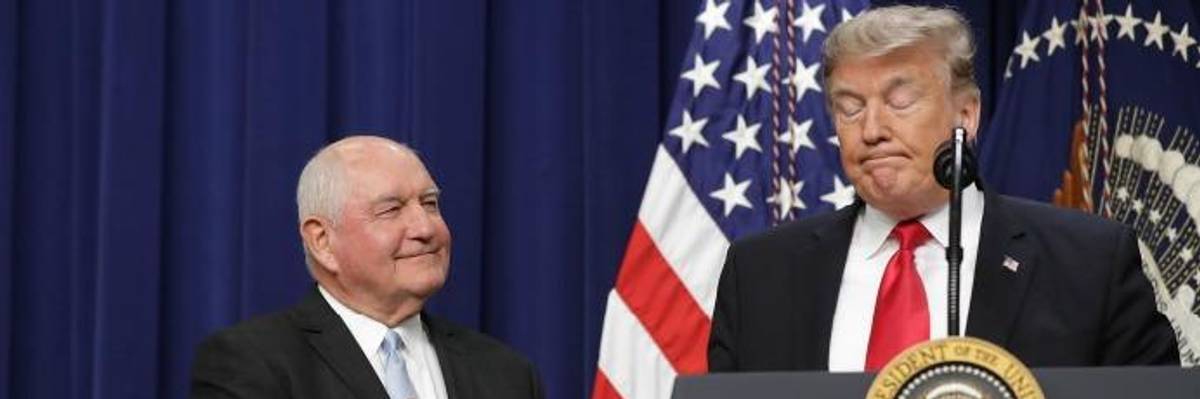
U.S. President Donald Trump (R) congratulates Agriculture Secretary Sonny Perdue before signing the the Agriculture Improvement Act during a ceremony in the South Court Auditorium of the Eisenhower Executive Office Building December 20, 2018 in Washington, D.C. (Photo: Chip Somodevilla/Getty Images)
A federal judge on Friday cited the impact of the coronavirus pandemic when she temporarily blocked a Trump administration rule change that could have stripped federal food assistance from roughly 700,000 people.
"Good news," advocacy group Maryland Health Care for All! Coalition said Monday.
The sharply criticized U.S. Department of Agriculture rule change would have tightened work requirements on certain adult Supplemental Nutrition Assistance Program (SNAP) recipients and hampered states' authority to waive those requirements. It was scheduled to go into effect April 1--a timeline the administration saw no need to push back despite mounting economic and societal impacts of the nationally spreading outbreak of the novel coronavirus.
A lawsuit challenging the plan was led by the attorneys general of New York and the District of Columbia.
Chief Judge Beryl Howell of the U.S. District Court in Washington, D.C. wrote (pdf) in her Friday ruling that "aspects of the final rule are likely unlawful because they are arbitrary and capricious."
"Especially now, as a global pandemic poses widespread health risks, guaranteeing that government officials at both the federal and state levels have flexibility to address the nutritional needs of residents and ensure their well-being through programs like SNAP is essential," Howell wrote.
"The low-income Americans targeted by USDA's final rule depend on monthly SNAP benefits to avoid hunger," she wrote. "These SNAP participants may wield little political or economic power, but, nonetheless, USDA's proposed changes to take away nutrition benefits from almost 700,000 people prompted 'more than100,000 comments,' the 'majority' of which the agency concedes were opposed to the proposed changes."
"Notwithstanding these critical comments," continued Howell, "USDA proceeded in the challenged final rule to adopt changes that, in some respects, were more draconian than those initially proposed."
New York AG Letitia James celebrated the suspension of the rule, which she called "cruel to its core."
"At a time of national crisis, this decision is a win for common sense and basic human decency," said James.
The Trump administration proposal, she continued, would make "those who already worry about ending their days hungry even more vulnerable, and as we find ourselves in the midst of a pandemic, the effects of this rule would be more destructive than ever. We are grateful that this rule will not be implemented as we fight to permanently prevent it from ever going into effect."
Dear Common Dreams reader, It’s been nearly 30 years since I co-founded Common Dreams with my late wife, Lina Newhouser. We had the radical notion that journalism should serve the public good, not corporate profits. It was clear to us from the outset what it would take to build such a project. No paid advertisements. No corporate sponsors. No millionaire publisher telling us what to think or do. Many people said we wouldn't last a year, but we proved those doubters wrong. Together with a tremendous team of journalists and dedicated staff, we built an independent media outlet free from the constraints of profits and corporate control. Our mission has always been simple: To inform. To inspire. To ignite change for the common good. Building Common Dreams was not easy. Our survival was never guaranteed. When you take on the most powerful forces—Wall Street greed, fossil fuel industry destruction, Big Tech lobbyists, and uber-rich oligarchs who have spent billions upon billions rigging the economy and democracy in their favor—the only bulwark you have is supporters who believe in your work. But here’s the urgent message from me today. It's never been this bad out there. And it's never been this hard to keep us going. At the very moment Common Dreams is most needed, the threats we face are intensifying. We need your support now more than ever. We don't accept corporate advertising and never will. We don't have a paywall because we don't think people should be blocked from critical news based on their ability to pay. Everything we do is funded by the donations of readers like you. When everyone does the little they can afford, we are strong. But if that support retreats or dries up, so do we. Will you donate now to make sure Common Dreams not only survives but thrives? —Craig Brown, Co-founder |
A federal judge on Friday cited the impact of the coronavirus pandemic when she temporarily blocked a Trump administration rule change that could have stripped federal food assistance from roughly 700,000 people.
"Good news," advocacy group Maryland Health Care for All! Coalition said Monday.
The sharply criticized U.S. Department of Agriculture rule change would have tightened work requirements on certain adult Supplemental Nutrition Assistance Program (SNAP) recipients and hampered states' authority to waive those requirements. It was scheduled to go into effect April 1--a timeline the administration saw no need to push back despite mounting economic and societal impacts of the nationally spreading outbreak of the novel coronavirus.
A lawsuit challenging the plan was led by the attorneys general of New York and the District of Columbia.
Chief Judge Beryl Howell of the U.S. District Court in Washington, D.C. wrote (pdf) in her Friday ruling that "aspects of the final rule are likely unlawful because they are arbitrary and capricious."
"Especially now, as a global pandemic poses widespread health risks, guaranteeing that government officials at both the federal and state levels have flexibility to address the nutritional needs of residents and ensure their well-being through programs like SNAP is essential," Howell wrote.
"The low-income Americans targeted by USDA's final rule depend on monthly SNAP benefits to avoid hunger," she wrote. "These SNAP participants may wield little political or economic power, but, nonetheless, USDA's proposed changes to take away nutrition benefits from almost 700,000 people prompted 'more than100,000 comments,' the 'majority' of which the agency concedes were opposed to the proposed changes."
"Notwithstanding these critical comments," continued Howell, "USDA proceeded in the challenged final rule to adopt changes that, in some respects, were more draconian than those initially proposed."
New York AG Letitia James celebrated the suspension of the rule, which she called "cruel to its core."
"At a time of national crisis, this decision is a win for common sense and basic human decency," said James.
The Trump administration proposal, she continued, would make "those who already worry about ending their days hungry even more vulnerable, and as we find ourselves in the midst of a pandemic, the effects of this rule would be more destructive than ever. We are grateful that this rule will not be implemented as we fight to permanently prevent it from ever going into effect."
A federal judge on Friday cited the impact of the coronavirus pandemic when she temporarily blocked a Trump administration rule change that could have stripped federal food assistance from roughly 700,000 people.
"Good news," advocacy group Maryland Health Care for All! Coalition said Monday.
The sharply criticized U.S. Department of Agriculture rule change would have tightened work requirements on certain adult Supplemental Nutrition Assistance Program (SNAP) recipients and hampered states' authority to waive those requirements. It was scheduled to go into effect April 1--a timeline the administration saw no need to push back despite mounting economic and societal impacts of the nationally spreading outbreak of the novel coronavirus.
A lawsuit challenging the plan was led by the attorneys general of New York and the District of Columbia.
Chief Judge Beryl Howell of the U.S. District Court in Washington, D.C. wrote (pdf) in her Friday ruling that "aspects of the final rule are likely unlawful because they are arbitrary and capricious."
"Especially now, as a global pandemic poses widespread health risks, guaranteeing that government officials at both the federal and state levels have flexibility to address the nutritional needs of residents and ensure their well-being through programs like SNAP is essential," Howell wrote.
"The low-income Americans targeted by USDA's final rule depend on monthly SNAP benefits to avoid hunger," she wrote. "These SNAP participants may wield little political or economic power, but, nonetheless, USDA's proposed changes to take away nutrition benefits from almost 700,000 people prompted 'more than100,000 comments,' the 'majority' of which the agency concedes were opposed to the proposed changes."
"Notwithstanding these critical comments," continued Howell, "USDA proceeded in the challenged final rule to adopt changes that, in some respects, were more draconian than those initially proposed."
New York AG Letitia James celebrated the suspension of the rule, which she called "cruel to its core."
"At a time of national crisis, this decision is a win for common sense and basic human decency," said James.
The Trump administration proposal, she continued, would make "those who already worry about ending their days hungry even more vulnerable, and as we find ourselves in the midst of a pandemic, the effects of this rule would be more destructive than ever. We are grateful that this rule will not be implemented as we fight to permanently prevent it from ever going into effect."