SUBSCRIBE TO OUR FREE NEWSLETTER
Daily news & progressive opinion—funded by the people, not the corporations—delivered straight to your inbox.
5
#000000
#FFFFFF
To donate by check, phone, or other method, see our More Ways to Give page.
Daily news & progressive opinion—funded by the people, not the corporations—delivered straight to your inbox.
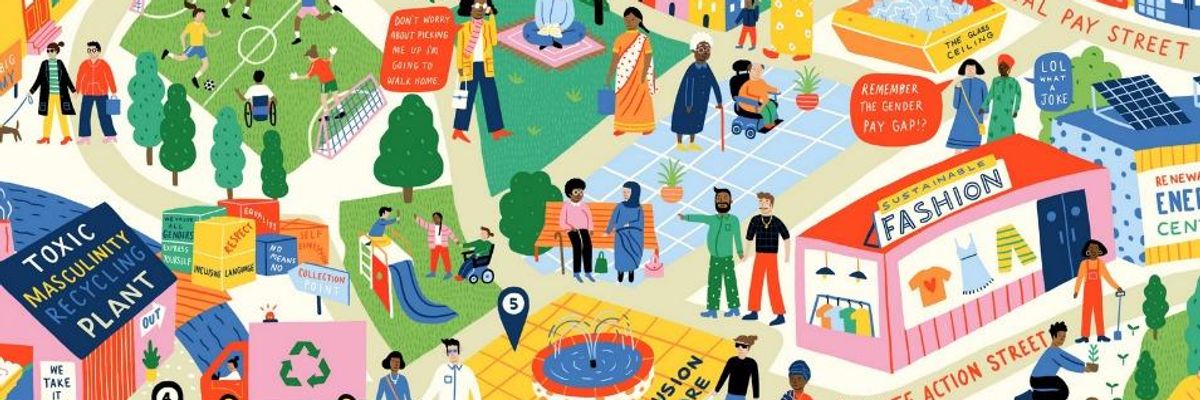
UN Women envisioned a new country called Equiterra, in which equality between genders, climate justice, and inclusion would reign. (Photo: Ruby Taylor/UN Women)
The United Nations Entity for Gender Equality and the Empowerment of Women marked the beginning of Women's History Month by offering a vision of what true gender equality and justice would look like in a new utopian world.
In Equiterra, the country described by the panel in a post on Medium, all people would have equal rights and opportunities regardless of gender. Children would not be inundated with stereotypes from a young age limiting their vision of what they are capable of, and adults of all gender identities would be represented in governments, companies, and in decision-making.
According to the UN group, Equiterra would push the global community toward realizing the promises made 25 years ago at the Fourth World Conference on Women. UN Women noted on social media that no country in the world has achieved gender equality.
"Equiterra exists only in our imagination, but it's a place that we can all aspire to build," wrote the group. "There has been a lot of progress since [the Fourth World Conference], but many of the promises are yet to be fulfilled."
The description of Equiterra is divided into several sections named after streets, describing how climate justice, education equity, reproductive freedom, and other issues would look in a utopia of equal opportunity.
In Violence-Free Alley, women are able to walk safely without fear of facing violence.
"Girls are taught science and math without the presumption that it's not for them. Boys learn humanities and art and learn the importance of gender equality. There's no such thing as child marriage that pulls girls out of school to become brides."
--UN WomenWomen in Equiterra "don't face persistent sexual harassment at work or when walking on the streets," UN Women wrote. "They aren't taught to walk with their keys between their fingers in case they are attacked or worry about being judged for the clothes they wear. There is no such thing as femicide, women are valued and respected here."
On Equal Pay Street, UN Women describes a system with "unified parental leave across all sectors," minimum wages which provide a decent income, and "quality and affordable care available for those who need it."
On Climate Action Street, ones sees women "leading the charge" toward climate justice.
"Women leaders in business and government have been key actors in making the policies that are protecting the environment," wrote UN Women. "With the inclusion of women's experiences, talent and perspectives, Equiterra has found new ways of sustainably reducing the country's carbon footprint and food waste."
In our current world, marginalized women have contributed the least to the climate crisis and are some of those most harmed by the effects of a warming planet.
"Environmental degradation disproportionately affects low-income countries and the most marginalized women who have contributed least to the crisis," wrote the group in a "Reality Check" accompanying the climate justice section. "The destruction of women's livelihoods, which depend heavily on the natural environment, contributes to rising food insecurity and morbidity and increases the burden of unpaid care and domestic work."
Equiterra also includes an education system in universal access to school leaves no one behind, compared with current conditions in which 10 million boys and 15 million girls worldwide are not able to attend school and in which one in five girls are married before age 18, often cutting their education short.
"Girls are taught science and math without the presumption that it's not for them," wrote UN Women. "Boys learn humanities and art and learn the importance of gender equality. There's no such thing as child marriage that pulls girls out of school to become brides."
On social media, women around the world expressed hope that the global community will make major strides, bringing the imagined world of Equiterra far closer to reality.
"Equiterra seems like such a nice place," tweeted Karolina Guay, El Salvador's ambassador to Canada. "When can the world move in?"
"Contemplating a move to Equiterra," added Marjolein Moonen of Ireland.
UN Women released its description of Equiterra as part of its Generation Equality campaign, a theme the group is embracing as many countries prepare to mark International Women's Day on March 8. The organization says people of all gender identities around the world have a greater desire to make Equiterra a reality than many world governments make it seem.
"In today's world, both women and men--and girls and boys--all over the world are speaking up for themselves and for those who have been silenced, stigmatized, and shamed for far too long," wrote UN Women. "Many are from a new generation. They are seizing the moment to reimagine economies, societies, and political systems so that they uphold human rights and achieve gender equality, leaving no one behind."
Dear Common Dreams reader, It’s been nearly 30 years since I co-founded Common Dreams with my late wife, Lina Newhouser. We had the radical notion that journalism should serve the public good, not corporate profits. It was clear to us from the outset what it would take to build such a project. No paid advertisements. No corporate sponsors. No millionaire publisher telling us what to think or do. Many people said we wouldn't last a year, but we proved those doubters wrong. Together with a tremendous team of journalists and dedicated staff, we built an independent media outlet free from the constraints of profits and corporate control. Our mission has always been simple: To inform. To inspire. To ignite change for the common good. Building Common Dreams was not easy. Our survival was never guaranteed. When you take on the most powerful forces—Wall Street greed, fossil fuel industry destruction, Big Tech lobbyists, and uber-rich oligarchs who have spent billions upon billions rigging the economy and democracy in their favor—the only bulwark you have is supporters who believe in your work. But here’s the urgent message from me today. It's never been this bad out there. And it's never been this hard to keep us going. At the very moment Common Dreams is most needed, the threats we face are intensifying. We need your support now more than ever. We don't accept corporate advertising and never will. We don't have a paywall because we don't think people should be blocked from critical news based on their ability to pay. Everything we do is funded by the donations of readers like you. When everyone does the little they can afford, we are strong. But if that support retreats or dries up, so do we. Will you donate now to make sure Common Dreams not only survives but thrives? —Craig Brown, Co-founder |
The United Nations Entity for Gender Equality and the Empowerment of Women marked the beginning of Women's History Month by offering a vision of what true gender equality and justice would look like in a new utopian world.
In Equiterra, the country described by the panel in a post on Medium, all people would have equal rights and opportunities regardless of gender. Children would not be inundated with stereotypes from a young age limiting their vision of what they are capable of, and adults of all gender identities would be represented in governments, companies, and in decision-making.
According to the UN group, Equiterra would push the global community toward realizing the promises made 25 years ago at the Fourth World Conference on Women. UN Women noted on social media that no country in the world has achieved gender equality.
"Equiterra exists only in our imagination, but it's a place that we can all aspire to build," wrote the group. "There has been a lot of progress since [the Fourth World Conference], but many of the promises are yet to be fulfilled."
The description of Equiterra is divided into several sections named after streets, describing how climate justice, education equity, reproductive freedom, and other issues would look in a utopia of equal opportunity.
In Violence-Free Alley, women are able to walk safely without fear of facing violence.
"Girls are taught science and math without the presumption that it's not for them. Boys learn humanities and art and learn the importance of gender equality. There's no such thing as child marriage that pulls girls out of school to become brides."
--UN WomenWomen in Equiterra "don't face persistent sexual harassment at work or when walking on the streets," UN Women wrote. "They aren't taught to walk with their keys between their fingers in case they are attacked or worry about being judged for the clothes they wear. There is no such thing as femicide, women are valued and respected here."
On Equal Pay Street, UN Women describes a system with "unified parental leave across all sectors," minimum wages which provide a decent income, and "quality and affordable care available for those who need it."
On Climate Action Street, ones sees women "leading the charge" toward climate justice.
"Women leaders in business and government have been key actors in making the policies that are protecting the environment," wrote UN Women. "With the inclusion of women's experiences, talent and perspectives, Equiterra has found new ways of sustainably reducing the country's carbon footprint and food waste."
In our current world, marginalized women have contributed the least to the climate crisis and are some of those most harmed by the effects of a warming planet.
"Environmental degradation disproportionately affects low-income countries and the most marginalized women who have contributed least to the crisis," wrote the group in a "Reality Check" accompanying the climate justice section. "The destruction of women's livelihoods, which depend heavily on the natural environment, contributes to rising food insecurity and morbidity and increases the burden of unpaid care and domestic work."
Equiterra also includes an education system in universal access to school leaves no one behind, compared with current conditions in which 10 million boys and 15 million girls worldwide are not able to attend school and in which one in five girls are married before age 18, often cutting their education short.
"Girls are taught science and math without the presumption that it's not for them," wrote UN Women. "Boys learn humanities and art and learn the importance of gender equality. There's no such thing as child marriage that pulls girls out of school to become brides."
On social media, women around the world expressed hope that the global community will make major strides, bringing the imagined world of Equiterra far closer to reality.
"Equiterra seems like such a nice place," tweeted Karolina Guay, El Salvador's ambassador to Canada. "When can the world move in?"
"Contemplating a move to Equiterra," added Marjolein Moonen of Ireland.
UN Women released its description of Equiterra as part of its Generation Equality campaign, a theme the group is embracing as many countries prepare to mark International Women's Day on March 8. The organization says people of all gender identities around the world have a greater desire to make Equiterra a reality than many world governments make it seem.
"In today's world, both women and men--and girls and boys--all over the world are speaking up for themselves and for those who have been silenced, stigmatized, and shamed for far too long," wrote UN Women. "Many are from a new generation. They are seizing the moment to reimagine economies, societies, and political systems so that they uphold human rights and achieve gender equality, leaving no one behind."
The United Nations Entity for Gender Equality and the Empowerment of Women marked the beginning of Women's History Month by offering a vision of what true gender equality and justice would look like in a new utopian world.
In Equiterra, the country described by the panel in a post on Medium, all people would have equal rights and opportunities regardless of gender. Children would not be inundated with stereotypes from a young age limiting their vision of what they are capable of, and adults of all gender identities would be represented in governments, companies, and in decision-making.
According to the UN group, Equiterra would push the global community toward realizing the promises made 25 years ago at the Fourth World Conference on Women. UN Women noted on social media that no country in the world has achieved gender equality.
"Equiterra exists only in our imagination, but it's a place that we can all aspire to build," wrote the group. "There has been a lot of progress since [the Fourth World Conference], but many of the promises are yet to be fulfilled."
The description of Equiterra is divided into several sections named after streets, describing how climate justice, education equity, reproductive freedom, and other issues would look in a utopia of equal opportunity.
In Violence-Free Alley, women are able to walk safely without fear of facing violence.
"Girls are taught science and math without the presumption that it's not for them. Boys learn humanities and art and learn the importance of gender equality. There's no such thing as child marriage that pulls girls out of school to become brides."
--UN WomenWomen in Equiterra "don't face persistent sexual harassment at work or when walking on the streets," UN Women wrote. "They aren't taught to walk with their keys between their fingers in case they are attacked or worry about being judged for the clothes they wear. There is no such thing as femicide, women are valued and respected here."
On Equal Pay Street, UN Women describes a system with "unified parental leave across all sectors," minimum wages which provide a decent income, and "quality and affordable care available for those who need it."
On Climate Action Street, ones sees women "leading the charge" toward climate justice.
"Women leaders in business and government have been key actors in making the policies that are protecting the environment," wrote UN Women. "With the inclusion of women's experiences, talent and perspectives, Equiterra has found new ways of sustainably reducing the country's carbon footprint and food waste."
In our current world, marginalized women have contributed the least to the climate crisis and are some of those most harmed by the effects of a warming planet.
"Environmental degradation disproportionately affects low-income countries and the most marginalized women who have contributed least to the crisis," wrote the group in a "Reality Check" accompanying the climate justice section. "The destruction of women's livelihoods, which depend heavily on the natural environment, contributes to rising food insecurity and morbidity and increases the burden of unpaid care and domestic work."
Equiterra also includes an education system in universal access to school leaves no one behind, compared with current conditions in which 10 million boys and 15 million girls worldwide are not able to attend school and in which one in five girls are married before age 18, often cutting their education short.
"Girls are taught science and math without the presumption that it's not for them," wrote UN Women. "Boys learn humanities and art and learn the importance of gender equality. There's no such thing as child marriage that pulls girls out of school to become brides."
On social media, women around the world expressed hope that the global community will make major strides, bringing the imagined world of Equiterra far closer to reality.
"Equiterra seems like such a nice place," tweeted Karolina Guay, El Salvador's ambassador to Canada. "When can the world move in?"
"Contemplating a move to Equiterra," added Marjolein Moonen of Ireland.
UN Women released its description of Equiterra as part of its Generation Equality campaign, a theme the group is embracing as many countries prepare to mark International Women's Day on March 8. The organization says people of all gender identities around the world have a greater desire to make Equiterra a reality than many world governments make it seem.
"In today's world, both women and men--and girls and boys--all over the world are speaking up for themselves and for those who have been silenced, stigmatized, and shamed for far too long," wrote UN Women. "Many are from a new generation. They are seizing the moment to reimagine economies, societies, and political systems so that they uphold human rights and achieve gender equality, leaving no one behind."