SUBSCRIBE TO OUR FREE NEWSLETTER
Daily news & progressive opinion—funded by the people, not the corporations—delivered straight to your inbox.
5
#000000
#FFFFFF
To donate by check, phone, or other method, see our More Ways to Give page.
Daily news & progressive opinion—funded by the people, not the corporations—delivered straight to your inbox.
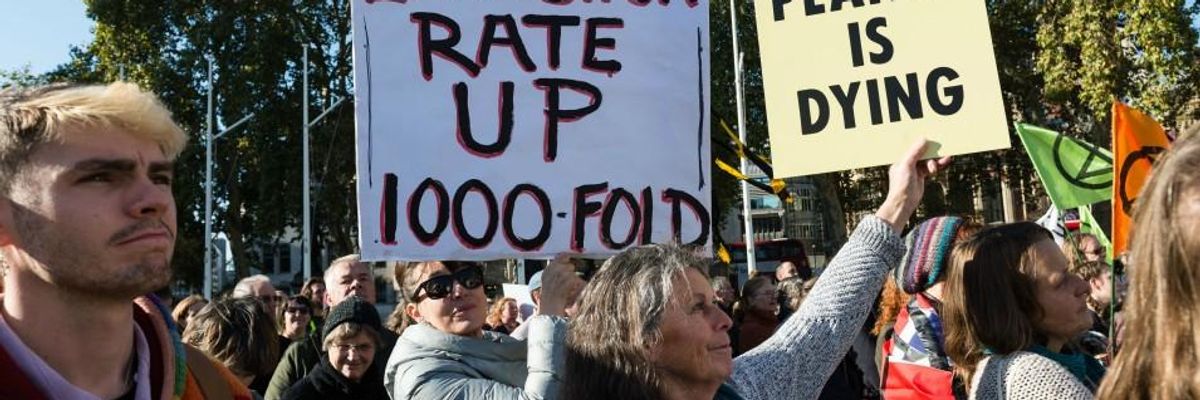
Hundreds of activists and campaigners gather in London's Parliament Square for 'Extinction Rebellion' protest against the inaction of the British government in the face of climate change and ecological collapse. (Photo: Wiktor Szymanowicz / Barcroft Media via Getty Images)
As global governments gathered at a conference in Rome Monday to advance a framework for protecting the planet's biodiversity, environmental and human rights advocates warned that the draft text that has emerged from meetings so far is "hopelessly weak and inadequate."
The draft document for "living in harmony with nature," first unveiled in January, is being considered at the Feb. 24-29 meeting of the Working Group on the Post-2020 Global Biodiversity Framework. It will form the basis for a 10-year strategy and replace the "Aichi Targets," which expire this year.
The meeting comes amid increased worldwide concern about the ecological crisis, with recent research warning the climate crisis could wipe out 30% of the world's plant and animal species by 2070, disasters like the recent Australian wildfires taking a devastating toll on wildlife and ecosystems, and more evidence that human activity is driving nature towards collapse.
Agence France-Presse reported Monday:
The 12-page document, which focuses on goals to be met by mid-century and envisages a stock-take in 2030, should be adopted at the COP15 summit on biodiversity in October. [...]
Negotiators in Rome are focusing on ways to reduce threats to biodiversity, including officially protecting at least 30 percent of land and marine areas and a 50 percent cut in pollution from fertilizers. It also calls for stricter regulation on plastic pollution and acknowledges the role that the preservation of nature can play in the battle against climate change.
According to Nele Marien, forests and biodiversity coordinator at Friends of the Earth International (FOEI), the document leaves much to be desired.
"The current draft plan is hopelessly weak and inadequate. It won't prevent the sixth mass extinction or build a fairer and safer future," she said.
Marien's group sees a number of problems with the plan, including that it calls for even weaker targets than the non-binding targets governments set out in 2010. Specifically, says FOEI, the draft:
"Time has almost run out. We need an urgent plan to save humanity and this is not it," said Friedrich Wulf, international nature campaigner at Friends of the Earth Europe.
Human rights organization Forest Peoples Programme also expressed concerns with the document and outlined those issues Monday in a Twitter thread:.
An improved framework for averting mass extinctions, according FOEI and other groups that form the CBD Alliance, could be forged. Such a plan would have:
The advocacy groups' warnings come a week after nearly two dozen former foreign ministers from various countries urged global negotiators urged world leaders to act "boldly" to avert further loss of nature.
"The world has a moral imperative to collaborate on strong actions to mitigate and adapt to the current climate change and biodiversity crisis. Ambitious targets for conservation of land and ocean ecosystems are vital components of the solution," a statement from the diplomats said.
"Humanity sits on the precipice of irreversible loss of biodiversity and a climate crisis that imperils the future for our grandchildren and generations to come," they wrote. "The world must act boldly, and it must act now."
Dear Common Dreams reader, It’s been nearly 30 years since I co-founded Common Dreams with my late wife, Lina Newhouser. We had the radical notion that journalism should serve the public good, not corporate profits. It was clear to us from the outset what it would take to build such a project. No paid advertisements. No corporate sponsors. No millionaire publisher telling us what to think or do. Many people said we wouldn't last a year, but we proved those doubters wrong. Together with a tremendous team of journalists and dedicated staff, we built an independent media outlet free from the constraints of profits and corporate control. Our mission has always been simple: To inform. To inspire. To ignite change for the common good. Building Common Dreams was not easy. Our survival was never guaranteed. When you take on the most powerful forces—Wall Street greed, fossil fuel industry destruction, Big Tech lobbyists, and uber-rich oligarchs who have spent billions upon billions rigging the economy and democracy in their favor—the only bulwark you have is supporters who believe in your work. But here’s the urgent message from me today. It's never been this bad out there. And it's never been this hard to keep us going. At the very moment Common Dreams is most needed, the threats we face are intensifying. We need your support now more than ever. We don't accept corporate advertising and never will. We don't have a paywall because we don't think people should be blocked from critical news based on their ability to pay. Everything we do is funded by the donations of readers like you. When everyone does the little they can afford, we are strong. But if that support retreats or dries up, so do we. Will you donate now to make sure Common Dreams not only survives but thrives? —Craig Brown, Co-founder |
As global governments gathered at a conference in Rome Monday to advance a framework for protecting the planet's biodiversity, environmental and human rights advocates warned that the draft text that has emerged from meetings so far is "hopelessly weak and inadequate."
The draft document for "living in harmony with nature," first unveiled in January, is being considered at the Feb. 24-29 meeting of the Working Group on the Post-2020 Global Biodiversity Framework. It will form the basis for a 10-year strategy and replace the "Aichi Targets," which expire this year.
The meeting comes amid increased worldwide concern about the ecological crisis, with recent research warning the climate crisis could wipe out 30% of the world's plant and animal species by 2070, disasters like the recent Australian wildfires taking a devastating toll on wildlife and ecosystems, and more evidence that human activity is driving nature towards collapse.
Agence France-Presse reported Monday:
The 12-page document, which focuses on goals to be met by mid-century and envisages a stock-take in 2030, should be adopted at the COP15 summit on biodiversity in October. [...]
Negotiators in Rome are focusing on ways to reduce threats to biodiversity, including officially protecting at least 30 percent of land and marine areas and a 50 percent cut in pollution from fertilizers. It also calls for stricter regulation on plastic pollution and acknowledges the role that the preservation of nature can play in the battle against climate change.
According to Nele Marien, forests and biodiversity coordinator at Friends of the Earth International (FOEI), the document leaves much to be desired.
"The current draft plan is hopelessly weak and inadequate. It won't prevent the sixth mass extinction or build a fairer and safer future," she said.
Marien's group sees a number of problems with the plan, including that it calls for even weaker targets than the non-binding targets governments set out in 2010. Specifically, says FOEI, the draft:
"Time has almost run out. We need an urgent plan to save humanity and this is not it," said Friedrich Wulf, international nature campaigner at Friends of the Earth Europe.
Human rights organization Forest Peoples Programme also expressed concerns with the document and outlined those issues Monday in a Twitter thread:.
An improved framework for averting mass extinctions, according FOEI and other groups that form the CBD Alliance, could be forged. Such a plan would have:
The advocacy groups' warnings come a week after nearly two dozen former foreign ministers from various countries urged global negotiators urged world leaders to act "boldly" to avert further loss of nature.
"The world has a moral imperative to collaborate on strong actions to mitigate and adapt to the current climate change and biodiversity crisis. Ambitious targets for conservation of land and ocean ecosystems are vital components of the solution," a statement from the diplomats said.
"Humanity sits on the precipice of irreversible loss of biodiversity and a climate crisis that imperils the future for our grandchildren and generations to come," they wrote. "The world must act boldly, and it must act now."
As global governments gathered at a conference in Rome Monday to advance a framework for protecting the planet's biodiversity, environmental and human rights advocates warned that the draft text that has emerged from meetings so far is "hopelessly weak and inadequate."
The draft document for "living in harmony with nature," first unveiled in January, is being considered at the Feb. 24-29 meeting of the Working Group on the Post-2020 Global Biodiversity Framework. It will form the basis for a 10-year strategy and replace the "Aichi Targets," which expire this year.
The meeting comes amid increased worldwide concern about the ecological crisis, with recent research warning the climate crisis could wipe out 30% of the world's plant and animal species by 2070, disasters like the recent Australian wildfires taking a devastating toll on wildlife and ecosystems, and more evidence that human activity is driving nature towards collapse.
Agence France-Presse reported Monday:
The 12-page document, which focuses on goals to be met by mid-century and envisages a stock-take in 2030, should be adopted at the COP15 summit on biodiversity in October. [...]
Negotiators in Rome are focusing on ways to reduce threats to biodiversity, including officially protecting at least 30 percent of land and marine areas and a 50 percent cut in pollution from fertilizers. It also calls for stricter regulation on plastic pollution and acknowledges the role that the preservation of nature can play in the battle against climate change.
According to Nele Marien, forests and biodiversity coordinator at Friends of the Earth International (FOEI), the document leaves much to be desired.
"The current draft plan is hopelessly weak and inadequate. It won't prevent the sixth mass extinction or build a fairer and safer future," she said.
Marien's group sees a number of problems with the plan, including that it calls for even weaker targets than the non-binding targets governments set out in 2010. Specifically, says FOEI, the draft:
"Time has almost run out. We need an urgent plan to save humanity and this is not it," said Friedrich Wulf, international nature campaigner at Friends of the Earth Europe.
Human rights organization Forest Peoples Programme also expressed concerns with the document and outlined those issues Monday in a Twitter thread:.
An improved framework for averting mass extinctions, according FOEI and other groups that form the CBD Alliance, could be forged. Such a plan would have:
The advocacy groups' warnings come a week after nearly two dozen former foreign ministers from various countries urged global negotiators urged world leaders to act "boldly" to avert further loss of nature.
"The world has a moral imperative to collaborate on strong actions to mitigate and adapt to the current climate change and biodiversity crisis. Ambitious targets for conservation of land and ocean ecosystems are vital components of the solution," a statement from the diplomats said.
"Humanity sits on the precipice of irreversible loss of biodiversity and a climate crisis that imperils the future for our grandchildren and generations to come," they wrote. "The world must act boldly, and it must act now."