SUBSCRIBE TO OUR FREE NEWSLETTER
Daily news & progressive opinion—funded by the people, not the corporations—delivered straight to your inbox.
5
#000000
#FFFFFF
To donate by check, phone, or other method, see our More Ways to Give page.
Daily news & progressive opinion—funded by the people, not the corporations—delivered straight to your inbox.
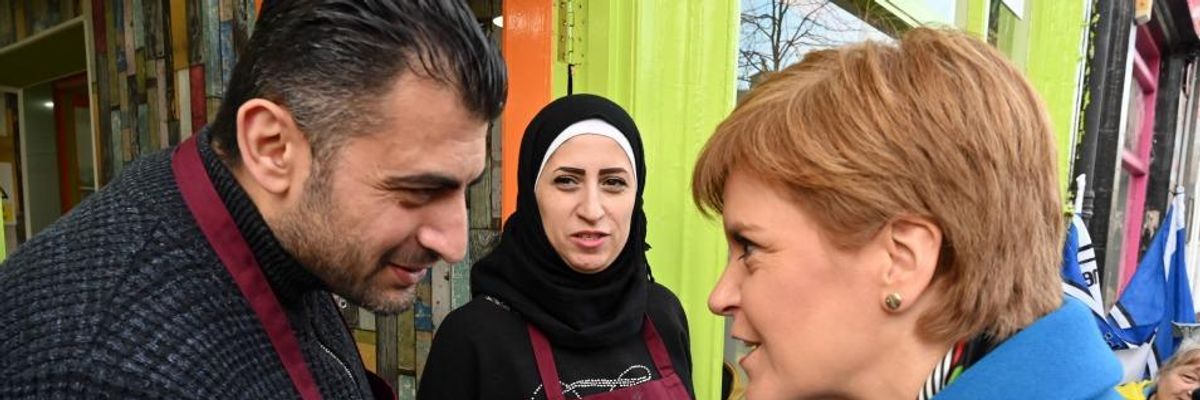
Scottish First Minister Nicola Sturgeon meets the Syrian owners, former refugees, of a cafe in Alloa, Scotland. Sturgeon has called for a Scottish visa and for Scottish Parliament to take policy-making regarding immigration into its own hands following Brexit. (Photo by Ken Jack/Getty Images)
Scottish First Minister Nicola Sturgeon condemned the United Kingdom's new post-Brexit border policy after it was released Wednesday, saying new rules barring people designated as "unskilled" and those who don't speak English will devastate a number of Scotland's industries and worsen the country's depopulation crisis.
The newly-unveiled "points system" dictating who can migrate to the U.K. spurred officials to reiterate their calls for a separate Scottish visa system which immigrants could use just for Scotland, which employs many people from overseas in its tourism, fishing, and healthcare industries.
"It is impossible to overstate how devastating this U.K. government policy will be for Scotland's economy," tweeted Sturgeon, who also called for a new referendum on Scottish independence after the Conservative government won the general election in December. "Getting power over migration in Scottish Parliament is now a necessity for our future prosperity."
Under the new U.K. border policy, migrants would be awarded "points," as they are under Australia's system, based on their skill level and background. Students and workers who don't speak English would not be permitted to migrate.
No temporary or general visas will be given to people identified as "low-skilled workers," and people considered "skilled" would need to have a job offer or endorsement from someone in their field.
"U.K. businesses will need to adapt and adjust to the end of free movement," the British government said of the plan, which officials want to enter into force on January 1, 2021.
The proposal appears intent on damaging the "U.K. manufacturing industry, services, agriculture, and fisheries... [and creating] more economic damage through deliberately causing labor shortages," tweeted Kirsty Hughes, director of the Scottish Center on European Relations.
One in five tourism jobs in Scotland are held by people from overseas, according to The Guardian. Migrants hold 16% of healthcare jobs, while more than 70% of those employed at fish processing plants in northeastern Scotland were born outside the country.
Under the new plan, it's estimated that 70% of the current E.U. workforce would not be awarded enough "points" to move to the United Kingdom. But in Scotland, which is projected to have more deaths than births over the next 25 years and whose population growth over the next two decades has been expected to come entirely from migration, industry leaders say people already in the country won't be able to fill roles that would otherwise go to migrants.
"Locking out some sets of skills from the U.K. will have a devastating impact on many parts of our economy and [is] deeply insulting," tweeted Hannah Bardell, a member of Parliament in Sturgeon's Scottish National Party. "The Tories have had 42 months to develop these proposals and they've come up with a half-finished, disastrous one size-fits-no-one policy that poses a very real threat to Scotland and leaves businesses and the public with just 10 months to prepare."
Scottish officials say the public widely supports a Scottish visa, which the government explained in a video on social media last month.
Industry groups in Northern Ireland echoed Scotland's concerns Wednesday, saying the hospitality sector would suffer a "crippling blow" under the immigration plan.
"We are looking to double the number of jobs in the sector to 25,000, but we just won't have the people to fill them," Colin Neill, chief executive of Hospitality Ulster, told the Irish Times.
Dear Common Dreams reader, It’s been nearly 30 years since I co-founded Common Dreams with my late wife, Lina Newhouser. We had the radical notion that journalism should serve the public good, not corporate profits. It was clear to us from the outset what it would take to build such a project. No paid advertisements. No corporate sponsors. No millionaire publisher telling us what to think or do. Many people said we wouldn't last a year, but we proved those doubters wrong. Together with a tremendous team of journalists and dedicated staff, we built an independent media outlet free from the constraints of profits and corporate control. Our mission has always been simple: To inform. To inspire. To ignite change for the common good. Building Common Dreams was not easy. Our survival was never guaranteed. When you take on the most powerful forces—Wall Street greed, fossil fuel industry destruction, Big Tech lobbyists, and uber-rich oligarchs who have spent billions upon billions rigging the economy and democracy in their favor—the only bulwark you have is supporters who believe in your work. But here’s the urgent message from me today. It's never been this bad out there. And it's never been this hard to keep us going. At the very moment Common Dreams is most needed, the threats we face are intensifying. We need your support now more than ever. We don't accept corporate advertising and never will. We don't have a paywall because we don't think people should be blocked from critical news based on their ability to pay. Everything we do is funded by the donations of readers like you. When everyone does the little they can afford, we are strong. But if that support retreats or dries up, so do we. Will you donate now to make sure Common Dreams not only survives but thrives? —Craig Brown, Co-founder |
Scottish First Minister Nicola Sturgeon condemned the United Kingdom's new post-Brexit border policy after it was released Wednesday, saying new rules barring people designated as "unskilled" and those who don't speak English will devastate a number of Scotland's industries and worsen the country's depopulation crisis.
The newly-unveiled "points system" dictating who can migrate to the U.K. spurred officials to reiterate their calls for a separate Scottish visa system which immigrants could use just for Scotland, which employs many people from overseas in its tourism, fishing, and healthcare industries.
"It is impossible to overstate how devastating this U.K. government policy will be for Scotland's economy," tweeted Sturgeon, who also called for a new referendum on Scottish independence after the Conservative government won the general election in December. "Getting power over migration in Scottish Parliament is now a necessity for our future prosperity."
Under the new U.K. border policy, migrants would be awarded "points," as they are under Australia's system, based on their skill level and background. Students and workers who don't speak English would not be permitted to migrate.
No temporary or general visas will be given to people identified as "low-skilled workers," and people considered "skilled" would need to have a job offer or endorsement from someone in their field.
"U.K. businesses will need to adapt and adjust to the end of free movement," the British government said of the plan, which officials want to enter into force on January 1, 2021.
The proposal appears intent on damaging the "U.K. manufacturing industry, services, agriculture, and fisheries... [and creating] more economic damage through deliberately causing labor shortages," tweeted Kirsty Hughes, director of the Scottish Center on European Relations.
One in five tourism jobs in Scotland are held by people from overseas, according to The Guardian. Migrants hold 16% of healthcare jobs, while more than 70% of those employed at fish processing plants in northeastern Scotland were born outside the country.
Under the new plan, it's estimated that 70% of the current E.U. workforce would not be awarded enough "points" to move to the United Kingdom. But in Scotland, which is projected to have more deaths than births over the next 25 years and whose population growth over the next two decades has been expected to come entirely from migration, industry leaders say people already in the country won't be able to fill roles that would otherwise go to migrants.
"Locking out some sets of skills from the U.K. will have a devastating impact on many parts of our economy and [is] deeply insulting," tweeted Hannah Bardell, a member of Parliament in Sturgeon's Scottish National Party. "The Tories have had 42 months to develop these proposals and they've come up with a half-finished, disastrous one size-fits-no-one policy that poses a very real threat to Scotland and leaves businesses and the public with just 10 months to prepare."
Scottish officials say the public widely supports a Scottish visa, which the government explained in a video on social media last month.
Industry groups in Northern Ireland echoed Scotland's concerns Wednesday, saying the hospitality sector would suffer a "crippling blow" under the immigration plan.
"We are looking to double the number of jobs in the sector to 25,000, but we just won't have the people to fill them," Colin Neill, chief executive of Hospitality Ulster, told the Irish Times.
Scottish First Minister Nicola Sturgeon condemned the United Kingdom's new post-Brexit border policy after it was released Wednesday, saying new rules barring people designated as "unskilled" and those who don't speak English will devastate a number of Scotland's industries and worsen the country's depopulation crisis.
The newly-unveiled "points system" dictating who can migrate to the U.K. spurred officials to reiterate their calls for a separate Scottish visa system which immigrants could use just for Scotland, which employs many people from overseas in its tourism, fishing, and healthcare industries.
"It is impossible to overstate how devastating this U.K. government policy will be for Scotland's economy," tweeted Sturgeon, who also called for a new referendum on Scottish independence after the Conservative government won the general election in December. "Getting power over migration in Scottish Parliament is now a necessity for our future prosperity."
Under the new U.K. border policy, migrants would be awarded "points," as they are under Australia's system, based on their skill level and background. Students and workers who don't speak English would not be permitted to migrate.
No temporary or general visas will be given to people identified as "low-skilled workers," and people considered "skilled" would need to have a job offer or endorsement from someone in their field.
"U.K. businesses will need to adapt and adjust to the end of free movement," the British government said of the plan, which officials want to enter into force on January 1, 2021.
The proposal appears intent on damaging the "U.K. manufacturing industry, services, agriculture, and fisheries... [and creating] more economic damage through deliberately causing labor shortages," tweeted Kirsty Hughes, director of the Scottish Center on European Relations.
One in five tourism jobs in Scotland are held by people from overseas, according to The Guardian. Migrants hold 16% of healthcare jobs, while more than 70% of those employed at fish processing plants in northeastern Scotland were born outside the country.
Under the new plan, it's estimated that 70% of the current E.U. workforce would not be awarded enough "points" to move to the United Kingdom. But in Scotland, which is projected to have more deaths than births over the next 25 years and whose population growth over the next two decades has been expected to come entirely from migration, industry leaders say people already in the country won't be able to fill roles that would otherwise go to migrants.
"Locking out some sets of skills from the U.K. will have a devastating impact on many parts of our economy and [is] deeply insulting," tweeted Hannah Bardell, a member of Parliament in Sturgeon's Scottish National Party. "The Tories have had 42 months to develop these proposals and they've come up with a half-finished, disastrous one size-fits-no-one policy that poses a very real threat to Scotland and leaves businesses and the public with just 10 months to prepare."
Scottish officials say the public widely supports a Scottish visa, which the government explained in a video on social media last month.
Industry groups in Northern Ireland echoed Scotland's concerns Wednesday, saying the hospitality sector would suffer a "crippling blow" under the immigration plan.
"We are looking to double the number of jobs in the sector to 25,000, but we just won't have the people to fill them," Colin Neill, chief executive of Hospitality Ulster, told the Irish Times.