SUBSCRIBE TO OUR FREE NEWSLETTER
Daily news & progressive opinion—funded by the people, not the corporations—delivered straight to your inbox.
5
#000000
#FFFFFF
To donate by check, phone, or other method, see our More Ways to Give page.
Daily news & progressive opinion—funded by the people, not the corporations—delivered straight to your inbox.
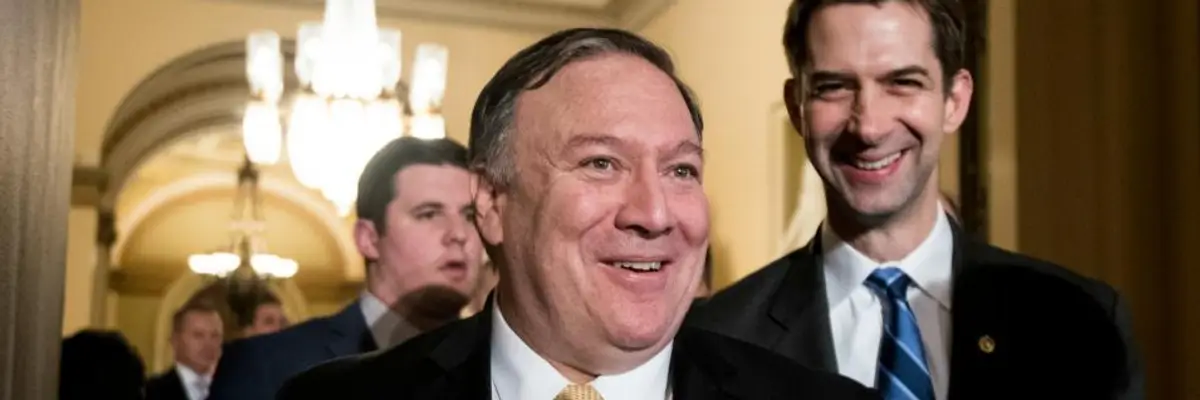
Secretary of State Mike Pompeo and Sen. Tom Cotton (R-Ark.) leave the House chamber after President Donald Trump's State of the Union Address to a joint session of Congress in the Capitol on Tuesday, Feb. 5, 2019. (Photo: Bill Clark/CQ Roll Call)
As peace advocates voiced alarm at the very real prospect of all-out conflict with Iran following the assassination Thursday night of that country's top military leader on orders from U.S. President Donald Trump, war hawks who have had their crosshairs trained on Iran for years enthusiastically celebrated Trump's decision--and even suggested the president should go further by targeting the nation's oil refineries.
"Trump's Iran policy has been seeking to incite war with Iran since he reneged on the nuclear deal in May 2018."
--Sina Toossi, National Iranian American Council
"To the Iranian government: If you want to stay in the oil business leave America and our allies alone and stop being the largest state sponsor of terrorism in the world," tweeted Sen. Lindsey Graham (R-S.C.), a longtime supporter of regime change in Iran.
Republican Sens. Marco Rubio (Fla.), Tom Cotton (Ark.), Jim Risch (R.-Idaho), and Ben Sasse (Neb.) joined the chorus of applause, hailing Trump for taking "decisive action."
Trita Parsi, executive vice president at the Quincy Institute for Responsible Statecraft, tweeted in response to the torrent of praise that "hawks are celebrating [Qassem] Soleimani's assassination not because they believe it weakened Iran. Or the IRGC. Or that Iran will lose in Iraq. But because they believe we have passed an irreversible point of escalation."
"From here, war is unavoidable, they believe," Parsi added. "And celebrate."
The likely unlawful U.S. assassination of Soleimani--and the jingoistic applause it provoked--led many to express fears of a global conflict, briefly catapulting "World War III" to the top of Twitter's trending list. Trump, for his part, simply tweeted an image of an American flag following the strike:
Trump's decision to kill Soleimani, as well as at least six others, with a drone strike in Baghdad came after the Pentagon threatened Iran with preemptive action in response to supposed indications it was planning attacks on U.S. forces in the region.
Though the Pentagon did not offer a shred of evidence that Soleimani or militia groups were planning attacks, corporate media outlets dutifully echoed the Trump administration's line, leading some commentators to see parallels with the buildup to the Bush administration's 2003 invasion of Iraq.
"I don't see any way to stop what is coming, war from the Mediterranean to the Indus and harsh repression in the U.S. that may vitiate the 2020 election," said Barnett Rubin of the Center on International Cooperation. "This is the test for the Democrats: have our leaders learned anything since 2003? I fear the answer."
Observers warned the U.S. assassination of Soleimani, on top of the Trump administration's violation of the nuclear accord last year and other aggressive actions, effectively foreclosed the possibility of peaceful negotiations with Iran.
"Whatever happens next, understand and never stop pointing out that Donald Trump walked into office with no crisis with Iran," said Stephen Miles, executive director of Win Without War. "He then filled his cabinet with warmongers, walked away from a multilateral diplomatic accord, and purposefully engaged in 'maximum pressure.' He owns this."
Iran's Supreme Leader Ayatollah Ali Khamenei quickly vowed "harsh retaliation" in response to Soleimani's assassination, and Iranian Foreign Minister Javad Zarif accused the U.S. of committing "an act of state terrorism."
Amid fears of revenge attacks, the State Department on Friday urged U.S. citizens to leave Iraq immediately.
"Trump's Iran policy has been seeking to incite war with Iran since he reneged on the nuclear deal in May 2018," said Sina Toossi, senior research analyst with the National Iranian American Council. "If a war breaks out, the blame lies squarely with this disastrous policy and its proponents."
"Trump thinks he got his Bin Laden moment in an election year," Toossi added. "In reality, he's made the worst strategic mistake by an American leader since the Iraq invasion. The consequences will be felt for years to come."
Dear Common Dreams reader, It’s been nearly 30 years since I co-founded Common Dreams with my late wife, Lina Newhouser. We had the radical notion that journalism should serve the public good, not corporate profits. It was clear to us from the outset what it would take to build such a project. No paid advertisements. No corporate sponsors. No millionaire publisher telling us what to think or do. Many people said we wouldn't last a year, but we proved those doubters wrong. Together with a tremendous team of journalists and dedicated staff, we built an independent media outlet free from the constraints of profits and corporate control. Our mission has always been simple: To inform. To inspire. To ignite change for the common good. Building Common Dreams was not easy. Our survival was never guaranteed. When you take on the most powerful forces—Wall Street greed, fossil fuel industry destruction, Big Tech lobbyists, and uber-rich oligarchs who have spent billions upon billions rigging the economy and democracy in their favor—the only bulwark you have is supporters who believe in your work. But here’s the urgent message from me today. It's never been this bad out there. And it's never been this hard to keep us going. At the very moment Common Dreams is most needed, the threats we face are intensifying. We need your support now more than ever. We don't accept corporate advertising and never will. We don't have a paywall because we don't think people should be blocked from critical news based on their ability to pay. Everything we do is funded by the donations of readers like you. When everyone does the little they can afford, we are strong. But if that support retreats or dries up, so do we. Will you donate now to make sure Common Dreams not only survives but thrives? —Craig Brown, Co-founder |
As peace advocates voiced alarm at the very real prospect of all-out conflict with Iran following the assassination Thursday night of that country's top military leader on orders from U.S. President Donald Trump, war hawks who have had their crosshairs trained on Iran for years enthusiastically celebrated Trump's decision--and even suggested the president should go further by targeting the nation's oil refineries.
"Trump's Iran policy has been seeking to incite war with Iran since he reneged on the nuclear deal in May 2018."
--Sina Toossi, National Iranian American Council
"To the Iranian government: If you want to stay in the oil business leave America and our allies alone and stop being the largest state sponsor of terrorism in the world," tweeted Sen. Lindsey Graham (R-S.C.), a longtime supporter of regime change in Iran.
Republican Sens. Marco Rubio (Fla.), Tom Cotton (Ark.), Jim Risch (R.-Idaho), and Ben Sasse (Neb.) joined the chorus of applause, hailing Trump for taking "decisive action."
Trita Parsi, executive vice president at the Quincy Institute for Responsible Statecraft, tweeted in response to the torrent of praise that "hawks are celebrating [Qassem] Soleimani's assassination not because they believe it weakened Iran. Or the IRGC. Or that Iran will lose in Iraq. But because they believe we have passed an irreversible point of escalation."
"From here, war is unavoidable, they believe," Parsi added. "And celebrate."
The likely unlawful U.S. assassination of Soleimani--and the jingoistic applause it provoked--led many to express fears of a global conflict, briefly catapulting "World War III" to the top of Twitter's trending list. Trump, for his part, simply tweeted an image of an American flag following the strike:
Trump's decision to kill Soleimani, as well as at least six others, with a drone strike in Baghdad came after the Pentagon threatened Iran with preemptive action in response to supposed indications it was planning attacks on U.S. forces in the region.
Though the Pentagon did not offer a shred of evidence that Soleimani or militia groups were planning attacks, corporate media outlets dutifully echoed the Trump administration's line, leading some commentators to see parallels with the buildup to the Bush administration's 2003 invasion of Iraq.
"I don't see any way to stop what is coming, war from the Mediterranean to the Indus and harsh repression in the U.S. that may vitiate the 2020 election," said Barnett Rubin of the Center on International Cooperation. "This is the test for the Democrats: have our leaders learned anything since 2003? I fear the answer."
Observers warned the U.S. assassination of Soleimani, on top of the Trump administration's violation of the nuclear accord last year and other aggressive actions, effectively foreclosed the possibility of peaceful negotiations with Iran.
"Whatever happens next, understand and never stop pointing out that Donald Trump walked into office with no crisis with Iran," said Stephen Miles, executive director of Win Without War. "He then filled his cabinet with warmongers, walked away from a multilateral diplomatic accord, and purposefully engaged in 'maximum pressure.' He owns this."
Iran's Supreme Leader Ayatollah Ali Khamenei quickly vowed "harsh retaliation" in response to Soleimani's assassination, and Iranian Foreign Minister Javad Zarif accused the U.S. of committing "an act of state terrorism."
Amid fears of revenge attacks, the State Department on Friday urged U.S. citizens to leave Iraq immediately.
"Trump's Iran policy has been seeking to incite war with Iran since he reneged on the nuclear deal in May 2018," said Sina Toossi, senior research analyst with the National Iranian American Council. "If a war breaks out, the blame lies squarely with this disastrous policy and its proponents."
"Trump thinks he got his Bin Laden moment in an election year," Toossi added. "In reality, he's made the worst strategic mistake by an American leader since the Iraq invasion. The consequences will be felt for years to come."
As peace advocates voiced alarm at the very real prospect of all-out conflict with Iran following the assassination Thursday night of that country's top military leader on orders from U.S. President Donald Trump, war hawks who have had their crosshairs trained on Iran for years enthusiastically celebrated Trump's decision--and even suggested the president should go further by targeting the nation's oil refineries.
"Trump's Iran policy has been seeking to incite war with Iran since he reneged on the nuclear deal in May 2018."
--Sina Toossi, National Iranian American Council
"To the Iranian government: If you want to stay in the oil business leave America and our allies alone and stop being the largest state sponsor of terrorism in the world," tweeted Sen. Lindsey Graham (R-S.C.), a longtime supporter of regime change in Iran.
Republican Sens. Marco Rubio (Fla.), Tom Cotton (Ark.), Jim Risch (R.-Idaho), and Ben Sasse (Neb.) joined the chorus of applause, hailing Trump for taking "decisive action."
Trita Parsi, executive vice president at the Quincy Institute for Responsible Statecraft, tweeted in response to the torrent of praise that "hawks are celebrating [Qassem] Soleimani's assassination not because they believe it weakened Iran. Or the IRGC. Or that Iran will lose in Iraq. But because they believe we have passed an irreversible point of escalation."
"From here, war is unavoidable, they believe," Parsi added. "And celebrate."
The likely unlawful U.S. assassination of Soleimani--and the jingoistic applause it provoked--led many to express fears of a global conflict, briefly catapulting "World War III" to the top of Twitter's trending list. Trump, for his part, simply tweeted an image of an American flag following the strike:
Trump's decision to kill Soleimani, as well as at least six others, with a drone strike in Baghdad came after the Pentagon threatened Iran with preemptive action in response to supposed indications it was planning attacks on U.S. forces in the region.
Though the Pentagon did not offer a shred of evidence that Soleimani or militia groups were planning attacks, corporate media outlets dutifully echoed the Trump administration's line, leading some commentators to see parallels with the buildup to the Bush administration's 2003 invasion of Iraq.
"I don't see any way to stop what is coming, war from the Mediterranean to the Indus and harsh repression in the U.S. that may vitiate the 2020 election," said Barnett Rubin of the Center on International Cooperation. "This is the test for the Democrats: have our leaders learned anything since 2003? I fear the answer."
Observers warned the U.S. assassination of Soleimani, on top of the Trump administration's violation of the nuclear accord last year and other aggressive actions, effectively foreclosed the possibility of peaceful negotiations with Iran.
"Whatever happens next, understand and never stop pointing out that Donald Trump walked into office with no crisis with Iran," said Stephen Miles, executive director of Win Without War. "He then filled his cabinet with warmongers, walked away from a multilateral diplomatic accord, and purposefully engaged in 'maximum pressure.' He owns this."
Iran's Supreme Leader Ayatollah Ali Khamenei quickly vowed "harsh retaliation" in response to Soleimani's assassination, and Iranian Foreign Minister Javad Zarif accused the U.S. of committing "an act of state terrorism."
Amid fears of revenge attacks, the State Department on Friday urged U.S. citizens to leave Iraq immediately.
"Trump's Iran policy has been seeking to incite war with Iran since he reneged on the nuclear deal in May 2018," said Sina Toossi, senior research analyst with the National Iranian American Council. "If a war breaks out, the blame lies squarely with this disastrous policy and its proponents."
"Trump thinks he got his Bin Laden moment in an election year," Toossi added. "In reality, he's made the worst strategic mistake by an American leader since the Iraq invasion. The consequences will be felt for years to come."