SUBSCRIBE TO OUR FREE NEWSLETTER
Daily news & progressive opinion—funded by the people, not the corporations—delivered straight to your inbox.
5
#000000
#FFFFFF
To donate by check, phone, or other method, see our More Ways to Give page.
Daily news & progressive opinion—funded by the people, not the corporations—delivered straight to your inbox.
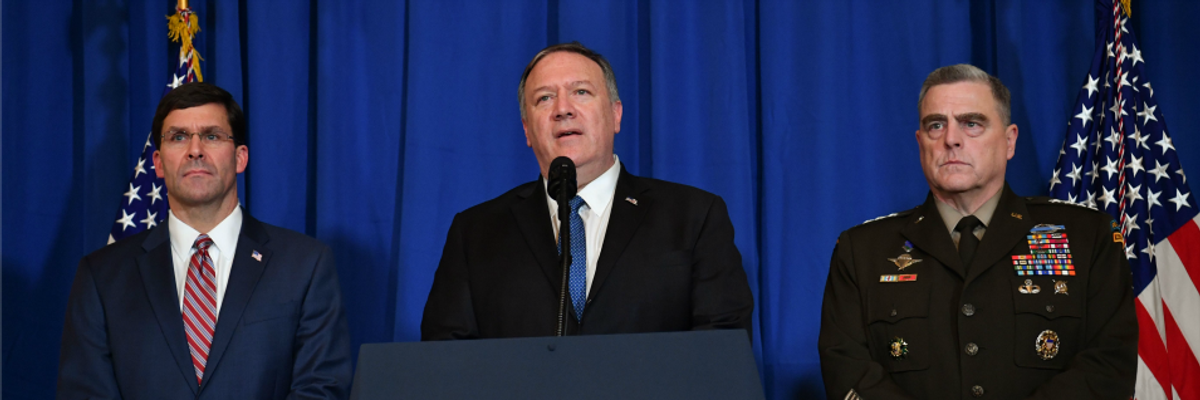
U.S. Secretary of State Mike Pompeo, Secretary of Defense Mark Esper, and Chairman of the Joint Chiefs of Staff Mark A. Milley speak on stage during a briefing on the past 72 hours events in Mar-a-Lago, Palm Beach, Florida on December 29, 2019. (Photo: Nicholas Kamm/AFP via Getty Images)
Iraqi Prime Minister Adel Abdul-Mahdi on Sunday accused the Trump administration of violating his nation's sovereignty and further heightening tensions in the region after the U.S. bombed several targets in Iraq and Syria, killing at least 25 fighters and injuring dozens more.
"We have previously confirmed our rejection of any unilateral action by the coalition forces or any other forces inside Iraq, and we consider it as a violation of Iraqi sovereignty and a dangerous escalation that threatens the security of Iraq and the region," Abdul-Mahdi said of the U.S. strikes.
"The dangerous escalation in Iraq occurs in the context of the Trump administration's reckless and needless 'maximum pressure' campaign that threatens to make Iraq an all-out battlefield between the U.S. and Iran."
--Sina Toossi, National Iranian American Council
The Pentagon claimed the airstrikes, which U.S. President Donald Trump approved late Saturday, were a "defensive" response to a rocket attack on an Iraqi military base last week that killed an American contractor.
The U.S. blamed the Kataib Hezbollah militia for the attack and pointed fingers at Iran, which the Trump administration said is funding and arming the group.
"We will not stand for the Islamic Republic of Iran to take actions that put American men and women in jeopardy," U.S. Secretary of State Mike Pompeo, a long-time supporter of regime change in Iran, said in a statement following the strikes on Sunday.
Kataib Hezbollah quickly vowed retaliatory action, saying the Trump administration's actions have left it with "no choice but confrontation."
"Trump should know that he will pay a heavy price in Iraq and the countries where his criminal forces are present," the group said.
Asa'ib Ahl al-Haq, an Iraqi militia group allied with Kataib Hezbollah, said "it is our duty to put an end to the U.S. military presence in Iraq through every legitimate method" and called on "political forces to stand against this cowardly aggression."
The latest U.S. bombing campaign in the Middle East prompted urgent calls for deescalation and warnings that the intensifying conflict could spark a full-blown regional war.
Sina Toossi, senior research analyst with the National Iranian American Council, said the U.S. strikes are linked to Trump's longstanding aggressive posture toward Iran and his decision last year to violate the 2015 nuclear accord.
"The dangerous escalation in Iraq occurs in the context of the Trump administration's reckless and needless 'maximum pressure' campaign that threatens to make Iraq an all-out battlefield between the U.S. and Iran," Toossi said in a statement. "Avoiding this scenario requires a broader rethinking of the maximum pressure policy away from mindless saber-rattling to one that opens channels of dialogue with Tehran."
"By reneging on the Iran nuclear deal and pursuing a maximalist goal of denying Iran influence in Iraq and elsewhere, President Trump has set the stage for chaos to overtake large parts of the region," Toossi added. "In its misplaced aim to sanction and isolate Iran, the administration risks yet again plunging Iraq into total chaos."
Dear Common Dreams reader, It’s been nearly 30 years since I co-founded Common Dreams with my late wife, Lina Newhouser. We had the radical notion that journalism should serve the public good, not corporate profits. It was clear to us from the outset what it would take to build such a project. No paid advertisements. No corporate sponsors. No millionaire publisher telling us what to think or do. Many people said we wouldn't last a year, but we proved those doubters wrong. Together with a tremendous team of journalists and dedicated staff, we built an independent media outlet free from the constraints of profits and corporate control. Our mission has always been simple: To inform. To inspire. To ignite change for the common good. Building Common Dreams was not easy. Our survival was never guaranteed. When you take on the most powerful forces—Wall Street greed, fossil fuel industry destruction, Big Tech lobbyists, and uber-rich oligarchs who have spent billions upon billions rigging the economy and democracy in their favor—the only bulwark you have is supporters who believe in your work. But here’s the urgent message from me today. It's never been this bad out there. And it's never been this hard to keep us going. At the very moment Common Dreams is most needed, the threats we face are intensifying. We need your support now more than ever. We don't accept corporate advertising and never will. We don't have a paywall because we don't think people should be blocked from critical news based on their ability to pay. Everything we do is funded by the donations of readers like you. When everyone does the little they can afford, we are strong. But if that support retreats or dries up, so do we. Will you donate now to make sure Common Dreams not only survives but thrives? —Craig Brown, Co-founder |
Iraqi Prime Minister Adel Abdul-Mahdi on Sunday accused the Trump administration of violating his nation's sovereignty and further heightening tensions in the region after the U.S. bombed several targets in Iraq and Syria, killing at least 25 fighters and injuring dozens more.
"We have previously confirmed our rejection of any unilateral action by the coalition forces or any other forces inside Iraq, and we consider it as a violation of Iraqi sovereignty and a dangerous escalation that threatens the security of Iraq and the region," Abdul-Mahdi said of the U.S. strikes.
"The dangerous escalation in Iraq occurs in the context of the Trump administration's reckless and needless 'maximum pressure' campaign that threatens to make Iraq an all-out battlefield between the U.S. and Iran."
--Sina Toossi, National Iranian American Council
The Pentagon claimed the airstrikes, which U.S. President Donald Trump approved late Saturday, were a "defensive" response to a rocket attack on an Iraqi military base last week that killed an American contractor.
The U.S. blamed the Kataib Hezbollah militia for the attack and pointed fingers at Iran, which the Trump administration said is funding and arming the group.
"We will not stand for the Islamic Republic of Iran to take actions that put American men and women in jeopardy," U.S. Secretary of State Mike Pompeo, a long-time supporter of regime change in Iran, said in a statement following the strikes on Sunday.
Kataib Hezbollah quickly vowed retaliatory action, saying the Trump administration's actions have left it with "no choice but confrontation."
"Trump should know that he will pay a heavy price in Iraq and the countries where his criminal forces are present," the group said.
Asa'ib Ahl al-Haq, an Iraqi militia group allied with Kataib Hezbollah, said "it is our duty to put an end to the U.S. military presence in Iraq through every legitimate method" and called on "political forces to stand against this cowardly aggression."
The latest U.S. bombing campaign in the Middle East prompted urgent calls for deescalation and warnings that the intensifying conflict could spark a full-blown regional war.
Sina Toossi, senior research analyst with the National Iranian American Council, said the U.S. strikes are linked to Trump's longstanding aggressive posture toward Iran and his decision last year to violate the 2015 nuclear accord.
"The dangerous escalation in Iraq occurs in the context of the Trump administration's reckless and needless 'maximum pressure' campaign that threatens to make Iraq an all-out battlefield between the U.S. and Iran," Toossi said in a statement. "Avoiding this scenario requires a broader rethinking of the maximum pressure policy away from mindless saber-rattling to one that opens channels of dialogue with Tehran."
"By reneging on the Iran nuclear deal and pursuing a maximalist goal of denying Iran influence in Iraq and elsewhere, President Trump has set the stage for chaos to overtake large parts of the region," Toossi added. "In its misplaced aim to sanction and isolate Iran, the administration risks yet again plunging Iraq into total chaos."
Iraqi Prime Minister Adel Abdul-Mahdi on Sunday accused the Trump administration of violating his nation's sovereignty and further heightening tensions in the region after the U.S. bombed several targets in Iraq and Syria, killing at least 25 fighters and injuring dozens more.
"We have previously confirmed our rejection of any unilateral action by the coalition forces or any other forces inside Iraq, and we consider it as a violation of Iraqi sovereignty and a dangerous escalation that threatens the security of Iraq and the region," Abdul-Mahdi said of the U.S. strikes.
"The dangerous escalation in Iraq occurs in the context of the Trump administration's reckless and needless 'maximum pressure' campaign that threatens to make Iraq an all-out battlefield between the U.S. and Iran."
--Sina Toossi, National Iranian American Council
The Pentagon claimed the airstrikes, which U.S. President Donald Trump approved late Saturday, were a "defensive" response to a rocket attack on an Iraqi military base last week that killed an American contractor.
The U.S. blamed the Kataib Hezbollah militia for the attack and pointed fingers at Iran, which the Trump administration said is funding and arming the group.
"We will not stand for the Islamic Republic of Iran to take actions that put American men and women in jeopardy," U.S. Secretary of State Mike Pompeo, a long-time supporter of regime change in Iran, said in a statement following the strikes on Sunday.
Kataib Hezbollah quickly vowed retaliatory action, saying the Trump administration's actions have left it with "no choice but confrontation."
"Trump should know that he will pay a heavy price in Iraq and the countries where his criminal forces are present," the group said.
Asa'ib Ahl al-Haq, an Iraqi militia group allied with Kataib Hezbollah, said "it is our duty to put an end to the U.S. military presence in Iraq through every legitimate method" and called on "political forces to stand against this cowardly aggression."
The latest U.S. bombing campaign in the Middle East prompted urgent calls for deescalation and warnings that the intensifying conflict could spark a full-blown regional war.
Sina Toossi, senior research analyst with the National Iranian American Council, said the U.S. strikes are linked to Trump's longstanding aggressive posture toward Iran and his decision last year to violate the 2015 nuclear accord.
"The dangerous escalation in Iraq occurs in the context of the Trump administration's reckless and needless 'maximum pressure' campaign that threatens to make Iraq an all-out battlefield between the U.S. and Iran," Toossi said in a statement. "Avoiding this scenario requires a broader rethinking of the maximum pressure policy away from mindless saber-rattling to one that opens channels of dialogue with Tehran."
"By reneging on the Iran nuclear deal and pursuing a maximalist goal of denying Iran influence in Iraq and elsewhere, President Trump has set the stage for chaos to overtake large parts of the region," Toossi added. "In its misplaced aim to sanction and isolate Iran, the administration risks yet again plunging Iraq into total chaos."