

SUBSCRIBE TO OUR FREE NEWSLETTER
Daily news & progressive opinion—funded by the people, not the corporations—delivered straight to your inbox.
5
#000000
#FFFFFF
To donate by check, phone, or other method, see our More Ways to Give page.
Daily news & progressive opinion—funded by the people, not the corporations—delivered straight to your inbox.
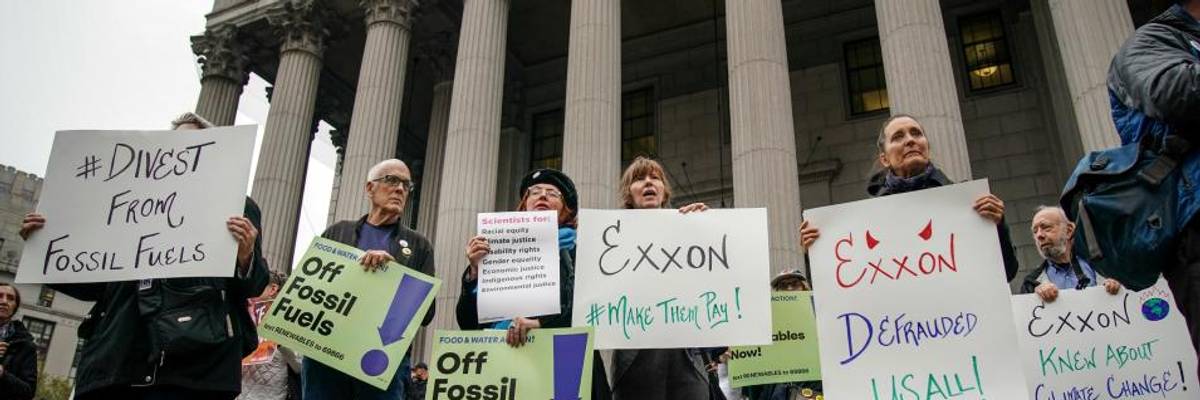
Environmental activists rally for accountability for fossil fuel companies outside of New York Supreme Court on Oct. 22, 2019 in New York City. (Photo: Drew Angerer/Getty Images)
As ExxonMobil faced the second day of a New York state trial for defrauding investors about climate-related risks of burning fossil fuels, a Democrat-controlled U.S. House Oversight subcommittee on Wednesday held a historic hearing "examining the oil industry's efforts to suppress the truth about climate change."
"Like Big Tobacco, we must expose Big Oil's deception and force their executives to confess under oath that they have risked the entire planet for their short-term greed."
--Mike Tidwell, CCAN Action Fund
"The devastating effects of climate change are not borne equally by our planet's population. Instead the consequences of climate change have had a disproportionate effect on people of color, low-income communities, and vulnerable populations that are often hit 'first and worst," noted a memo (pdf) from the subcommittee staff published ahead of the hearing. "Decades of climate denialism by the oil industry forestalled meaningful government action to avert the current crisis."
In a statement Wednesday, Tamara Toles O'Laughlin, North America director for the environmental group 350.org, said the Subcommittee on Civil Rights and Civil Liberties hearing was "an important step in demonstrating how the climate crisis deepens racial injustice and public health challenges."
"Just like Big Tobacco, Exxon executives buried the warnings of its own scientists, bankrolled deniers as politicians and advocates for destruction, and spent millions blocking the transformative action that science and justice demand," she said. "Communities who have done nothing to cause the climate crisis--poor communities, communities of color, Indigenous Peoples, and workers--are bearing the full cost of Exxon's lies through lives and livelihoods. It's time fossil fuel billionaires pay for care and repair."
That sentiment was echoed by Greenpeace USA, which tweeted: "Yesterday, Exxon was taken to court. Today, its climate denial scheme was put in front of Congress! Climate justice means making Big Oil pay for the climate crisis it created!"
Watch the hearing:
The subcommittee hearing featured testimony from experts on environmental justice and the human-caused climate crisis as well as a former scientist and consultant for ExxonMobil. Among the experts was Sharon Eubanks, who prosecuted the U.S. Department of Justice's racketeering case against Big Tobacco.
In her statement (pdf) to lawmakers Wednesday, Eubanks outlined similarities between the tobacco and oil industries:
As in the case of tobacco, the oil industry's campaign of misinformation was conducted by individual companies and by trade groups, advertisers, and other proxies that spread its message of doubt. Also, like tobacco, in-house scientists confirmed present and future threats to the public, while the companies and their proxies publicly disputed or distorted scientific findings, in particular, the dangers of carbon pollution and climate change. This campaign of climate change denial had the intended effect of delaying actions that might resolve the issues, including government regulatory actions while the public bore the effects of delay.
The #ExxonKnew campaign tweeted highlights from the hearing, including parts of Eubanks' testimony:
Another witness was Harvard University professor Naomi Oreskes. In August of 2017, Oreskes and fellow researcher Geoffrey Supran published a peer-reviewed study in the journal Environmental Research Letters that confirmed findings from 2015 InsideClimate News and The Los Angeles Times reports about ExxonMobil's decades-long record of suppressing climate science and sowing public doubt about the planetary crisis. She referenced the study in her prepared statement (pdf).
"In our study of ExxonMobil we demonstrated two things: First, that many of their advertorials were misleading, misrepresenting the state of the science, and exaggerating the degree of uncertainty," Oreskes said. "Second, that there was a systematic discrepancy between what the advertorials--designed to influence public opinion--said about climate change and what the company and its scientists said either in private, or in communications that were intended for restricted scientific or industrial audiences."
However, "fossil fuel disinformation goes well beyond ExxonMobil's advertorials," Oreskes continued. "The fossil fuel industry has also promoted disinformation through the activities of 'third-party allies': other organizations and groups, with whom they collaborated on messaging, helped to fund, or helped to create."
Ahead of this week's hearing, Oreskes and Supran--along with researchers from George Mason University and the University of Bristol--released a new report exposing how, "over the past few decades, the fossil fuel industry has subjected the American public to a well-funded, well-orchestrated disinformation campaign."
Details of what ExxonMobil knew about the climate crisis and when the company knew it were also confirmed Wednesday by former Exxon scientist Ed Garvey (pdf) and former company consultant Martin Hoffert (pdf). In terms of the fossil fuel giant's disinformation campaign, Hoffert told lawmakers that "what they did was wrong."
"They spread doubt about the dangers of climate change. The effect of this disinformation was to delay action internally and externally," said Hoffert. "As a result, in my opinion, homes and livelihoods will likely be destroyed and lives lost."
"The hearing completely destroyed Big Oil's myth that we are all responsible for climate change by exposing their multi-hundred million dollar climate deception campaign," Richard Wiles, executive director of the Center for Climate Integrity, declared Wednesday.
CCAN Action Fund executive director Mike Tidwell said in a statement that "like Big Tobacco, we must expose Big Oil's deception and force their executives to confess under oath that they have risked the entire planet for their short-term greed."
"This hearing put the industry's deception front and center," Tidwell added. "Congress owes it to the American people to keep the pressure on."
Advocates of climate action and corporate accountability praised Subcommittee Chairman Jamie Raskin (D-Md.) and other members of Congress--including Democratic freshmen Reps. Alexandria Ocasio-Cortez (N.Y.) and Ayanna Pressley (Mass.)--for bringing "their A game" to Wednesday's hearing.
Raskin, in his opening statement (pdf), denounced the fossil fuel industry for funding a "decades-long denial campaign that has twisted and perverted our democracy" by depriving "voters and policymakers of the materials and ability necessary to make informed decisions about the most fundamental challenge to human existence."
"We are thankfully beginning to see momentum shifting toward action to prevent further destruction of our planet, but we must remain wary of the feel-good commercials and empty promises from oil companies that are still intent on deceiving the American public," Raskin warned. "Exxon and their corporate allies are continuing to fund climate denialism and explore new oil fields to exploit, even as the warnings from scientists grow increasingly dire."
Dear Common Dreams reader, It’s been nearly 30 years since I co-founded Common Dreams with my late wife, Lina Newhouser. We had the radical notion that journalism should serve the public good, not corporate profits. It was clear to us from the outset what it would take to build such a project. No paid advertisements. No corporate sponsors. No millionaire publisher telling us what to think or do. Many people said we wouldn't last a year, but we proved those doubters wrong. Together with a tremendous team of journalists and dedicated staff, we built an independent media outlet free from the constraints of profits and corporate control. Our mission has always been simple: To inform. To inspire. To ignite change for the common good. Building Common Dreams was not easy. Our survival was never guaranteed. When you take on the most powerful forces—Wall Street greed, fossil fuel industry destruction, Big Tech lobbyists, and uber-rich oligarchs who have spent billions upon billions rigging the economy and democracy in their favor—the only bulwark you have is supporters who believe in your work. But here’s the urgent message from me today. It's never been this bad out there. And it's never been this hard to keep us going. At the very moment Common Dreams is most needed, the threats we face are intensifying. We need your support now more than ever. We don't accept corporate advertising and never will. We don't have a paywall because we don't think people should be blocked from critical news based on their ability to pay. Everything we do is funded by the donations of readers like you. When everyone does the little they can afford, we are strong. But if that support retreats or dries up, so do we. Will you donate now to make sure Common Dreams not only survives but thrives? —Craig Brown, Co-founder |
As ExxonMobil faced the second day of a New York state trial for defrauding investors about climate-related risks of burning fossil fuels, a Democrat-controlled U.S. House Oversight subcommittee on Wednesday held a historic hearing "examining the oil industry's efforts to suppress the truth about climate change."
"Like Big Tobacco, we must expose Big Oil's deception and force their executives to confess under oath that they have risked the entire planet for their short-term greed."
--Mike Tidwell, CCAN Action Fund
"The devastating effects of climate change are not borne equally by our planet's population. Instead the consequences of climate change have had a disproportionate effect on people of color, low-income communities, and vulnerable populations that are often hit 'first and worst," noted a memo (pdf) from the subcommittee staff published ahead of the hearing. "Decades of climate denialism by the oil industry forestalled meaningful government action to avert the current crisis."
In a statement Wednesday, Tamara Toles O'Laughlin, North America director for the environmental group 350.org, said the Subcommittee on Civil Rights and Civil Liberties hearing was "an important step in demonstrating how the climate crisis deepens racial injustice and public health challenges."
"Just like Big Tobacco, Exxon executives buried the warnings of its own scientists, bankrolled deniers as politicians and advocates for destruction, and spent millions blocking the transformative action that science and justice demand," she said. "Communities who have done nothing to cause the climate crisis--poor communities, communities of color, Indigenous Peoples, and workers--are bearing the full cost of Exxon's lies through lives and livelihoods. It's time fossil fuel billionaires pay for care and repair."
That sentiment was echoed by Greenpeace USA, which tweeted: "Yesterday, Exxon was taken to court. Today, its climate denial scheme was put in front of Congress! Climate justice means making Big Oil pay for the climate crisis it created!"
Watch the hearing:
The subcommittee hearing featured testimony from experts on environmental justice and the human-caused climate crisis as well as a former scientist and consultant for ExxonMobil. Among the experts was Sharon Eubanks, who prosecuted the U.S. Department of Justice's racketeering case against Big Tobacco.
In her statement (pdf) to lawmakers Wednesday, Eubanks outlined similarities between the tobacco and oil industries:
As in the case of tobacco, the oil industry's campaign of misinformation was conducted by individual companies and by trade groups, advertisers, and other proxies that spread its message of doubt. Also, like tobacco, in-house scientists confirmed present and future threats to the public, while the companies and their proxies publicly disputed or distorted scientific findings, in particular, the dangers of carbon pollution and climate change. This campaign of climate change denial had the intended effect of delaying actions that might resolve the issues, including government regulatory actions while the public bore the effects of delay.
The #ExxonKnew campaign tweeted highlights from the hearing, including parts of Eubanks' testimony:
Another witness was Harvard University professor Naomi Oreskes. In August of 2017, Oreskes and fellow researcher Geoffrey Supran published a peer-reviewed study in the journal Environmental Research Letters that confirmed findings from 2015 InsideClimate News and The Los Angeles Times reports about ExxonMobil's decades-long record of suppressing climate science and sowing public doubt about the planetary crisis. She referenced the study in her prepared statement (pdf).
"In our study of ExxonMobil we demonstrated two things: First, that many of their advertorials were misleading, misrepresenting the state of the science, and exaggerating the degree of uncertainty," Oreskes said. "Second, that there was a systematic discrepancy between what the advertorials--designed to influence public opinion--said about climate change and what the company and its scientists said either in private, or in communications that were intended for restricted scientific or industrial audiences."
However, "fossil fuel disinformation goes well beyond ExxonMobil's advertorials," Oreskes continued. "The fossil fuel industry has also promoted disinformation through the activities of 'third-party allies': other organizations and groups, with whom they collaborated on messaging, helped to fund, or helped to create."
Ahead of this week's hearing, Oreskes and Supran--along with researchers from George Mason University and the University of Bristol--released a new report exposing how, "over the past few decades, the fossil fuel industry has subjected the American public to a well-funded, well-orchestrated disinformation campaign."
Details of what ExxonMobil knew about the climate crisis and when the company knew it were also confirmed Wednesday by former Exxon scientist Ed Garvey (pdf) and former company consultant Martin Hoffert (pdf). In terms of the fossil fuel giant's disinformation campaign, Hoffert told lawmakers that "what they did was wrong."
"They spread doubt about the dangers of climate change. The effect of this disinformation was to delay action internally and externally," said Hoffert. "As a result, in my opinion, homes and livelihoods will likely be destroyed and lives lost."
"The hearing completely destroyed Big Oil's myth that we are all responsible for climate change by exposing their multi-hundred million dollar climate deception campaign," Richard Wiles, executive director of the Center for Climate Integrity, declared Wednesday.
CCAN Action Fund executive director Mike Tidwell said in a statement that "like Big Tobacco, we must expose Big Oil's deception and force their executives to confess under oath that they have risked the entire planet for their short-term greed."
"This hearing put the industry's deception front and center," Tidwell added. "Congress owes it to the American people to keep the pressure on."
Advocates of climate action and corporate accountability praised Subcommittee Chairman Jamie Raskin (D-Md.) and other members of Congress--including Democratic freshmen Reps. Alexandria Ocasio-Cortez (N.Y.) and Ayanna Pressley (Mass.)--for bringing "their A game" to Wednesday's hearing.
Raskin, in his opening statement (pdf), denounced the fossil fuel industry for funding a "decades-long denial campaign that has twisted and perverted our democracy" by depriving "voters and policymakers of the materials and ability necessary to make informed decisions about the most fundamental challenge to human existence."
"We are thankfully beginning to see momentum shifting toward action to prevent further destruction of our planet, but we must remain wary of the feel-good commercials and empty promises from oil companies that are still intent on deceiving the American public," Raskin warned. "Exxon and their corporate allies are continuing to fund climate denialism and explore new oil fields to exploit, even as the warnings from scientists grow increasingly dire."
As ExxonMobil faced the second day of a New York state trial for defrauding investors about climate-related risks of burning fossil fuels, a Democrat-controlled U.S. House Oversight subcommittee on Wednesday held a historic hearing "examining the oil industry's efforts to suppress the truth about climate change."
"Like Big Tobacco, we must expose Big Oil's deception and force their executives to confess under oath that they have risked the entire planet for their short-term greed."
--Mike Tidwell, CCAN Action Fund
"The devastating effects of climate change are not borne equally by our planet's population. Instead the consequences of climate change have had a disproportionate effect on people of color, low-income communities, and vulnerable populations that are often hit 'first and worst," noted a memo (pdf) from the subcommittee staff published ahead of the hearing. "Decades of climate denialism by the oil industry forestalled meaningful government action to avert the current crisis."
In a statement Wednesday, Tamara Toles O'Laughlin, North America director for the environmental group 350.org, said the Subcommittee on Civil Rights and Civil Liberties hearing was "an important step in demonstrating how the climate crisis deepens racial injustice and public health challenges."
"Just like Big Tobacco, Exxon executives buried the warnings of its own scientists, bankrolled deniers as politicians and advocates for destruction, and spent millions blocking the transformative action that science and justice demand," she said. "Communities who have done nothing to cause the climate crisis--poor communities, communities of color, Indigenous Peoples, and workers--are bearing the full cost of Exxon's lies through lives and livelihoods. It's time fossil fuel billionaires pay for care and repair."
That sentiment was echoed by Greenpeace USA, which tweeted: "Yesterday, Exxon was taken to court. Today, its climate denial scheme was put in front of Congress! Climate justice means making Big Oil pay for the climate crisis it created!"
Watch the hearing:
The subcommittee hearing featured testimony from experts on environmental justice and the human-caused climate crisis as well as a former scientist and consultant for ExxonMobil. Among the experts was Sharon Eubanks, who prosecuted the U.S. Department of Justice's racketeering case against Big Tobacco.
In her statement (pdf) to lawmakers Wednesday, Eubanks outlined similarities between the tobacco and oil industries:
As in the case of tobacco, the oil industry's campaign of misinformation was conducted by individual companies and by trade groups, advertisers, and other proxies that spread its message of doubt. Also, like tobacco, in-house scientists confirmed present and future threats to the public, while the companies and their proxies publicly disputed or distorted scientific findings, in particular, the dangers of carbon pollution and climate change. This campaign of climate change denial had the intended effect of delaying actions that might resolve the issues, including government regulatory actions while the public bore the effects of delay.
The #ExxonKnew campaign tweeted highlights from the hearing, including parts of Eubanks' testimony:
Another witness was Harvard University professor Naomi Oreskes. In August of 2017, Oreskes and fellow researcher Geoffrey Supran published a peer-reviewed study in the journal Environmental Research Letters that confirmed findings from 2015 InsideClimate News and The Los Angeles Times reports about ExxonMobil's decades-long record of suppressing climate science and sowing public doubt about the planetary crisis. She referenced the study in her prepared statement (pdf).
"In our study of ExxonMobil we demonstrated two things: First, that many of their advertorials were misleading, misrepresenting the state of the science, and exaggerating the degree of uncertainty," Oreskes said. "Second, that there was a systematic discrepancy between what the advertorials--designed to influence public opinion--said about climate change and what the company and its scientists said either in private, or in communications that were intended for restricted scientific or industrial audiences."
However, "fossil fuel disinformation goes well beyond ExxonMobil's advertorials," Oreskes continued. "The fossil fuel industry has also promoted disinformation through the activities of 'third-party allies': other organizations and groups, with whom they collaborated on messaging, helped to fund, or helped to create."
Ahead of this week's hearing, Oreskes and Supran--along with researchers from George Mason University and the University of Bristol--released a new report exposing how, "over the past few decades, the fossil fuel industry has subjected the American public to a well-funded, well-orchestrated disinformation campaign."
Details of what ExxonMobil knew about the climate crisis and when the company knew it were also confirmed Wednesday by former Exxon scientist Ed Garvey (pdf) and former company consultant Martin Hoffert (pdf). In terms of the fossil fuel giant's disinformation campaign, Hoffert told lawmakers that "what they did was wrong."
"They spread doubt about the dangers of climate change. The effect of this disinformation was to delay action internally and externally," said Hoffert. "As a result, in my opinion, homes and livelihoods will likely be destroyed and lives lost."
"The hearing completely destroyed Big Oil's myth that we are all responsible for climate change by exposing their multi-hundred million dollar climate deception campaign," Richard Wiles, executive director of the Center for Climate Integrity, declared Wednesday.
CCAN Action Fund executive director Mike Tidwell said in a statement that "like Big Tobacco, we must expose Big Oil's deception and force their executives to confess under oath that they have risked the entire planet for their short-term greed."
"This hearing put the industry's deception front and center," Tidwell added. "Congress owes it to the American people to keep the pressure on."
Advocates of climate action and corporate accountability praised Subcommittee Chairman Jamie Raskin (D-Md.) and other members of Congress--including Democratic freshmen Reps. Alexandria Ocasio-Cortez (N.Y.) and Ayanna Pressley (Mass.)--for bringing "their A game" to Wednesday's hearing.
Raskin, in his opening statement (pdf), denounced the fossil fuel industry for funding a "decades-long denial campaign that has twisted and perverted our democracy" by depriving "voters and policymakers of the materials and ability necessary to make informed decisions about the most fundamental challenge to human existence."
"We are thankfully beginning to see momentum shifting toward action to prevent further destruction of our planet, but we must remain wary of the feel-good commercials and empty promises from oil companies that are still intent on deceiving the American public," Raskin warned. "Exxon and their corporate allies are continuing to fund climate denialism and explore new oil fields to exploit, even as the warnings from scientists grow increasingly dire."

