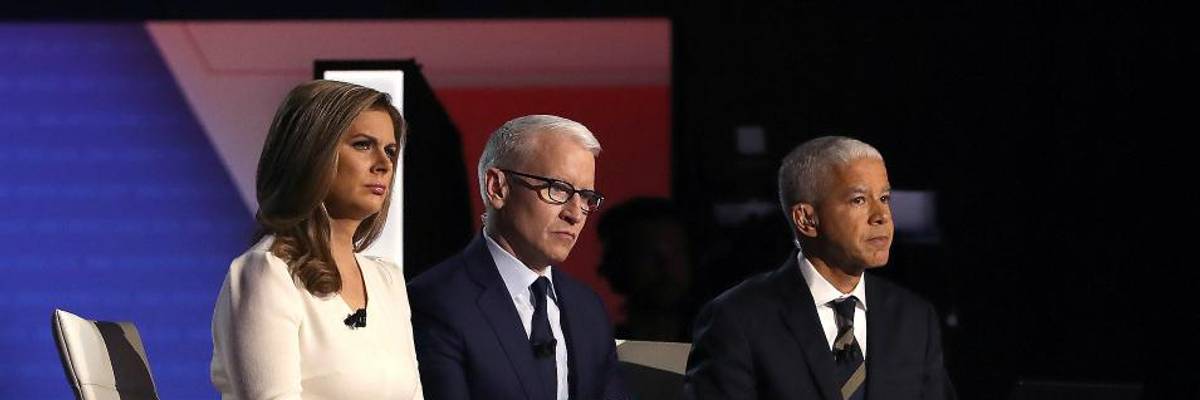
CNN anchors Erin Burnett and Anderson Cooper and New York Times national editor Marc Lacey moderate the Democratic presidential debate at Otterbein University on October 15, 2019 in Westerville, Ohio. (Photo by Win McNamee/Getty Images)
'An Absolute Joke': Debate Moderators Condemned for Asking About Ellen and George Bush After Completely Ignoring Climate Crisis
"CNN thought it was more important to use Ellen hanging out with a war criminal as a jumping off point to ask about bipartisan friendships than ask about the largest existential threat facing humanity."
As America's pundits and newspapers rushed to pronounce the winners and losers of Tuesday night's 2020 Democratic presidential debate, progressives argued the event's moderators deserve to be placed in the latter category for framing healthcare questions around insurance industry talking points, hand-wringing about "demonizing" rich people, and failing to ask a single question about the greatest existential threat facing humanity.
While they completely ignored the climate crisis, the event's moderators--Erin Burnett and Anderson Cooper of CNN and Marc Lacey of the New York Times--managed to find time at the very end of the debate to ask a question that infuriated environmentalists who were waiting all night for the planetary emergency to take center stage.
"The mainstream media's continuing bizarre fetish for bipartisanship is the new climate denial. What an absolute joke."
--Brian Kahn, Earther
"Last week, Ellen DeGeneres was criticized after she and former President George W. Bush were seen laughing together at a football game. Ellen defended their friendship, saying, we're all different and I think that we've forgotten that that's OK that we're all different," said Burnett. "So in that spirit, we'd like you to tell us about a friendship that you've had that would surprise us and what impact it's had on you and your beliefs."
The question set off a flood of outrage.
"THEY ASKED A QUESTION ABOUT ELLEN AND GEORGE BUSH BUT NOT CLIMATE CHANGE. I AM LOSING MY GODDAMN MIND," Earther managing editor Brian Kahn tweeted. "CNN thought it was more important to use Ellen hanging out with a war criminal as a jumping off point to ask about bipartisan friendships than ask about the largest existential threat facing humanity."
"The mainstream media's continuing bizarre fetish for bipartisanship is the new climate denial," Kahn added. "What an absolute joke."
Climate researcher Leah Stokes called the lack of climate questions "complete irresponsibility."
"Do you not understand that our house is on fire, New York Times and CNN? Do you not understand the stakes?" Stokes wrote. "Shame on you."
The Ellen question capped off an event progressives said was dominated by corporate-friendly framing of major issues, healthcare being the most glaring example.
In one of the first questions of the night, Lacey of the Times asked Sen. Elizabeth Warren (D-Mass.) whether she would "raise taxes on the middle class to pay for" Medicare for All.
Critics were quick to point out that a similar version of that same question has been asked in every previous debate, and on each occasion moderators have failed to acknowledge that Medicare for All would also eliminate co-pays, premiums, and deductibles, resulting in lower overall costs for most Americans.
Warren and Sen. Bernie Sanders (I-Vt.) both stressed the latter point, but Lacey continued to focus exclusively on "middle class taxes," echoing insurance industry propaganda against Medicare for All.
"Well, as somebody who wrote the damn bill, as I said, let's be clear. Under the Medicare for all bill that I wrote, premiums are gone. Co-payments are gone. Deductibles are gone. All out-of-pocket expenses are gone," said Sanders. "At the end of the day, the overwhelming majority of people will save money on their healthcare bills."
In an email to supporters after the debate, People's Action executive director George Goehl wrote that the "corporate media once again used insurance company talking points to attack Medicare For All, repeatedly asking candidates 'How are you going to pay for it?'--but never once mentioning that Medicare for All will cut costs for everyday people."
"The truth is, costs will go up if we pass Medicare for All--for big corporations and the very, very rich," wrote Goehl. "Meanwhile, the rest of us will get a guaranteed right to healthcare, no matter how rich or poor we are. That's why insurance companies and their lobbyists are fighting so hard--and spending so much--to frame the debate. If we pass Medicare for All, their days of profiteering off of other people's misery are over."
Los Angeles Times columnist David Lazarus put it more bluntly on Twitter:
The moderators' right-wing framing of Medicare for All pervaded other questions asked throughout Tuesday night's debate, which featured a historic 12 Democratic presidential candidates.
In a question on taxation directed at former Vice President Joe Biden, CNN host Erin Burnett said: "You have warned against demonizing rich people. Do you believe that Senator Sanders and Senator Warren's wealth tax plans do that?"
In her response, Warren flipped the question on its head.
"My question is not why do Bernie and I support a wealth tax," said Warren. "It's why is it does everyone else on this stage think it is more important to protect billionaires than it is to invest in an entire generation of Americans?"
We are at a crossroads
This country and this world are at a monumental crossroads. In a few short weeks, US voters will have an opportunity to beat back the forces of fascism and confront the billionaires who are rigging the economy, our media system, and our democracy, making it increasingly impossible for ordinary people to get by. We’re not just talking about the election. We’re talking about what must be done once these fascist elements are vanquished from power. We need a bolder set of solutions than what either major party has so far been willing to offer and a working-class movement ready to fight like hell for it. Trump didn't emerge from nowhere. The conditions that fueled MAGA authoritarianism were created by decades of radical neoliberal economic policies and a corrupt political system dominated by corporate interests. They slashed taxes on the super-rich, promising that the benefits would trickle down. They said giveaways to the corporate titans would make life more affordable for the rest of us. It was all bullshit. And when a bitter, betrayed populace searches for someone to blame, right-wing demagogues have little trouble finding scapegoats. People know when they're being lied to, but you won't hear any of this from the corporate media. Only independent journalism—powered and funded by people who believe in building a better world—can deliver truly trustworthy daily news. Our Fall Campaign is underway, and we need your help. To power our newsroom through the rest of the year, we need to raise $125,000 by midnight on October 31. So if you share our vision, please contribute whatever you can to sustain our work. |
As America's pundits and newspapers rushed to pronounce the winners and losers of Tuesday night's 2020 Democratic presidential debate, progressives argued the event's moderators deserve to be placed in the latter category for framing healthcare questions around insurance industry talking points, hand-wringing about "demonizing" rich people, and failing to ask a single question about the greatest existential threat facing humanity.
While they completely ignored the climate crisis, the event's moderators--Erin Burnett and Anderson Cooper of CNN and Marc Lacey of the New York Times--managed to find time at the very end of the debate to ask a question that infuriated environmentalists who were waiting all night for the planetary emergency to take center stage.
"The mainstream media's continuing bizarre fetish for bipartisanship is the new climate denial. What an absolute joke."
--Brian Kahn, Earther
"Last week, Ellen DeGeneres was criticized after she and former President George W. Bush were seen laughing together at a football game. Ellen defended their friendship, saying, we're all different and I think that we've forgotten that that's OK that we're all different," said Burnett. "So in that spirit, we'd like you to tell us about a friendship that you've had that would surprise us and what impact it's had on you and your beliefs."
The question set off a flood of outrage.
"THEY ASKED A QUESTION ABOUT ELLEN AND GEORGE BUSH BUT NOT CLIMATE CHANGE. I AM LOSING MY GODDAMN MIND," Earther managing editor Brian Kahn tweeted. "CNN thought it was more important to use Ellen hanging out with a war criminal as a jumping off point to ask about bipartisan friendships than ask about the largest existential threat facing humanity."
"The mainstream media's continuing bizarre fetish for bipartisanship is the new climate denial," Kahn added. "What an absolute joke."
Climate researcher Leah Stokes called the lack of climate questions "complete irresponsibility."
"Do you not understand that our house is on fire, New York Times and CNN? Do you not understand the stakes?" Stokes wrote. "Shame on you."
The Ellen question capped off an event progressives said was dominated by corporate-friendly framing of major issues, healthcare being the most glaring example.
In one of the first questions of the night, Lacey of the Times asked Sen. Elizabeth Warren (D-Mass.) whether she would "raise taxes on the middle class to pay for" Medicare for All.
Critics were quick to point out that a similar version of that same question has been asked in every previous debate, and on each occasion moderators have failed to acknowledge that Medicare for All would also eliminate co-pays, premiums, and deductibles, resulting in lower overall costs for most Americans.
Warren and Sen. Bernie Sanders (I-Vt.) both stressed the latter point, but Lacey continued to focus exclusively on "middle class taxes," echoing insurance industry propaganda against Medicare for All.
"Well, as somebody who wrote the damn bill, as I said, let's be clear. Under the Medicare for all bill that I wrote, premiums are gone. Co-payments are gone. Deductibles are gone. All out-of-pocket expenses are gone," said Sanders. "At the end of the day, the overwhelming majority of people will save money on their healthcare bills."
In an email to supporters after the debate, People's Action executive director George Goehl wrote that the "corporate media once again used insurance company talking points to attack Medicare For All, repeatedly asking candidates 'How are you going to pay for it?'--but never once mentioning that Medicare for All will cut costs for everyday people."
"The truth is, costs will go up if we pass Medicare for All--for big corporations and the very, very rich," wrote Goehl. "Meanwhile, the rest of us will get a guaranteed right to healthcare, no matter how rich or poor we are. That's why insurance companies and their lobbyists are fighting so hard--and spending so much--to frame the debate. If we pass Medicare for All, their days of profiteering off of other people's misery are over."
Los Angeles Times columnist David Lazarus put it more bluntly on Twitter:
The moderators' right-wing framing of Medicare for All pervaded other questions asked throughout Tuesday night's debate, which featured a historic 12 Democratic presidential candidates.
In a question on taxation directed at former Vice President Joe Biden, CNN host Erin Burnett said: "You have warned against demonizing rich people. Do you believe that Senator Sanders and Senator Warren's wealth tax plans do that?"
In her response, Warren flipped the question on its head.
"My question is not why do Bernie and I support a wealth tax," said Warren. "It's why is it does everyone else on this stage think it is more important to protect billionaires than it is to invest in an entire generation of Americans?"
As America's pundits and newspapers rushed to pronounce the winners and losers of Tuesday night's 2020 Democratic presidential debate, progressives argued the event's moderators deserve to be placed in the latter category for framing healthcare questions around insurance industry talking points, hand-wringing about "demonizing" rich people, and failing to ask a single question about the greatest existential threat facing humanity.
While they completely ignored the climate crisis, the event's moderators--Erin Burnett and Anderson Cooper of CNN and Marc Lacey of the New York Times--managed to find time at the very end of the debate to ask a question that infuriated environmentalists who were waiting all night for the planetary emergency to take center stage.
"The mainstream media's continuing bizarre fetish for bipartisanship is the new climate denial. What an absolute joke."
--Brian Kahn, Earther
"Last week, Ellen DeGeneres was criticized after she and former President George W. Bush were seen laughing together at a football game. Ellen defended their friendship, saying, we're all different and I think that we've forgotten that that's OK that we're all different," said Burnett. "So in that spirit, we'd like you to tell us about a friendship that you've had that would surprise us and what impact it's had on you and your beliefs."
The question set off a flood of outrage.
"THEY ASKED A QUESTION ABOUT ELLEN AND GEORGE BUSH BUT NOT CLIMATE CHANGE. I AM LOSING MY GODDAMN MIND," Earther managing editor Brian Kahn tweeted. "CNN thought it was more important to use Ellen hanging out with a war criminal as a jumping off point to ask about bipartisan friendships than ask about the largest existential threat facing humanity."
"The mainstream media's continuing bizarre fetish for bipartisanship is the new climate denial," Kahn added. "What an absolute joke."
Climate researcher Leah Stokes called the lack of climate questions "complete irresponsibility."
"Do you not understand that our house is on fire, New York Times and CNN? Do you not understand the stakes?" Stokes wrote. "Shame on you."
The Ellen question capped off an event progressives said was dominated by corporate-friendly framing of major issues, healthcare being the most glaring example.
In one of the first questions of the night, Lacey of the Times asked Sen. Elizabeth Warren (D-Mass.) whether she would "raise taxes on the middle class to pay for" Medicare for All.
Critics were quick to point out that a similar version of that same question has been asked in every previous debate, and on each occasion moderators have failed to acknowledge that Medicare for All would also eliminate co-pays, premiums, and deductibles, resulting in lower overall costs for most Americans.
Warren and Sen. Bernie Sanders (I-Vt.) both stressed the latter point, but Lacey continued to focus exclusively on "middle class taxes," echoing insurance industry propaganda against Medicare for All.
"Well, as somebody who wrote the damn bill, as I said, let's be clear. Under the Medicare for all bill that I wrote, premiums are gone. Co-payments are gone. Deductibles are gone. All out-of-pocket expenses are gone," said Sanders. "At the end of the day, the overwhelming majority of people will save money on their healthcare bills."
In an email to supporters after the debate, People's Action executive director George Goehl wrote that the "corporate media once again used insurance company talking points to attack Medicare For All, repeatedly asking candidates 'How are you going to pay for it?'--but never once mentioning that Medicare for All will cut costs for everyday people."
"The truth is, costs will go up if we pass Medicare for All--for big corporations and the very, very rich," wrote Goehl. "Meanwhile, the rest of us will get a guaranteed right to healthcare, no matter how rich or poor we are. That's why insurance companies and their lobbyists are fighting so hard--and spending so much--to frame the debate. If we pass Medicare for All, their days of profiteering off of other people's misery are over."
Los Angeles Times columnist David Lazarus put it more bluntly on Twitter:
The moderators' right-wing framing of Medicare for All pervaded other questions asked throughout Tuesday night's debate, which featured a historic 12 Democratic presidential candidates.
In a question on taxation directed at former Vice President Joe Biden, CNN host Erin Burnett said: "You have warned against demonizing rich people. Do you believe that Senator Sanders and Senator Warren's wealth tax plans do that?"
In her response, Warren flipped the question on its head.
"My question is not why do Bernie and I support a wealth tax," said Warren. "It's why is it does everyone else on this stage think it is more important to protect billionaires than it is to invest in an entire generation of Americans?"