

SUBSCRIBE TO OUR FREE NEWSLETTER
Daily news & progressive opinion—funded by the people, not the corporations—delivered straight to your inbox.
5
#000000
#FFFFFF
To donate by check, phone, or other method, see our More Ways to Give page.
Daily news & progressive opinion—funded by the people, not the corporations—delivered straight to your inbox.
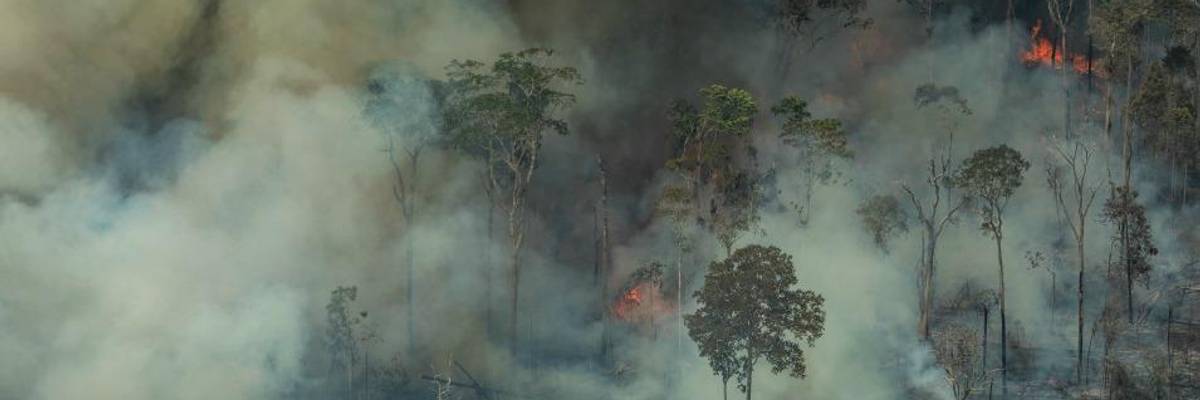
The fires engulfing the Amazon rain forest are a sign that the Earth is approaching an environmental and ecological "tipping point" that all of humanity must work together to avoid, the U.N.'s top biodiversity expert said Friday. (Photo: (c)Victor Moriyama/Greenpeace)
Unless world governments, consumers, and businesses all work together to address the root causes of the current burning of the Amazon rain forest, the Arctic, and forests in the Congo and Angola, the planet will continue careening toward a point of no return, the U.N.'s top biodiversity expert said Friday.
Cristiana Pasca Palmer, executive secretary of the U.N. Convention on Biological Diversity, called the fires that have torn through more than 1,300 square miles of the Amazon this year "extraordinarily concerning."
"But it is not just the Amazon," she told The Guardian. "We're also concerned with what's happening in other forests and ecosystems, and with the broader and rapid degradation of nature."
"We need to address the root causes. Even if the amount involved in extinguishing fires in rainforests was a billion or 500 million dollars, we won't see an improvement unless more profound structural changes are taking place. We need a transformation in the way we consume and produce."
--Cristiana Pasca Palmer, U.N. Convention on Biological DiversityThe Amazon fires themselves are a sign, Pasca Palmer said, that "we are moving towards the tipping points that scientists talk about that could produce cascading collapses of natural systems."
Green groups have largely blamed Brazilian President Jair Bolsonaro for the fires, pointing to his encouragement of what one indigenous leader called "predatory behavior" of loggers, ranchers, and miners who want to clear forests for their industrial use.
World governments and philanthropists have offered tens of millions of dollars to help save the rain forest, often called the "lungs of the Earth" because of the amount of oxygen its trees produce, but Pasca Palmer emphasized that a paradigm shift is needed in how the world approaches biodiversity and ecosystems.
"We need to address the root causes," Pasca Palmer said. "Even if the amount involved in extinguishing fires in rainforests was a billion or 500 million dollars, we won't see an improvement unless more profound structural changes are taking place. We need a transformation in the way we consume and produce."
Helping to protect the world's pollinators by ending the use of harmful pesticides, cutting fossil fuel emissions to net zero by 2030 to avoid a catastrophic warming of the planet by more than 1.5 degrees Celsius above pre-industrial levels, and ending habitat destruction through deforestation and other human activities, are all necessary to maintain the Earth's biodiversity, the U.N. panel led by Pasca Palmer says.
Pasca Palmer pointed to robust biodiversity programs in Costa Rica and Colombia as models for the rest of the world when they meet for an upcoming biodiversity summit in Kunming, China next year.
Costa Rica's government has offered payments to landowners for preserving forests and planting trees, while Colombia has nearly doubled its federally protected lands in recent years.
"I hope this will have a snowball effect," said Pasca Palmer. "It's a growing movement. I feel that now the heads of state are embracing this, we have a good signal."
On social media, Extinction Rebellion Ireland expressed support for Pasca Palmer's message, writing, "If we don't work together, we are going to die together."
Climate campaigner Tony Juniper called the U.N. official's comments "a timely reminder that nature underpins the human world."
"It is vital to embed ecological recovery at the heart of our economic system," wrote Juniper, "a reality that must be reflected in actual policy and spending decisions."
Dear Common Dreams reader, It’s been nearly 30 years since I co-founded Common Dreams with my late wife, Lina Newhouser. We had the radical notion that journalism should serve the public good, not corporate profits. It was clear to us from the outset what it would take to build such a project. No paid advertisements. No corporate sponsors. No millionaire publisher telling us what to think or do. Many people said we wouldn't last a year, but we proved those doubters wrong. Together with a tremendous team of journalists and dedicated staff, we built an independent media outlet free from the constraints of profits and corporate control. Our mission has always been simple: To inform. To inspire. To ignite change for the common good. Building Common Dreams was not easy. Our survival was never guaranteed. When you take on the most powerful forces—Wall Street greed, fossil fuel industry destruction, Big Tech lobbyists, and uber-rich oligarchs who have spent billions upon billions rigging the economy and democracy in their favor—the only bulwark you have is supporters who believe in your work. But here’s the urgent message from me today. It's never been this bad out there. And it's never been this hard to keep us going. At the very moment Common Dreams is most needed, the threats we face are intensifying. We need your support now more than ever. We don't accept corporate advertising and never will. We don't have a paywall because we don't think people should be blocked from critical news based on their ability to pay. Everything we do is funded by the donations of readers like you. When everyone does the little they can afford, we are strong. But if that support retreats or dries up, so do we. Will you donate now to make sure Common Dreams not only survives but thrives? —Craig Brown, Co-founder |
Unless world governments, consumers, and businesses all work together to address the root causes of the current burning of the Amazon rain forest, the Arctic, and forests in the Congo and Angola, the planet will continue careening toward a point of no return, the U.N.'s top biodiversity expert said Friday.
Cristiana Pasca Palmer, executive secretary of the U.N. Convention on Biological Diversity, called the fires that have torn through more than 1,300 square miles of the Amazon this year "extraordinarily concerning."
"But it is not just the Amazon," she told The Guardian. "We're also concerned with what's happening in other forests and ecosystems, and with the broader and rapid degradation of nature."
"We need to address the root causes. Even if the amount involved in extinguishing fires in rainforests was a billion or 500 million dollars, we won't see an improvement unless more profound structural changes are taking place. We need a transformation in the way we consume and produce."
--Cristiana Pasca Palmer, U.N. Convention on Biological DiversityThe Amazon fires themselves are a sign, Pasca Palmer said, that "we are moving towards the tipping points that scientists talk about that could produce cascading collapses of natural systems."
Green groups have largely blamed Brazilian President Jair Bolsonaro for the fires, pointing to his encouragement of what one indigenous leader called "predatory behavior" of loggers, ranchers, and miners who want to clear forests for their industrial use.
World governments and philanthropists have offered tens of millions of dollars to help save the rain forest, often called the "lungs of the Earth" because of the amount of oxygen its trees produce, but Pasca Palmer emphasized that a paradigm shift is needed in how the world approaches biodiversity and ecosystems.
"We need to address the root causes," Pasca Palmer said. "Even if the amount involved in extinguishing fires in rainforests was a billion or 500 million dollars, we won't see an improvement unless more profound structural changes are taking place. We need a transformation in the way we consume and produce."
Helping to protect the world's pollinators by ending the use of harmful pesticides, cutting fossil fuel emissions to net zero by 2030 to avoid a catastrophic warming of the planet by more than 1.5 degrees Celsius above pre-industrial levels, and ending habitat destruction through deforestation and other human activities, are all necessary to maintain the Earth's biodiversity, the U.N. panel led by Pasca Palmer says.
Pasca Palmer pointed to robust biodiversity programs in Costa Rica and Colombia as models for the rest of the world when they meet for an upcoming biodiversity summit in Kunming, China next year.
Costa Rica's government has offered payments to landowners for preserving forests and planting trees, while Colombia has nearly doubled its federally protected lands in recent years.
"I hope this will have a snowball effect," said Pasca Palmer. "It's a growing movement. I feel that now the heads of state are embracing this, we have a good signal."
On social media, Extinction Rebellion Ireland expressed support for Pasca Palmer's message, writing, "If we don't work together, we are going to die together."
Climate campaigner Tony Juniper called the U.N. official's comments "a timely reminder that nature underpins the human world."
"It is vital to embed ecological recovery at the heart of our economic system," wrote Juniper, "a reality that must be reflected in actual policy and spending decisions."
Unless world governments, consumers, and businesses all work together to address the root causes of the current burning of the Amazon rain forest, the Arctic, and forests in the Congo and Angola, the planet will continue careening toward a point of no return, the U.N.'s top biodiversity expert said Friday.
Cristiana Pasca Palmer, executive secretary of the U.N. Convention on Biological Diversity, called the fires that have torn through more than 1,300 square miles of the Amazon this year "extraordinarily concerning."
"But it is not just the Amazon," she told The Guardian. "We're also concerned with what's happening in other forests and ecosystems, and with the broader and rapid degradation of nature."
"We need to address the root causes. Even if the amount involved in extinguishing fires in rainforests was a billion or 500 million dollars, we won't see an improvement unless more profound structural changes are taking place. We need a transformation in the way we consume and produce."
--Cristiana Pasca Palmer, U.N. Convention on Biological DiversityThe Amazon fires themselves are a sign, Pasca Palmer said, that "we are moving towards the tipping points that scientists talk about that could produce cascading collapses of natural systems."
Green groups have largely blamed Brazilian President Jair Bolsonaro for the fires, pointing to his encouragement of what one indigenous leader called "predatory behavior" of loggers, ranchers, and miners who want to clear forests for their industrial use.
World governments and philanthropists have offered tens of millions of dollars to help save the rain forest, often called the "lungs of the Earth" because of the amount of oxygen its trees produce, but Pasca Palmer emphasized that a paradigm shift is needed in how the world approaches biodiversity and ecosystems.
"We need to address the root causes," Pasca Palmer said. "Even if the amount involved in extinguishing fires in rainforests was a billion or 500 million dollars, we won't see an improvement unless more profound structural changes are taking place. We need a transformation in the way we consume and produce."
Helping to protect the world's pollinators by ending the use of harmful pesticides, cutting fossil fuel emissions to net zero by 2030 to avoid a catastrophic warming of the planet by more than 1.5 degrees Celsius above pre-industrial levels, and ending habitat destruction through deforestation and other human activities, are all necessary to maintain the Earth's biodiversity, the U.N. panel led by Pasca Palmer says.
Pasca Palmer pointed to robust biodiversity programs in Costa Rica and Colombia as models for the rest of the world when they meet for an upcoming biodiversity summit in Kunming, China next year.
Costa Rica's government has offered payments to landowners for preserving forests and planting trees, while Colombia has nearly doubled its federally protected lands in recent years.
"I hope this will have a snowball effect," said Pasca Palmer. "It's a growing movement. I feel that now the heads of state are embracing this, we have a good signal."
On social media, Extinction Rebellion Ireland expressed support for Pasca Palmer's message, writing, "If we don't work together, we are going to die together."
Climate campaigner Tony Juniper called the U.N. official's comments "a timely reminder that nature underpins the human world."
"It is vital to embed ecological recovery at the heart of our economic system," wrote Juniper, "a reality that must be reflected in actual policy and spending decisions."

