

SUBSCRIBE TO OUR FREE NEWSLETTER
Daily news & progressive opinion—funded by the people, not the corporations—delivered straight to your inbox.
5
#000000
#FFFFFF
To donate by check, phone, or other method, see our More Ways to Give page.
Daily news & progressive opinion—funded by the people, not the corporations—delivered straight to your inbox.
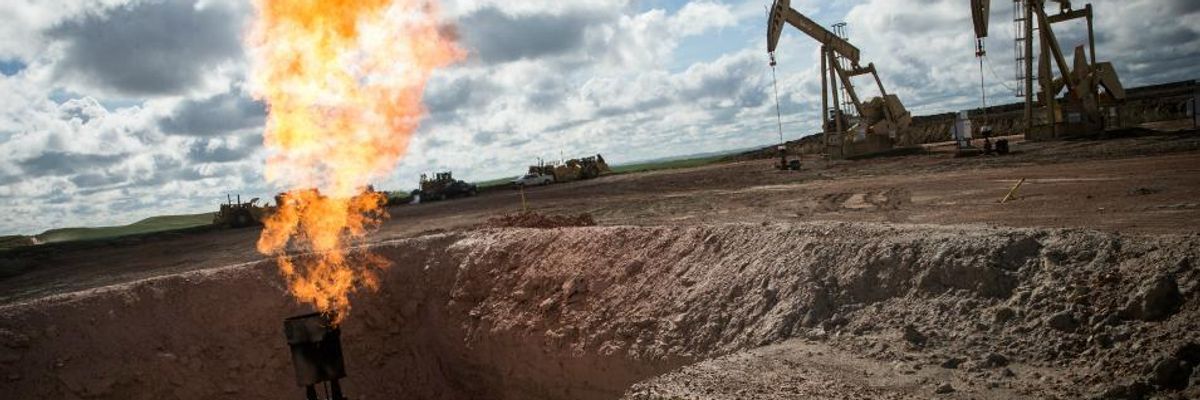
A gas flare is seen at an oil well site on outside Williston, North Dakota. (Photo: Andrew Burton/Getty Images)
Amid dire scientific warnings that the international community must act immediately to slash greenhouse gas emissions, President Donald Trump's Environmental Protection Agency is reportedly set to take another step in the opposite direction Thursday by unveiling a rule that would gut restrictions on the fossil fuel industry's methane pollution.
According to the Wall Street Journal, which first reported the proposed rule change Thursday, the EPA's plan would scrap regulations requiring the oil and gas industry to "install technologies that monitor and limit leaks from new wells, tanks and pipeline networks and to more frequently inspect for leaks."
"This administration is ultimately driven by sociopathic disregard for our future."
--Wenonah Hauter, Food & Water Watch
"It would also forestall legal requirements that would have forced the EPA to set rules on emissions from thousands of pre-existing wells and industry sites," the Journal reported.
Environmentalists reacted with outrage to the new proposal. "This administration is ultimately driven by sociopathic disregard for our future," said Wenonah Hauter, executive director of Food & Water Watch.
Earthworks policy director Lauren Pagel called the rule "reckless" and said it will "impact millions of families living with oil and gas air pollution in their backyards."
"President Trump once again signaled his ignorance towards the science of climate crisis and his indifference towards public health," said Pagel.
The Trump administration expects the rule, which must go through a 60-day public comment period, to take effect early next year. The rollback was immediately praised by the American Petroleum Institute, a major trade group representing the fossil fuel industry.
Because of methane's potency--some estimates suggest the greenhouse gas has more than 80 times the warming power of carbon dioxide--environmentalists and scientists have warned the Trump administration's efforts to gut methane regulations could have disastrous consequences.
"This is extraordinarily harmful," Rachel Kyte, United Nations special representative on sustainable energy, said of the Trump administration's proposed rule change. "Just at a time when the federal government's job should be to help localities and states move faster toward cleaner energy and a cleaner economy, just at that moment when speed and scale is what's at stake, the government is walking off the field."
Trump administration officials, and the president himself, have gleefully touted the White House's success in ramping up American production of methane-emitting natural gas, which Assistant Secretary for Fossil Energy Steven Winberg infamously described as "molecules of U.S. freedom."
During the G20 summit in Japan in June, Trump said he is "not willing" to take action to curb greenhouse gas emissions because such a move would harm corporate profits.
A report published earlier this year by Oil Change International in collaboration with over a dozen other environmental groups warned that U.S. fossil fuel production has the potential to single-handedly imperil global efforts to combat the climate crisis.
"Right now, we're on a sinking boat, and instead of just scooping water out, we must take immediate action to patch the hole where it's gushing in," said Patrick McCully of the Rainforest Action Network. "This means we must put a full-stop to fossil fuel expansion, or we all sink into climate chaos."
Dear Common Dreams reader, It’s been nearly 30 years since I co-founded Common Dreams with my late wife, Lina Newhouser. We had the radical notion that journalism should serve the public good, not corporate profits. It was clear to us from the outset what it would take to build such a project. No paid advertisements. No corporate sponsors. No millionaire publisher telling us what to think or do. Many people said we wouldn't last a year, but we proved those doubters wrong. Together with a tremendous team of journalists and dedicated staff, we built an independent media outlet free from the constraints of profits and corporate control. Our mission has always been simple: To inform. To inspire. To ignite change for the common good. Building Common Dreams was not easy. Our survival was never guaranteed. When you take on the most powerful forces—Wall Street greed, fossil fuel industry destruction, Big Tech lobbyists, and uber-rich oligarchs who have spent billions upon billions rigging the economy and democracy in their favor—the only bulwark you have is supporters who believe in your work. But here’s the urgent message from me today. It's never been this bad out there. And it's never been this hard to keep us going. At the very moment Common Dreams is most needed, the threats we face are intensifying. We need your support now more than ever. We don't accept corporate advertising and never will. We don't have a paywall because we don't think people should be blocked from critical news based on their ability to pay. Everything we do is funded by the donations of readers like you. When everyone does the little they can afford, we are strong. But if that support retreats or dries up, so do we. Will you donate now to make sure Common Dreams not only survives but thrives? —Craig Brown, Co-founder |
Amid dire scientific warnings that the international community must act immediately to slash greenhouse gas emissions, President Donald Trump's Environmental Protection Agency is reportedly set to take another step in the opposite direction Thursday by unveiling a rule that would gut restrictions on the fossil fuel industry's methane pollution.
According to the Wall Street Journal, which first reported the proposed rule change Thursday, the EPA's plan would scrap regulations requiring the oil and gas industry to "install technologies that monitor and limit leaks from new wells, tanks and pipeline networks and to more frequently inspect for leaks."
"This administration is ultimately driven by sociopathic disregard for our future."
--Wenonah Hauter, Food & Water Watch
"It would also forestall legal requirements that would have forced the EPA to set rules on emissions from thousands of pre-existing wells and industry sites," the Journal reported.
Environmentalists reacted with outrage to the new proposal. "This administration is ultimately driven by sociopathic disregard for our future," said Wenonah Hauter, executive director of Food & Water Watch.
Earthworks policy director Lauren Pagel called the rule "reckless" and said it will "impact millions of families living with oil and gas air pollution in their backyards."
"President Trump once again signaled his ignorance towards the science of climate crisis and his indifference towards public health," said Pagel.
The Trump administration expects the rule, which must go through a 60-day public comment period, to take effect early next year. The rollback was immediately praised by the American Petroleum Institute, a major trade group representing the fossil fuel industry.
Because of methane's potency--some estimates suggest the greenhouse gas has more than 80 times the warming power of carbon dioxide--environmentalists and scientists have warned the Trump administration's efforts to gut methane regulations could have disastrous consequences.
"This is extraordinarily harmful," Rachel Kyte, United Nations special representative on sustainable energy, said of the Trump administration's proposed rule change. "Just at a time when the federal government's job should be to help localities and states move faster toward cleaner energy and a cleaner economy, just at that moment when speed and scale is what's at stake, the government is walking off the field."
Trump administration officials, and the president himself, have gleefully touted the White House's success in ramping up American production of methane-emitting natural gas, which Assistant Secretary for Fossil Energy Steven Winberg infamously described as "molecules of U.S. freedom."
During the G20 summit in Japan in June, Trump said he is "not willing" to take action to curb greenhouse gas emissions because such a move would harm corporate profits.
A report published earlier this year by Oil Change International in collaboration with over a dozen other environmental groups warned that U.S. fossil fuel production has the potential to single-handedly imperil global efforts to combat the climate crisis.
"Right now, we're on a sinking boat, and instead of just scooping water out, we must take immediate action to patch the hole where it's gushing in," said Patrick McCully of the Rainforest Action Network. "This means we must put a full-stop to fossil fuel expansion, or we all sink into climate chaos."
Amid dire scientific warnings that the international community must act immediately to slash greenhouse gas emissions, President Donald Trump's Environmental Protection Agency is reportedly set to take another step in the opposite direction Thursday by unveiling a rule that would gut restrictions on the fossil fuel industry's methane pollution.
According to the Wall Street Journal, which first reported the proposed rule change Thursday, the EPA's plan would scrap regulations requiring the oil and gas industry to "install technologies that monitor and limit leaks from new wells, tanks and pipeline networks and to more frequently inspect for leaks."
"This administration is ultimately driven by sociopathic disregard for our future."
--Wenonah Hauter, Food & Water Watch
"It would also forestall legal requirements that would have forced the EPA to set rules on emissions from thousands of pre-existing wells and industry sites," the Journal reported.
Environmentalists reacted with outrage to the new proposal. "This administration is ultimately driven by sociopathic disregard for our future," said Wenonah Hauter, executive director of Food & Water Watch.
Earthworks policy director Lauren Pagel called the rule "reckless" and said it will "impact millions of families living with oil and gas air pollution in their backyards."
"President Trump once again signaled his ignorance towards the science of climate crisis and his indifference towards public health," said Pagel.
The Trump administration expects the rule, which must go through a 60-day public comment period, to take effect early next year. The rollback was immediately praised by the American Petroleum Institute, a major trade group representing the fossil fuel industry.
Because of methane's potency--some estimates suggest the greenhouse gas has more than 80 times the warming power of carbon dioxide--environmentalists and scientists have warned the Trump administration's efforts to gut methane regulations could have disastrous consequences.
"This is extraordinarily harmful," Rachel Kyte, United Nations special representative on sustainable energy, said of the Trump administration's proposed rule change. "Just at a time when the federal government's job should be to help localities and states move faster toward cleaner energy and a cleaner economy, just at that moment when speed and scale is what's at stake, the government is walking off the field."
Trump administration officials, and the president himself, have gleefully touted the White House's success in ramping up American production of methane-emitting natural gas, which Assistant Secretary for Fossil Energy Steven Winberg infamously described as "molecules of U.S. freedom."
During the G20 summit in Japan in June, Trump said he is "not willing" to take action to curb greenhouse gas emissions because such a move would harm corporate profits.
A report published earlier this year by Oil Change International in collaboration with over a dozen other environmental groups warned that U.S. fossil fuel production has the potential to single-handedly imperil global efforts to combat the climate crisis.
"Right now, we're on a sinking boat, and instead of just scooping water out, we must take immediate action to patch the hole where it's gushing in," said Patrick McCully of the Rainforest Action Network. "This means we must put a full-stop to fossil fuel expansion, or we all sink into climate chaos."

