SUBSCRIBE TO OUR FREE NEWSLETTER
Daily news & progressive opinion—funded by the people, not the corporations—delivered straight to your inbox.
5
#000000
#FFFFFF
To donate by check, phone, or other method, see our More Ways to Give page.
Daily news & progressive opinion—funded by the people, not the corporations—delivered straight to your inbox.
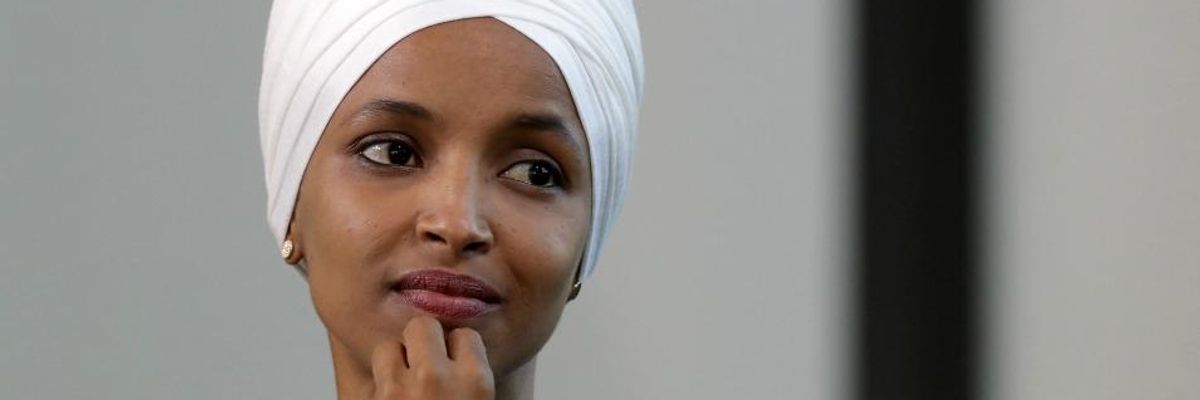
Rep. Ilhan Omar (D-Minn.) participates in a panel discussion during the Muslim Collective For Equitable Democracy Conference and Presidential Forum at the The National Housing Center July 23, 2019 in Washington, D.C. (Photo: Chip Somodevilla/Getty Images)
At a conference on Muslim Americans' rights and involvement in politics on Tuesday, Rep. Ilhan Omar vehemently rejected the suggestion by an attendee that, as one of two Muslim women in Congress, she should make a statement about female genital mutilation or other issues affecting Muslim communities around the world and in the United States.
Ani Osman-Zonneveld of the human rights group Muslims for Progressive Values told Omar that "it would be really powerful if the two Muslim congresswomen, yourself and Rashida [Tlaib] would make a statement on this issue."
Omar and Tlaib, who are Somali American and Palestinian American respectively, should not be expected to condemn female genital mutilation (FGM), Al Qaeda, or any other group or practice embraced in some parts of the world where many Muslims live, any more than other American politicians are asked to do so, the Minnesota Democrat said.
"Should I make a schedule?" Omar asked. "Does this need to be on repeat every five minutes? Should I be like, 'So today I forgot to condemn al-Qaeda, so here's the al-Qaeda one, today I forgot to condemn FGM, so here it goes, today I forgot to condemn Hamas, so here it goes, you know what I mean?"
Watch:
The first-term congresswoman added that--in addition to her work fighting for numerous progressive causes including Medicare for All, a Green New Deal, and economic justice--she has in fact condemned FGM through legislation she's supported and statements she's made.
"You can look at my record, I voted for bills doing exactly what you're asking me to do," Omar said. "I've put out statements upon statements. There's a bill in Congress, there's a resolution that I am the co-author of, that I voted out of the Foreign Affairs Committee...and then we're in a panel like this and the question is posed: 'Could you and Rashida do this?'"
Osman-Zonneveld's question was indicative of an assumption among many Americans, Omar said, that Muslims in Congress might be sympathetic to communities which practice FGM or to violent groups like Al Qaeda.
"As Muslim legislators we are constantly being asked to waste our time speaking to issues that other people are not asked to speak to because the assumption exists that we somehow support and are for [these practices]," Omar said.
The exchange came in the wake of racist remarks by President Donald Trump about Omar's background as a Somali refugee who came to the U.S. as a child. The president tweeted that Omar and other progressive women of color in Congress should "go back" to the countries "from which they came," paused for 13 seconds during a campaign speech to allow rally-goers to chant, "Send her back!" in regards to Omar, and made a baseless claim at the rally that Omar had expressed pride in Al Qaeda.
Questions suggesting that Omar should confirm for the public that she does not support FGM are another way of marginalizing members of Congress like her and Tlaib, the congresswoman said.
"What this whole conversation is about is that not only do we have internalized fears about what we might believe and how that gets implemented, but that we also don't have assumptions about what our value basis might be because of where we might come from and who we pray to," Omar said. "If you want us to speak as politicians, American politicians, then you treat us as such."
Omar received applause for her comments at the event and a number of Muslims living in the U.S., as well as progressive organizations, praised her remarks.
"Most Muslims born and brought up in the West,' tweeted journalist Mehdi Hasan, "have been waiting our whole lives for a politician who is Muslim to get elected and deliver an answer like this to the 'usual' questions."
Dear Common Dreams reader, It’s been nearly 30 years since I co-founded Common Dreams with my late wife, Lina Newhouser. We had the radical notion that journalism should serve the public good, not corporate profits. It was clear to us from the outset what it would take to build such a project. No paid advertisements. No corporate sponsors. No millionaire publisher telling us what to think or do. Many people said we wouldn't last a year, but we proved those doubters wrong. Together with a tremendous team of journalists and dedicated staff, we built an independent media outlet free from the constraints of profits and corporate control. Our mission has always been simple: To inform. To inspire. To ignite change for the common good. Building Common Dreams was not easy. Our survival was never guaranteed. When you take on the most powerful forces—Wall Street greed, fossil fuel industry destruction, Big Tech lobbyists, and uber-rich oligarchs who have spent billions upon billions rigging the economy and democracy in their favor—the only bulwark you have is supporters who believe in your work. But here’s the urgent message from me today. It's never been this bad out there. And it's never been this hard to keep us going. At the very moment Common Dreams is most needed, the threats we face are intensifying. We need your support now more than ever. We don't accept corporate advertising and never will. We don't have a paywall because we don't think people should be blocked from critical news based on their ability to pay. Everything we do is funded by the donations of readers like you. When everyone does the little they can afford, we are strong. But if that support retreats or dries up, so do we. Will you donate now to make sure Common Dreams not only survives but thrives? —Craig Brown, Co-founder |
At a conference on Muslim Americans' rights and involvement in politics on Tuesday, Rep. Ilhan Omar vehemently rejected the suggestion by an attendee that, as one of two Muslim women in Congress, she should make a statement about female genital mutilation or other issues affecting Muslim communities around the world and in the United States.
Ani Osman-Zonneveld of the human rights group Muslims for Progressive Values told Omar that "it would be really powerful if the two Muslim congresswomen, yourself and Rashida [Tlaib] would make a statement on this issue."
Omar and Tlaib, who are Somali American and Palestinian American respectively, should not be expected to condemn female genital mutilation (FGM), Al Qaeda, or any other group or practice embraced in some parts of the world where many Muslims live, any more than other American politicians are asked to do so, the Minnesota Democrat said.
"Should I make a schedule?" Omar asked. "Does this need to be on repeat every five minutes? Should I be like, 'So today I forgot to condemn al-Qaeda, so here's the al-Qaeda one, today I forgot to condemn FGM, so here it goes, today I forgot to condemn Hamas, so here it goes, you know what I mean?"
Watch:
The first-term congresswoman added that--in addition to her work fighting for numerous progressive causes including Medicare for All, a Green New Deal, and economic justice--she has in fact condemned FGM through legislation she's supported and statements she's made.
"You can look at my record, I voted for bills doing exactly what you're asking me to do," Omar said. "I've put out statements upon statements. There's a bill in Congress, there's a resolution that I am the co-author of, that I voted out of the Foreign Affairs Committee...and then we're in a panel like this and the question is posed: 'Could you and Rashida do this?'"
Osman-Zonneveld's question was indicative of an assumption among many Americans, Omar said, that Muslims in Congress might be sympathetic to communities which practice FGM or to violent groups like Al Qaeda.
"As Muslim legislators we are constantly being asked to waste our time speaking to issues that other people are not asked to speak to because the assumption exists that we somehow support and are for [these practices]," Omar said.
The exchange came in the wake of racist remarks by President Donald Trump about Omar's background as a Somali refugee who came to the U.S. as a child. The president tweeted that Omar and other progressive women of color in Congress should "go back" to the countries "from which they came," paused for 13 seconds during a campaign speech to allow rally-goers to chant, "Send her back!" in regards to Omar, and made a baseless claim at the rally that Omar had expressed pride in Al Qaeda.
Questions suggesting that Omar should confirm for the public that she does not support FGM are another way of marginalizing members of Congress like her and Tlaib, the congresswoman said.
"What this whole conversation is about is that not only do we have internalized fears about what we might believe and how that gets implemented, but that we also don't have assumptions about what our value basis might be because of where we might come from and who we pray to," Omar said. "If you want us to speak as politicians, American politicians, then you treat us as such."
Omar received applause for her comments at the event and a number of Muslims living in the U.S., as well as progressive organizations, praised her remarks.
"Most Muslims born and brought up in the West,' tweeted journalist Mehdi Hasan, "have been waiting our whole lives for a politician who is Muslim to get elected and deliver an answer like this to the 'usual' questions."
At a conference on Muslim Americans' rights and involvement in politics on Tuesday, Rep. Ilhan Omar vehemently rejected the suggestion by an attendee that, as one of two Muslim women in Congress, she should make a statement about female genital mutilation or other issues affecting Muslim communities around the world and in the United States.
Ani Osman-Zonneveld of the human rights group Muslims for Progressive Values told Omar that "it would be really powerful if the two Muslim congresswomen, yourself and Rashida [Tlaib] would make a statement on this issue."
Omar and Tlaib, who are Somali American and Palestinian American respectively, should not be expected to condemn female genital mutilation (FGM), Al Qaeda, or any other group or practice embraced in some parts of the world where many Muslims live, any more than other American politicians are asked to do so, the Minnesota Democrat said.
"Should I make a schedule?" Omar asked. "Does this need to be on repeat every five minutes? Should I be like, 'So today I forgot to condemn al-Qaeda, so here's the al-Qaeda one, today I forgot to condemn FGM, so here it goes, today I forgot to condemn Hamas, so here it goes, you know what I mean?"
Watch:
The first-term congresswoman added that--in addition to her work fighting for numerous progressive causes including Medicare for All, a Green New Deal, and economic justice--she has in fact condemned FGM through legislation she's supported and statements she's made.
"You can look at my record, I voted for bills doing exactly what you're asking me to do," Omar said. "I've put out statements upon statements. There's a bill in Congress, there's a resolution that I am the co-author of, that I voted out of the Foreign Affairs Committee...and then we're in a panel like this and the question is posed: 'Could you and Rashida do this?'"
Osman-Zonneveld's question was indicative of an assumption among many Americans, Omar said, that Muslims in Congress might be sympathetic to communities which practice FGM or to violent groups like Al Qaeda.
"As Muslim legislators we are constantly being asked to waste our time speaking to issues that other people are not asked to speak to because the assumption exists that we somehow support and are for [these practices]," Omar said.
The exchange came in the wake of racist remarks by President Donald Trump about Omar's background as a Somali refugee who came to the U.S. as a child. The president tweeted that Omar and other progressive women of color in Congress should "go back" to the countries "from which they came," paused for 13 seconds during a campaign speech to allow rally-goers to chant, "Send her back!" in regards to Omar, and made a baseless claim at the rally that Omar had expressed pride in Al Qaeda.
Questions suggesting that Omar should confirm for the public that she does not support FGM are another way of marginalizing members of Congress like her and Tlaib, the congresswoman said.
"What this whole conversation is about is that not only do we have internalized fears about what we might believe and how that gets implemented, but that we also don't have assumptions about what our value basis might be because of where we might come from and who we pray to," Omar said. "If you want us to speak as politicians, American politicians, then you treat us as such."
Omar received applause for her comments at the event and a number of Muslims living in the U.S., as well as progressive organizations, praised her remarks.
"Most Muslims born and brought up in the West,' tweeted journalist Mehdi Hasan, "have been waiting our whole lives for a politician who is Muslim to get elected and deliver an answer like this to the 'usual' questions."