SUBSCRIBE TO OUR FREE NEWSLETTER
Daily news & progressive opinion—funded by the people, not the corporations—delivered straight to your inbox.
5
#000000
#FFFFFF
To donate by check, phone, or other method, see our More Ways to Give page.
Daily news & progressive opinion—funded by the people, not the corporations—delivered straight to your inbox.
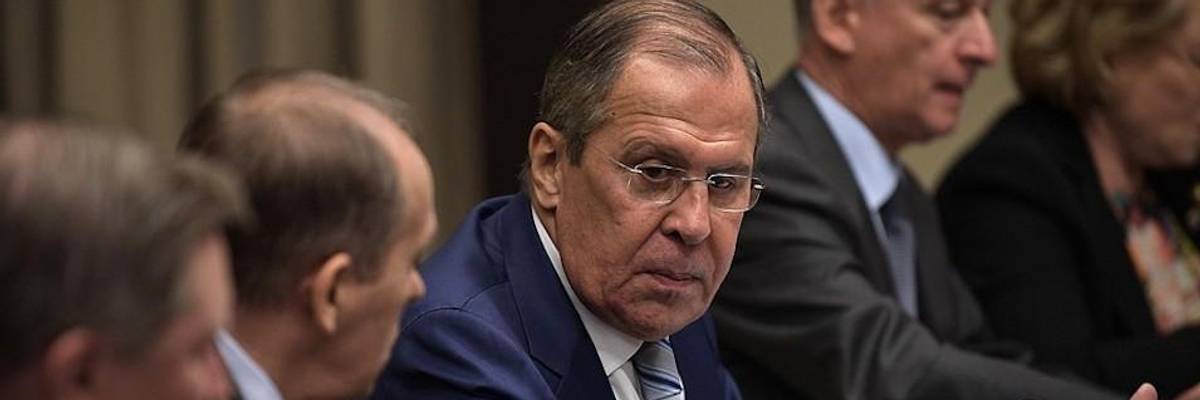
Russian Foreign Minister Sergei Lavrov at a security meeting in Moscow. (Photo: Russian President Vladimir Putin's public website)
Pointing to "the map of the U.S. military bases" around the world as evidence of American imperialism, Russian Foreign Minister Sergei Lavrov said Wednesday his country has no plans to remove the small number of troops it has stationed in Venezuela despite- Trump administration demands to withdraw.
On March 24, a Russian military plane landed in Venezuela, depositing around 100 Russian soldiers in the country, as Common Dreams reported at the time. The move was "akin to tripwire" against U.S. intervention in Venezuela, said Washington Institute fellow Soner Cagaptay.
The move angered U.S. officials and, on March 29, President Donald Trump's National Security Advisor John Bolton issued a statement criticizing Russia for its presence in the Latin American country.
"We strongly caution actors external to the Western Hemisphere against deploying military assets to Venezuela, or elsewhere in the Hemisphere, with the intent of establishing or expanding military operations," said Bolton.
The rhetoric didn't stop there: Bolton also called the Russian presence in Venezuela "a direct threat to international peace and security in the region."
Bolton's comments didn't sit well with Lavrov. In an interview with Russian newspaper Moskovskij Komsomolets, Lavrov called U.S. demands Russian military personnel leave Venezuela "insolent" and asserted that America does not, in fact, have the right to tell Russia what to do--even in America's so-called "sphere of influence."
"What do they mean by insolent remarks that the countries external to the Western Hemisphere are not allowed to have any interests there?" Lavrov said.
Further, said Lavrov, a country like the U.S. isn't in the best position to throw stones about stationing troops in foreign countries.
"Take a look at the map of the U.S. military bases--the whole world is dotted with red spots and each of them poses rather serious risks," said Lavrov.
The U.S. operates around an estimated 800 bases worldwide, though that number moves even higher depending on how the term "bases" is defined.
Dear Common Dreams reader, It’s been nearly 30 years since I co-founded Common Dreams with my late wife, Lina Newhouser. We had the radical notion that journalism should serve the public good, not corporate profits. It was clear to us from the outset what it would take to build such a project. No paid advertisements. No corporate sponsors. No millionaire publisher telling us what to think or do. Many people said we wouldn't last a year, but we proved those doubters wrong. Together with a tremendous team of journalists and dedicated staff, we built an independent media outlet free from the constraints of profits and corporate control. Our mission has always been simple: To inform. To inspire. To ignite change for the common good. Building Common Dreams was not easy. Our survival was never guaranteed. When you take on the most powerful forces—Wall Street greed, fossil fuel industry destruction, Big Tech lobbyists, and uber-rich oligarchs who have spent billions upon billions rigging the economy and democracy in their favor—the only bulwark you have is supporters who believe in your work. But here’s the urgent message from me today. It's never been this bad out there. And it's never been this hard to keep us going. At the very moment Common Dreams is most needed, the threats we face are intensifying. We need your support now more than ever. We don't accept corporate advertising and never will. We don't have a paywall because we don't think people should be blocked from critical news based on their ability to pay. Everything we do is funded by the donations of readers like you. When everyone does the little they can afford, we are strong. But if that support retreats or dries up, so do we. Will you donate now to make sure Common Dreams not only survives but thrives? —Craig Brown, Co-founder |
Pointing to "the map of the U.S. military bases" around the world as evidence of American imperialism, Russian Foreign Minister Sergei Lavrov said Wednesday his country has no plans to remove the small number of troops it has stationed in Venezuela despite- Trump administration demands to withdraw.
On March 24, a Russian military plane landed in Venezuela, depositing around 100 Russian soldiers in the country, as Common Dreams reported at the time. The move was "akin to tripwire" against U.S. intervention in Venezuela, said Washington Institute fellow Soner Cagaptay.
The move angered U.S. officials and, on March 29, President Donald Trump's National Security Advisor John Bolton issued a statement criticizing Russia for its presence in the Latin American country.
"We strongly caution actors external to the Western Hemisphere against deploying military assets to Venezuela, or elsewhere in the Hemisphere, with the intent of establishing or expanding military operations," said Bolton.
The rhetoric didn't stop there: Bolton also called the Russian presence in Venezuela "a direct threat to international peace and security in the region."
Bolton's comments didn't sit well with Lavrov. In an interview with Russian newspaper Moskovskij Komsomolets, Lavrov called U.S. demands Russian military personnel leave Venezuela "insolent" and asserted that America does not, in fact, have the right to tell Russia what to do--even in America's so-called "sphere of influence."
"What do they mean by insolent remarks that the countries external to the Western Hemisphere are not allowed to have any interests there?" Lavrov said.
Further, said Lavrov, a country like the U.S. isn't in the best position to throw stones about stationing troops in foreign countries.
"Take a look at the map of the U.S. military bases--the whole world is dotted with red spots and each of them poses rather serious risks," said Lavrov.
The U.S. operates around an estimated 800 bases worldwide, though that number moves even higher depending on how the term "bases" is defined.
Pointing to "the map of the U.S. military bases" around the world as evidence of American imperialism, Russian Foreign Minister Sergei Lavrov said Wednesday his country has no plans to remove the small number of troops it has stationed in Venezuela despite- Trump administration demands to withdraw.
On March 24, a Russian military plane landed in Venezuela, depositing around 100 Russian soldiers in the country, as Common Dreams reported at the time. The move was "akin to tripwire" against U.S. intervention in Venezuela, said Washington Institute fellow Soner Cagaptay.
The move angered U.S. officials and, on March 29, President Donald Trump's National Security Advisor John Bolton issued a statement criticizing Russia for its presence in the Latin American country.
"We strongly caution actors external to the Western Hemisphere against deploying military assets to Venezuela, or elsewhere in the Hemisphere, with the intent of establishing or expanding military operations," said Bolton.
The rhetoric didn't stop there: Bolton also called the Russian presence in Venezuela "a direct threat to international peace and security in the region."
Bolton's comments didn't sit well with Lavrov. In an interview with Russian newspaper Moskovskij Komsomolets, Lavrov called U.S. demands Russian military personnel leave Venezuela "insolent" and asserted that America does not, in fact, have the right to tell Russia what to do--even in America's so-called "sphere of influence."
"What do they mean by insolent remarks that the countries external to the Western Hemisphere are not allowed to have any interests there?" Lavrov said.
Further, said Lavrov, a country like the U.S. isn't in the best position to throw stones about stationing troops in foreign countries.
"Take a look at the map of the U.S. military bases--the whole world is dotted with red spots and each of them poses rather serious risks," said Lavrov.
The U.S. operates around an estimated 800 bases worldwide, though that number moves even higher depending on how the term "bases" is defined.